
ChatGPT apps architecture is a dual-layer framework combining the Model Context Protocol (MCP) for back-end data connectivity with interactive UI widgets rendered directly in the chat interface — transforming conversations into real-time, state-aware application workspaces. For operations leaders, this shift means AI is no longer just answering questions but executing actions, displaying dashboards, and enabling multiplayer collaboration, making governance more critical than ever.
The core of this evolution is the combination of the Model Context Protocol (MCP) and interactive UI widgets. This isn't just about getting a better answer from a chatbot; it is about transforming the chat window into a multiplayer, state-aware workspace where real work gets done. By analyzing the latest "Build Hour" from OpenAI, we can extract the strategic implications for mid-market and scaling companies looking to harness these tools without losing control of their data sovereignty.
The anatomy of the new AI app
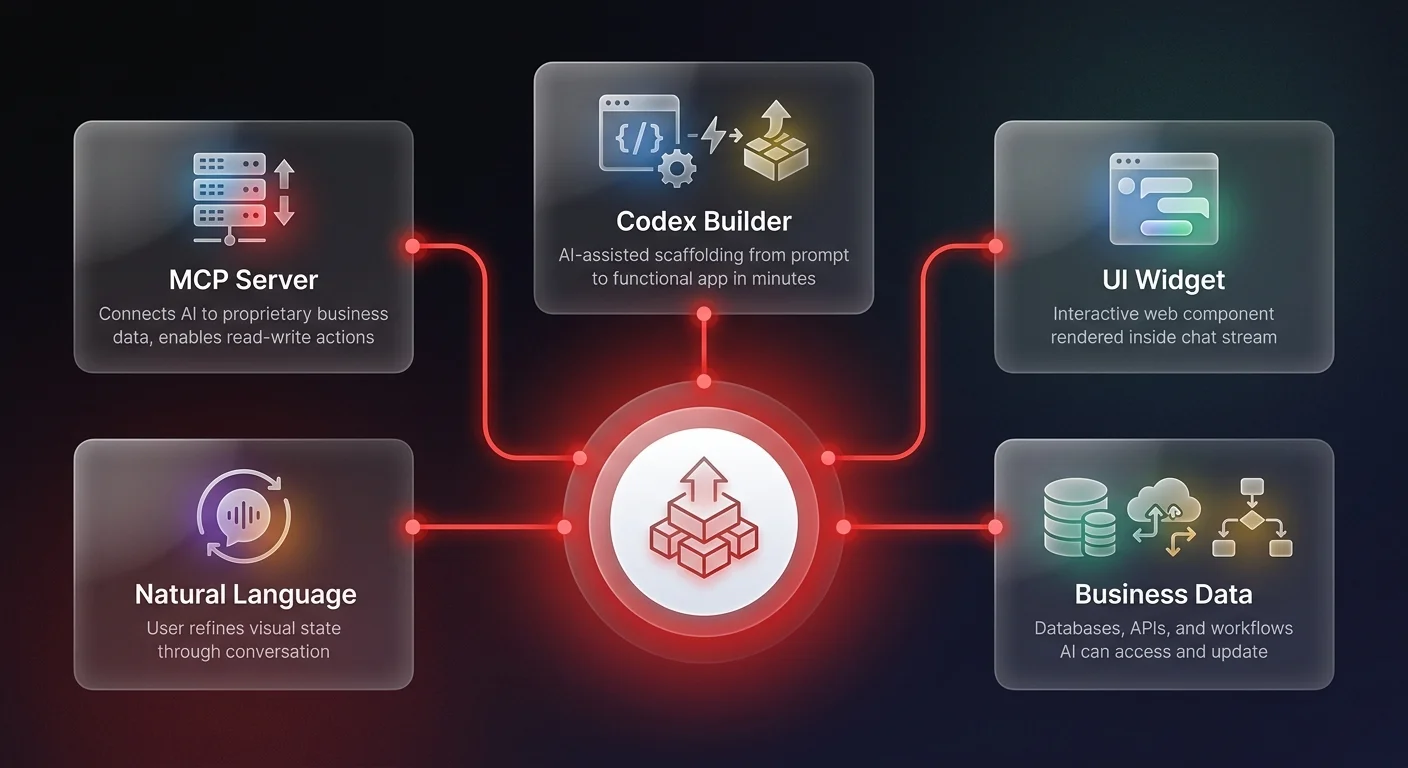
To understand the operational impact, we must first look at the architectural change. Traditionally, AI interactions were linear: prompt in, text out. The new architecture introduces a dual-layer approach that separates logic from presentation, allowing for far more complex workflows.
The power of MCP servers
At the backend, these apps rely on the Model Context Protocol (MCP). As explained by Corey from OpenAI's developer experience team, MCP enables AI clients to access tools, resources, and actions to perform tasks on behalf of the user. In the demo, he showcased how an app like AllTrails uses an MCP server to pull in specific data - like dog-friendly hiking trails in Marin - that the model wouldn't natively know.
For operations leaders, MCP is becoming the industry standard for connecting AI to proprietary data. Whether you are building inside ChatGPT or deploying sovereign agents on your own infrastructure, your data layer will likely need to speak MCP. This standardization allows for "read-write capabilities," meaning agents don't just retrieve information; they can update databases, file tickets, or trigger workflows.
The interactive UI layer
On the frontend, the architecture now supports a web component that renders inside the chat. This is powered by the window.openai API, which allows the widget to communicate with the chat context. This means an agent can present a map, a design interface, or a dashboard, rather than just describing it in text.
The implications for user experience are profound. During the demonstration, the team showed an Adobe Express app generating a flyer. The user could ask for an "outdoor clothing theme," and the app didn't just describe the flyer - it rendered a visual template editor directly in the chat stream. The user could then refine the design through conversation. This creates a feedback loop where the model understands the visual state of the application, and the user can manipulate that state through natural language.
Accelerating development with Codex
One of the most striking operational takeaways from the session was the sheer speed of development enabled by AI-assisted coding. The demonstration didn't just show finished apps; it showed how to build them using Codex, OpenAI's coding model.
The docs MCP server
The presenters introduced a "Docs MCP server" - a tool that allows the coding agent (Codex) to ingest OpenAI's own developer documentation as a dynamic resource. Instead of a developer needing to read pages of API references, they simply loaded the documentation server into the coding environment.
Corey demonstrated this by issuing a single prompt: "Create me a ChatGPT app with a simple UI and MCP server to play a ping pong game." Because Codex had direct access to the documentation via MCP, it was able to scaffold the entire project structure, create the package.json, write the HTML for the web component, and set up the server logic in minutes.
From idea to execution
This "prompt-to-product" workflow fundamentally changes the economics of internal tool development. Operations teams often suffer from a backlog of needed tools that IT never prioritizes. With this architecture, a developer can spin up a functional, interactive utility - like a custom inventory checker or a localized sales dashboard - in a fraction of the time traditionally required. However, this ease of creation brings a significant risk of "Shadow AI," where unmanaged, unmaintained micro-apps proliferate across the organization without central governance — the kind of sprawl that IT service management automation frameworks are increasingly designed to detect and contain.
Multiplayer and real-time state management
Perhaps the most futuristic capability demonstrated was real-time multiplayer synchronization. The team live-coded a Ping Pong game where two different users, on different computers, played against each other within their respective ChatGPT windows.
While a game seems trivial, the underlying technology is critical for business operations. It proved that two distinct AI agents, interacting with two different human users, could share a synchronized state via a backend server.
Imagine a scenario where a Sales VP and a RevOps manager are both looking at a deal desk application inside their AI agents. If the VP changes a discount parameter, the RevOps manager sees that update instantly in their interface, and the AI agent analyzing the deal updates its margin calculation in real-time. This moves AI from a solitary experience to a collaborative operational layer.
Post-game analysis and data loops
The demo went a step further. After the game, both players asked the AI for "post-game stats and analysis." The model pulled data from the game session (hits, misses, rallies) and provided coaching advice.
For a business, this translates to "post-project analysis." An operations team could run a logistics workflow through an app, and immediately ask the agent to analyze efficiency bottlenecks based on the session data. The seamless transition between doing the work (the game) and analyzing the work (the chat) is the core value proposition of this architecture.
Best practices: extract, don't port
Christine, from the startup marketing team, offered a crucial piece of strategic advice for leaders looking to build these tools: "Extract, don't port."
There is a temptation to take an entire existing SaaS platform and shove it inside a chat window. This is usually a mistake. The best experiences extract specific, high-value workflows where conversational refinement adds value.
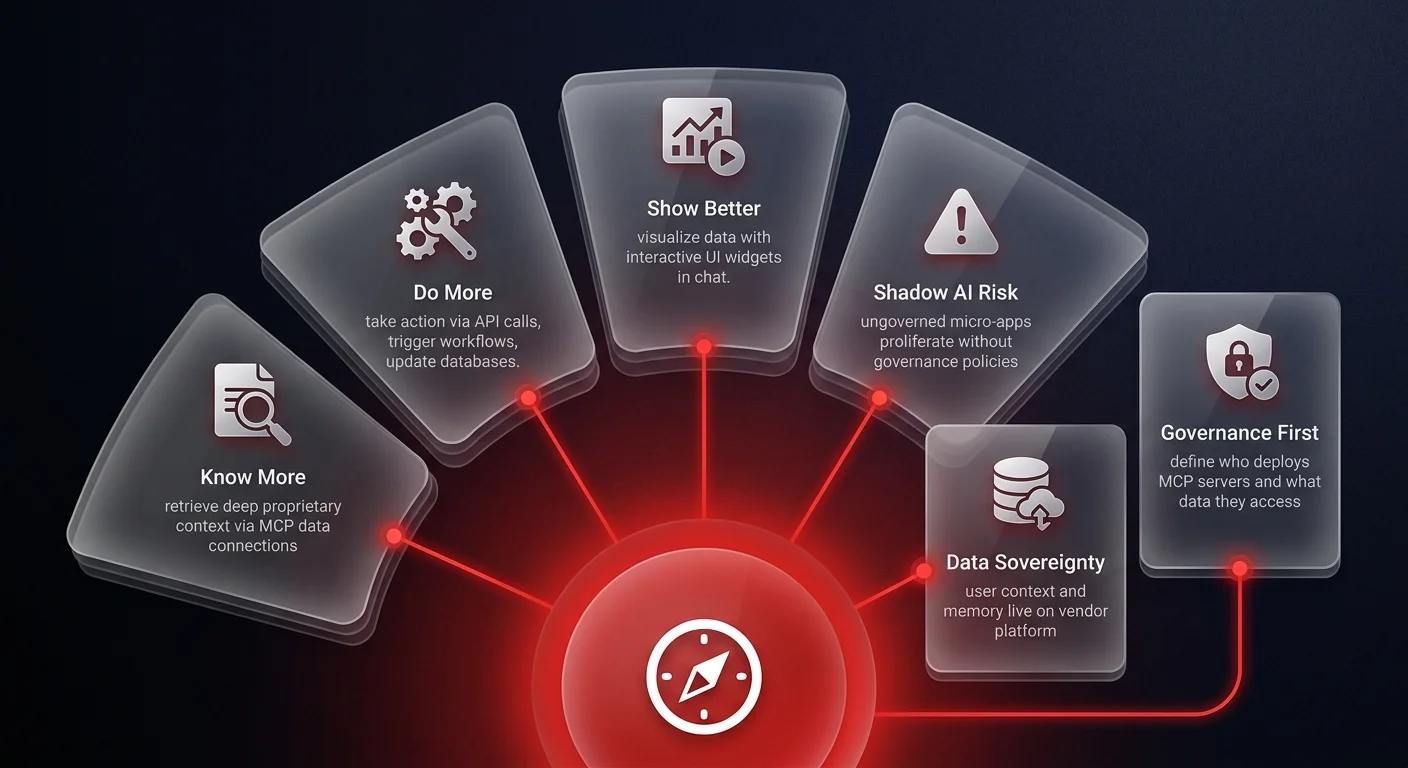
Three pillars of value
The presentation outlined three questions to determine if an app is valuable:
- Does it help me know something more? (Retrieving deep context via MCP)
- Does it help me do something more? (Taking action via API calls)
- Does it show me something better? (Visualizing data via the UI widget)
If you are planning internal AI tools, focus on these pillars. Don't rebuild your CRM inside an agent. Instead, build a tool that extracts the specific approval workflow that slows down your sales team and enhances it with conversational context.
The governance and sovereignty challenge
While the technology is impressive, the operational risks are real. The demonstration highlighted that these apps run inside OpenAI's "walled garden." While the MCP server (the logic) can run locally or on your own cloud (tunneled via tools like ngrok or Cloudflare), the interface and the user context live on the platform — which is why many enterprises are evaluating purpose-built AI agents that deliver equivalent capabilities within their own governance perimeter.
Data privacy and memory
The team discussed a new feature regarding "Memories." Developers can toggle a setting to request access to a user's memory bank. If the user consents, the app can leverage historical context to personalize interactions. While powerful, this raises significant data governance questions. If an employee uses a third-party productivity app inside ChatGPT and grants memory access, what corporate data is being exposed?
The monetization of workflow
The session also teased "Agentic Commerce" and instant checkout capabilities coming in the future. Currently, apps use deep links to external checkout flows. As this evolves, the friction between decision and purchase will vanish. For procurement operations, this requires strict controls on which agents have purchasing authority.
Operational takeaways for leaders
The introduction of this architecture signals that the "chat interface" is becoming a "platform interface." For CEOs and COOs, here are the immediate takeaways:
1. Standardize on MCP: Regardless of whether you build for ChatGPT or use sovereign agents like Ability AI, the Model Context Protocol is winning the battle for the data layer. Ensure your engineering teams are adopting this standard for internal data connections.
2. Governance before scaffolding: The speed at which Codex can scaffold apps means you will have "shadow apps" by the end of the quarter if you don't establish clear policies. Define who is allowed to deploy MCP servers and what data they can access.
3. Evaluate the platform risk:
Building deeply into the specific window.openai API creates vendor lock-in. While the MCP backend is portable, the frontend widgets are specific to the host. Weigh the convenience of the ChatGPT distribution channel against the need for operational sovereignty and ownership of the user interface.
The future of operations isn't just chatting with AI - it is interacting with dynamic, state-aware applications that blur the line between software and service. The tools to build this future are here; the challenge now is to govern them effectively.