
Documentation for AI agents is the practice of structuring technical knowledge in two distinct layers: horizontal docs that establish global system context, and vertical 'feature flows' that agents load on demand for specific tasks. Unlike traditional documentation written for human onboarding, agent-optimized docs treat information architecture as part of system design — the quality of your docs directly determines the quality of your agent's outputs.
Most engineering teams treat documentation as a chore for human onboarding. But in the age of AI agents, your documentation strategy is your system architecture. If your docs are a mess, your agents will be useless. You need to stop documenting just for people and start documenting for the machine. This requires a 'horizontal vs. vertical' model.
Horizontal vs. vertical documentation
Horizontal documents are your layers - architecture.md, requirements.md. These provide the broad, high-level context that gives an agent the 'map of the territory.' They answer questions like: What is the overall system design? What are the core principles? What are the constraints?
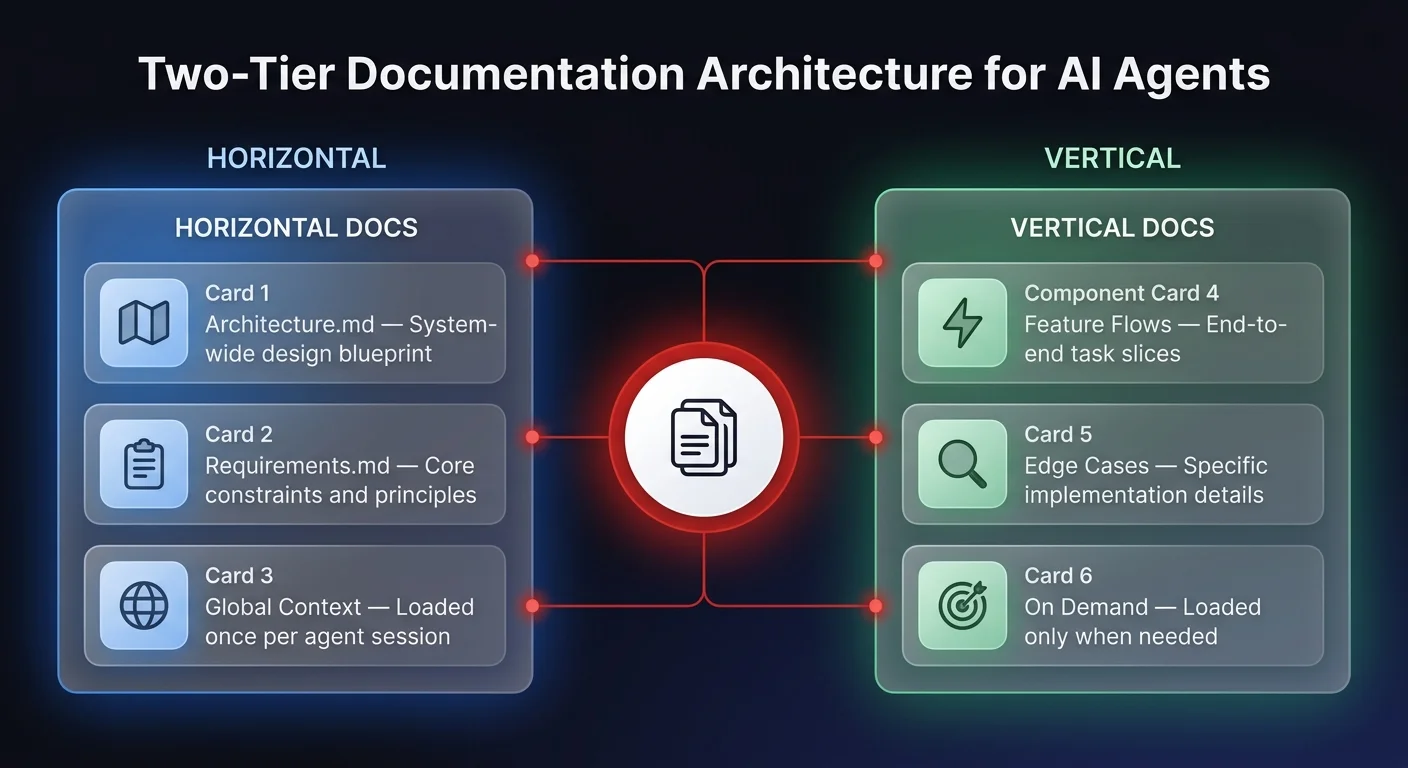
Vertical documents are the slices - 'feature flows' that cut through every layer. They answer: How does a specific feature work from end to end? What are the exact steps? What are the edge cases?
The key insight is that agents need both, but at different times. Horizontal docs are loaded once to establish context. Vertical slices are loaded on demand when the agent needs to work on a specific feature. This keeps the context window clean and focused.
Loading on demand
Vertical slices are loaded on demand. This keeps the context window clean and focused.
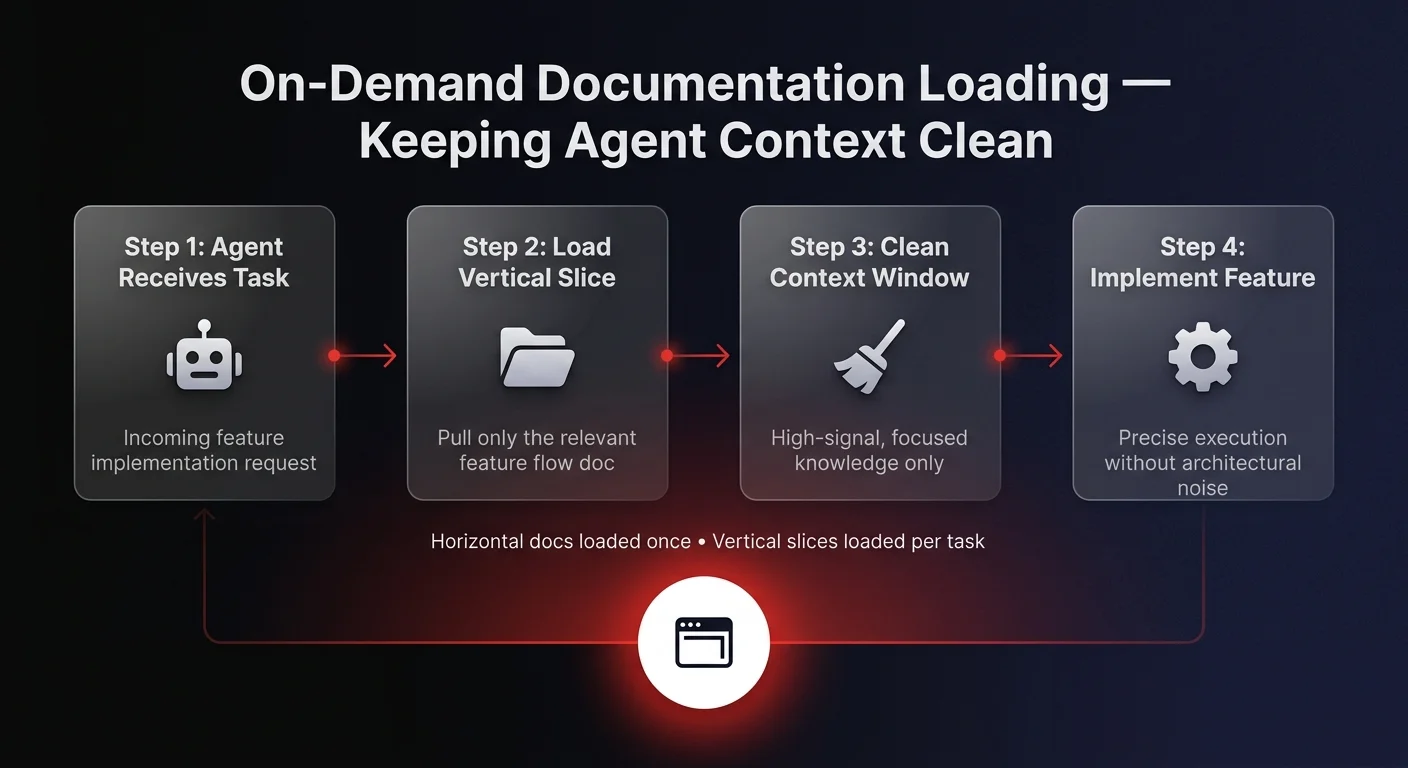
When an agent needs to implement a feature, it doesn't need to re-read the entire architecture. It loads the relevant vertical slice - the specific flow for that feature. This is how you scale documentation without drowning your agents in noise. Teams using AI-assisted software development consistently structure their repos with explicit agent-readable docs from the start.
The game has changed. Documentation isn't just for onboarding humans anymore. It's the interface your agents use to understand and modify your system. Structure it right, and your agents become powerful. Structure it wrong, and they become confused.
At Ability AI, we build autonomous agents that understand these structures natively. We help you orchestrate documentation that serves both humans and machines. Ready to build documentation that actually scales? Let's talk.