

A content factory is an automated operational process that converts raw ideas into published content across multiple channels without manual formatting or publishing effort. Rather than waiting for creative inspiration, founders who build content factories define a single high-leverage input — a voice note, a transcript — and let orchestrated AI workflows transform it into newsletters, social posts, and carousels in under 10 minutes. Random acts of content lead to random results. It's time to stop relying on willpower and start building a pipeline.
The content factory
I hate to break it to you, but relying on 'creative flow' is a strategy for burnout. I treat content creation as an engineering problem. Let me show you what I mean. I don't sit down to 'write LinkedIn posts.' I have a content factory.
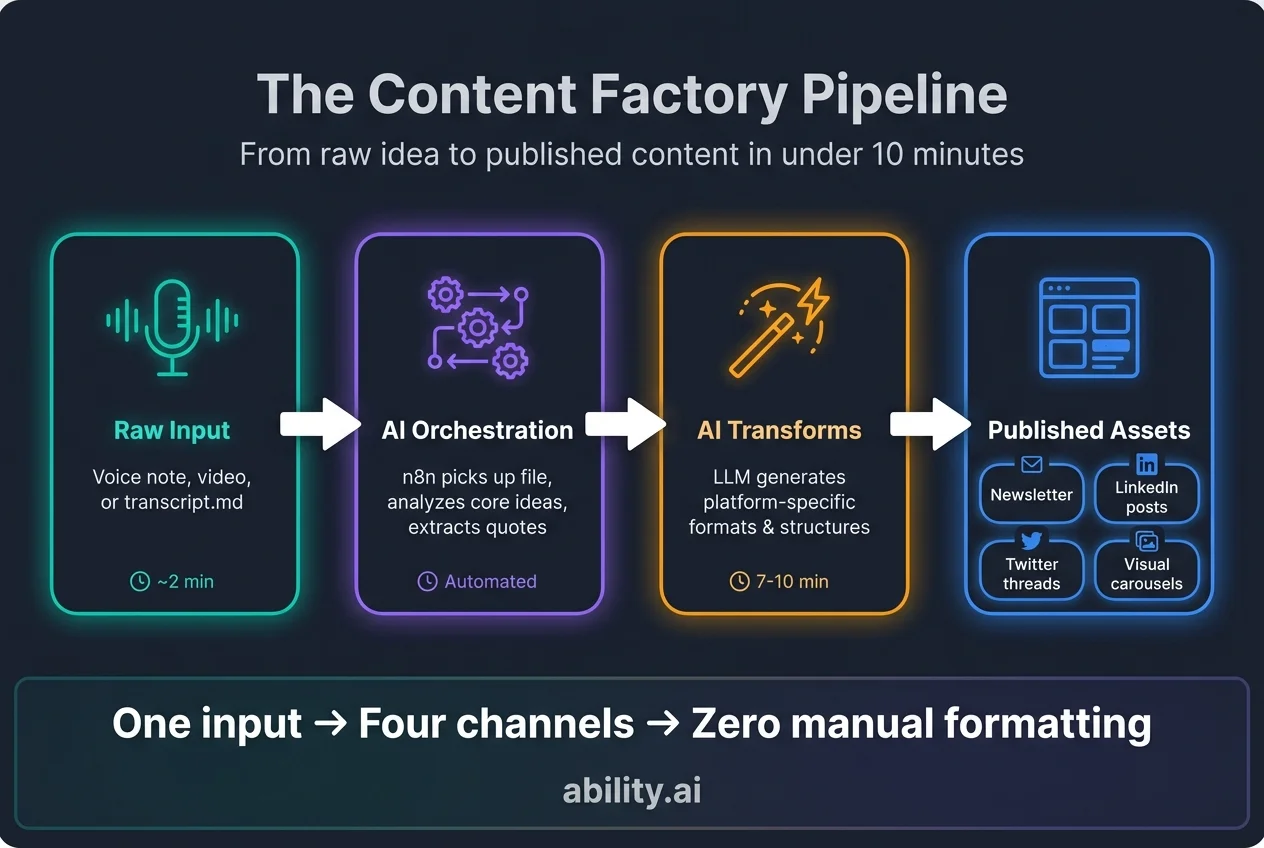
Here is the actual workflow I use. I record a video or voice note, capturing the raw insight. I drop a single file - transcript.md - into a specific Google Drive folder. That's it. That is where my manual work ends.
Behind the scenes, an orchestrated system built on n8n picks up that file. It analyzes the core ideas, extracts quotable moments, and transforms that one transcript into a complete suite of assets. In 7 to 10 minutes, I have a newsletter, LinkedIn text posts, Twitter threads, and visual carousels ready for review.
This isn't about replacing creativity. It's about amplifying it. The 'art' is the initial insight. Everything that follows - the formatting, the resizing, the platform-specific tweaking - that is just operations. And operations should be automated. By building this system, I turn unpredictable creative acts into a predictable value-generation factory.
Building your own content factory
So how do you build your own content factory? You need to radically rethink your stack. Stop looking for the perfect all-in-one writing tool and start orchestrating a workflow.
First, define your input. What is the highest leverage way for you to produce ideas? For me, it's speaking. For you, it might be bullet points or rough drafts.
Second, map the transformation. What specific outputs do you need? Don't just say 'social posts.' Define the structure. A carousel needs a hook, 5 slides, and a takeaway. A newsletter needs a subject line, a story, and a CTA. Once you define these structures, you can program LLMs to generate them reliably.
Third, automate the handoff. Use tools like n8n or Make to move data between your storage (like Drive) and your generators — this is the backbone of any AI marketing content system that scales reliably.
The goal is to remove friction. When you remove the friction of 'packaging' your ideas, you unlock the ability to publish high-signal content at scale. You aren't just posting more; you are owning your narrative with consistency. The reality is, if you aren't building a system, you're just competing with people who are.
Turning content into a growth engine
Ready to stop playing the lottery with your content strategy? At Ability AI, we help businesses orchestrate AI agent systems that turn manual grinds into automated factories — see how we built a full AI content production pipeline for a real business. We don't just talk about automation; we build the infrastructure that amplifies your expertise.