
Data integration beats better AI models because an agent with amnesia about your business is just a fancy toy, regardless of benchmark scores. The race to find the best LLM is a distraction — it doesn't matter if your AI has an IQ of 200 if it can't see your email, read your calendar, or access your CRM. The businesses that win won't have the smartest models; they'll have the deepest data orchestration.
The real power of an AI agent doesn't come from the model itself. It comes from the context you feed it. If your agent can't see your email, doesn't know your calendar exists, and is blind to your CRM, it's just a fancy toy. The game has changed, and the winners won't be the ones with the best models. They'll be the ones who successfully orchestrate their data into a single, unified brain.
A real-world scenario
Let me walk you through a scenario I live every day to show you what I mean.
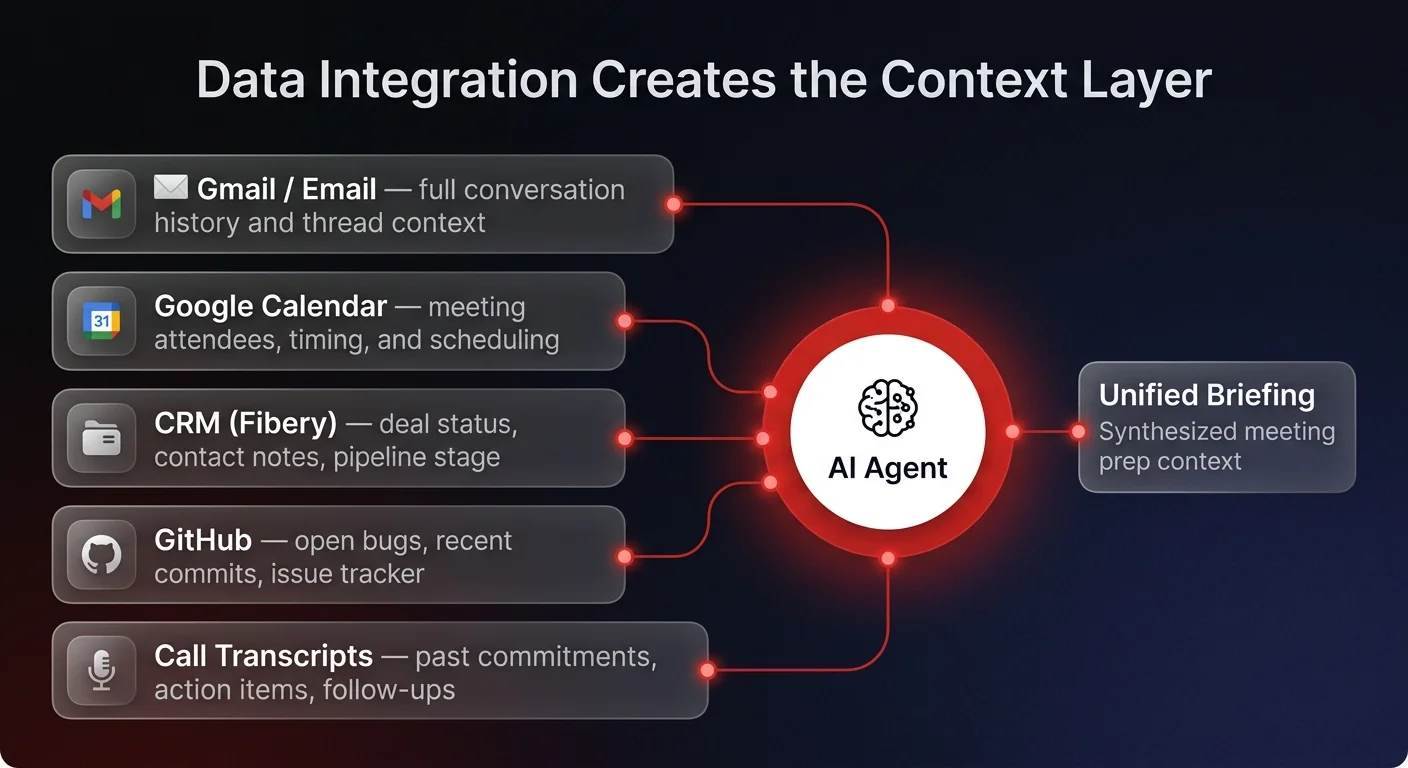
I have a high-stakes meeting coming up in ten minutes. The old way of preparing? It's frantic. I'm checking Google Calendar to see who is attending. I'm searching Gmail to find our last exchange. I'm digging into Fibery - our internal CRM and knowledge system - to check the deal status. Then I'm skimming Read AI transcripts to remember exactly what we promised on the last call. It's a mess of context switching that kills focus.
Now, let's look at the agentic way. I have an agent connected to my entire stack - email, Google contacts, calendar, Fibery, GitHub, and our call transcripts. It sits on top of these data silos.
I give one simple command: 'Give me a full rundown for my next call.'
Because it orchestrates these disparate sources, it instantly synthesizes a comprehensive briefing. It tells me exactly who these people are, contextualized by our email history. It summarizes the current topic we're discussing based on the CRM data. It lists the next steps that need to be taken based on the transcript of our last call.
This isn't just data retrieval. It's data synthesis. The agent understands that the bug in GitHub is related to the complaint in the email, which is why the meeting in the calendar is happening. That is the power of a unified context layer. It eliminates the cognitive load of stitching these pieces together yourself.
The architecture shift
This shifts the focus entirely from the model to the architecture. The intelligence of your agent is defined by the 'connective tissue' you build between your data silos.
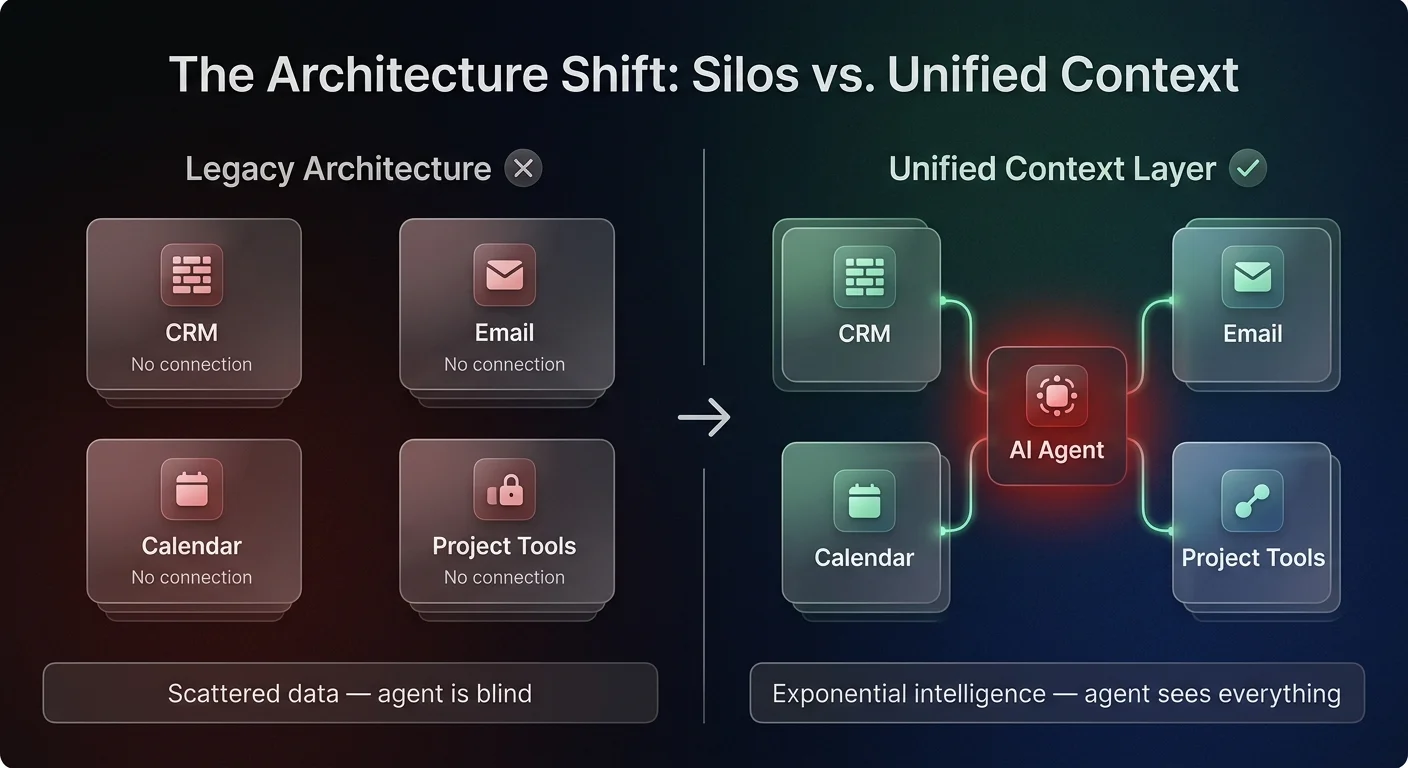
Most businesses have their data locked in rigid fortresses. Your CRM doesn't talk to your email, and your email doesn't know about your project management tools. To make agents work, you need to radically rethink this. You need to build a single, continuously updated context layer — the foundation of effective operations automation that gives AI true business awareness. This means your agent isn't just reacting to a static prompt; it's sitting on top of a live stream of your business reality.
When you amplify an LLM with real-time access to your specific business context, the results are exponential. You stop getting generic, hallucinated advice and start getting high-signal, actionable intelligence. The agent becomes a partner because it knows what happened five minutes ago in that email thread you haven't read yet.
The question isn't 'which model are you using?' The question is 'how deep is your integration?' If you own the data architecture, you own the outcome. Don't settle for a chatbot that chats. Build an agent that knows.
Building agents that drive results
Ready to stop playing with chatbots and start building agents that drive real business results? At Ability AI, we specialize in orchestrating the complex data integrations that give AI agents true context. We help you turn your scattered data into a unified intelligence layer — the same approach behind our AI content system case study. Let's talk about how to make your data work for you, not against you.