
The AI POC graveyard describes the pattern where AI proof-of-concept projects impress in boardrooms but never reach production. The core problem is that POCs only need to work once under controlled conditions, while production AI systems must handle messy inputs, API failures, and edge cases consistently — a fundamentally different engineering challenge. Budgets get approved, leadership nods, and then reality hits: there is a massive chasm between a demo that works once and a system that works consistently.
The reality is
The reality is - building a prototype is the easy part. In this world of accessible LLMs and low-code tools, almost anyone can orchestrate a basic interaction that looks like magic. We take these prototypes to leadership to signal how advanced we are. It feels like progress. It feels like we are winning.
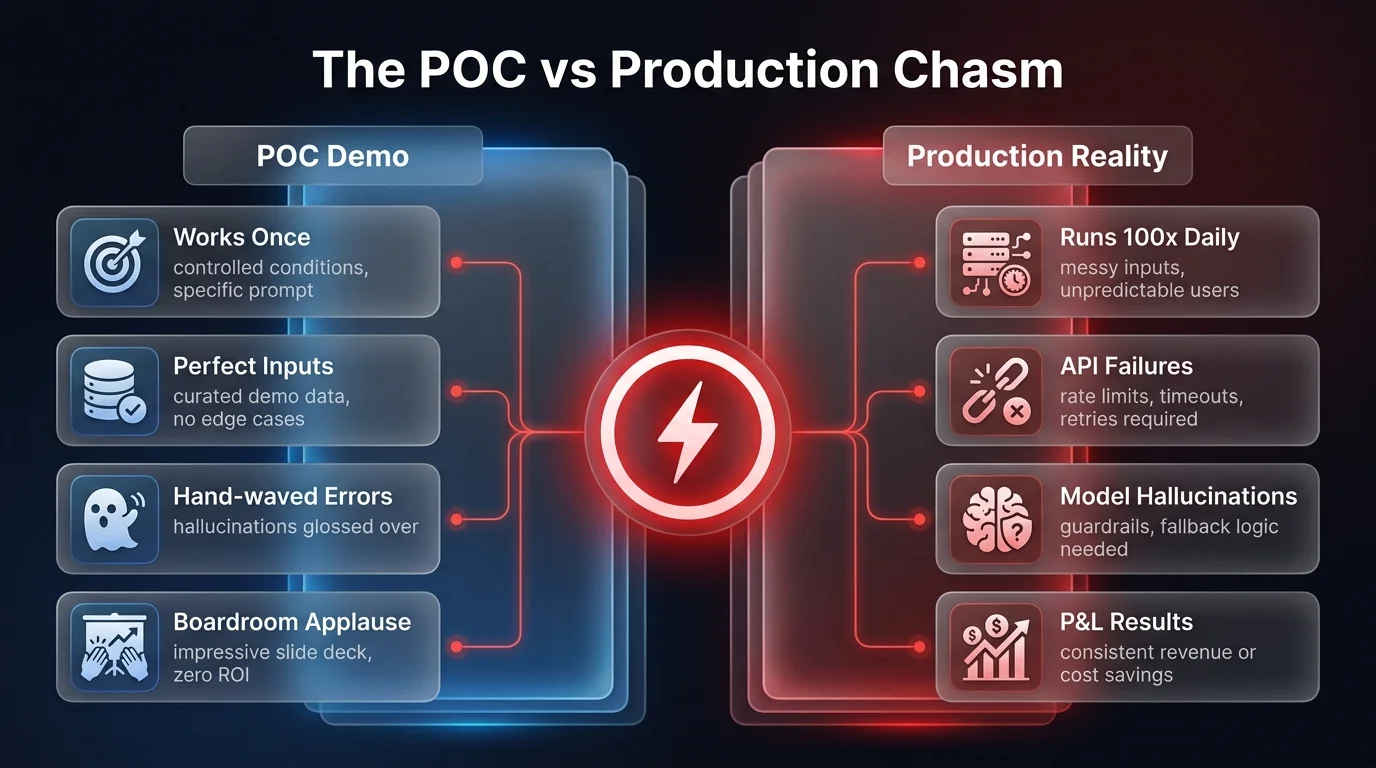
But here's the hard truth. A POC only needs to work one time, under controlled conditions, with a specific prompt. That is fundamentally different from a production implementation.
When you move from the boardroom to the real world, the variables explode. What happens when the input is messy? What happens when the API hangs? What happens when the model hallucinates? In a demo, you can hand-wave these issues away. In production, these are the things that kill your ROI.
The POC graveyard is filled with projects that looked great on a slide deck but couldn't handle the messy reality of daily business operations. We confuse the ability to generate a response with the ability to deliver value. One is a party trick; the other is a business asset. If you are optimizing for the 'wow' factor instead of reliability, you are building for the graveyard — a pattern explored in our AI readiness assessment case study, where the difference between a POC and a production system comes down to engineering discipline.
So, how do we escape this cycle?
So, how do we escape this cycle? We need to radically shift our definition of success. The goal isn't to build something that looks cool - the goal is to build something that runs consistently and generates revenue.
To do this, you have to stop treating AI as a magic box and start treating it as a complex software component that requires rigorous engineering. You need to obsess over failure modes, not just happy paths. You need to orchestrate systems that can catch errors, retry logic, and fallback gracefully when the model gets confused.
The game has changed. It's no longer about who can access the smartest model; it's about who can tame that model into a reliable workflow.
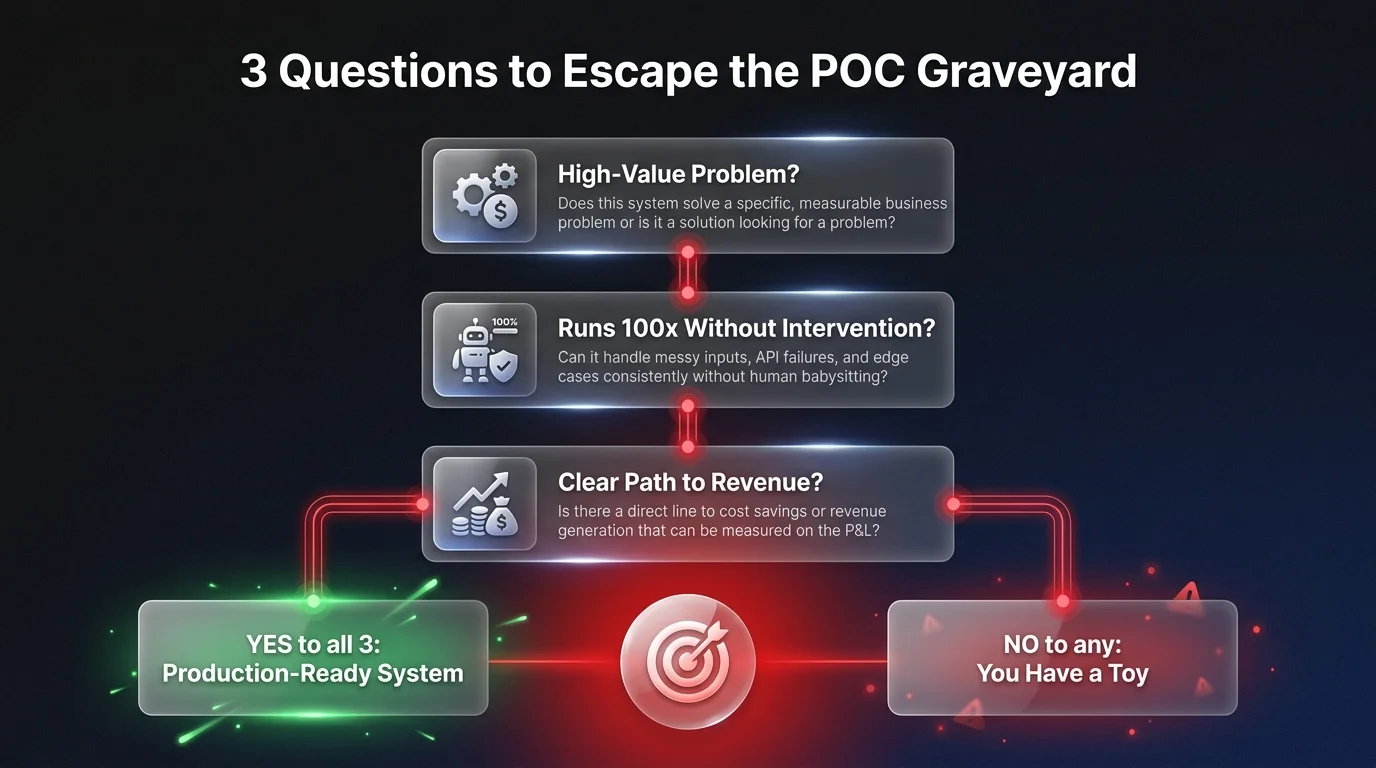
Ask yourself these questions: Does this system solve a specific, high-value problem? Can it run 100 times in a row without human intervention? Is there a clear path to revenue or cost savings?
If the answer is no, you don't have a product - you have a toy. Ownership means taking responsibility for the boring parts of implementation: the testing, the guardrails, and the integration. That is where the actual value lives. Don't settle for the applause in the boardroom. Settle for the results on the P&L.
The trick isn't building the POC - the trick is surviving the transition to production. At Ability AI, we don't just build demos; we engineer AI agents that run consistently and drive real business outcomes. If you're tired of the innovation theater and ready to build systems that scale, let's talk.