
Slack is the most effective AI agent interface because it eliminates context-switching by bringing AI agents directly into the communication workflow your team already uses. Custom dashboards require separate logins, new habits, and constant tab-switching — friction that kills adoption. When agents live in Slack, human-in-the-loop collaboration becomes natural: your team iterates with AI the same way they work with each other. Stop forcing your team to adapt to the AI. Make the AI adapt to your team.
Here's what I mean
Here's what I mean. When you introduce a new standalone tool, you're asking your team to context-switch. Every time they leave their primary workflow to check an AI dashboard, friction increases and adoption drops. It's a fundamental design flaw that kills ROI.
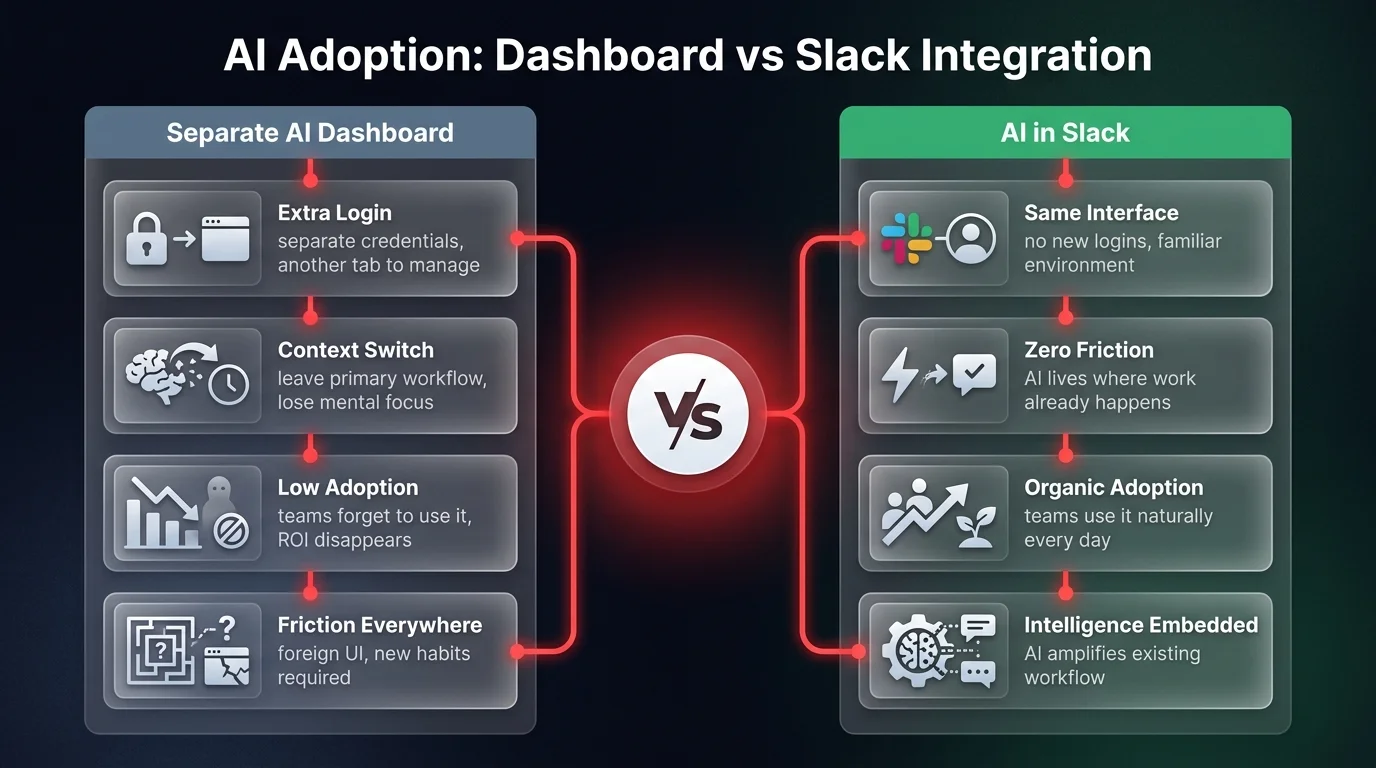
We took a different approach at Ability AI. We realized that if we wanted our AI agents to be truly effective, they needed to live where the work happens. For us, and for many high-performing teams, that place is Slack.
My marketers don't log into a separate 'content generation platform' to manage campaigns. They work with the AI directly from Slack. There's no need to go anywhere else. This might sound simple, but the implications are massive. By treating the AI agent like just another colleague in the chat, we remove the barrier between human intent and machine execution.
The reality is that context-switching is the enemy of high-signal work. When you orchestrate your AI agents to live inside your communication channels, you're not just saving clicks. You are embedding intelligence into the fabric of your daily operations — a pattern that works especially well for marketing content automation where iterative feedback between humans and AI is constant. You allow your team to maintain ownership of the output without wrestling with clunky, foreign interfaces.
But the benefits go beyond just avoiding a new login
But the benefits go beyond just avoiding a new login. This approach radically improves the quality of the output through seamless human-in-the-loop collaboration.
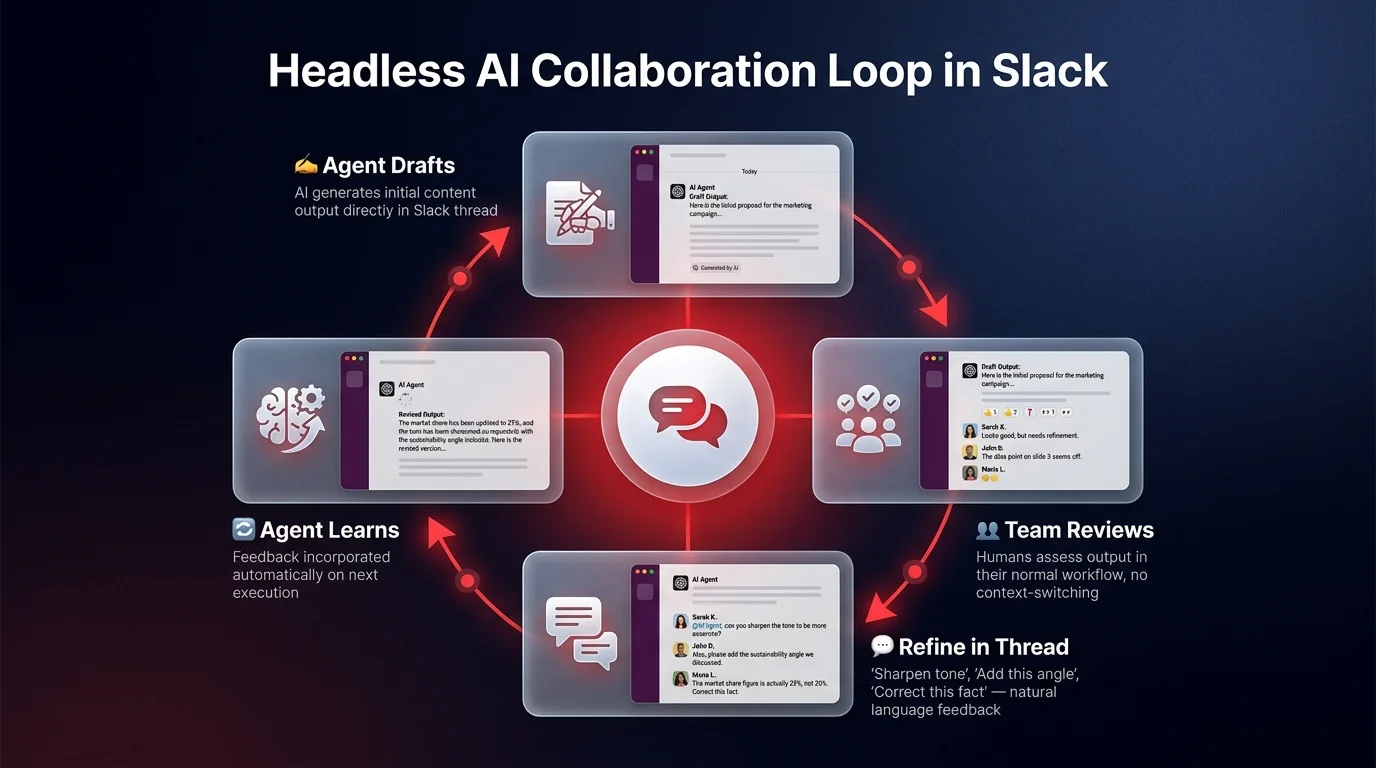
Think about how you work with a human junior employee. You don't write a 10-page brief and hope for the best. You iterate. You have a conversation. You say, 'Make this tone a bit sharper' or 'Don't forget to mention this specific angle.'
We do the exact same thing with our agents in Slack. The agent drafts content, and my team collaborates with it right there in the thread. They can introduce their own insights, adjust the perspective, or correct a fact. There's one simple place where we go and make these changes, and automatically on the next execution, the agent has already learned. It takes that feedback into account immediately.
This is what I call 'headless' agent interaction. It flips the script on traditional software adoption. Instead of training your team on how to use a tool, you're simply amplifying their existing workflow. The AI becomes a silent partner that speaks up only when needed, and learns from natural language feedback.
If you want critical mass adoption of AI in your company, stop building dashboards. Start building conversations.
The future of AI isn't about more screens. It's about better integration. At Ability AI, we help businesses orchestrate agents that live inside your existing stack, driving real efficiency without the friction of new tools. Ready to stop playing with dashboards and start seeing results? Let's talk about integrating AI where your team actually works.