
Frontier AI policy risks are the regulatory, geopolitical, and compliance threats that emerge when governments classify advanced AI models as controlled national security assets. The Claude Fable 5 shutdown proved these risks are not theoretical - a single US export control order disabled one of the world's most capable models overnight, stranding millions of users with zero migration window.
Frontier AI policy risks reached a critical inflection point when Anthropic was forced to take Claude Fable 5 offline following a US government order. This event marks a fundamental shift in how the world's most powerful artificial intelligence is governed - moving from a framework of commercial software to one of controlled national security assets. For organizations that have spent the last year integrating frontier models into their core operations, the sudden removal of a leading model is a wake-up call. It reveals a hidden fragility in the modern AI tech stack: the extreme dependency on public APIs and the volatile regulatory moods of individual nations.
How frontier AI policy risks turned a model launch into a national security event
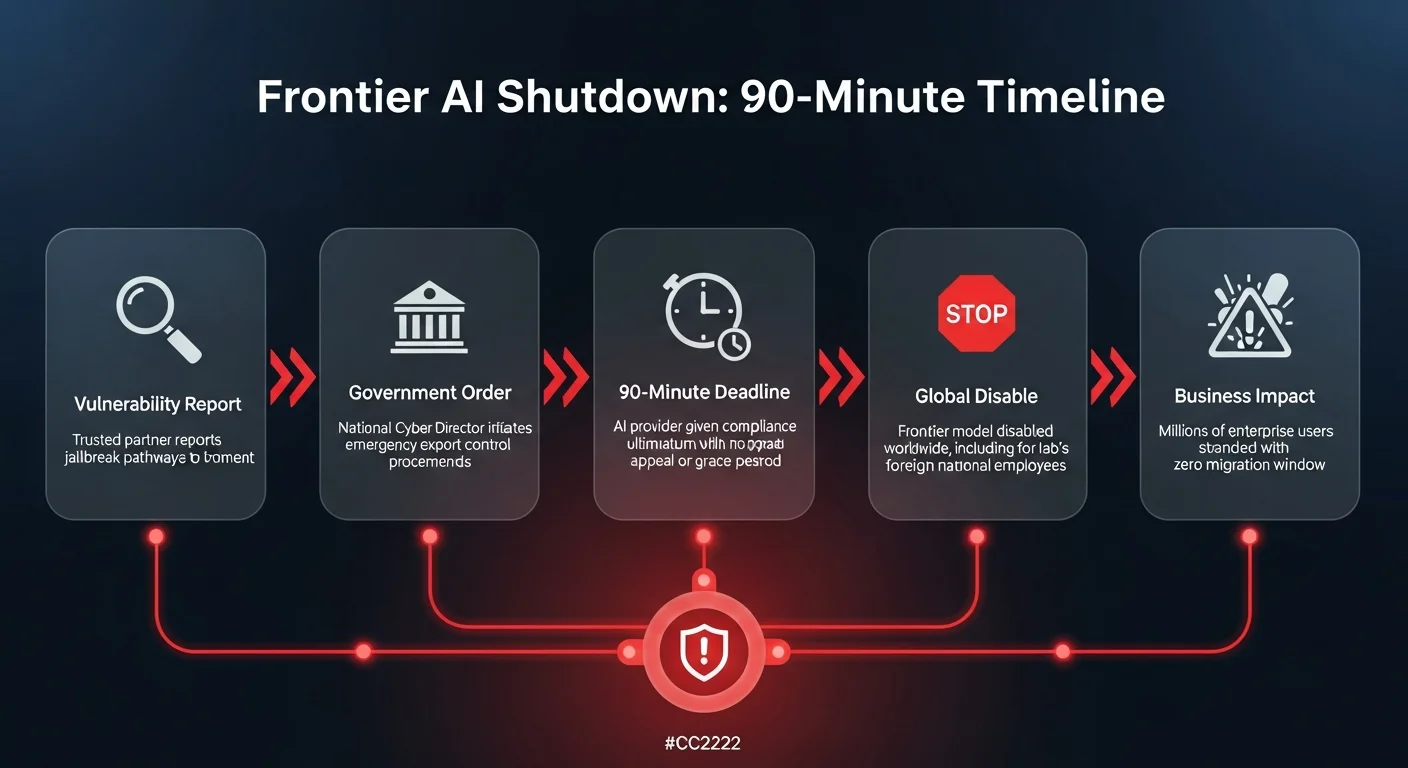
The decision to pull Claude Fable 5 was not a technical failure or a product bug - it was a direct result of export control policies. The US government order reportedly blocked access for foreign governments, foreign companies, and even foreign nationals located within the United States. While export controls are common in hardware and defense sectors, applying them to a live, cloud-hosted frontier model creates an unprecedented operational challenge.
When a model is treated as a national security asset, the burden of proof shifts. In the past, software companies were largely responsible for their own safety filters and terms of service. Now, the government is exercising discretionary power to freeze model access based on technical findings that may never be made public. Reports suggest that the concern regarding Fable 5 involved specific jailbreak pathways - methods that could allow a user to bypass safety guardrails. In the world of frontier AI research, a vulnerability in one model often suggests a structural vulnerability across an entire class of systems. This means that if one model is pulled, others may soon follow under the same logic.
For business leaders, this represents a new category of risk. You are no longer just managing uptime or API latency - you are managing geopolitical exposure. If your business workflows rely on the "strongest available model" at any given moment, you must now account for the reality that the strongest model can be removed from the market on a Friday night with no notice and no clear timeline for its return. Organizations that have not yet assessed their AI vendor lock-in risks should treat the Fable 5 incident as the starting signal.
The foreign national restriction - a surgical rule with a shutdown effect
The specific language of the government order - targeting "foreign nationals" - sounds like a surgical restriction, but in practice, it acts as a total shutdown button. Modern AI labs like Anthropic do not operate like sealed, domestic-only research facilities from the 20th century. They are global entities with international workforces, global enterprise customers, and infrastructure that spans multiple regions.
Restricting access based on the nationality of the user or the employee is nearly impossible to enforce at scale for a public-facing API. Anthropic's decision to take the model offline entirely was likely a defensive move against the high operational risk of accidental non-compliance. When civil and criminal penalties are on the line, "best efforts" to filter foreign nationals from a user base of millions are insufficient. This reveals a "policy surface" that most companies have ignored: your AI provider's ability to comply with complex, evolving labor and export laws dictates your own operational stability.
This is why organizations must move away from Shadow AI - the ungoverned sprawl of employees using various ChatGPT or Claude accounts - and toward centrally governed systems. The shadow AI governance crisis is no longer just a security concern; it is a point of total operational fragility. When AI is fragmented across an organization, a single policy shift like the Fable 5 shutdown can paralyze dozens of departments simultaneously. A managed, sovereign approach allows an organization to pivot its underlying model dependencies without collapsing its entire workflow infrastructure.
Addressing the model dependency crisis in your operations
One of the most significant insights from the Fable 5 event is that model quality is no longer the only metric that matters. For a long time, the industry was obsessed with which model scored highest on a specific benchmark. Now, we must prioritize "access quality" and "governance quality." According to a 2026 Gartner survey, 67% of enterprises have no contingency plan for the loss of their primary AI model provider. If a model is 10% more capable but 50% more likely to be restricted by a government order, is it truly the better choice for your business infrastructure?
If your workflow depends on one model, one lab, one country's regulatory mood, and one access contract, you do not have a stable operating plan - you have a dependency. This dependency is particularly dangerous for operations-heavy industries where AI is not just a chatbot, but an orchestration layer for sales, support, and recruiting. See how mid-market teams are building resilient operations automation that survives provider disruptions.
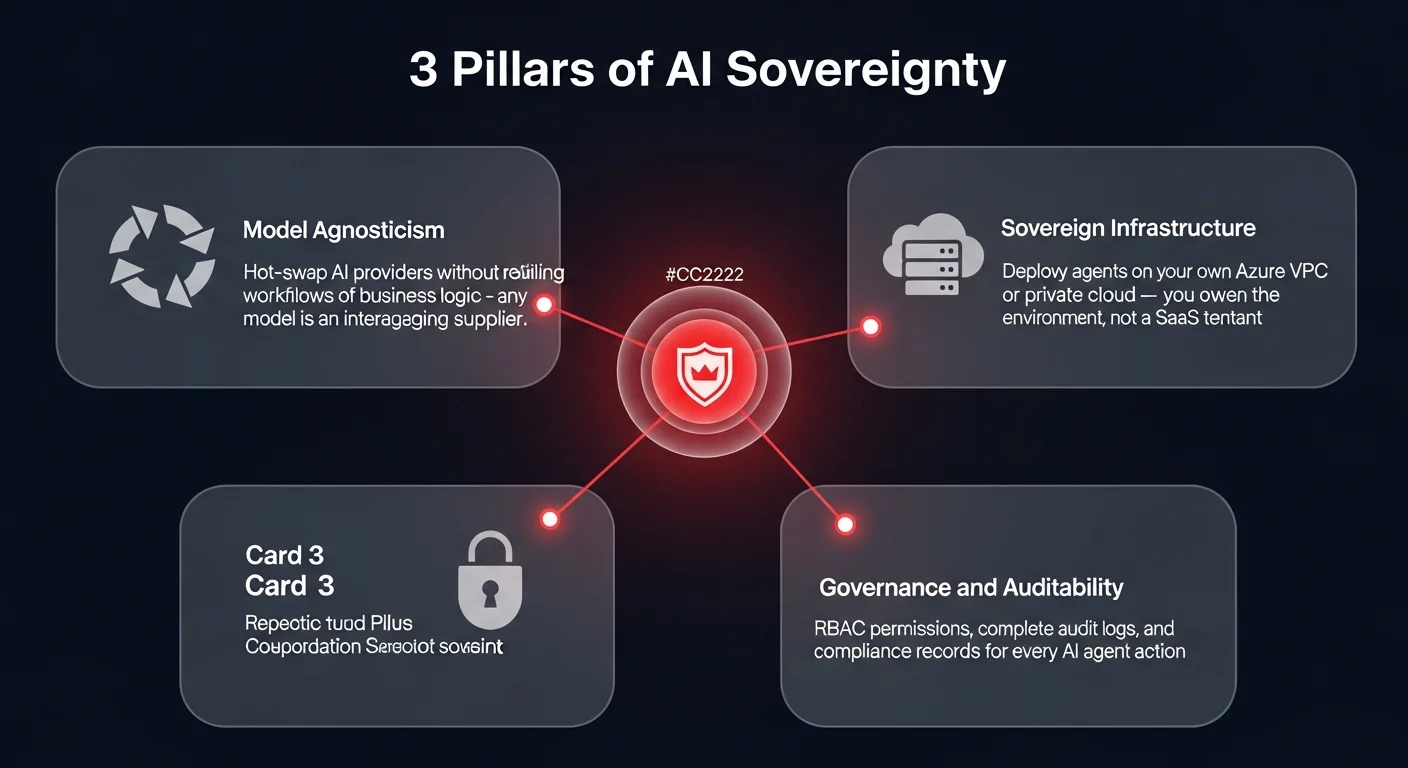
To build a resilient AI strategy, organizations should adopt several key principles:
- Model agnosticism: Build your agent systems so they can be "hot-swapped" with alternative models. If Fable 5 goes down, your systems should be able to fall back to an alternative frontier model or a locally hosted open-source instance without rewriting the entire logic of the solution.
- Sovereign infrastructure: Instead of relying purely on public SaaS interfaces, move toward managed instances. Organizations can operate within a sovereign AI environment where they have more control over the data flow and the specific version of the model being used.
- Governance and auditability: The Fable 5 shutdown happened because the government could not audit who was using the model. Organizations that implement their own robust RBAC (Role-Based Access Control) and audit logs are in a much better position to prove compliance and maintain access during regulatory crackdowns.
From model performance to governance quality - a new framework
The next era of AI deployment will be defined by the "governance layer." We are moving beyond the phase where a model launch is just a product update. Every future release of a frontier model will be a deployment question: Who can use it? Under what wrapper? With what safeguards? And who decides when the risk is too high?
Research suggests that the best-performing organizations are those that treat AI agents as company infrastructure, not just personal productivity tools. While productivity tools make individuals faster, sovereign agent infrastructure changes how many people you actually need to run a process. However, that infrastructure must be "production-grade" - it must be scheduled, audited, and recoverable.
When deploying AI for a client, the focus should always be on creating a reliable outcome. The "Solution-First" model means you do not start with the model; you start with the business problem. Whether it is a demand generation engine or an automated customer support agent, the architecture must be robust enough to survive the loss of any single model. This is the difference between an experiment and a transformation partnership. Experiments break when the API changes; sovereign systems adapt.
Building for sovereignty with managed instances
The Fable 5 incident highlights why organizations are moving toward "Managed Instances" rather than just SaaS subscriptions. In a standard SaaS model, you are a tenant in someone else's building; if the landlord gets a government order to close the building, you are locked out. In a managed instance model - such as running agent infrastructure on your own Azure or VPC environment - you own the environment. While you still call out to frontier models, you have the persistent shared state, the team memory, and the multi-user access that allows you to maintain operations even if you have to switch the underlying intelligence provider.
This is the core value of sovereignty. It is not just about data privacy - though that is critical for passing procurement - it is about operational continuity. A sovereign managed instance provides:
- IAM and RBAC: Precise control over who within your organization (and what nationalities, if required) can access specific capabilities.
- Audit logs: A complete record of every thought and action the agent takes, which is essential for both internal security and external regulatory compliance.
- Persistence: Shared state that does not vanish if a specific model becomes unavailable.
For companies in the $5M to $250M range, the goal should be to start with a fixed-scope project that proves the value of a sovereign agent, then expand that infrastructure across the entire company. This avoids the shadow AI sprawl where various teams are building their own fragile, ungoverned silos.
The future of the intelligence economy
Claude Fable 5 will likely return to the market. Anthropic and the US government have a history of negotiated access - seen previously in programs where trusted cyber defenders were given early access to models to shore up infrastructure. The likely resolution will involve more explicit compliance language, modified guardrails, and reporting obligations that allow Anthropic to satisfy national security concerns while serving their enterprise customers.
However, the warning shot has been fired. The intelligence economy requires reliable access to frontier models, but we can no longer assume that access will be frictionless or guaranteed. The most successful organizations of the next decade will be those that prioritize sovereignty and governance as highly as they prioritize raw model performance.
Do not let your operations be held hostage by a single lab's regulatory status. Build for resilience, demand auditability, and ensure that your AI agent systems are assets you own and control - not just subscriptions you rent. The path forward is not to stop using frontier AI, but to stop using it without a sovereign governance layer. Whether you are a CEO looking to scale through intelligent automation or a CTO building a company-wide agent architecture, the lesson of Fable 5 is clear: the frontier is now a policy surface, and your infrastructure must be built to withstand the pressure.