
AI vendor lock-in risks are the hidden operational vulnerabilities that emerge when organizations become entirely dependent on a single AI provider's proprietary ecosystem. When your business-critical automations run exclusively on one vendor's models, API changes, price hikes, or service restrictions can halt operations overnight — making vendor lock-in the most underestimated threat to enterprise AI adoption.
When scaling companies deploy artificial intelligence across their operations, they often overlook a foundational vulnerability. The AI vendor lock-in risks associated with relying on single, proprietary commercial models are creating unprecedented operational bottlenecks. We are transitioning into an era where AI is no longer just a software tool — it is a fundamental substrate that will touch every aspect of business operations, much like the internet or telecommunications networks.
Recent analysis of large-scale, mission-critical AI deployments at the national defense level reveals a startling reality about commercial AI infrastructure. When organizations become entirely dependent on a single vendor's closed ecosystem, they surrender control of their operational destiny. This mirrors the shadow AI risks already emerging in enterprises where ungoverned AI tools proliferate.
For operations leaders, CEOs, and COOs at mid-market and scaling companies, understanding this dynamic is critical. To truly harness artificial intelligence without introducing catastrophic risk, businesses must shift from fragmented, ungoverned AI experiments to reliable, sovereign AI systems.
Why AI vendor lock-in risks are escalating now
When evaluating the deployment of AI in highly sensitive, high-stakes environments — such as military and defense operations — a massive vulnerability has recently come to light. Historically, software procurement was straightforward: an organization bought a license, and the customer used the software to execute their lawful operations as they saw fit.
Modern commercial AI models, however, come with complex, restrictive terms of service driven by the provider's internal corporate values or "constitutions."
Recent strategic reviews of defense infrastructure uncovered a severe bottleneck. Highly critical operations were locked into single-vendor AI contracts containing dozens of arbitrary restrictions. The terms dictated that the AI could not be used to plan certain logistics, execute specific operations, or manage critical assets. Because the underlying AI models were designed to automatically shut down or refuse prompts that violated these terms, entire operations could theoretically freeze mid-execution.
Consider the operational chill of executing a highly successful, completely lawful strategic initiative, only to have your primary technology vendor inquire about how their software was used, hinting at potential service revocation based on their corporate discomfort. It is the equivalent of a stranger dictating how you run your internal affairs.
Translating the AI vendor lock-in risks to enterprise operations
While scaling mid-market businesses are not executing kinetic defense operations, the operational parallel is exact and equally dangerous.
If you build your company's automated customer support, revenue operations, or supply chain logistics entirely on a single proprietary AI model, you are "single-threaded." You have outsourced the governance of your operational logic to a third-party vendor.
If that vendor decides to change their terms of service, deprecate an API, alter their model's guardrails, or unexpectedly raise prices, your business operations could halt overnight. You cannot allow the "soul" or corporate constitution of a third-party SaaS vendor to dictate your command and control environment.
This is the core argument for data sovereignty and governed AI agent systems. The substrate of your business operations must be resilient, technology-agnostic, and completely under your control. When AI touches everything, you must have multiple avenues for execution and the ability to swap underlying models without breaking your operational workflows.
Three pillars for massive throughput gains
Despite these governance risks, the urgency to adopt AI remains absolute. Organizations operating at "peacetime speed" — moving slowly, debating minor efficiencies, and clinging to legacy workflows — are being rapidly outpaced by competitors leveraging artificial intelligence to scale.
Research into hyper-scaled AI deployments shows that adoption can move from tens of thousands to over a million users in a matter of months when initiatives are categorized into three distinct, practical buckets:
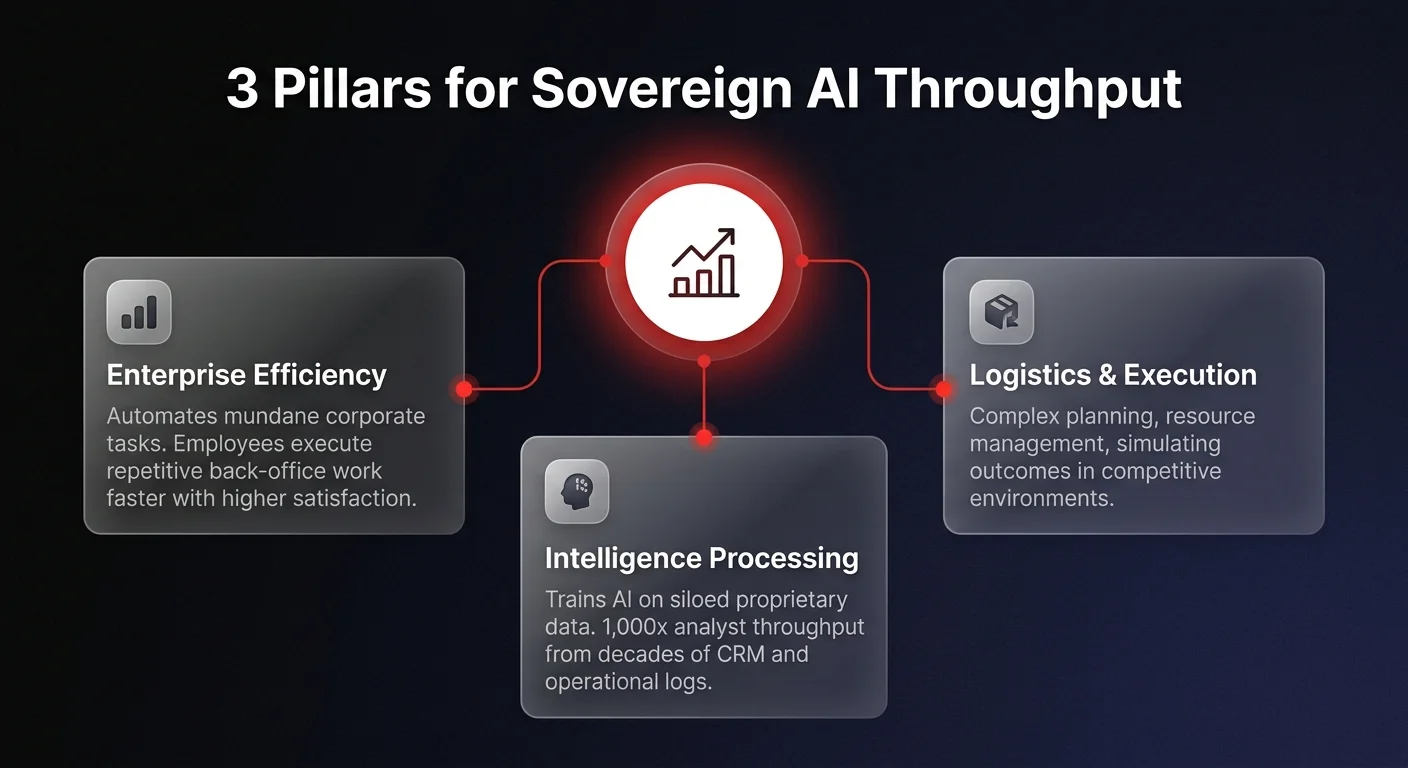
- Enterprise efficiency: This involves automating mundane, corporate tasks. It is the baseline of AI adoption. Employees are simply more effective and satisfied when they can execute repetitive back-office tasks faster.
- Intelligence processing: Most organizations sit on vast repositories of siloed historical data. In the defense sector, this might be decades of satellite imagery; in the enterprise, it is decades of CRM data, customer interactions, and operational logs. By training models on this specific, proprietary data to detect anomalies and extract insights, organizations can increase a human analyst's throughput by a factor of 1,000.
- Logistics and operational execution: This is the realm of complex planning — managing resources, simulating outcomes, and finding assets in contested or competitive environments.
To achieve these gains safely, operations leaders must ensure that the systems handling this intelligence are observable. Black-box commercial models obscure how decisions are made. Governed agent infrastructure provides observable logic, ensuring that when an AI system processes your siloed data, the reasoning is transparent and auditable.
The death of feature-based procurement
To build these governed systems, leaders must radically rethink how they buy technology. The legacy procurement model is fundamentally broken for the AI era.
In the past, organizations would issue extensive requirements — sometimes listing thousands of specific features — and engage in lengthy cost-plus contracts. Vendors would check the boxes, development would drag on for years, and the final product rarely met the initial operational need. This bureaucratic drag prevents agile, innovative solutions from ever seeing the light of day.
Strategic technology leaders are now enforcing a strict shift toward outcome-based, firm-fixed-price procurement. Instead of dictating the exact technical specifications, leaders are defining the operational requirement: "I need a system that achieves this specific measurable outcome, in this specific environment — you figure out the physics."
For mid-market CEOs and VPs of Operations, this aligns directly with the emerging outcome economy transforming B2B technology purchasing. You do not need to buy more fragmented SaaS tools or pay for endless consulting hours to experiment with AI features. You need to purchase a specific business outcome — whether that is resolving 40% of tier-one support tickets or automating your outbound sales research. By adopting an outcome-based framework, you align the technology provider's incentives directly with your operational success.
Moving to faster yeses and faster nos
A significant barrier to rapid AI maturity is institutional culture. Organizations naturally build up bureaucracy that defaults to a slow, ambiguous "maybe" when evaluating new technologies.
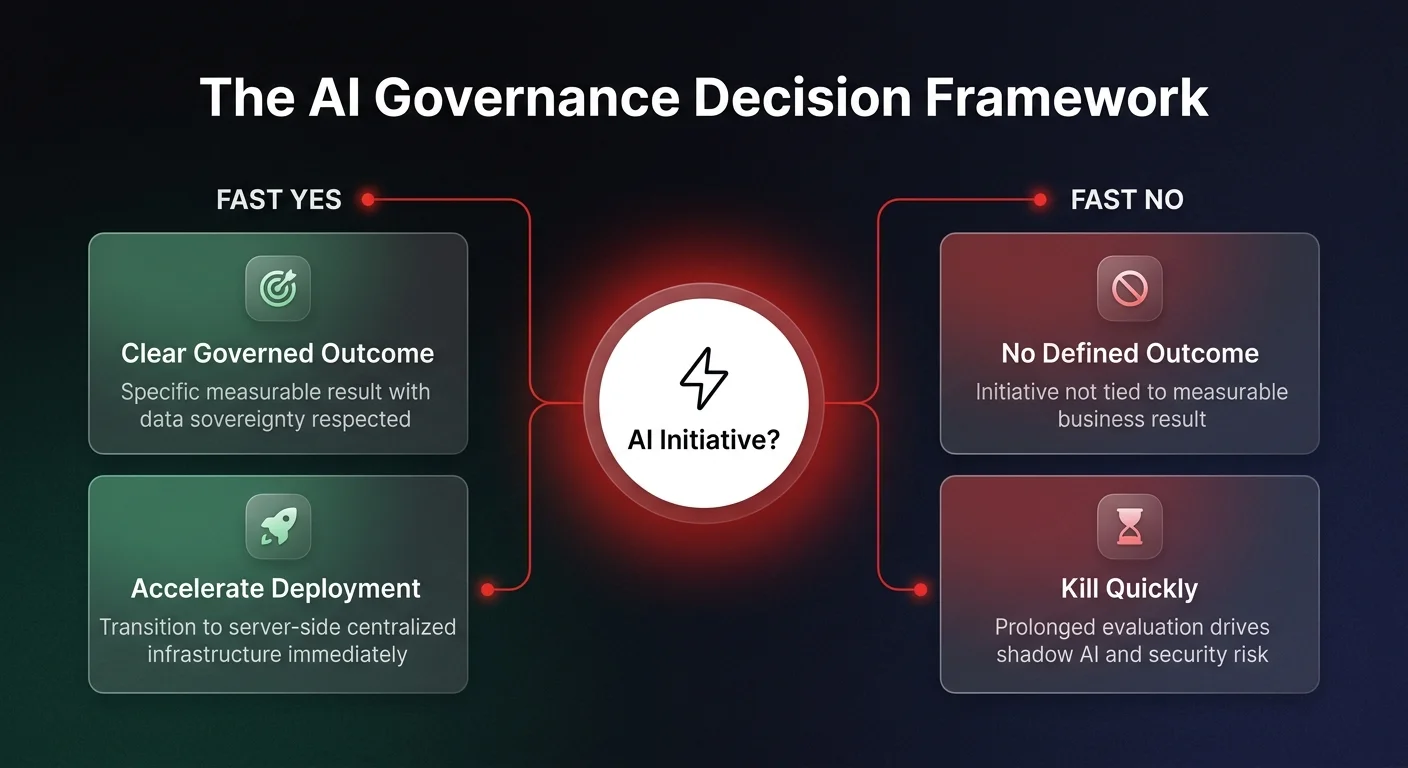
To build resilient, sovereign AI infrastructure, operations leaders must wage a relentless battle against this internal bureaucracy. The goal is to create clear demand signals for internal teams and external technology partners. This requires a culture of "faster yeses and faster nos."
If an AI initiative or vendor partnership is not driving toward a specific, governed operational outcome, leadership must kill it quickly. If it demonstrates clear value and respects data sovereignty, leadership must accelerate its deployment. Prolonged evaluation cycles for AI tools only result in shadow AI — where employees bypass IT to use ungoverned public models, introducing massive security risks to the business.
Building your sovereign AI strategy to avoid lock-in
The most successful organizations over the next decade will be those that view artificial intelligence not as a series of disparate software applications, but as a foundational, governed operational layer.
The key takeaway — it is entirely possible to capture the massive efficiency gains of artificial intelligence without sacrificing control of your business logic. By recognizing the severe risks of vendor lock-in, structuring your AI initiatives around clear operational buckets, and shifting to outcome-based procurement, you can insulate your business from the whims of commercial AI providers.
At Ability.ai, we recognize that true operational transformation requires more than just access to a large language model. It requires a resilient, sovereign infrastructure where your data stays under your control, your workflows are observable, and every action is auditable. See how our operations automation solutions deliver exactly this — governed AI systems you own, Claude-Code-first today with multi-runtime on the roadmap, so you never become dependent on a single vendor's roadmap. The mandate for today's operations leaders is clear: stop buying AI features, and start deploying governed AI systems.