
An opinionated AI agent is a knowledge system trained to interpret new information through your specific mental models and worldview, rather than providing neutral summaries. Unlike passive second brains that store data until manually queried, opinionated agents actively cross-reference every new input against your existing knowledge graph — developing a consistent cognitive perspective that amplifies your unique point of view at scale.
The game has changed. The goal isn't just to store information anymore. It's to orchestrate an 'opinionated agent' - a system that actively interprets reality through your specific lens. Instead of a passive archive, imagine a true cognitive partner that doesn't just retrieve facts but develops a worldview based on the connections in your knowledge base.
Let's talk about how to move from hoarding data to amplifying intelligence.
Here's the hard truth
Here's the hard truth about most knowledge management systems. They are functionally brain-dead. You put information in, and it sits there until you manually drag it out. That's not a second brain; that's a hard drive.
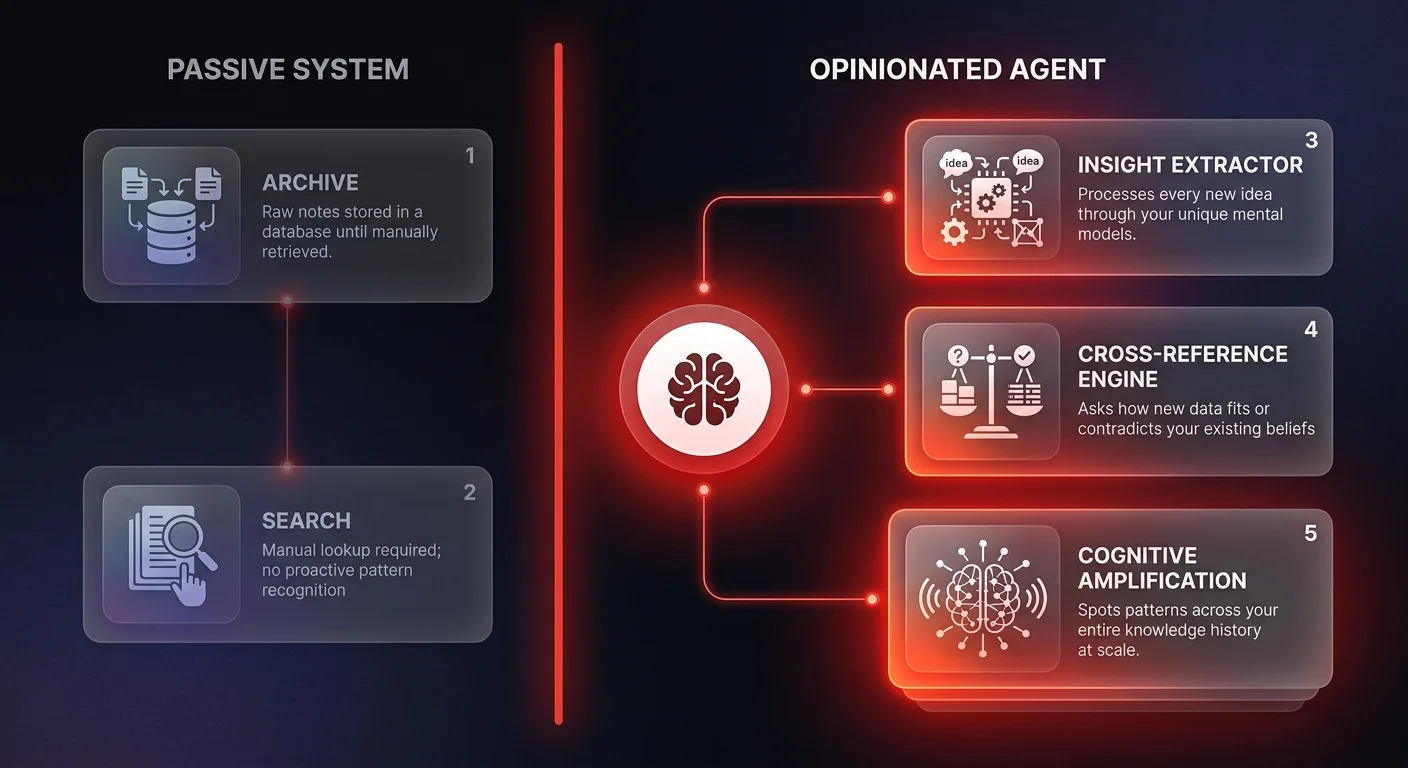
To radically shift this dynamic, we need to build systems that are 'opinionated in a good way.' What does this mean? It means your AI agent shouldn't just summarize new information neutrally. It should be specifically trained to interpret reality and see the world in ways defined by the concepts in your unique knowledge graph.
In my own workflow, I don't just dump raw notes into a database. I orchestrate specific sub-agents - like an 'Insight Extractor' - to process raw ideas. But here's the key differentiator. This agent doesn't look at the new idea in isolation. It references my existing knowledge base first. It asks: 'How does this new piece of data fit into Eugene's existing mental models? Does it contradict something? Does it reinforce a pattern?'
This turns your system into an evolving system of concepts and values that you are driving. The agent begins to 'think' like you, but at a scale you can't match manually. It starts spotting patterns you would have missed because it's constantly cross-referencing every new input against your entire history of thoughts. This isn't just automation; it's cognitive amplification — the same principle powering enterprise personal productivity AI systems that give leaders an unfair strategic advantage.
So how do you actually build this?
So how do you actually build this? You need to stop thinking about 'files' and start thinking about 'connections.'
The architecture relies on specialized sub-agents. Beyond the Insight Extractor, you might orchestrate a 'Cross-Domain Connection Hunter.' This agent's sole job is to look at your different areas of interest - say, AI architecture and behavioral psychology - and actively hunt for intersections.
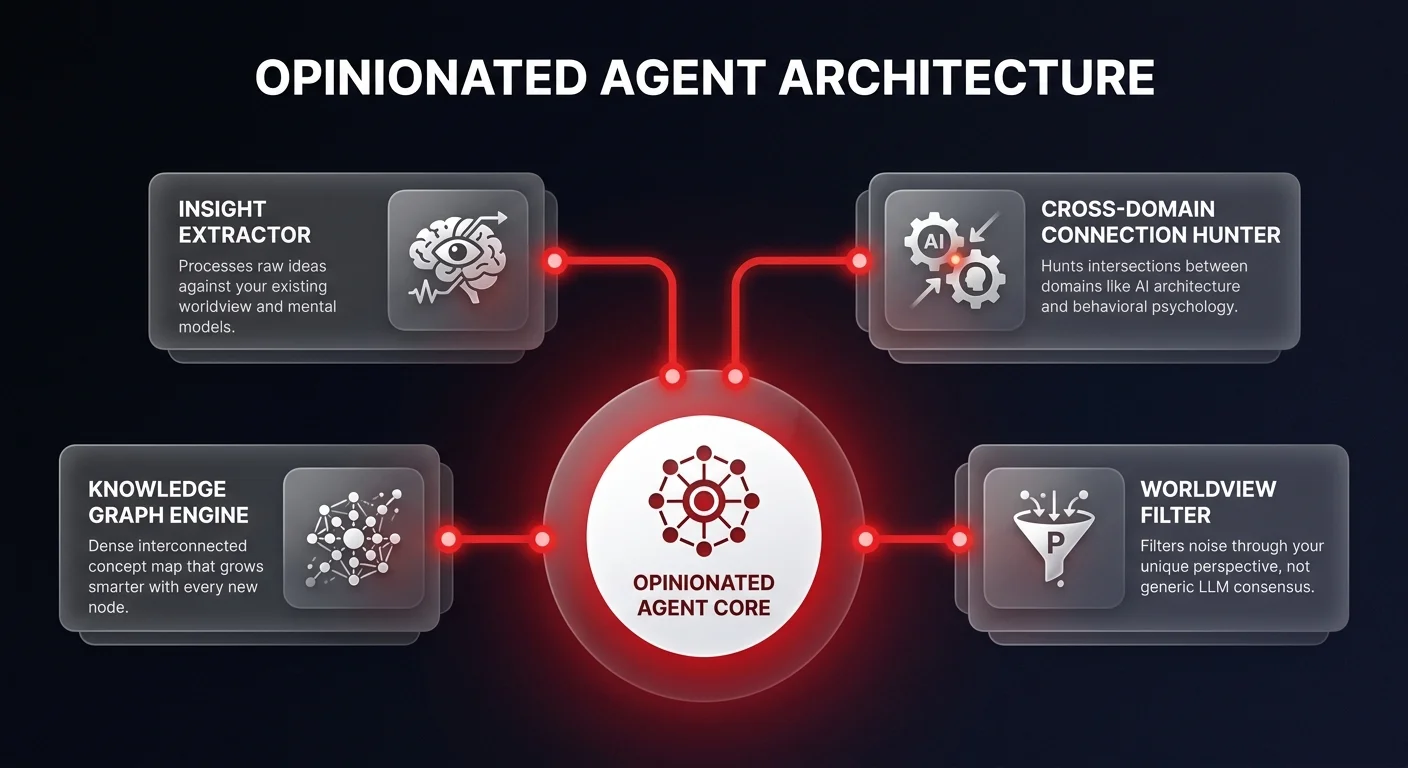
When you set this up, your knowledge base stops being a linear list of notes. It becomes a dense, interconnected graph. As it grows, it doesn't just get bigger; it gets smarter. It becomes more specialized. A standard database gets harder to manage as it scales. An opinionated agent gets more coherent because every new node reinforces the network effects of your specific worldview.
This is how you achieve radical ownership of your intellectual output. You aren't just relying on a generic LLM that gives you the average internet consensus. You are building a system that leverages your unique perspective to filter the noise.
Don't settle for a smart notebook. Build a system that challenges you, connects dots you didn't see, and actively participates in your thinking process. That is the future of agentic workflows.
Ready to stop hoarding data and start building an active cognitive architecture? At Ability AI, we help businesses orchestrate these kinds of high-signal agent systems. We don't just automate tasks; we amplify human intelligence. Let's discuss how to turn your static data into an unfair advantage.