
In-house AI projects fail 75% of the time because companies treat AI agent development as a software engineering problem rather than a change management and business process challenge. I've watched companies burn millions on internal 'science projects' that never deliver a dollar of ROI. The reason is simple but painful: smart engineers don't know your business processes. Treating AI agents as just another software engineering problem is the fastest way to fail. It's not about the code. It's about the business process.
Let's break it down
Let's break it down. I have immense respect for engineers - I've been one, and I've managed them. But when you task a pure engineering team with building an AI workforce, they default to what they know: optimization, stack architecture, and technical elegance. They don't naturally obsess over workflow nuances, operational friction, or specific ROI targets.
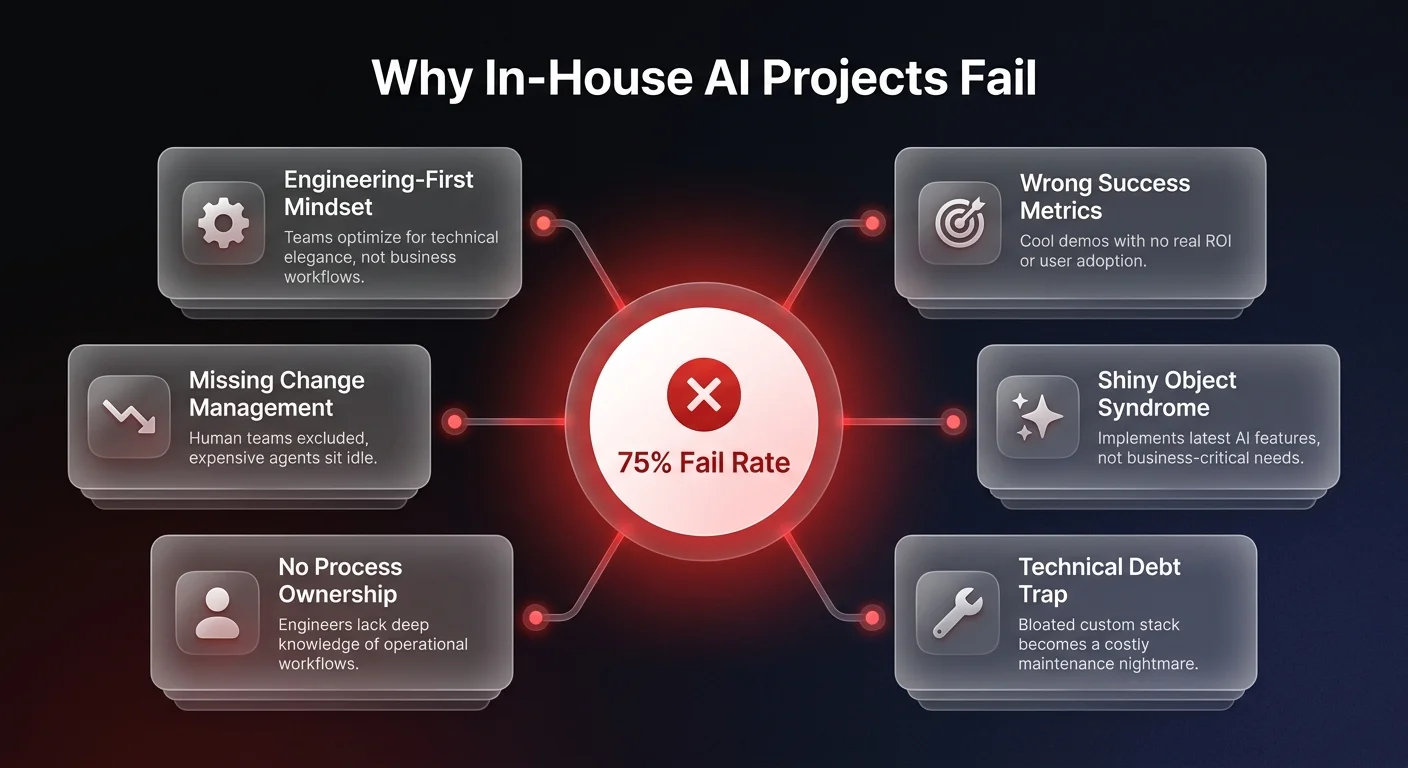
I've seen this play out in friends' companies repeatedly. They hire a brilliant team, build a massive, complex architecture, and six months later, they have a "cool" demo that nobody uses. Why? Because it solves a technical problem, not a business one. It doesn't account for the messy reality of how sales teams actually update CRMs or how support agents triage tickets.
The reality is that an AI agent isn't just a software tool; it's a digital worker. When you hire a human employee, you don't ask a software architect to design their job description. You ask a manager who deeply understands the workflow. Yet, for AI agents, companies are flipping the script in the wrong direction. They let technical capability drive the product roadmap instead of business necessity.
This leads to two critical failure points. First, you get 'shiny object syndrome' where the team implements the latest model capabilities just because they can, not because they add value. Second, you end up with a bloated, custom-coded stack that becomes a maintenance nightmare. Instead of a streamlined business solution, you own a pile of technical debt that requires constant engineering oversight just to keep running. That's not automation; that's just moving the bottleneck.
So, how do you ensure you're not part of that failing 75% statistic?
So, how do you ensure you're not part of that failing 75% statistic? You have to fundamentally change your approach. The majority of success in this space isn't associated with the LLM you choose or the vector database you spin up. It comes from radical ownership of process management.
Here is the hard truth: you need to stop treating this as an engineering challenge and start treating it as a change management challenge.
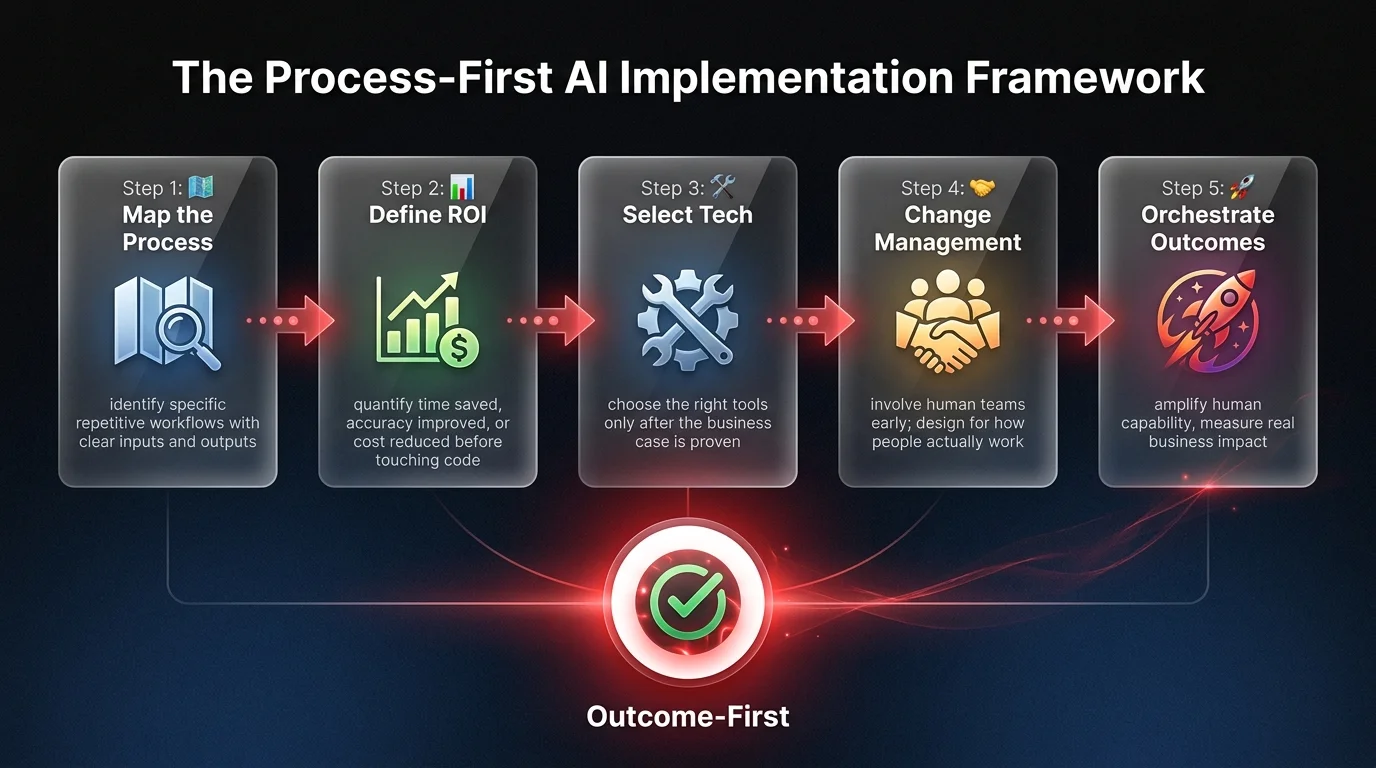
Instead of asking 'What can this technology do?', start asking 'What is the specific business process we are trying to orchestrate?' You need to map the process first. You cannot automate what you do not understand. If your current process is chaotic, adding AI just scales the chaos — which is why our AI readiness assessment identifies process gaps before any implementation begins.
High-signal implementation looks like this: You identify a specific, repetitive workflow with clear inputs and outputs. You define the ROI - is it time saved? Accuracy improved? Then, you bring in the tech to solve that specific constraint.
This is where the game has changed. We are moving from a world of 'building software' to 'orchestrating outcomes.' Success requires deep empathy for the human teams whose jobs are changing — which is why the most effective operations automation projects start with change management, not code. You aren't replacing people; you are building systems to amplify them. If you ignore the human element of change management - how people actually interact with these tools - your expensive agent will sit idle. Focus on the business logic, not the code. That is where the real leverage lives.
If you are tired of internal AI projects that stall out or fail to deliver, it's time for a different approach. At Ability AI, we don't just ship code; we engineer business outcomes. We help you orchestrate AI agents that actually drive ROI from day one. Let's stop playing with tech and start transforming your business.