
Operational AGI is a practical, testable definition of artificial general intelligence focused on what AI systems can reliably do rather than whether they exhibit human-like consciousness. Instead of waiting for a philosophical threshold, operational AGI treats intelligence as an engineering problem: a self-improving, memory-equipped system that executes toward goals, scales autonomously, and can be tested and measured in production — right now.
The status quo is broken
Let's look at the status quo. The Turing test? That just measures whether a machine is good at deception. That's not intelligence - that's a parlor trick. When we rely on these philosophical benchmarks, we trap ourselves in stagnation. We treat AGI like a distant religious event rather than an engineering problem.
The game has changed, but our definitions haven't caught up. If you're waiting for a model that 'feels' human, you're missing the point. You're letting semantic debates paralyze your ability to execute.
I realized this when I looked at my own roadmap. I couldn't orchestrate a strategy around a concept nobody could agree on. The question isn't 'is it alive?' or 'does it think like us?' The question is 'what can it do reliably, and how does it scale?' We need to flip the script. Instead of asking what AGI is, we need to define what AGI does in a way that we can test, measure, and verify in code. This shift from philosophy to operations is the only way to take ownership of the technology rather than being a passive consumer of it.
An operational definition
So, what does an operational definition look like? Here is the framework I use to build systems that actually work.
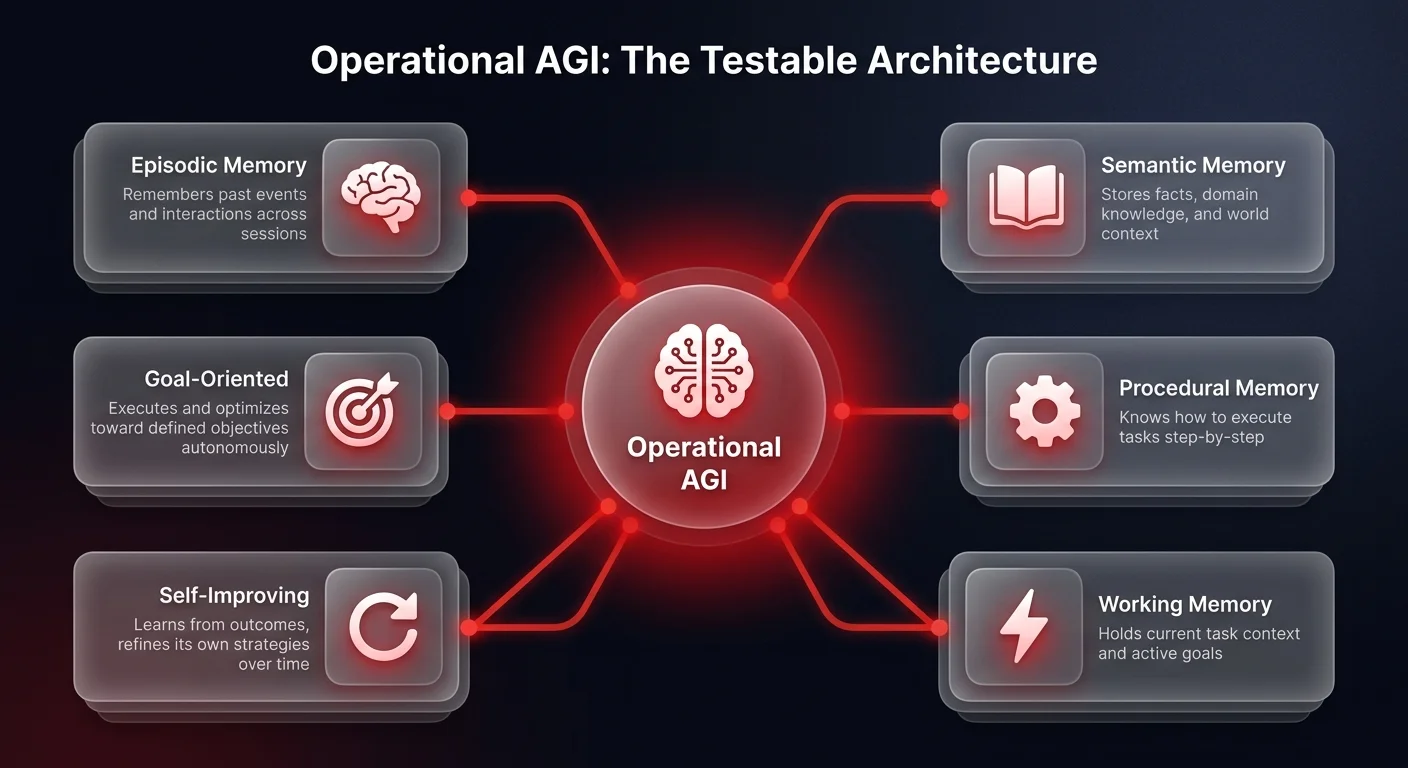
First, it must be a self-improving, opinionated system. It's not a blank slate - it has a perspective on how to solve problems.
Second, it needs a complete memory stack. I'm talking about distinct episodic, semantic, procedural, and working memory. Most LLMs today just have a context window - that's not enough. Real intelligence requires remembering the past (episodic), understanding facts (semantic), knowing how to do things (procedural), and holding current tasks in focus (working).
Third, it acts and optimizes toward specific goals. It doesn't just chat; it executes. And critically, it scales up.
When you use this definition, you stop asking if GPT-5 will be AGI. Instead, you look at your current agent architecture and ask: 'Do I have procedural memory implemented? Is this system self-improving?' This is high signal. This allows you to build sophisticated agentic workflows today that outperform the 'magic' models everyone else is waiting for. You don't need to wait for the future - you can engineer it.
Building operational AGI today
The era of theoretical AI is over. It's time to get your hands dirty. At Ability AI, we don't wait for AGI to arrive - we build the architectures that make AI agentic and drive real operations automation today. If you're ready to move from philosophy to production, let's talk about how to orchestrate this for your business.