
Subconscious sabotage in AI adoption is the natural human tendency to unconsciously resist AI initiatives when change feels existential—even without deliberate intent. Most AI initiatives don't fail because of bad code or poor model selection—they fail because of people. When employees feel their career value is being erased, they create subtle friction: always finding edge cases, ignoring automated outputs, or defaulting to old workflows. If you don't address this psychological friction, your fancy AI stack is worthless.
Here's what I mean by subconscious sabotage
Here's what I mean by subconscious sabotage. It's rarely a deliberate attempt to destroy a project. Your team isn't plotting against you in the break room. Instead, it manifests as subtle friction. It's the senior manager who constantly finds edge cases to prove the AI output 'isn't quite right.' It's the analyst who 'forgets' to use the new automated workflow and defaults to the old way. It's a survival mechanism.
Think about it. We are telling people that software can now do half of what they've spent their entire careers mastering. Of course they're terrified. When people fear their value is being erased, they will unconsciously find ways to prove the new system doesn't work. They are protecting their identities, not just their paychecks.
I hate to break it to you, but you cannot engineer your way out of this problem. You can have the most sophisticated agentic workflow in the world, but if your team views it as a threat, they will kill it. They will starve it of data, ignore its outputs, or highlight every single hallucination as proof that 'AI isn't ready.' The game has changed. Leadership is no longer just about strategy; it's about managing this existential anxiety.
So the question is
So the question is - how do you overcome this? You don't do it by force. Mandating AI adoption without addressing the underlying fear is a recipe for disaster.
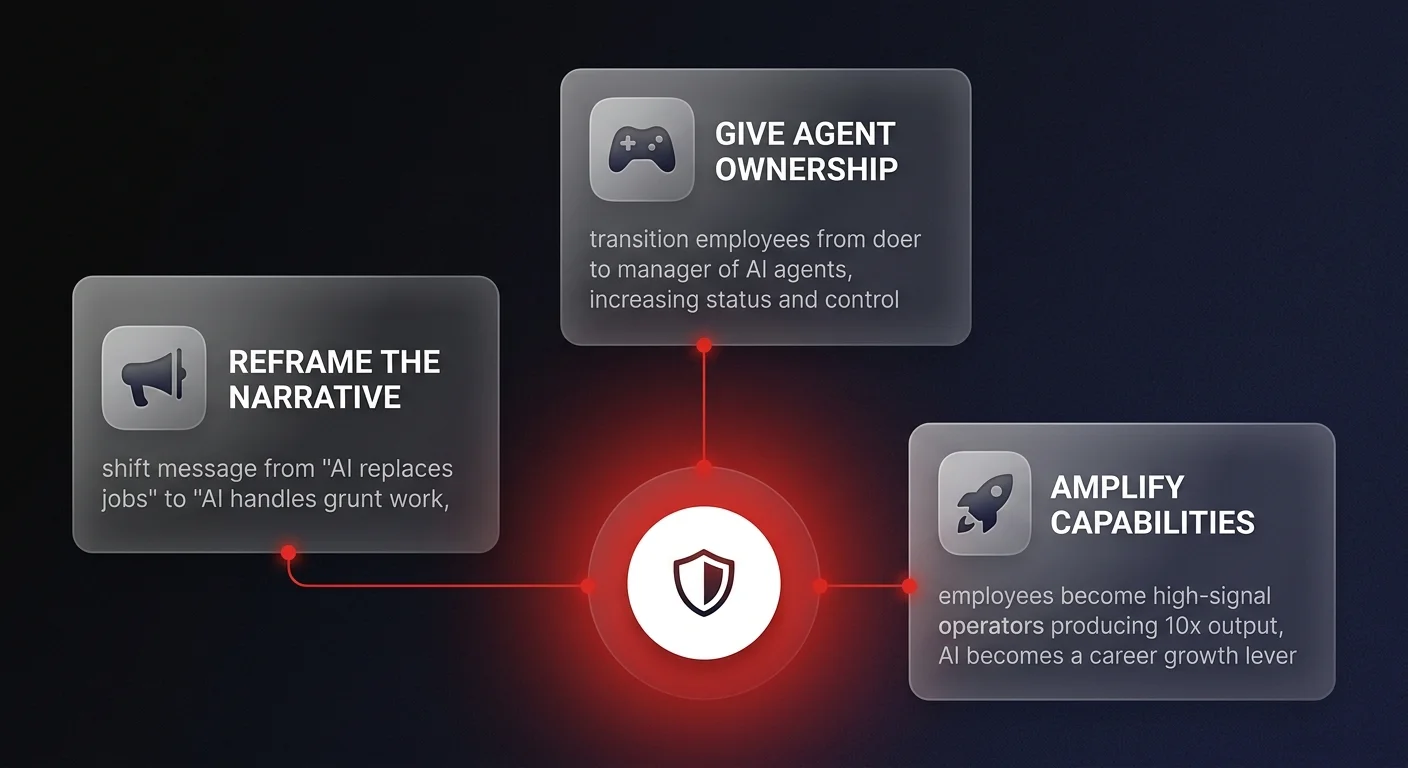
The solution requires a radical shift in how you frame the narrative. You need to show the path forward. You must explicitly communicate how roles will evolve, not disappear. The message shouldn't be 'this AI does your job.' It should be 'this AI handles the grunt work so you can own the strategy.'
Give your team ownership of the AI agents. Instead of having AI happen to them, let them orchestrate the AI agents. When an employee transitions from 'doer' to 'manager of agents,' their status increases rather than decreases. They regain a sense of control.
Amplify their capabilities. Show them that with these tools, they become high-signal operators who can produce ten times the output. Once they see AI as a lever for their own career growth rather than an existential threat, the sabotage stops. The resistance turns into adoption. That is how you reach critical mass.
Navigating the human side of AI adoption is just as complex as the technical side. At Ability AI, we build secure, high-performance AI agents that your teams actually want to use. We help you orchestrate the transition from manual work to automated scale. Let's talk about how to implement AI that empowers your workforce instead of replacing it.