

AI content slop is generic, mass-produced content created by generative AI tools without proprietary data, original research, or operational insight. It fails to rank in search engines, gets ignored by AI search platforms, and wastes marketing budgets - yet most scaling companies are still publishing it without realizing the damage.
The phrase "AI content slop" has quickly become the defining threat to modern digital marketing. As generative AI makes it infinitely cheaper to produce generic articles, scaling companies face a harsh new reality - commodity content will no longer rank in Google, nor will it be surfaced by AI search engines like Perplexity or ChatGPT. Marketing teams that continue to publish high-volume, low-value information are actively wasting their budgets. To survive and capture market share, organizations must pivot entirely toward non-commoditized, original content fueled by proprietary data and deep operational insights.
Organizations are caught between a rock and a hard place. On one side, massive marketing budgets are being burned on SEO strategies from 2021. On the other side, employees are turning to ungoverned shadow AI - copying and pasting generic prompts into ChatGPT to churn out uninspired blog posts. Neither approach drives revenue. The future of visibility belongs to companies that can extract their internal, proprietary expertise and turn it into actionable insights that no large language model could possibly hallucinate. Teams already tackling content governance challenges understand that the solution starts with structured internal data extraction, not better prompts.
Why AI content slop kills your search visibility
For the past decade, the standard playbook for digital visibility was simple - find a high-volume search query, write a longer article than the competitors, and optimize the headers. This led to an explosion of informative but entirely commoditized content.
Today, standard informative content is dead. AI bots instantly provide generic answers to basic questions, removing any incentive for a user to click through to a company's website. If your marketing strategy relies on answering surface-level questions, you are competing directly against the baseline capabilities of every major AI model on the market.
To win visibility today, content must rely on proprietary evidence, deep specificity, and first-hand experience. It must be fundamentally impossible for off-the-shelf AI to generate without access to your private operational data. Organizations that have already built AI content engines for marketing are seeing this shift firsthand - the teams that centralize proprietary data pipelines outperform those still publishing generic articles.
The running shoe test: specific versus general information
To understand the massive gap between commodity content and proprietary insight, consider a standard retail example. A few years ago, a specialty running store might have published an article titled, "Top 10 things to consider when buying running shoes." At the time, that was moderately useful information that could capture search traffic.
Then AI arrived on the scene. Now, that same generic list is instantly available from any AI chatbot in seconds. It is the definition of AI content slop.
What does high-ranking, non-commoditized content look like today? It looks like micro-specific case studies. Instead of top 10 lists, the modern running store publishes an article titled: "Why this customer's shoes collapsed after 400 miles: a wear pattern analysis."
The content dives deep into a highly specific scenario. It notes that a customer named Jake brought his Brooks Ghost 15s into the store exactly at 402 miles of use. The analysis reveals that the lateral foam on the right heel was compressed 4 millimeters deeper than the left - a signature indicator of his specific forefoot strike. The store includes actual macro photographs of the compressed foam and millimeters of wear.
There is deep data, deep specificity, and photographic proof. ChatGPT cannot make up Jake. An LLM cannot hallucinate the exact millimeter compression of a specific pair of Brooks Ghost 15s after 402 miles, nor can it generate authentic photos of the wear pattern. This is proprietary evidence - content that only the store could have created because they possess the operational data and the physical product.
Six checkpoints to ensure your content is not AI content slop
To ensure your marketing team is producing assets that will actually drive traffic and influence buyers, every piece of content must pass six strict checkpoints. If an article fails these tests, it is likely commodity content destined to be ignored by both search engines and human readers.
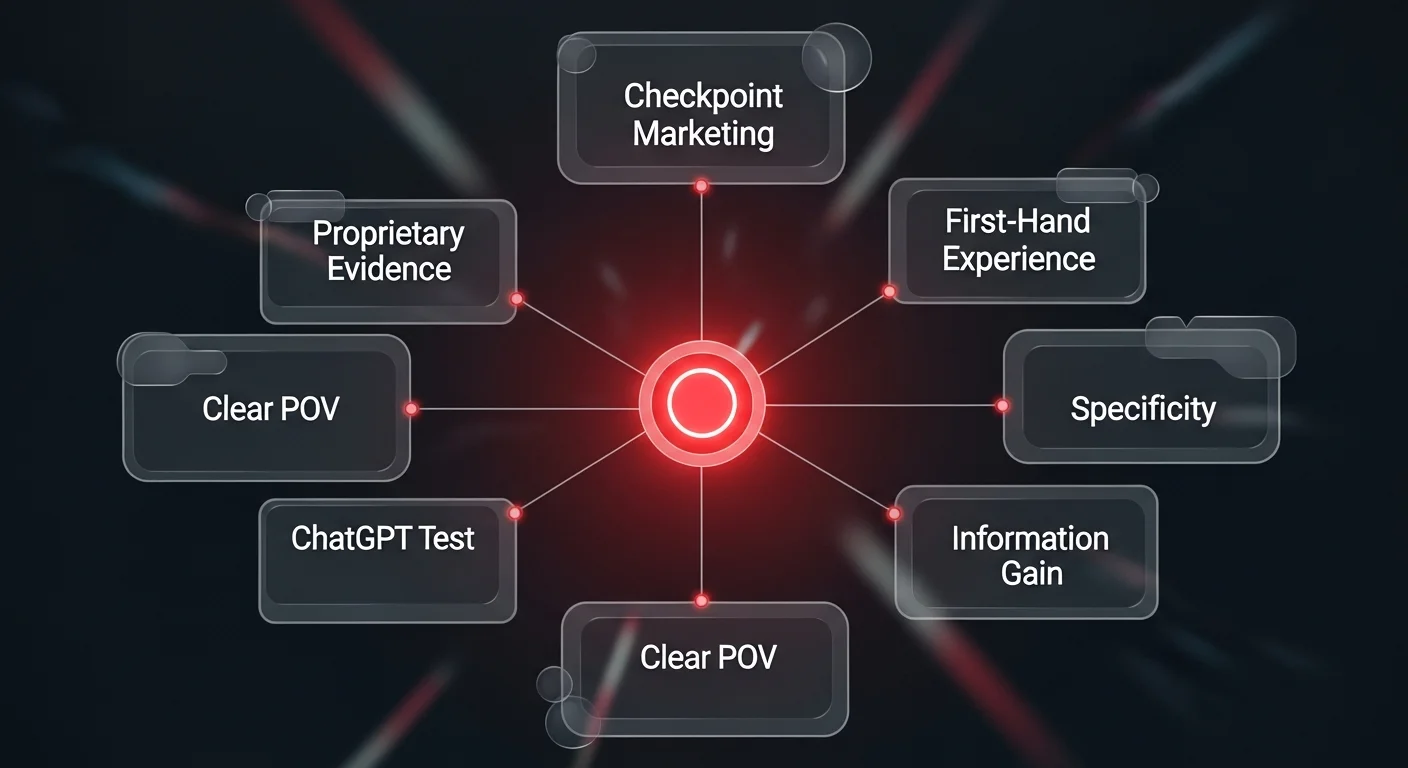
Do you have proprietary evidence?
Proprietary evidence is data, metrics, or physical proof that exists exclusively within your organization. In the B2B space, this might be anonymized user data from your software, specific hours saved during a client implementation, or unique operational workflows you have designed. If you are quoting the same industry reports as your competitors, you lack proprietary evidence.
Is it based on first-hand experience?
Content must be rooted in actual operational reality. Theoretical advice is easily generated by AI. First-hand experience requires the input of subject matter experts - your sales engineers, your customer success managers, and your operations leaders. The content should reflect the messy, nuanced reality of solving real business problems, complete with the unexpected hurdles that only operators encounter.
Is it specific versus general?
Generalization is the enemy of modern content. High-performing assets zoom in on micro-specific scenarios. Instead of writing about "How to improve supply chain efficiency," write about "How a mid-market logistics firm reduced regional routing delays by 14 percent using automated dispatch triggers." The more specific the scenario, the harder it is for AI to replicate, and the more valuable it becomes to a reader facing that exact same problem.
Do you have a clear point of view?
Commodity content attempts to be entirely objective, presenting both sides of an argument without taking a stance. This results in bland, forgettable reading. Original content requires a strong, defensible perspective. Your organization must have a distinct point of view on the market, the technology, or the methodology. A clear stance polarizes the audience slightly, which is essential for building actual thought leadership.
Could ChatGPT write this without any help from you?
This is the ultimate litmus test. If you can open a standard LLM, type in the title of your proposed article, and receive a draft that is 80 percent identical to what your team planned to publish - that is a massive red flag. If off-the-shelf AI can write it unassisted, it holds zero competitive value.
Does it provide information gain?
The concept of "information gain" is critical to modern search algorithms. Does the reader learn something entirely new that is not already present in the top three results of Google? If your article simply summarizes the existing consensus of the first page of search results, it provides negative information gain. To rank, you must introduce new variables, new data sets, or entirely new frameworks to the conversation.
Why operations leaders must rethink their data workflows
Understanding these six checkpoints is only half the battle. The real challenge for mid-market and scaling companies is operational. How do you consistently extract this proprietary evidence and first-hand experience from your organization to feed your marketing engine?
Marketing teams often lack direct access to deep operational data. Because it is difficult to interview engineers or mine customer success tickets for insights, marketers default to the path of least resistance - they use shadow AI to generate generic thought leadership. They use consumer-grade tools to rewrite competitor blogs, creating security risks and consistency issues along the way.
This highlights a critical need for intelligent content distribution workflows that bridge the gap between operations and marketing. Organizations that have automated their content repurposing workflows are already solving this problem by systematically extracting expert knowledge into structured content briefs.
Moving from shadow AI to sovereign AI agent systems
Organizations cannot solve this data extraction problem with simple prompt engineering. They need structured, centrally governed systems.
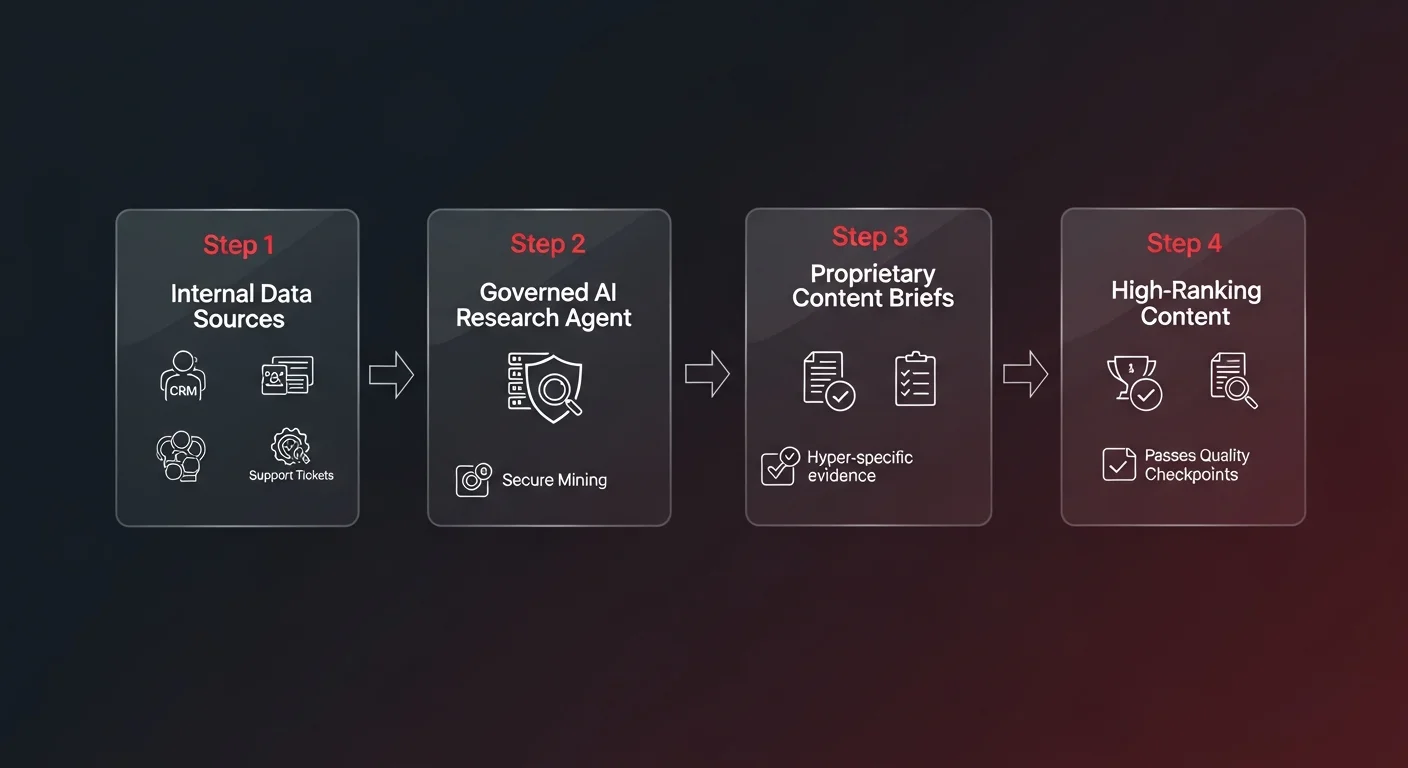
This is where the deployment of a sovereign AI agent system transforms business outcomes. By utilizing a secure, governed platform, organizations can build specific agents designed to mine internal data securely. See how companies are implementing AI marketing content solutions to build exactly this kind of centralized content intelligence infrastructure.
Imagine a researcher agent securely connected to your anonymized customer support tickets and CRM data. This agent does not write generic marketing copy. Instead, it identifies recurring customer pain points, pulls the exact resolution times, extracts the specific technical solutions provided by your team, and packages this proprietary data into a brief for your marketing department.
This approach eliminates the risks of shadow AI. Your proprietary data never leaks into public LLM training sets, and your marketing team receives a continuous pipeline of hyper-specific, proprietary evidence that passes all six content checkpoints. Furthermore, because you own the system and everything it produces, you're not tied to a single vendor's roadmap - just reliable infrastructure turning your operational exhaust into marketing gold.
Your next step: automating information gain
The era of ranking on Google through generic word counts is permanently over. AI has reset the baseline, and only organizations that leverage their unique, proprietary operational data will earn the attention of the market.
Stop paying for content that generative AI can create for free. The strategic move for operations and marketing leaders is to centralize and govern how internal data is transformed into public insights. By launching a focused Starter Project - fixed scope, fixed cost, delivered in weeks - you can deploy a secure, custom AI workflow that automatically mines your proprietary internal data, formats it into unique market insights, and proves immediate value. It is time to stop publishing AI content slop and start engineering true information gain.