
An AI content engine is a custom AI agent system that transforms a single source — such as a webinar transcript — into a complete omni-channel marketing campaign, generating social posts, blog articles, email sequences, and visual assets simultaneously. In 2026, mid-market companies deploying a governed AI content engine are reducing post-event content production from weeks to minutes — but the shadow AI risks introduced by local, ungoverned deployments are just as significant as the productivity gains.
The deployment of an AI content engine has become a critical differentiator for mid-market and scaling companies. As organizations attempt to scale their marketing operations without ballooning headcount, the ability to automatically transform a single piece of source material into an omni-channel marketing campaign is no longer just a competitive advantage — it is an operational necessity.
However, a fascinating shift is occurring in how these systems are built. The industry is rapidly moving away from fragile, multi-step automation platforms toward custom, locally deployed AI agents. While this shift unlocks incredible creative potential and efficiency, it simultaneously introduces complex challenges regarding data sovereignty, governance, and operational security.
Here is a comprehensive look at how modern AI content engines are being constructed, the operational workflows they replace, and the strategic governance steps leaders must take to deploy them securely.
The live event shift and the post-webinar ecosystem
To understand the value of a custom AI content engine, we must first look at the source material fueling it. Despite the rapid advancement of digital marketing, webinars and live remote events are experiencing a massive resurgence. As we move further into an AI-generated landscape, audiences are actively seeking the human experience of live interaction as a counterweight to automated interactions.
But the true operational value of a webinar is rarely the live attendance. The most significant return on investment comes from the post-event content ecosystem.
Traditionally, a company would host a webinar using platforms like Riverside or Zoom. After the event, a marketing team would spend weeks manually dissecting the recording to create follow-up materials. The modern AI content engine workflow condenses this timeline into minutes through a structured, three-step framework:
- Planning: Utilizing current Ideal Customer Profile (ICP) data and email lists to draft highly targeted topics.
- Promotion: Leveraging distribution networks to drive RSVPs, rather than relying solely on organic social media followers.
- Post-event extraction: Feeding the raw event transcript into a custom AI agent to generate a complete ecosystem of repurposed content.
It is in this third step — the AI content engine itself — where the operational mechanics have completely transformed.
The evolution from fragile automations to custom AI content engines
Until recently, the standard method for automating post-webinar content relied heavily on integration tools like Zapier or n8n. A typical workflow would trigger when a Riverside transcript was finalized, sending the text through a Zapier webhook to an AI model, which would then output generic social posts into a Google Doc or Notion workspace.
While functional, this approach is fundamentally flawed for scaling operations. Integrations are brittle. Workflows break silently, and teams often remain unaware that their automated sequences have been offline for days until the pipeline dries up.
Today, the most effective strategy replaces these fragile connections with a dedicated AI content engine built entirely within environments like Claude Code. Rather than relying on conditional "if/then" triggers, these custom agents act as intelligent engines. They execute multiple, specialized API calls simultaneously — one for LinkedIn posts, one for blog articles, one for email sequences — all guided by complex system prompts and deep contextual data.
This shift allows non-technical team members to build highly complex systems. By simply describing their ideal workflow in plain language, a user can generate a markdown file that dictates the agent's behavior, refine it through conversational prompting, and deploy a bespoke tool in a matter of hours. As we covered in autonomous marketing agents and the creative velocity advantage, this speed of deployment is itself becoming a competitive moat.
The context folder framework: eliminating generic AI slop
One of the most persistent complaints from operations and marketing leaders is that AI-generated content sounds robotic, generic, and off-brand. The telltale signs — starting a post with "Here's what actually works" or relying heavily on predictable sentence structures — instantly degrade brand trust.
Research reveals that the secret to bypassing this generic output is the "Context Folder" framework. When a custom AI content engine is built locally, it can be connected directly to a directory on a user's machine that houses dense, highly specific company data.
To achieve a 70 to 80 percent usable output on the first generation, the agent must be fed:
- Writing examples directly from the founder or CEO
- Detailed case studies and historical performance data
- Strict blog post and brand voice guidelines
- Specific ICP lists and target audience segmentations
- A "marketing blacklist" of banned industry buzzwords and overused phrases
By pulling from these context documents rather than relying solely on the foundational training of the LLM, the AI content engine produces highly nuanced content. When an agent processes a transcript, it cross-references the spoken words against the brand's exact tone, ensuring the resulting assets require minimal human editing.
Omni-channel extraction from a single transcript
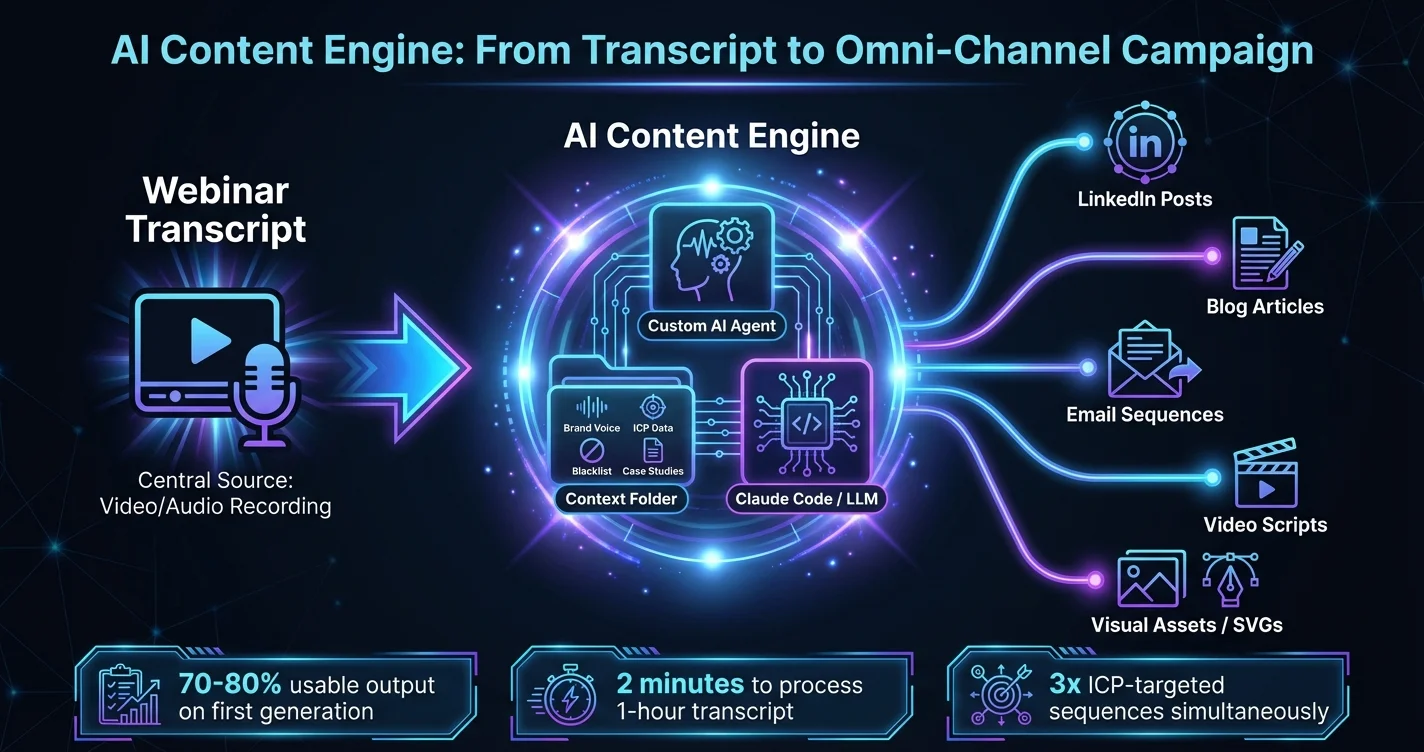
When properly configured, a custom AI content engine can process a one-hour transcript and output a comprehensive operational package in under two minutes. The standard output typically lands in a centralized Google Doc — preferred by many teams over Notion for seamless client or cross-departmental sharing — and includes:
- Platform-specific social content: Long-form blog posts and concise, optimized LinkedIn articles generated simultaneously.
- Video editing blueprints: Specific short-form video scripts and timestamped extraction guides for editors using tools like CapCut.
- Targeted outreach sequences: Immediate newsletter recaps for attendees, alongside customized cold email sequences built for integration with outreach platforms like HeyReach and Instantly.
Perhaps the most significant technical breakthrough involves visual assets. Historically, AI image generation was entirely locked; if the output was slightly wrong, the user had to regenerate the entire image. Now, advanced agents can generate graphics as SVG files. These vector graphics can be imported directly into design platforms like Figma, allowing human designers to manually adjust text, move elements, and refine the branding seamlessly.
Furthermore, the text generation can be hyper-segmented. If a webinar is attended by three distinct buyer personas, the AI content engine can be instructed to generate three entirely different post-event email sequences, tailoring the value proposition and landing page destinations for each specific ICP — a task that would normally take a marketing team a full week of coordination to execute.
The shadow AI risk of local AI content engines
The capabilities of these custom agents are undeniable, but they introduce a critical blind spot for operations leaders.
Building an AI content engine in Claude Code on a local laptop means that highly sensitive, proprietary company data — ICP lists, strategic marketing roadmaps, founder IP, and competitive blacklists — must reside in local folders on an individual employee's machine.
This is the definition of shadow AI. While an individual marketer might achieve incredible efficiency by building their own custom agent, the organization loses all oversight. If that employee leaves the company, the customized agent and the perfectly tuned operational workflow leave with them. Furthermore, feeding sensitive corporate strategy documents into local, ungoverned AI environments poses severe data privacy and security risks.
For a mid-market CEO or COO, relying on fragmented, locally hosted agents across different departments creates operational chaos disguised as efficiency. The shadow AI governance crisis is not hypothetical — it is already arriving through the back door of individual productivity wins.
Moving from desktop experiments to governed AI content engine systems
To safely harness the power of an AI content engine, organizations must elevate these local workflows into governed, enterprise-grade systems. This is the core philosophy behind Ability.ai's approach to sovereign AI agent systems.
Instead of allowing unobservable agents to run on individual laptops, scaling companies must deploy these capabilities within a secure, observable infrastructure. A governed AI content engine provides the exact same high-leverage content extraction, but it does so while maintaining strict data sovereignty.
In a governed system, the "Context Folders" — the brand voice guidelines, the ICP data, the performance analytics — are secured within the company's proprietary environment. The logic driving the agent is centralized, observable, and fully owned by the organization. If a zap breaks, or a local markdown file is accidentally deleted, a local user is paralyzed. But a sovereign, observable agent provides reliable, repeatable execution that operations leaders can trust.
If your marketing team is already running local content experiments, our AI marketing content solutions practice can help you centralize these workflows into a governed system that scales without the shadow AI exposure.
Strategic takeaways for operational leaders
The transformation of a single live event into a month's worth of targeted marketing assets is a workflow every scaling business should adopt. It maximizes the return on human effort and keeps leads engaged without burning out your internal teams.
However, the strategy is only as viable as its infrastructure. As you look to implement an AI content engine within your own operations, consider the following:
- Audit your current automations: Identify where brittle integration tools are bottlenecking your marketing operations and evaluate where intelligent agents can replace them.
- Centralize your context: Begin compiling the specific brand guidelines, blacklists, and historical data required to make AI outputs usable. Do not settle for generic generation.
- Prioritize governance over localized speed: Avoid the trap of letting individual team members build siloed agents on their local machines.
The future of operational efficiency lies in transforming these fragmented, localized AI content engine experiments into reliable, governed systems. By doing so, you protect your corporate data while empowering your teams to execute at an unprecedented scale.