
AI marketing spam refers to automated, machine-generated comments, posts, and engagement deployed at scale by ungoverned AI agents across professional networks like LinkedIn and Reddit. Companies deploying these tools without governance frameworks face severe brand reputation damage, polluted pipeline data, and shadow AI governance failures that operations leaders cannot afford to ignore.
The race to deploy artificial intelligence has created an unexpected crisis in digital spaces. What began as a push for efficiency has devolved into a deluge of AI marketing spam across professional and social networks. For operations leaders and CEOs, this isn't just a marketing problem — it is a fundamental breakdown in brand governance. When AI tools are deployed without oversight to automate external engagement, companies risk severe reputational damage. The line between marketing and automated spam is vanishing, leaving business leaders to manage the fallout of ungoverned agents running wild on the social web.
How AI marketing spam floods professional networks
Platforms like LinkedIn and Reddit are currently fighting a losing battle against a new breed of automation tools. Take Astral, for example. This application functions as a marketing agent designed specifically to execute commenting at scale. The workflow is deceptively simple: users define their target audience and interests, and the system creates a swarm of autonomous agents. These agents then deploy across social platforms, reading posts and generating contextual comments on behalf of the user or brand.
On paper, this sounds like the ultimate growth hack for a busy marketing department. In practice, it is brutal. When operations leaders examine the output of these tools, the immediate reaction is often disbelief. This is not marketing — it is the industrialization of noise. By automating the very act of human connection, brands are participating in a system that alienates the exact prospects they are trying to attract. It takes the nuance out of professional networking and replaces it with a relentless, automated spam machine.
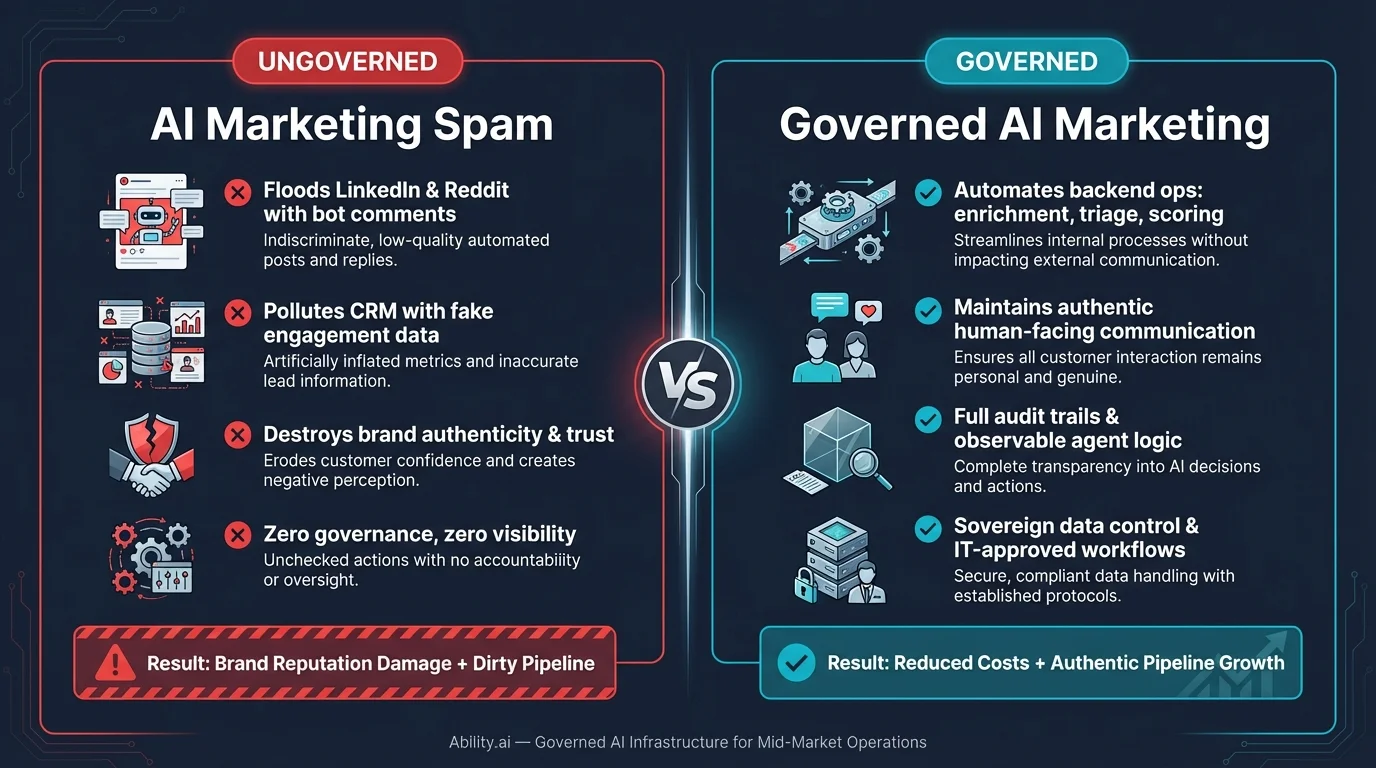
The contrast with properly governed AI is stark. When AI is deployed inside a controlled marketing infrastructure — handling content strategy, audience segmentation, and campaign analytics — it amplifies human capability. When it is used to simulate human presence on social networks, it destroys it. For a deeper look at how ungoverned tools create systematic risk, read our analysis of automated AI marketing risks and the governance failures behind them.
Welcome to the dead internet: when AI talks to AI
The proliferation of these agents brings us dangerously close to a dystopian digital reality. We are rapidly approaching a closed loop where an AI system creates a piece of content, a different AI tool distributes it, and an entirely separate swarm of AI agents generates the comments and engagement.
For anyone who has been a victim of automated AI commenting on LinkedIn, the experience is intensely frustrating. The comments often lack genuine insight, relying on generic praise or poorly synthesized summaries of the original post. This cycle actively erodes the authentic essence of the web. Historically, the internet elevated marketing by creating genuine value and facilitating real conversations between buyers and sellers. When we replace that exchange with machines talking to machines, we destroy the foundation of digital trust. If your audience suspects they are talking to a bot rather than an expert, your brand equity plummets to zero.
The illusion of scale: why vanity metrics destroy pipeline
Operations leaders must ask a critical question — why are teams deploying these tools in the first place? The answer usually points to misaligned incentives. Front-end vanity metrics like impressions, profile views, and comment counts are easily manipulated by automated agents. Marketers deploy commenting bots to artificially inflate these numbers, creating the illusion of massive scale and reach.
However, the operational reality paints a very different picture. These inflated metrics do not translate to actual revenue. In fact, they actively damage your sales pipeline. When automated agents generate fake engagement, they feed dirty data into your customer relationship management systems. Operations teams are then forced to clean up the mess, wasting time trying to discern which leads are genuine prospects and which are just the byproduct of a machine-generated feedback loop. You end up optimizing your business processes around artificial noise rather than genuine market signals.
The real cost of shadow AI on brand equity
For mid-market and scaling companies, the threat extends far beyond annoying social media comments or messy CRM data. This trend represents a critical failure in technology governance. When marketing or sales teams independently adopt unvetted tools to artificially inflate their engagement, they are engaging in shadow AI deployment.
Shadow AI occurs when employees use undocumented or unapproved artificial intelligence tools to execute business functions. In the case of automated commenting tools, the risks are profound. Your brand's voice — arguably your most valuable intangible asset — is handed over to a third-party language model with no sovereign control, no observable logic, and no strategic alignment with your actual business operations.
The damage is twofold. First, the brand appears robotic and inauthentic to the market. Second, the organization loses visibility into its own digital footprint. Operations leaders cannot manage what they cannot see, and unauthorized marketing agents create massive blind spots in corporate communication strategies. If an ungoverned agent posts an inappropriate, off-brand, or factually incorrect comment on a viral Reddit thread or a key prospect's LinkedIn post, the resulting public relations crisis falls squarely on the leadership team.
These governance blind spots are the same ones that emerge when AI marketing agents operate without a governed operations framework. The root cause is always identical: tools deployed faster than governance can follow.
Why operations leaders must govern AI deployment
The visceral backlash against automated commenting highlights a critical lesson for business leaders. AI is not a magic wand for front-end vanity metrics. When deployed to mimic human relationships, it almost always fails. The true power of artificial intelligence lies in solving complex, backend operational challenges.
Rather than unleashing ungoverned agents to spam the market, organizations must pivot toward governed agent infrastructure. A sovereign AI agent system operates with strict data controls and observable logic, focusing on specific business outcomes rather than superficial engagement.
For example, instead of automating LinkedIn comments, intelligent systems should be deployed to handle support triage, recruitment operations, and complex lead enrichment. These backend applications do not risk your brand reputation. They work silently and securely to reduce operational costs, streamline data flow, and equip your human employees with the insights they need to have genuine, high-value conversations with prospects and customers. When you deploy AI to handle the operational heavy lifting, you free your human team to do what they do best — build authentic relationships.
If your organization is ready to eliminate shadow AI tools and replace scattered experiments with governed AI systems, explore how Ability.ai architects sovereign marketing automation for mid-market companies.
Shifting from vanity automation to operational value
The allure of scaling engagement through ungoverned artificial intelligence is a trap. Tools that promise to automate human connection ultimately deliver nothing but noise, degrading the very channels that modern businesses rely on for growth. As AI marketing spam continues to flood the internet, the companies that stand out will be those that maintain their human authenticity while leveraging AI to build flawless backend operations.
The path forward requires a firm operational hand. Business leaders must draw a hard line between value-driven automation and automated spam. By eliminating shadow AI tools and investing in governed, sovereign AI architectures, operations leaders can transform fragmented AI experiments into reliable operational systems. The key takeaway — AI should automate your back office, not spam your customers.