
Answer engine optimization (AEO) is the strategic process of making your brand visible and citable in AI-powered search systems like ChatGPT, Claude, and Perplexity. With 62% of all AI citations sourced from blog posts and an increasing share of B2B buyers using AI search during vendor evaluation, AEO is no longer optional - it is a core infrastructure requirement for scaling brands.
The persistent rumor that the corporate blog is dead has officially been debunked by the rise of generative AI. In reality, the blog has never been more critical to a company's survival - it has simply changed its primary audience. For years, organizations optimized content for human readers and Google's ranking algorithms. Today, a new player has entered the funnel: the Large Language Model (LLM). Answer engine optimization is the strategic process of ensuring your brand is not just mentioned, but cited as a trusted authority by systems like ChatGPT, Claude, and Perplexity. If your brand is invisible in these environments, you are losing access to a segment of buyers that increasingly relies on AI to navigate the vendor landscape.
Recent data shows a fundamental shift in how information is synthesized. While traditional search engines prioritize authority and backlinks, AI models prioritize context and specificity. Our research into millions of AI prompts reveals that 62% of all citations in AI-generated answers come from blog posts and listicles. This is not just about traffic - it is about influence. We are entering the era of Business-to-Bot-to-Consumer (B2B2C) marketing, where your ability to influence the bot determines your ability to reach the customer. For a deeper look at how this shift rewrites brand strategy, see our analysis of AEO vs SEO and the structural changes driving this transition.
Answer engine optimization starts with blogs - the 62% rule
Many marketing leaders have shifted their focus toward gated whitepapers or short-form social media, assuming the long-form blog had lost its utility. However, for an LLM looking to "show its math" through a citation, a well-structured blog post is the gold standard. A citation occurs when an AI engine links directly to your website as the source of its information, whereas a mention is a simple name-drop without a link. To win in the current landscape, you need both.
This finding has massive implications for content strategy. In the pre-AI world, the goal was to rank on Google to drive direct traffic. In the post-AI world, the blog serves as an influence channel. Its purpose is to feed the crawlers and scrapers that populate LLM databases. This creates a disconnect between traditional KPIs and actual business value. You may see a decline in direct blog traffic while simultaneously seeing an increase in high-intent leads who say they discovered you through an AI search.
Our analysis shows that roughly 20% of bot traffic on enterprise websites is now concentrated specifically on blog content. This small sliver of traffic accounts for nearly two-thirds of all brand citations in AI responses. For operations leaders, this means the blog can no longer be treated as a creative side project - it is a core piece of data infrastructure that must be governed, optimized, and maintained to ensure the brand's narrative remains accurate in the eyes of the bots. Organizations already building AI content engines for marketing automation have a natural advantage here - their content pipelines are already structured for consistency and volume.
Why traditional SEO rankings break down in answer engine optimization
A common misconception among digital marketers is that answer engine optimization is just traditional SEO with a different name. The data suggests otherwise. There is an incredibly weak correlation between what ranks in the top ten on Google and what gets cited by ChatGPT. In fact, in some instances, there is an inverse relationship - the higher you rank for a broad keyword on Google, the less likely you may be to appear in a highly specific AI response.
This happens because AI models do not search the way humans do. A traditional search query might be three or four words: "best CRM for manufacturing." An AI prompt, however, is often a long-tail, hyper-specific question. The average prompt in ChatGPT is now between 23 and 25 words. A user is not just looking for a list - they are looking for a tailored solution: "I am a mid-sized manufacturing company using legacy ERP software and I need a CRM that integrates with my specific database and supports HIPAA compliance."
Google's AI systems (like Gemini) still lean heavily on their historical indexing and blue-link rankings, but independent models like ChatGPT are moving in a different direction. They value specificity over broad authority. This is a massive opportunity for mid-market and scaling companies. You no longer have to outspend the largest players on high-volume keywords. Instead, you can win by creating "custom-tailored" content that answers niche, technical questions that the giants have ignored. If you provide the most relevant answer to a 25-word prompt, the AI will cite you, regardless of whether you have the most backlinks in your industry.
Social validation - how Reddit, LinkedIn, and YouTube feed AI models
When an AI model is deciding whether your brand is trustworthy enough to recommend, it looks beyond your own website. It seeks external validation from real humans. Our research identifies a "trifecta" of platforms that play an outsized role in building this trust: Reddit, LinkedIn, and YouTube. These platforms act as the ground truth for human sentiment.
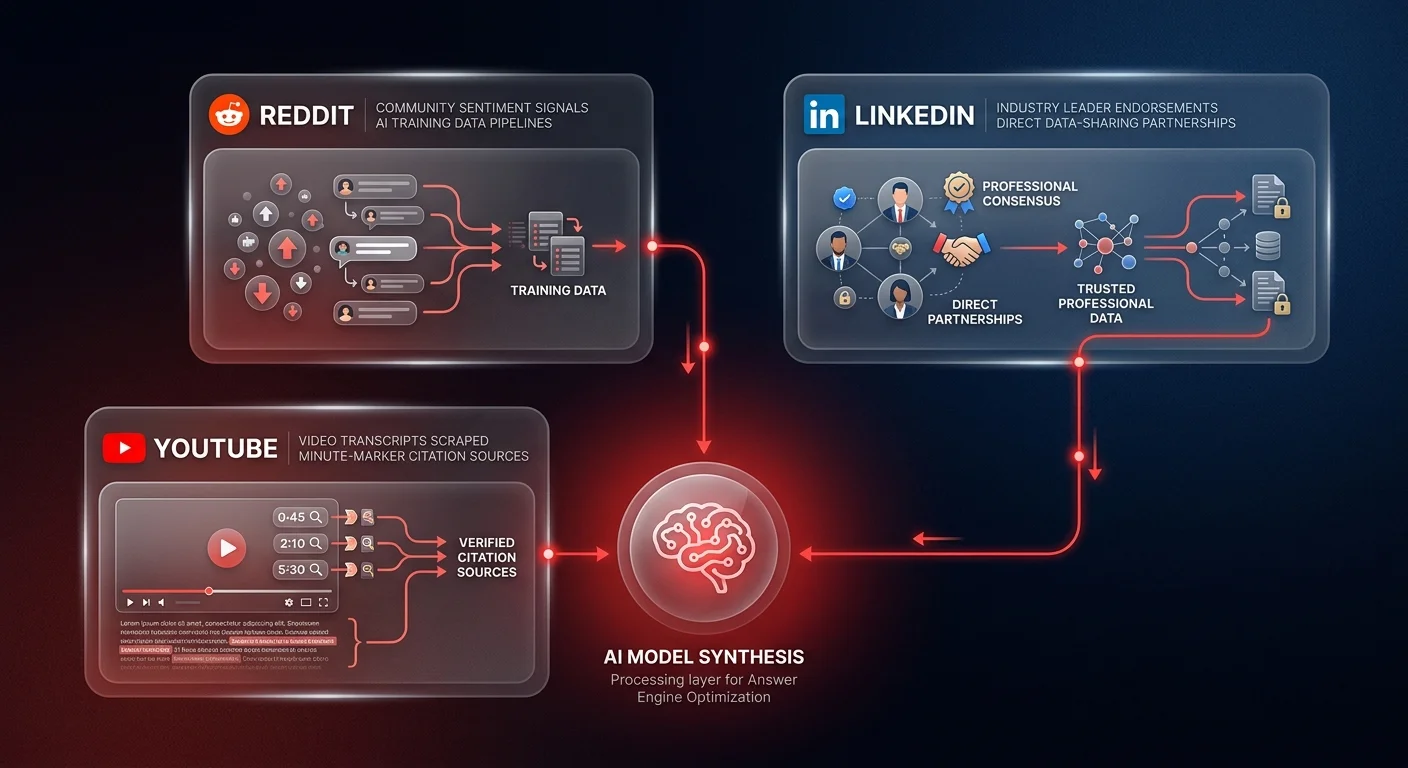
Reddit and LinkedIn have signed data-sharing partnerships with major AI developers, creating direct "pipes" of information that feed into the models. If users on Reddit are discussing your product's flaws or if industry leaders on LinkedIn are praising your innovation, those signals are ingested and synthesized by the AI. This means brand reputation management is now a technical requirement for AI visibility.
YouTube presents a unique opportunity for brand discovery. AI bots are effectively "watching" your videos by scraping transcripts and descriptions. In many AI responses, you will see citations that link to a specific minute-marker in a YouTube video where a particular fact was stated. This transforms YouTube into a primary citation source. For operations and marketing teams, this means the transcript of a video is just as important as the video's production value. If the transcript is clear, keyword-rich, and authoritative, it becomes a "mini-ad" within the AI's answer. Companies using video insights and podcast monitoring automation can systematically extract and repurpose these transcripts for maximum AI discoverability.
The attribution gap - measuring the invisible influence of AI search
One of the most significant challenges for leadership is the attribution gap. Only about 7% of traffic might come directly from an answer engine link, leading some to believe AEO is not worth the investment. However, when we survey prospects, we find that nearly 50% are using AI search during their evaluation process. More importantly, arriving via an AI search is currently the single biggest predictor of purchase intent.
This is a classic governance problem. Traditional analytics tools are designed to track human clicks, not bot influence. If a buyer spends twenty minutes chatting with Claude about their operational challenges and Claude repeatedly recommends your solution, that buyer may eventually go directly to your website and sign up. In your CRM, that looks like "Direct Traffic," but the actual driver was the AI.
Organizations that fail to account for this invisible influence will likely underfund their most effective discovery channel. To solve this, companies need to move away from manual tracking - which often involves employees manually typing prompts into ChatGPT and recording the results in spreadsheets - and toward automated monitoring systems. You need to know your "Brand Visibility Score" - the percentage of AI responses in which your brand appears for your target ICP (Ideal Customer Profile) prompts. Without this metric, you are flying blind in the most important search revolution of the decade. For a detailed look at the broader AI search landscape, see our guide to AI search visibility in ChatGPT and Claude.
Managing citation volatility in the answer engine optimization landscape
Unlike traditional search results, which can remain stable for months or years, AI citations are highly volatile. Our data indicates that a significant percentage of citations disappear or change within just one to six months. This "decay" happens because models are constantly being updated with new data, and their reasoning processes are refreshed.
This volatility creates a risk of "Shadow AI" discovery - where your brand might be recommended today but erased tomorrow because a competitor published a more specific blog post or gained more traction on Reddit. You cannot "set and forget" an AEO strategy. It requires an always-on approach to content refreshing and sentiment monitoring.
For many organizations, the sheer volume of data required to track visibility across multiple products, regions, and prompts is overwhelming. This is where the transition from manual labor to sovereign AI systems becomes necessary. By deploying focused, internal agent systems, companies can automate the process of querying LLMs, scoring brand sentiment, and identifying specific gaps in their content. See how teams are already using content trend discovery and market research automation to stay ahead of these shifts at scale.
Strategic implications for operations leaders
To capture the value of answer engine optimization, operations and marketing leaders must rethink their resource allocation. The old model of chasing broad keywords and high-volume traffic is yielding diminishing returns. The new model focuses on specificity, authority, and bot-readability.
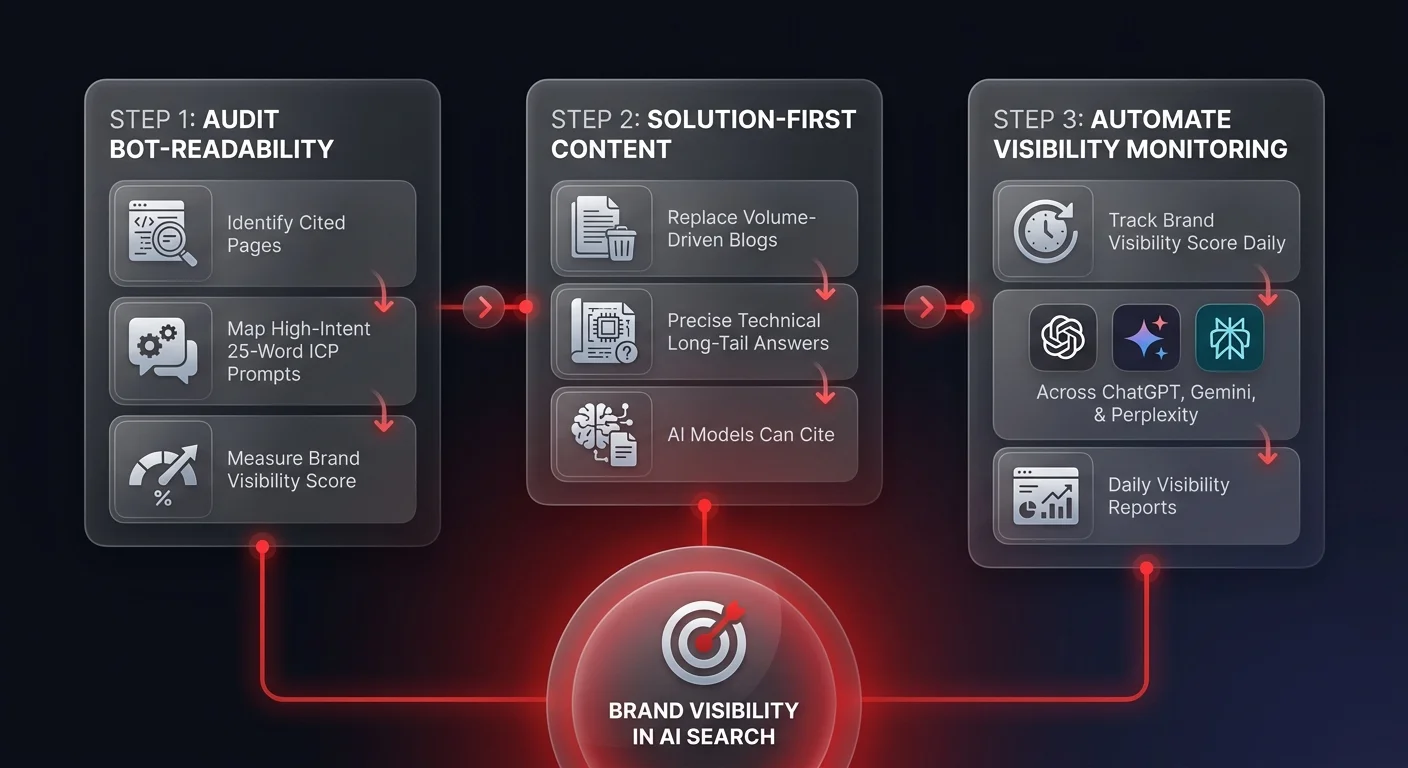
We recommend a three-step approach to securing your brand's future in AI search:
- Audit your bot-readability: Use specialized tools to determine which of your pages are currently being cited and why. Identify the high-intent prompts your customers are actually using and see if you appear in the results.
- Shift to a solution-first content model: Stop writing for the sake of volume. Every new blog post or video should be a precise answer to a technical, long-tail problem. Think of your content as a library of "solutions" that an AI can easily index and recommend.
- Automate visibility monitoring: The manual tracking of AI mentions is a waste of human capital. Implement automated workflows that track your brand visibility score and competitor share of voice across ChatGPT, Gemini, and Perplexity on a daily basis.
The volatility and lack of transparency in AI search engines make this a governance challenge as much as a marketing one. By treating your content as a structured data source for AI, you ensure that your brand remains visible, trusted, and recommended in the environments where your next customers are already looking for answers. The move from fragmented, ungoverned AI experiments to a centrally managed, sovereign approach to AEO is no longer optional - it is a strategic necessity for any organization looking to scale in the AI era.