
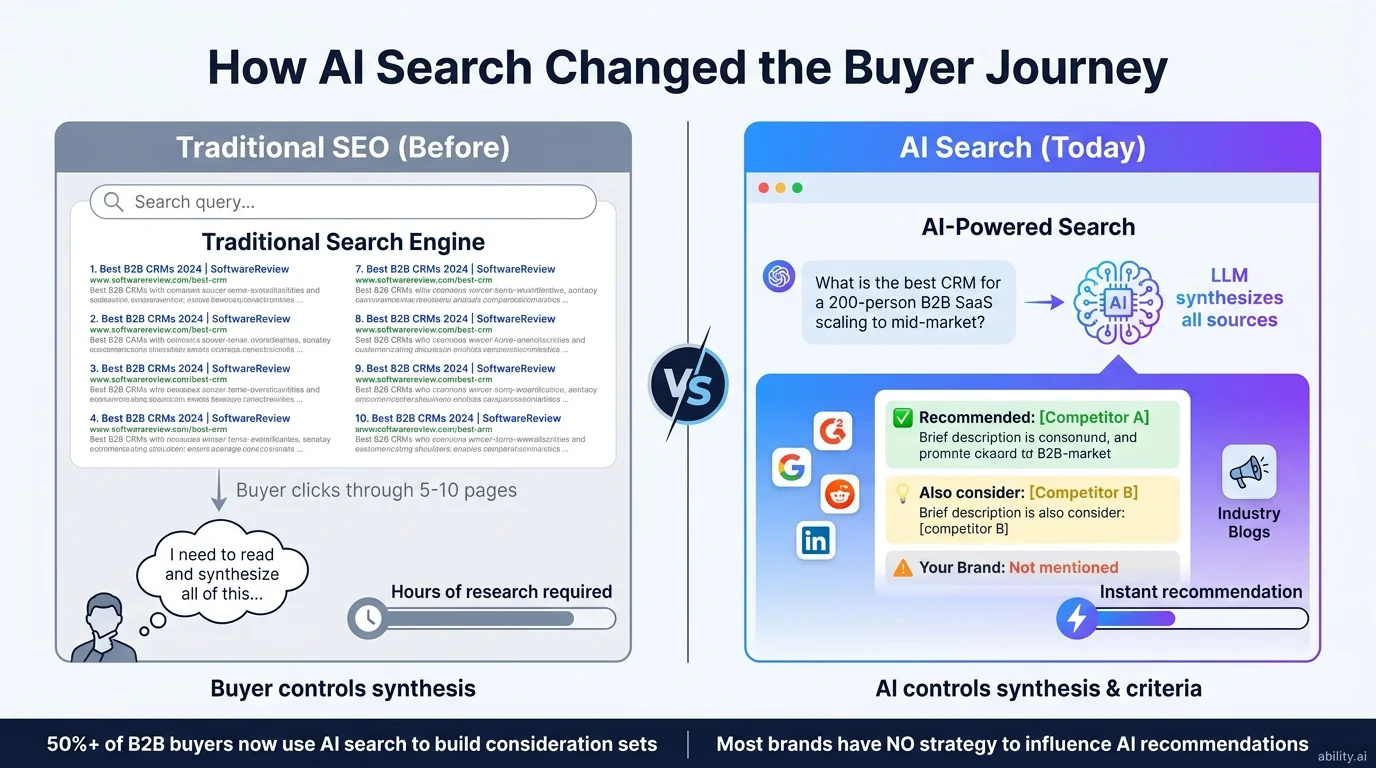
AI search visibility is the practice of optimizing your brand's presence across AI-powered search engines like ChatGPT, Claude, and Perplexity so they recommend your products and services. With over 50% of B2B buyers now using AI search to build consideration sets, mastering AI search visibility has become an urgent revenue imperative for mid-market companies.
Tools like ChatGPT, Claude, and Perplexity are actively telling your target customers to buy your competitors' products - and most operations and marketing leaders don't even know it's happening. Recent industry data reveals a critical tipping point: organizations that fail to manage their AI search presence are being systematically excluded from buyer consideration sets, regardless of product quality.
Through our research into how large language models (LLMs) evaluate and recommend B2B software and services, we have identified a clear framework for auditing and transforming how your brand is found across AI search engines. Here is a comprehensive breakdown of why your competitors are winning in ChatGPT and Claude, and the exact steps you can take to reclaim your narrative. If you are navigating the broader AEO vs SEO strategic shift, this guide provides the operational playbook to execute on it.
Why AI search visibility matters more than traditional SEO
Traditional search engines historically provided a list of ten links, leaving the buyer to click through, read, and synthesize the information. In this model, you controlled the narrative on your landing pages.
AI search has fundamentally changed this dynamic. Today, the AI is doing the synthesis, and more importantly, it is setting the evaluation criteria for your product category on your behalf.
Modern buyers are no longer typing short, disjointed keywords. They are using multi-sentence, highly contextual prompts to explain their exact business situations. A typical buyer prompt today looks like this: "What is the best CRM for a 200-person B2B SaaS company that is scaling from SMB to mid-market? We need something our sales and marketing teams can both use."
When this query is run through tools like ChatGPT or Claude, the AI provides a real, in-depth recommendation. Instead of immediately listing companies, the AI often sets the stage by defining the evaluation criteria - what the buyer should actually care about. If you are not actively shaping that criteria across the digital ecosystem, the AI will build a narrative for you, and it may not be accurate.
The positioning gap: why AI models mischaracterize products
One of the most alarming findings in our research is how drastically recommendations vary across different AI engines. A query run through ChatGPT will yield different results and reasoning than the exact same query run through Claude, Google Gemini, or Perplexity.
Consider a real-world scenario involving a major player like HubSpot. When evaluating marketing automation platforms, AI engines consistently recommend HubSpot as a top-tier choice. However, when the prompt shifts to customer service platforms - using a query like, "What are the best customer service platforms for a B2B company doing $50 million in revenue? We want AI-powered ticket resolution but don't want to rip out our whole stack" - the results change drastically.
Across multiple AI engines, competitors like Zendesk and Intercom dominate the top spots. The AI models consistently push the alternative product down the list, framing it as a mere CRM add-on rather than a standalone service platform. The AI cites the product for its ecosystem fit, not its service depth.
This highlights a critical lesson for operations and revenue leaders - this is a positioning problem, not a product problem. AI engines form their opinions based on digital consensus. If the internet talks about your product as an add-on, ChatGPT will recommend it as an add-on. This is closely related to the AI brand risk from low-quality content - what the internet says about you directly shapes what AI engines tell your buyers.
How LLMs build consensus and determine AI search visibility rankings
To change how you show up, you must understand where AI search engines get their answers. In traditional Google search, domain authority was largely driven by backlinks. In AI search, authority is driven by brand mentions, semantic relevance, and digital consensus.
When AI models scan online conversations, they look for a high density of brand mentions and authoritative context. Here are the primary data sources that dictate your AI search visibility:
Review platforms and contextual data
Sites like G2, Capterra, Trustpilot, and Google Reviews carry massive weight with AI engines. These platforms contain deep contextual information from real buyers. The AI reads these reviews to understand specific use cases, complaints, and benefits, using that data to inform its recommendations. If you are poorly categorized on G2, the AI will categorize you poorly in its answers.
Earned media and community forums
AI models index conversations happening on Reddit, LinkedIn, YouTube, and industry podcasts. If your brand is frequently mentioned as a solution to a specific problem in these forums, the AI learns to associate your company with that problem.
Domain authority and broken context
Your own website still matters, but in a different way. Publishing original research, creating interactive tools, and ensuring technical hygiene are critical. For example, if external sites link to your product pages but those links lead to 404 errors, an AI bot hits a dead end. It loses the context of what you do and simply moves on to your competitor.
<!-- INFOGRAPHIC: Pyramid diagram showing AI search visibility data sources ranked by influence - review platforms at the top, community forums in the middle, domain authority signals at the base -->A practical framework to improve your AI search visibility
If you want to transform how you are recommended across AI search engines, you cannot wait for the market to figure it out. You must proactively engineer your digital presence. Here is a step-by-step methodology to correct your AI positioning.
1. Conduct a comprehensive prompt audit
You need to know exactly how you are currently positioned. Ask ChatGPT or Claude to research your business and generate a list of the 10 most likely prompts your buyers are using.
Take those prompts and manually run them across ChatGPT, Claude, Perplexity, and Gemini. Document the results. Identify where you are missing, where you are mischaracterized, and which competitors are winning the top spots. Compile this into a gap analysis report for your executive team.
2. Reclaim your review platform narrative
Audit your listings on major review sites. Ensure your products are listed in the exact categories you want to be known for - whether that is "help desk software" or "AI customer service tools."
Launch targeted review campaigns to incentivize customers to leave detailed, use-case-specific reviews. Crucially, you must engage with and respond to every review. If a customer leaves a review with a misconception, your public response helps reframe that issue. The AI models read your responses too, giving you a chance to course-correct the narrative.
3. Publish strategic comparison content
AI models look for authoritative breakdowns of the competitive landscape. Publish dedicated comparison pages on your own high-authority domain - such as "Your Brand vs. Competitor." This signals directly to the LLMs exactly how your company views the market and how your features stack up, feeding the AI the exact talking points you want it to use. Organizations building AI-powered content systems can automate much of this competitive content production while maintaining quality through proper content governance checkpoints.
4. Build interactive domain assets
To build topic authority, go beyond standard blog posts. Develop free interactive tools - like a "cost of complexity calculator" or an "ROI assessment tool" - related to your specific niche. These assets naturally generate links and high-quality traffic, signaling to the AI that you are the definitive industry leader on that specific subject.
The operational reality of managing AI engine optimization
Understanding AEO is one thing; operationalizing it is another. For mid-market scaling companies, the sheer volume of data required to monitor and influence AI search visibility can quickly become overwhelming.
Tracking 10 to 20 complex buyer prompts across four different AI engines, parsing the sentiment of the responses, and identifying positioning gaps on a daily basis is a highly manual process. It is exactly the type of repetitive, data-heavy task that drains marketing and RevOps teams.
Organizations generally face two bad options to solve this - they either let employees use scattered, ungoverned shadow AI tools to manually scrape data, creating massive inconsistencies, or they hire expensive consultants for massive, slow digital transformation projects.
At Ability.ai, we view this challenge through a different operational lens. Monitoring competitive intelligence and AI search presence is a use case for autonomous AI agent systems. Using a solution-first model, organizations can deploy a specialized starter project - a fixed-scope, fixed-cost implementation that takes weeks, not months. See how Ability.ai built a content system that increased output 5x while maintaining the quality signals that drive AI search visibility.
Autonomous research agents can run your target prompts daily, scrape the AI responses, analyze the sentiment shifts, and deliver a unified dashboard of your AI search visibility. This approach eliminates manual tracking and provides real-time observability into how the market views your brand.
Securing your AI search visibility in the AI era
AI search engines are rewriting the rules of B2B discovery. The brands that win will be the ones that proactively manage their digital consensus, ensuring that every review, forum mention, and domain asset works together to feed the LLMs a unified, accurate narrative.
If you are not actively participating in how you show up in these AI engines, you are leaving your brand positioning entirely up to chance - and your buyers will inevitably be guided straight to your competitors. The time to audit your AI search visibility and build a governed, scalable strategy is right now.