
Closed loop AI systems are autonomous agent networks that continuously monitor, execute, and self-correct business operations by feeding real-time outcomes back into a central intelligence layer. Unlike traditional open-loop workflows where information degrades as it moves through organizational hierarchies, closed loop AI systems create a queryable organization where every action produces a data artifact — eliminating the human middleware that routes information slowly and expensively between teams.
The business world is currently fixated on AI as a simple productivity booster. We add copilots to existing workflows, hoping to squeeze out a few extra hours of efficiency for our teams while simultaneously battling the security risks of Shadow AI sprawl. But this framing entirely misses the true operational shift happening right now. The future of enterprise automation does not rely on fragmented chat interfaces. It relies on closed loop AI systems.
AI is not just going to change how quickly software gets built or what specific workflows get automated. It is going to fundamentally change the way companies are run — from what roles will exist on your organizational chart to what products are actually possible to build. The right person equipped with governed AI tools can now execute outcomes that used to require an entire department.
To achieve this level of exponential velocity, organizations must stop viewing AI as a tool and start treating it as the core operating system of the business. Here is how leading mid-market operations are replacing human middleware with intelligent systems.
Moving from lossy open loops to closed loop AI systems
If you have ever studied control systems, you understand the difference between an open loop and a closed loop system. In the old operational world, companies essentially ran as open loops. You made a decision, executed a process, and rarely had the infrastructure to systematically measure the exact outcome and adjust the process in real-time.
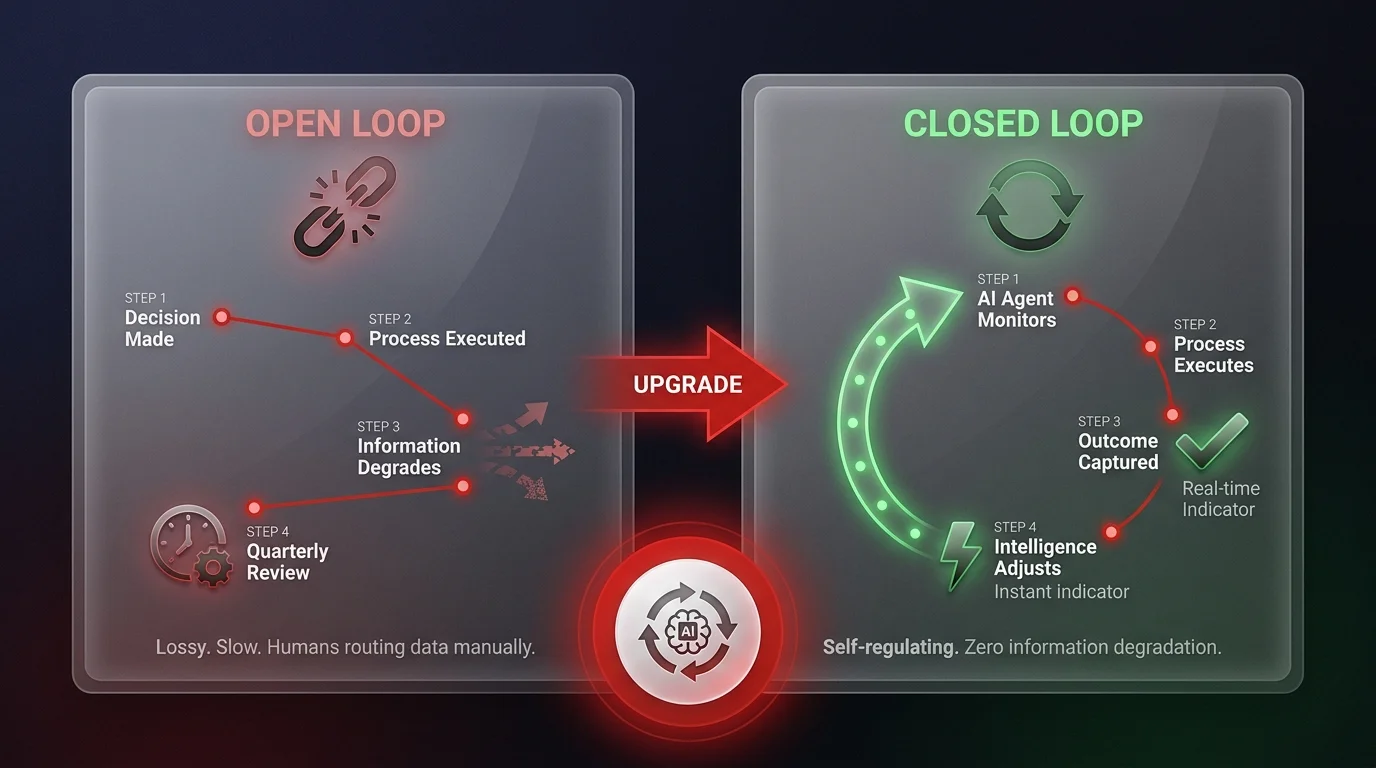
Open loops are inherently lossy. Information degrades as it moves through the company, and course correction happens slowly — usually during quarterly reviews or post-mortem meetings.
Closed loop AI systems, on the other hand, are self-regulating. Every important workflow, decision, and process flows through an intelligent layer that continuously monitors its output and adjusts its process to better meet the stated business goal. Status, decisions, and outcomes are continuously captured and fed back into this central intelligence layer. The result is a Sovereign AI Agent System that always has an up-to-date, real-time view of what is actually happening within your organization.
This challenge of ungoverned, siloed AI tools is closely related to the problem of shadow AI sprawl and coordination debt — where isolated AI agents fracture team alignment and compound operational overhead instead of resolving it.
Creating a queryable organization
To build these closed loops, you must make your entire company queryable. In other words, the whole organization must be legible to AI. Every important action should produce a data artifact that the intelligence at the center of your company can learn from and use to self-improve.
Historically, vital company context has been trapped in siloed SaaS applications or lost in fleeting direct messages. A queryable organization changes this default state. It means deploying AI note-takers for crucial meetings, minimizing fragmented Slack DMs, and using platforms like n8n to orchestrate data across your entire tech stack into centralized, agent-actionable dashboards.
Consider a concrete example in engineering management and sprint planning. An open loop requires an engineering manager to manually chase down updates, coordinate across teams, and roll up status reports that are often outdated the moment they are written.
Now, imagine an agentic closed loop. If you have an intelligent agent that has secure, governed access to your Linear tickets, engineering channels, customer feedback tools like Pylon, GitHub repositories, and daily standup transcripts, that agent can autonomously analyze what was actually shipped in the previous sprint. It can measure how well those shipments met real customer needs. With full visibility into what worked and what failed, the agent can then look ahead and propose sprint plans that are highly predictable and accurate.
The days of lossy status rollups are gone. Teams implementing this level of operational observability have cut their sprint times in half while getting significantly more done. The overarching principle is clear — to extract the full capabilities of AI, you must provide your models with as much context as you would provide a senior employee.
<!-- INFOGRAPHIC: Diagram showing open loop vs closed loop AI system comparison: open loop has linear flow with information loss at each step, closed loop shows continuous feedback cycle with real-time adjustment and zero information degradation -->The rise of AI software factories
There is a new paradigm emerging for how the highest velocity companies build products — the AI software factory. If you are familiar with test-driven development, this is the next logical evolution.
In an AI software factory, human operators write a detailed specification and a set of tests that define successful execution. Then, AI agents generate the implementation and the code, iterating autonomously until the tests pass. The human defines what to build and judges the final output; the actual execution is the agent's job.
Some forward-thinking organizations have already pushed this methodology to its limits. StrongDM's AI team serves as a perfect example of this shift. Their ultimate goal was to build a system that essentially eliminated the need for a human to write or review code manually. They built an internal software factory where specs and scenario-based validations drive agents to write tests and iterate on code until it meets a strict probabilistic satisfaction threshold.
And it works. Their repositories contain virtually no handwritten code — only specifications and test harnesses. This is how organizations are currently achieving the mythical "1,000x operator" — by surrounding a single skilled employee with a system of agents that enables them to build things they would have never been able to build before. For a deeper look at how these agent systems are being structured, see our breakdown of autonomous AI agents as digital employees — which covers how sovereign agent systems replicate the function of entire departments.
Token-maxing and the death of human middleware
One massive implication of building your company this way — with AI loops everywhere, a queryable organization, and software factories — is that the classic management hierarchy no longer makes sense.
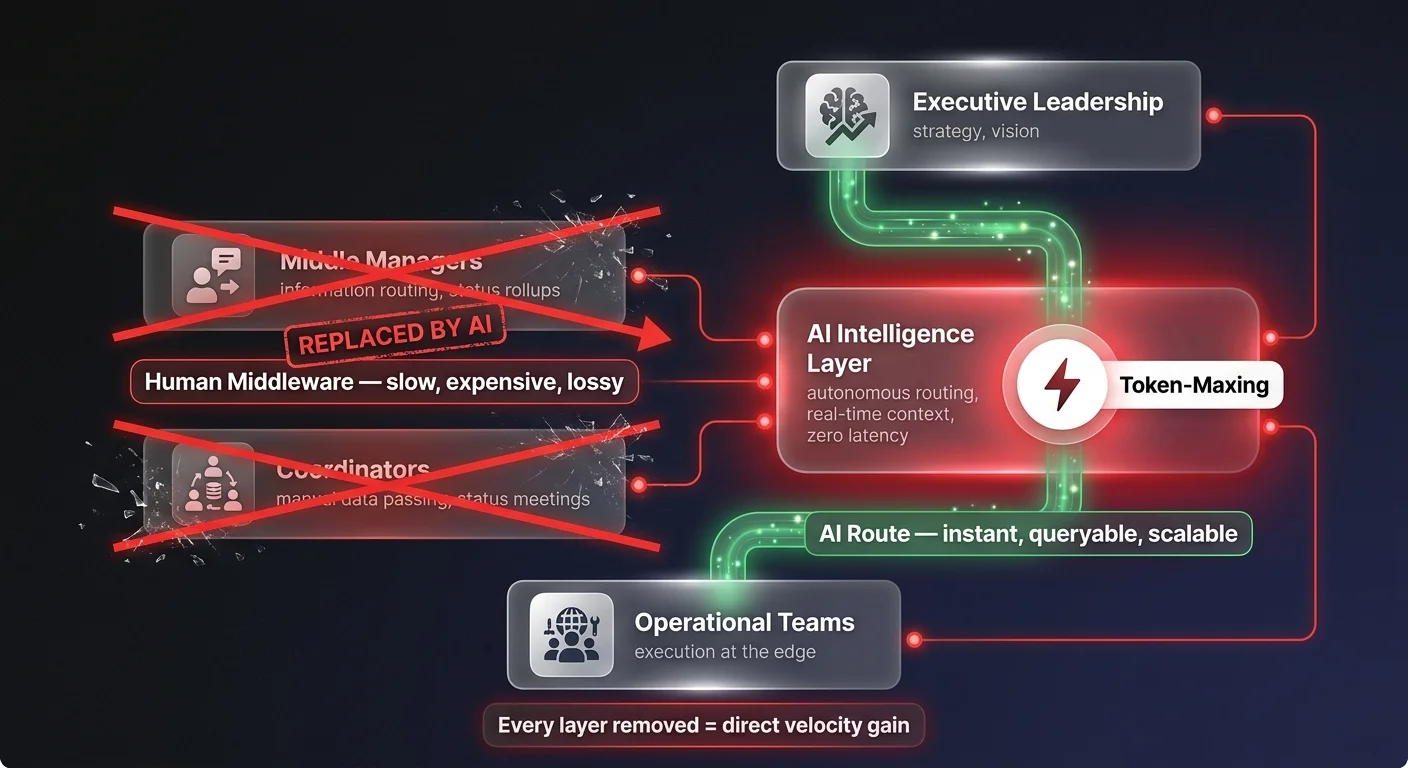
In the old world, companies needed middle managers and coordinators to route information inefficiently up and down the organizational chart. In the new world, the AI intelligence layer serves that exact purpose. If your company is artifact-rich and legible to an AI system, you should have almost no human middleware. Your company's velocity is only as fast as its information flow, meaning every layer of human routing you can safely remove translates to a direct speed gain.
Jack Dorsey's recent restructuring at Block provides a compelling look at this future. After diving deep into AI capabilities, his view is that keeping the same organizational chart and management structure guarantees you will miss this technological shift entirely. The company itself must be rebuilt as an intelligence layer with humans at the edge guiding it, rather than humans routing information through the middle.
This shift demands a new mindset for operational leaders — prioritizing token-maxing over headcount. You should be entirely willing to run an uncomfortably high API bill because those compute tokens are systematically replacing what would have taken a far more expensive, slower, and inflated headcount across engineering, design, HR, and administration.
The incumbent dilemma: adapting without breaking
If you are an early-stage founder, you have a massive advantage. You do not have legacy systems, entrenched organizational charts, or thousands of people to retrain. You can build closed loop AI systems from day one.
However, scaling mid-market companies and established enterprises face a distinct dilemma. They have to maintain and grow a live product while simultaneously unwinding years of standard operating procedures. For most mid-market organizations, making sudden changes to core processes risks breaking systems that are currently driving revenue.
Because of this constraint, large companies have a much harder time going AI-native. But there is a proven playbook for incumbents. Organizations like Mutiny have successfully navigated this by spinning up small, internal skunkworks teams. These specialized units build AI-native systems from scratch, separate from the core business, proving the value before integrating it into wider operations.
This is exactly why our operations automation solutions follow a Solution-First model through focused Starter Projects. Rather than engaging in massive, slow consulting overhauls that threaten your existing operations, mid-market companies can deploy a focused, fixed-scope Sovereign AI Agent System in a matter of weeks — acting as an outsourced skunkworks team that builds a governed, closed loop intelligence layer alongside your existing business to prove immediate ROI and operational velocity.
<!-- INFOGRAPHIC: Skunkworks approach diagram showing incumbent company running parallel track: existing business on left, AI-native closed loop system being built separately on right, then integration arrow connecting them after proof of value -->Building your intelligence layer
You cannot outsource your conviction on the power of these tools. Operations leaders must develop this conviction themselves by actively testing and deploying agentic systems until it breaks their own assumptions about what is now possible.
The transition from open loops and shadow AI sprawl to governed, closed loop AI systems is not just a technical upgrade — it is a fundamental reimagining of enterprise architecture. By making your organization queryable, eliminating human middleware, and embracing token-maxing, you position your company to operate at a velocity that incumbents relying on traditional management hierarchies simply cannot match. The technology is ready. The only question is whether your operational structure is prepared to leverage it.