
Autonomous AI agents are self-directed digital employees that execute complex, multi-step workflows without requiring constant human intervention - accepting an initial objective and the necessary raw materials, then independently planning, researching, and producing a finalized output entirely on their own. Organizations deploying these agents are collapsing workflows that once took human teams several days into automated sequences completed in minutes.
The business landscape is experiencing a fundamental shift in how organizations interact with artificial intelligence. For operations leaders, the emergence of autonomous AI agents represents a critical inflection point. We are rapidly moving away from standard conversational interfaces that require constant human prompting, toward sophisticated systems that function as actual digital employees. These agents are designed to execute complex, multi-step workflows entirely on their own, shifting the corporate focus from AI experimentation to reliable operational systems.
Recent industry testing and implementation of advanced platforms, such as Manus AI, reveal exactly how these systems operate in real-world scenarios. By moving beyond the limitations of single-prompt interactions, autonomous systems are fundamentally changing how businesses approach scaling their workforce and managing operational output.
The evolution from chat interfaces to autonomous AI agents
When we look at standard tools like ChatGPT or Claude, the operational paradigm is inherently limited by human bottlenecks. The human operator must act as the project manager - issuing a prompt, reviewing the output, copying the text into a different software application, issuing a secondary prompt for a new step, and manually piecing together the final deliverable.
The defining characteristic of an autonomous AI agent is its ability to act as a self-directed digital employee. Instead of requiring continuous human intervention at every sub-step, an agent requires only the initial objective and the necessary raw materials. Once deployed, the agent formulates its own plan, executes the necessary research, manipulates files, and produces a finalized asset.
This shift is not just a technological upgrade - it is an operational overhaul. It allows scaling companies to view AI not merely as a brainstorming assistant, but as a mechanism for executing end-to-end business outcomes. For a broader framework on governing these agents at scale, see our guide to autonomous AI agents governance.
Anatomy of an autonomous marketing workflow
To understand the practical application of these digital employees, we can examine a highly effective marketing use case: the automated creation of lead generation assets. In modern sales and marketing, repurposing content is a time-intensive burden that traditionally requires coordination between content writers, researchers, and graphic designers.
In a recent implementation analyzing agent capabilities, an autonomous system was tasked with creating a comprehensive PDF lead magnet based on existing content. The input provided to the digital employee was minimal:
- A link to a YouTube video discussing seven different AI agent tools
- A corporate logo file
- A specific set of brand colors and guidelines
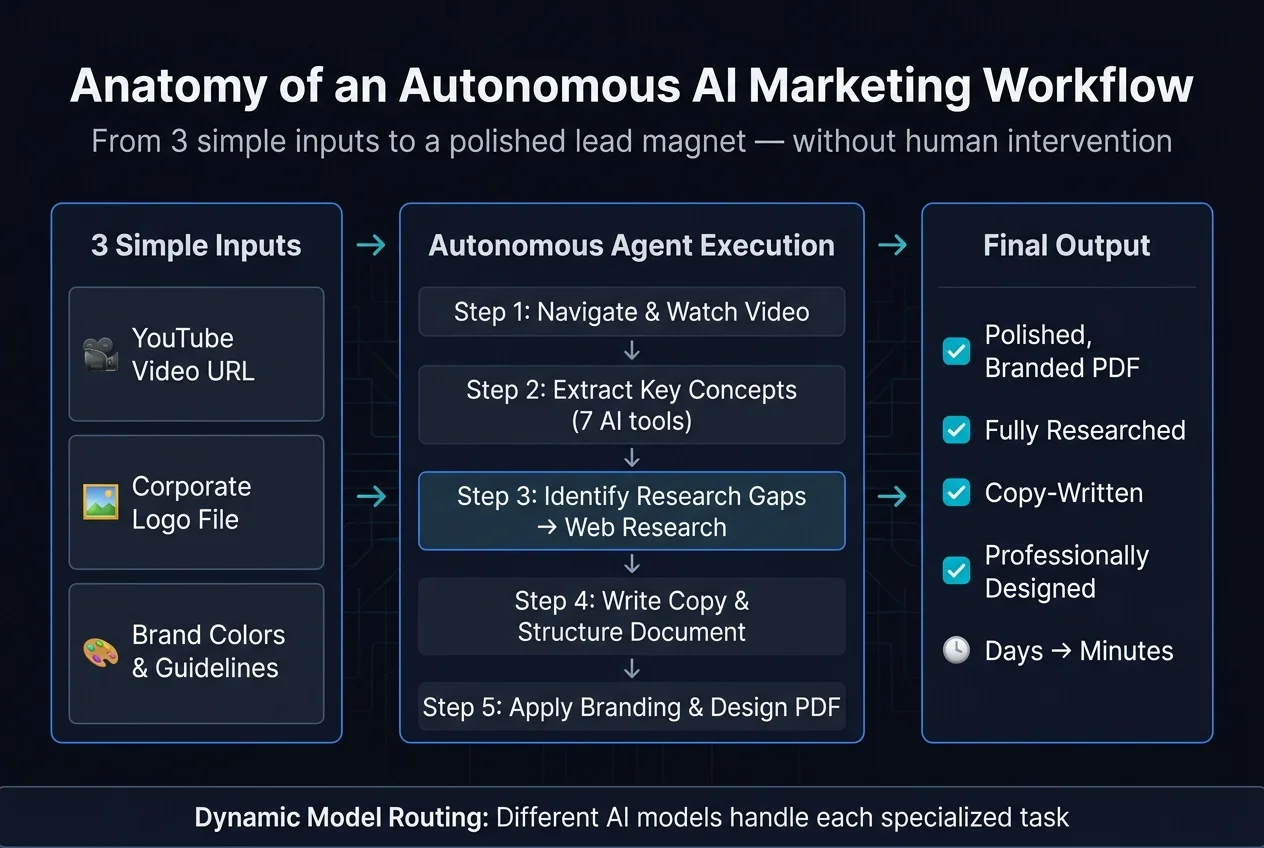
From these three simple inputs, the agent autonomously executed a sequence that would typically take a human team several days to complete. The system navigated to YouTube, watched and analyzed the video, and extracted the core concepts surrounding the seven AI tools. It then developed the necessary copywriting for the PDF, structuring the document logically. Finally, it acted as a designer, applying the uploaded logo and brand colors to format a highly polished, publishable PDF document.
This is the power of a digital employee - the human operator simply set the parameters and stepped back, allowing the agent to manage the entire lifecycle of the task. Operations teams looking to deploy similar autonomous workflows can explore how Ability AI builds governed AI automation for marketing and sales teams.
Dynamic model routing in practice
One of the most critical technical capabilities enabling these autonomous workflows is dynamic model routing. Not all artificial intelligence models are created equal. Some excel at natural language processing, others are optimized for deep internet research, and some are specifically designed for visual formatting and coding.
When the digital employee executes a complex workflow like the PDF creation example, it does not rely on a single, monolithic model. Instead, it intelligently switches between different underlying models depending on whatever task is currently relevant.
For example, while processing the video, the agent might route the task to a model highly specialized in transcription and summarization. But the agent does not stop at mere extraction. In our test case, the agent noticed that the video only provided surface-level information about the seven tools. Recognizing a gap in the data, it autonomously formulated a plan to conduct external web research. It routed this new task to a research-specific model to gather additional context, ultimately blending the video transcript data with its own independent research to create a more comprehensive final document.
This multi-model orchestration is exactly what makes AI agent harnesses so much more capable than raw LLMs - the agent deploys a coordinated suite of specialized tools rather than a single model working in isolation.
Turning ad-hoc tasks into reusable corporate skills
For COOs and VPs of Operations, the true value of automation lies in scalability. A successful one-off AI experiment is interesting, but an easily repeatable process drives bottom-line growth.
Advanced autonomous systems bridge this gap through the creation of reusable automation assets. In the Manus AI environment, this is known as a "Skill Creator." Once the agent successfully completed the complex process of researching a topic, writing the copy, and designing the branded PDF, the human operator could issue a simple command: turn this process into a skill.
By packaging this orchestration into a reusable skill, the organization transforms a complex multi-step workflow into a single-click template. The next time the marketing team needs to research a new topic and generate a branded report, they do not need to rebuild the prompt or explain the design parameters. They simply select the saved skill from their library, type in the new topic, and the digital employee goes off and generates the entire report autonomously.
This concept aligns directly with the need for organizations to package complex orchestrations into simple, deployable assets that non-technical business leaders can use reliably.
The governance gap in autonomous execution
While the operational efficiency of autonomous agents is undeniable, deploying digital employees introduces significant leadership and governance challenges. When an agent is dynamically routing tasks, scraping external web data, processing corporate logos, and generating files on its own, it creates a massive blind spot for IT and operations leaders.
Ungoverned AI tools are actively creating operational complexity and security risks across the mid-market sector. If a digital employee is performing external web research, what data is it feeding back into public models? If it fails during a multi-step design process, how does a human operator trace the logic to understand where the breakdown occurred?
This is where data sovereignty and observable logic become non-negotiable. Organizations cannot afford to let digital employees run amok with corporate assets in a black-box environment. To safely deploy these agents, companies must utilize governed agent infrastructure. Every autonomous action - from the websites the agent chooses to research, to the models it dynamically routes data through - must be observable, auditable, and strictly confined within the organization's sovereign data perimeter. For a deeper analysis of the risks that emerge as agent deployments scale, see our guide to agentic AI risks and governance challenges.
Operationalizing AI for sustainable growth
The transition from standard AI chat interfaces to autonomous digital employees is an operational inevitability. The ability to hand off a URL and a brand kit, and receive a fully researched, copy-written, and designed lead magnet in return, completely changes the economics of content creation and operational output.
However, the organizations that will truly benefit from this shift are those that view these agents through an operational lens. Success requires moving beyond isolated, ungoverned AI experiments and focusing on building robust skill libraries and workflow templates. By pairing the sheer power of autonomous execution with strict governance, data sovereignty, and observable logic, operations leaders can safely transform manual, time-intensive burdens into automated, scalable engines for business growth.