
Enterprise AI agents are autonomous software systems that execute business processes end-to-end—handling tasks from accounts receivable collection to customer reference checks—but create a critical governance challenge when deployed without observable logic, data sovereignty controls, and predictable pricing frameworks. The "intern problem" describes the operational chaos that emerges when dozens of ungoverned agents run independently, demanding constant supervision instead of delivering autonomous efficiency.
Enterprise AI agents are rapidly moving from experimental novelties to core operational requirements for mid-market and scaling companies. But as organizations rush to deploy these technologies, operations leaders are colliding with a new, unexpected bottleneck. The promise of autonomous work is being overshadowed by a lack of operational governance, unpredictable pricing models, and a phenomenon best described as the "intern problem."
To successfully deploy enterprise AI agents that drive specific business outcomes, organizations must fundamentally rethink how they view software, process categorization, and trust. The transition from passive software to active agents requires more than just new tools — it demands a governed infrastructure built on observable logic.
The evolution of the enterprise filing cabinet
To understand the current shift in enterprise technology, we must look at the historical trajectory of business software. From 1960 until roughly 2022, the entire history of software was defined by a single objective: turning a physical filing cabinet into a static database.
This began in 1960 with Sabre Systems, an early database built by IBM to replace the vaults of paper filing cabinets managed by airline secretaries. It continued with MUMPS for electronic health records at Mass General Hospital, and Act Systems in 1987, which pioneered the modern CRM. For decades, every functional area of a business took its paper records and digitized them.
While this digitization allowed for complex data joins and remote collaboration, it did not fundamentally change the nature of the work. If you needed an employee's file, a human still had to retrieve it — they just clicked a button in Workday instead of opening a metal drawer. Software was largely a passive system of record.
The critical shift happening today is that the filing cabinet can now do the work.
Instead of a human logging into an accounting platform to find an overdue invoice and manually sending an email, systems like QuickBooks can be empowered to actively collect accounts receivable. Instead of an HR representative using a database to find a candidate's previous employers, the system itself can call those companies to conduct reference checks. This transition from static storage to dynamic execution represents the highest value opportunity in modern operations.
Why core software survives the vibe coding threat
As AI capabilities expand, a narrative has emerged suggesting an impending SaaS apocalypse driven by AI agents. The theory posits that business users will simply use AI to "vibe code" — using natural language to generate their own custom applications — rendering traditional enterprise software obsolete.
This perspective fundamentally misunderstands what enterprise software actually does. Core enterprise platforms are not merely databases; they are the codification of decades of edge cases, compliance requirements, and governance rules.
Consider a complex HR system. You could theoretically use AI to write a basic employee database in an afternoon. But what happens when an employee in Indiana goes on maternity leave? What are the specific state tax implications, healthcare compliance mandates, and labor law requirements? Traditional systems of record hold their value because they have learned and embedded these non-deterministic rules over decades of real-world friction.
Drawing on the 1817 economic theory of comparative advantage by David Ricardo, just because you can build your own tools doesn't mean it is an efficient use of your resources. You could farm your own food or weld your own aluminum, but it is vastly more efficient to rely on established systems.
However, there is massive operational value in using AI for extensibility. While you shouldn't rebuild your core HR platform, you can use AI to build highly specific, governed edge-cases on top of it — such as a custom meeting room booking application for a remote Miami office that integrates specific local HR policies. The future is not replacing the system of record; it is deploying sovereign enterprise AI agents that execute specialized tasks while securely tethered to your governed data.
Input versus output: a framework for operational processes
To deploy enterprise AI agents effectively, COOs and operational leaders must categorize their business processes correctly. Every business is essentially a collection of coordinated processes, which generally fall into two categories: input-constrained and output-constrained.
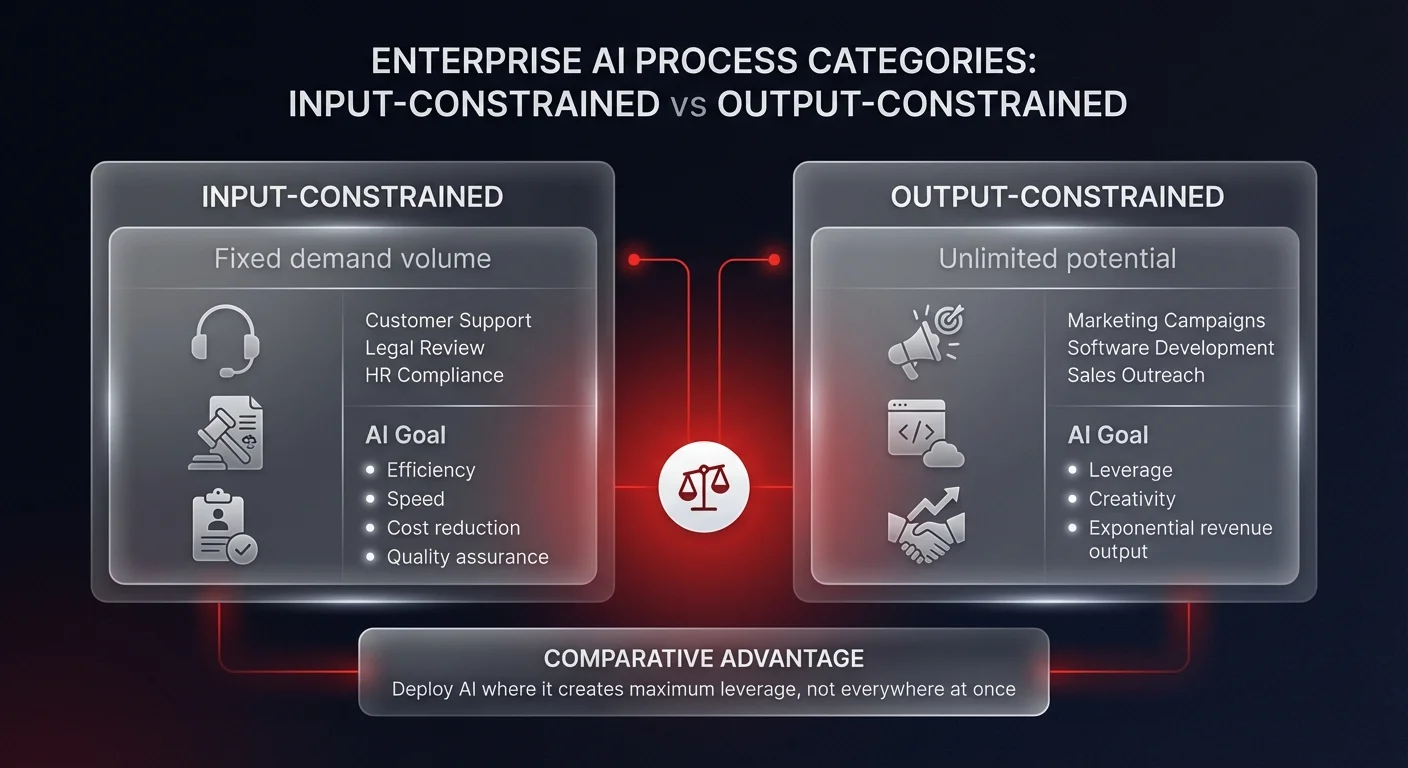
Input-constrained processes have a fixed volume of demand. Customer support and legal review are prime examples. A company has a specific number of leases to review or a finite number of customer support tickets generated per day. If you process these 10 times faster, you do not magically receive 10 times more customer complaints. For input-constrained processes, the operational goal of AI is efficiency, speed, cost reduction, and quality assurance.
Output-constrained processes have virtually unlimited potential. Marketing, software development, and sales outreach fall into this bucket. You can theoretically write an infinite number of tailored marketing campaigns or code an infinite number of new features. For these processes, the operational goal of AI is leverage and creativity. You take the efficiency gains and reinvest them into producing exponentially more output to drive revenue.
Understanding this distinction is critical for establishing ROI expectations and defining the observable logic your AI agents will follow.
Enterprise AI agents and the intern problem: when autonomy creates chaos
As companies begin deploying multiple agents across these processes, they quickly run into a severe management bottleneck. Give a user access to an ungoverned agent with unlimited power, and the result is often operational paralysis.
When organizations deploy dozens of fragmented, autonomous enterprise AI agents across different departments, they create what industry experts call the "intern problem." The agentic AI governance challenges this creates are significant — and they compound quickly as deployments scale.
Having 50 AI agents running independently is exactly like hiring 50 eager interns. The benefit is that a massive amount of work gets processed. The critical flaw is that 50 interns will ask you 50 questions a minute. They lack context, require constant direction, and demand endless supervision. Instead of doing your job, your entire day becomes consumed by managing the fragmented outputs of your autonomous tools.
Furthermore, this sprawl creates a severe trust deficit. Users inherently distrust "black box" AI systems that execute tasks too quickly without explanation. If an AI agent claims it just processed and cleared your entire inbox, the immediate human reaction is panic — what did it say, who did it email, and did it delete something important?
To build trust, agents require a "human-in-the-loop" design, pausing to say, "Here is what I plan to do, do you approve?" However, if an agent asks for approval on every micro-task, it becomes an annoying bottleneck. Finding the exact right balance of autonomy and oversight is the defining governance challenge of this new era.
Restoring trust through governed infrastructure
Solving the intern problem requires moving away from fragmented, ungoverned AI tools toward a unified, observable AI agent infrastructure. Operations leaders must demand systems where data sovereignty is protected and decision-making logic is transparent. Establishing clear agent reliability and governance metrics is the first step toward building that trust with stakeholders.
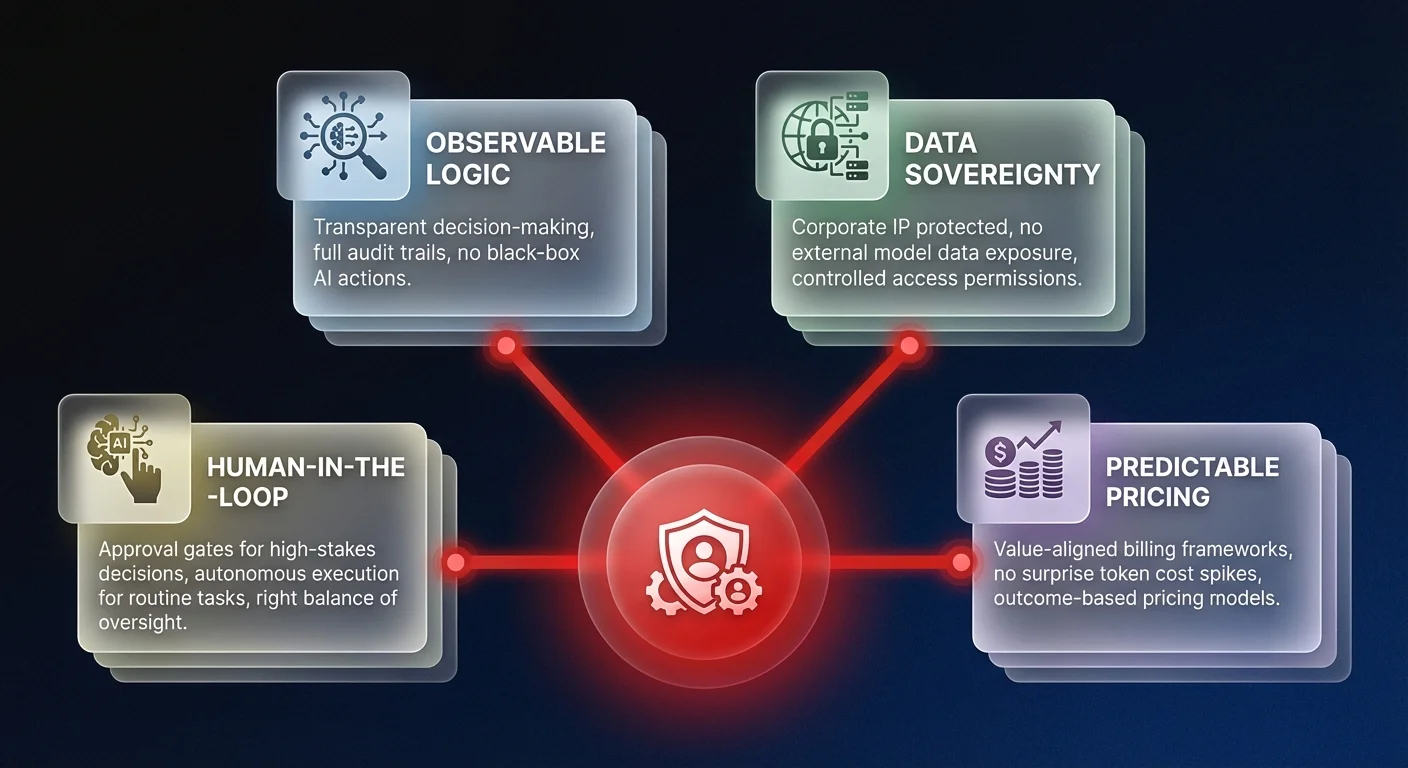
This also extends to the commercial realities of AI deployment. The market is currently flooded with "casino chip" pricing models — consumption-based token systems that are entirely unpredictable. Operations leaders despise billing models where costs can 10x overnight because a vendor added a new background feature that consumed more tokens without the customer's explicit consent.
Enterprise AI must be built on predictable, value-aligned frameworks. Whether tied to specific business outcomes or fixed operational capacities, the pricing and the performance must be as reliable as the legacy software it augments.
The most successful organizations over the next decade will not be the ones that run the most AI experiments. They will be the companies that successfully corral their AI initiatives into secure, governed systems. By replacing black-box magic with observable logic, operations leaders can finally turn their static systems of record into dynamic engines of execution — without the chaos of managing fifty digital interns.
Explore how Ability AI's operations automation solutions help mid-market companies solve the intern problem with governed, observable AI infrastructure. For organizations managing complex HR and recruiting workflows, Ability AI's HR and recruiting automation delivers the reliable agent behavior that transforms fragmented AI experiments into dependable operational systems.