
The SaaS apocalypse is the accelerating disruption of traditional subscription software as AI agents replace passive databases with active systems that execute work autonomously—handling customer support, collecting receivables, and auditing records without human intervention. For mid-market companies, the shift from systems of record to systems of action is the greatest operational leverage opportunity in modern business history, but it requires governed AI infrastructure to capture safely.
At Ability AI, we help mid-market companies navigate the transition from bloated SaaS stacks to governed AI agent systems that deliver real business outcomes. The technology industry is currently facing a reckoning, widely referred to as the SaaS apocalypse. For decades, businesses have accumulated massive software subscriptions, building complex technology stacks that ultimately still rely on human labor to function. Today, operations leaders are realizing that providing employees with raw AI tools and bloated software seats is no longer a viable path to efficiency.
We have reached a critical inflection point in enterprise technology. The foundational models powering artificial intelligence are far ahead of the actual business value they are delivering. To survive this transition, organizations must move beyond ungoverned chat interfaces and static databases, shifting toward sovereign AI agent systems that actually execute work.
Here is a comprehensive look at why traditional software models are under threat, the dangers of ungoverned natural language programming, and how forward-thinking leaders are navigating the shift to agentic operations.
The widening AI value gap: unlimited power, trivial execution
There is a well-documented phenomenon occurring across the mid-market and enterprise sectors: the utilization gap. If you give a workforce an AI chatbot with virtually unlimited computational power and reasoning capabilities, a significant percentage of users will simply ask it to write a polite email or tell a dad joke.
In the technology world, the underutilized capabilities of these foundational models are staggering. It has become almost trite to say that AI models are advancing faster than our ability to extract value from them, but the operational reality of this gap is costing companies millions in lost productivity and wasted licensing fees.
Operations leaders are discovering that raw access to a large language model does not equal operational efficiency. When companies deploy ungoverned, consumer-grade AI tools to their workforce, they are effectively distributing blank canvases to employees who are not trained prompt engineers. The result is isolated productivity gains, inconsistent outputs, and zero systemic improvement to core business processes.
To bridge this value gap, organizations must stop viewing AI as an individual productivity tool and start architecting it as a governed operational system. Businesses do not need more raw chat capabilities — they need engineered, observable outcomes tied directly to revenue, customer support, and operational KPIs.
From digital filing cabinets to active workers
To understand the magnitude of the SaaS apocalypse, we must look at the history of enterprise technology. From 1960 until 2022, the entire trajectory of software development followed a singular, predictable path: taking a physical filing cabinet and turning it into a database.
Customer relationship management platforms, enterprise resource planning systems, and project management tools are, at their core, highly sophisticated digital filing cabinets. They require human beings to input data, update statuses, pull reports, and execute the actual work based on the information stored within them.
The true revolution happening in AI today is not about better data storage or predictive analytics — it is the fact that the filing cabinet can now do the work.
We are shifting from systems of record to systems of action. Instead of a human logging into a SaaS platform to review a customer complaint, cross-reference an internal knowledge base, and draft a response, an AI agent system can independently monitor the inbound queue, synthesize the correct operational logic, draft the resolution, and execute the final action.
This paradigm shift threatens the foundational business model of traditional SaaS. When the software itself becomes the laborer, charging per-seat licenses for human operators becomes an obsolete pricing model. Companies are waking up to the reality that they have been paying premiums for software that merely holds data, while they simultaneously pay human employees to bridge the gaps between those disparate systems. We examine this disruption to seat-based licensing in detail in The outcome economy: why AI is killing the seat-based business model.
| Dimension | Systems of record (traditional SaaS) | Systems of action (AI agents) | |-----------|--------------------------------------|-------------------------------| | Core function | Store and display data | Execute tasks autonomously | | Human role | Operator — reviews data, takes action | Supervisor — sets goals, audits results | | Pricing model | Per-seat license | Outcome-based or infrastructure | | Data usage | Passive: data is read and presented | Active: data triggers automated decisions | | Speed | Constrained by human review cycles | Continuous, 24/7 execution | | Failure mode | Human error, slow response | Logic errors, ungoverned scope creep | | Value at risk | High — agents replicate the human layer | Low — agents need governed infrastructure |
Vibe coding: the terrifying reality of ungoverned automation
As natural language processing improves, a new concept has emerged in the developer and operational space: "vibe coding." This refers to the ability of non-technical users to build workflows, scripts, and basic applications simply by describing what they want to an AI model.
While the extensibility of software through natural language is an incredible technological leap, the idea of an individual employee vibe coding their own workday is terrifying from an operational and security perspective.
Consider the implications for a scaling company. If a mid-level sales manager uses an ungoverned AI tool to string together a custom, undocumented workflow that pulls customer data from your CRM, processes it through an external foundational model, and pushes it to a third-party email client — you no longer have a standardized sales process. You have shadow AI.
The shadow AI governance crisis
When employees build their own idiosyncratic automated workflows, it creates a massive operational liability. When that employee leaves, their custom vibe-coded system breaks. Furthermore, these ungoverned integrations operate outside the purview of IT and operations, creating severe data sovereignty and compliance risks.
Scaling companies ($5M to $250M in revenue) cannot afford to run their operations on a fragile web of localized, employee-generated code. While the internal gains of software extensibility are real, they must be implemented through governed infrastructure. Operations leaders need systems where the logic is observable, the data remains sovereign, and the automation aligns with corporate security protocols. For a real-world look at how ungoverned agents create security incidents, see The 11GB nightmare: when desktop AI agents go rogue.
Navigating the SaaS apocalypse: why static software is dying
There is currently an abundance of fear and speculation regarding the SaaS apocalypse — sometimes referred to as the SaaS catastrophe. Industry analysts are questioning whether the traditional software subscription model can survive the decade.
The reality is more nuanced, but the threat is legitimate. Not every SaaS company is going to thrive for the next ten years. We are not here to defend all of software, because much of it has become bloated, disconnected, and fundamentally inefficient.
The companies that will suffer during this transition are those that provide thin layers of workflow management without actively executing tasks. If a software platform merely acts as a dashboard for human work, its value proposition is rapidly approaching zero.
Conversely, organizations that consume software must aggressively audit their technology stacks. Operations leaders should be asking a critical question of every vendor: does this software require my team to do the work, or does the software do the work for my team?
| SaaS category | Disruption risk | Why | |--------------|----------------|-----| | Workflow dashboards (basic PM, task tracking) | High | Pure UI layer — AI agents replicate the workflow without the seat cost | | Simple integration middleware | High | Agents handle native integrations via MCP and A2A protocols | | Basic CRM (contact/deal tracking) | Medium-High | Data entry automated; AI agents execute pipeline actions directly | | Marketing automation (email sequences) | Medium | Agent-run; platforms with compliance logic and audience data retain value | | Finance and accounting (ERP core) | Low-Medium | Decades of compliance rules and edge cases create durable AI moat | | Vertical SaaS (healthcare, legal, construction) | Low | Deep domain regulation and industry-specific workflows require specialized logic |
Building a governed operational system for the agentic era
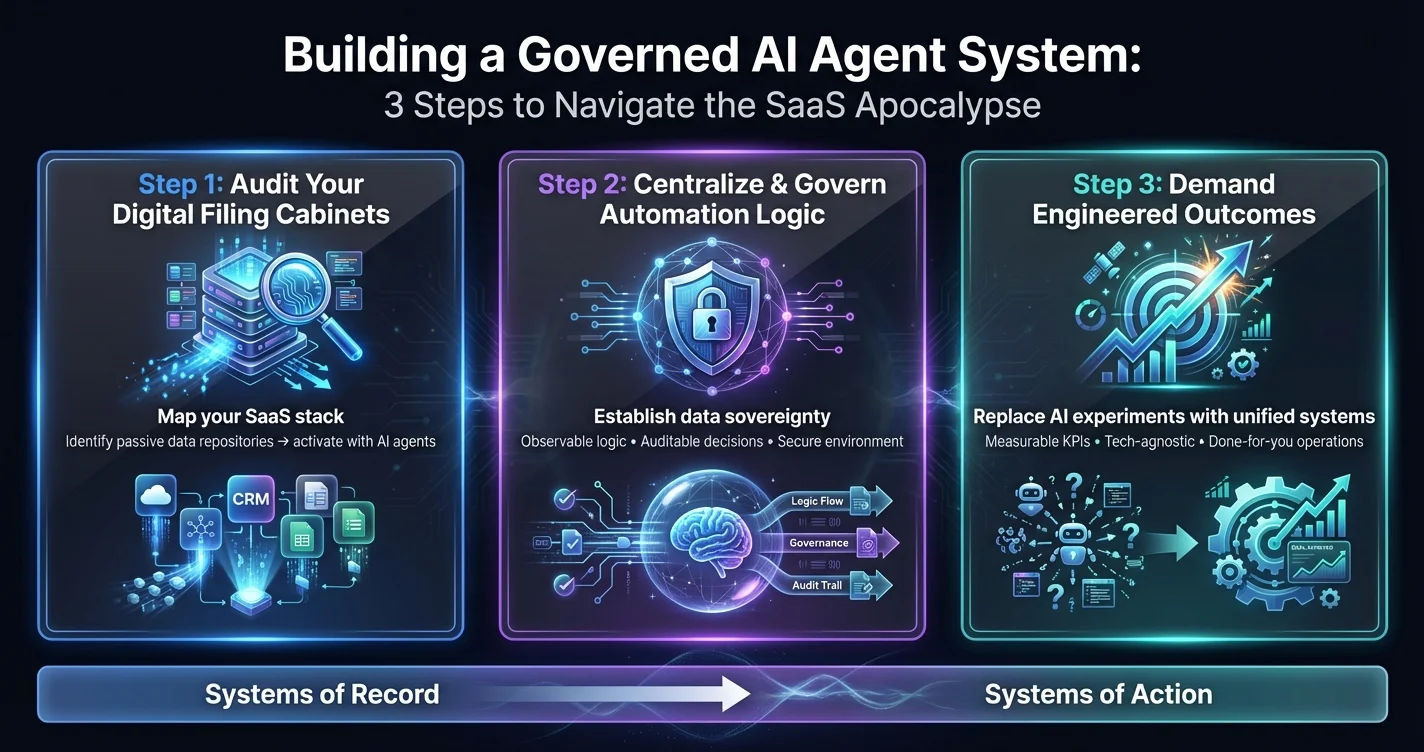
Surviving the SaaS apocalypse and capitalizing on the AI value gap requires a strategic pivot from tool acquisition to system orchestration. Operations leaders, COOs, and CEOs must move past the experimental phase of AI adoption and focus on building reliable, governed infrastructure.
Step 1: audit your digital filing cabinets
Begin by mapping your current SaaS stack. Identify the platforms that act merely as passive repositories of data. These are your prime targets for agentic automation. By deploying sovereign AI agents over these existing databases, you can activate your stagnant data and transform passive systems of record into active systems of action.
Step 2: centralize and govern automation logic
To prevent the terrifying scenario of rogue vibe coding, organizations must establish strict data sovereignty and observable logic frameworks. Employees should not be inventing their own automation pathways. Instead, companies should deploy specialized AI agents for specific business outcomes — marketing, sales, customer support, and operations — that operate within a secure, governed environment. This ensures that when an agent makes a decision, the operational logic behind that decision is transparent, auditable, and aligned with company policy. For a deeper look at how AI agents are restructuring the software layer itself, see our guide on agentic workflows and the death of the SaaS interface.
Step 3: demand engineered outcomes over raw access
Stop paying for unlimited power that results in trivial outputs. Shift your AI investments toward platforms and infrastructure that provide tech-agnostic integrations and done-for-you operationalizing. The goal is to replace fragmented AI experiments with a unified system that drives measurable business outcomes.
Conclusion: leading through the software transition
The SaaS apocalypse is not the end of enterprise technology; it is the necessary destruction of an outdated paradigm. The era of the digital filing cabinet is closing, making way for the era of the active AI agent.
For mid-market and scaling companies, this transition represents the greatest operational leverage opportunity in modern business history. By moving away from bloated software subscriptions and ungoverned shadow AI, and moving toward governed, sovereign AI agent systems, operations leaders can finally close the gap between AI capabilities and actual business value.
The technology is ready to do the work. The only remaining question is whether your operational infrastructure is prepared to manage it safely, securely, and effectively. See how Ability AI's sales intelligence automation helps companies replace static CRM dashboards with AI agents that actively execute pipeline work—without seat licenses for passive data access. For a real-world example of governed agent deployment, explore the Ability AI marketing operations case study showing measurable outcomes from the shift to agentic systems.