
Market research automation is the use of AI agents to gather, synthesize, and deliver competitive intelligence at consulting-grade quality — in minutes rather than weeks. For decades, deep strategic analysis required expensive engagements with firms like McKinsey or Bain. Today, specialized agents replicate that level of insight by integrating data providers like SimilarWeb with large language models. However, Meta's 2025 acquisition of agent platform Manas.im has exposed a critical vulnerability: organizations that build strategic infrastructure on rented tools face sudden disruption when vendors pivot or get acquired.
As organizations rush to adopt these powerful analytical tools, a new operational divide is emerging. On one side are companies renting intelligence capabilities that can be acquired, shut down, or altered overnight. On the other are forward-thinking organizations building sovereign agent infrastructure that secures their strategic edge permanently. This article explores the capabilities of modern research agents and the governance imperative for owning your intelligence stack.
How market research automation is evolving
The landscape of business intelligence has traditionally been fragmented. Marketing teams might use tools for SEO data, separate platforms for social listening, and expensive consultants to weave that disparate data into a coherent strategy. The emergence of advanced agents like Manas.im represents a fundamental shift in this workflow.
Through strategic partnerships with data providers like SimilarWeb, these agents have moved beyond reliable chat interfaces into deep data integration. The capabilities now available to automated agents include granular access to:
- Traffic source attribution: identifying exactly where competitors are acquiring customers
- Engagement metrics: analyzing bounce rates and unique visit data to gauge brand stickiness
- Global ranking data: tracking market share shifts in real-time
- Geo-specific performance: breaking down total traffic by country to identify expansion opportunities
- YouTube channel analytics: correlating video content performance with broader market trends
What makes this generation of tools distinct is not the access to data - SimilarWeb has offered this data for years - but the agent's ability to act as an analyst. The agent doesn't just display a table of numbers; it interprets them.
From raw metrics to executive synthesis
The primary value driver for the C-suite, particularly for CMOs and COOs, is not data availability but data synthesis. The bottleneck in operations is rarely a lack of information; it is the time required to turn information into a decision-ready narrative.
Research into current agent capabilities demonstrates that these tools can now generate what industry observers call "McKinsey-level reports." By ingesting complex datasets - such as HubSpot's performance metrics or competitor traffic flows - an agent can produce a comprehensive PDF report that includes:
- Seasonality analysis: automatically detecting cyclical trends in traffic and conversion that human analysts might miss without deep historical digging.
- Overarching trend identification: synthesizing cross-channel data to spot macro-shifts in consumer behavior.
- Visual storytelling: automatically generating charts and graphs that support the strategic narrative, ready for board-level presentation.
For an operations leader, the efficiency gains here are massive — a shift we explored in our marketing operations automation case study, where automated research pipelines replaced days of manual analysis. A report that might take a senior analyst forty hours to compile can now be generated effectively in minutes. However, this power comes with a significant catch that involves governance and platform risk.
The acquisition risk in the agent ecosystem
The recent acquisition of Manas.im by Facebook (Meta) serves as a stark warning for the B2B sector. When a startup builds a powerful, specialized agent that relies on unique integrations (like the SimilarWeb partnership), it becomes a prime target for consolidation by tech giants.
For a business relying on such a tool — particularly in sales intelligence and competitive research workflows — an acquisition often signals the beginning of "SaaS rot" or service deprecation. The tool you integrated into your weekly strategic planning workflow might be shut down, rolled into a massive enterprise suite you don't need, or have its API access revoked.
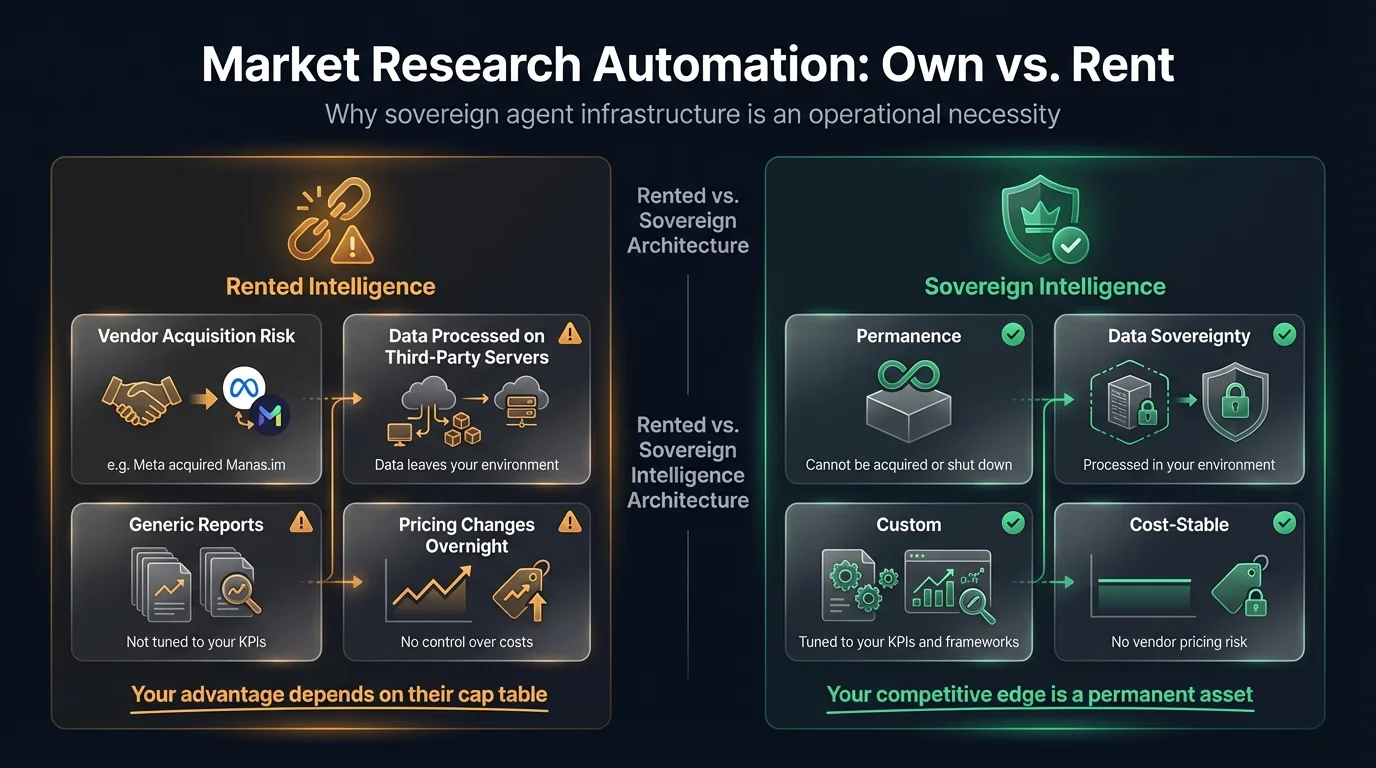
This highlights the fragility of "renting" AI agents. If your competitive advantage relies on a subscription to a third-party agent, that advantage is only as secure as that vendor's cap table. This is where the concept of sovereign AI becomes an operational necessity rather than just a technical preference.
Operationalizing intelligence with sovereign infrastructure
To mitigate the risks of vendor lock-in and acquisition, scaling companies must shift their mindset from buying AI tools to deploying governed AI agents they own and control. The goal is to own the "brain" that processes your market data.
The workflow demonstrated by tools like Manas - connecting a data source (SimilarWeb) to an LLM for analysis and an output generator for reporting - is replicable within a private, governed environment. By orchestrating these components through operations automation, organizations achieve three critical outcomes:
- Permanence: Your market research agent cannot be acquired or shut down. As long as you have access to data APIs (which are commoditized) and LLMs, your workflow remains intact.
- Data Sovereignty: When generating strategic reports using sensitive internal data alongside external market data, you ensure that high-level strategy documents aren't processed on public, third-party servers where data retention policies may be opaque.
- Customization: Off-the-shelf agents offer generic "CMO reports." A sovereign agent can be tuned to your specific KPIs, internal vernacular, and strategic frameworks.
The governance mandate for CEOs and COOs
The ability to automate deep strategic research is a massive competitive lever. It allows mid-market companies to punch above their weight, accessing insights that were previously the domain of Fortune 500s with unlimited consulting budgets.
However, the path forward requires operational discipline. We are moving into an era where the most valuable digital employees will be AI agents. Just as you wouldn't want your VP of Strategy to be "acquired" by a competitor, you cannot afford for your strategic intelligence infrastructure to be owned by a third party. AI governance has become a board-level responsibility, and your intelligence stack is one of the most critical systems to protect.
The lesson from the Manas acquisition is clear: the technology is ready, but the delivery model matters. Operations leaders must prioritize building governed, observable, and sovereign agent systems. By doing so, you transform market research from a rented subscription into a permanent, proprietary asset that grows with your business.