
Marketing AI agents are autonomous systems that execute multi-step campaign workflows - research, brief creation, asset generation, and cross-channel distribution - without continuous human intervention. The challenge is that most marketing AI agents today operate as ungoverned local desktop configurations, creating a severe data sovereignty and operational continuity crisis that operations leaders can no longer afford to ignore.
The deployment of marketing AI agents has crossed a critical threshold. We are no longer observing a landscape where marketing professionals simply use conversational chatbots for basic copywriting or brainstorming. Instead, there is a rapid, fundamental shift toward complex, multi-step automation happening directly on employee desktops. While this evolution unlocks massive productivity gains for campaign execution, it simultaneously creates a governance crisis that demands immediate leadership attention.
Recent industry research reveals a stark reality - individual employees are moving beyond web-based AI interfaces and are now building sophisticated, modular agent systems using local desktop environments and terminal commands. They are orchestrating end-to-end campaign workflows, complete with automated research, design system extraction, and multi-format asset generation. For context on the broader risk this creates, see our analysis of the shadow AI governance crisis and the desktop AI agents governance challenges that accompany it.
For CEOs, COOs, and VPs of Marketing, this presents a dual-edged sword. The capability to automate complex marketing systems is proven and available, but the current execution method represents the most advanced and risky form of shadow AI sprawl to date.
How marketing AI agents build modular skill stacks
To understand the operational implications, it is essential to understand how advanced users are structuring their AI workflows. The paradigm has shifted from managing massive, complex mega-prompts to building modular "skill stacks."
When AI capabilities are segmented into discrete skills, the AI transitions from a tool that requires constant manual management into an autonomous system. These skills are generally categorized into three distinct layers:
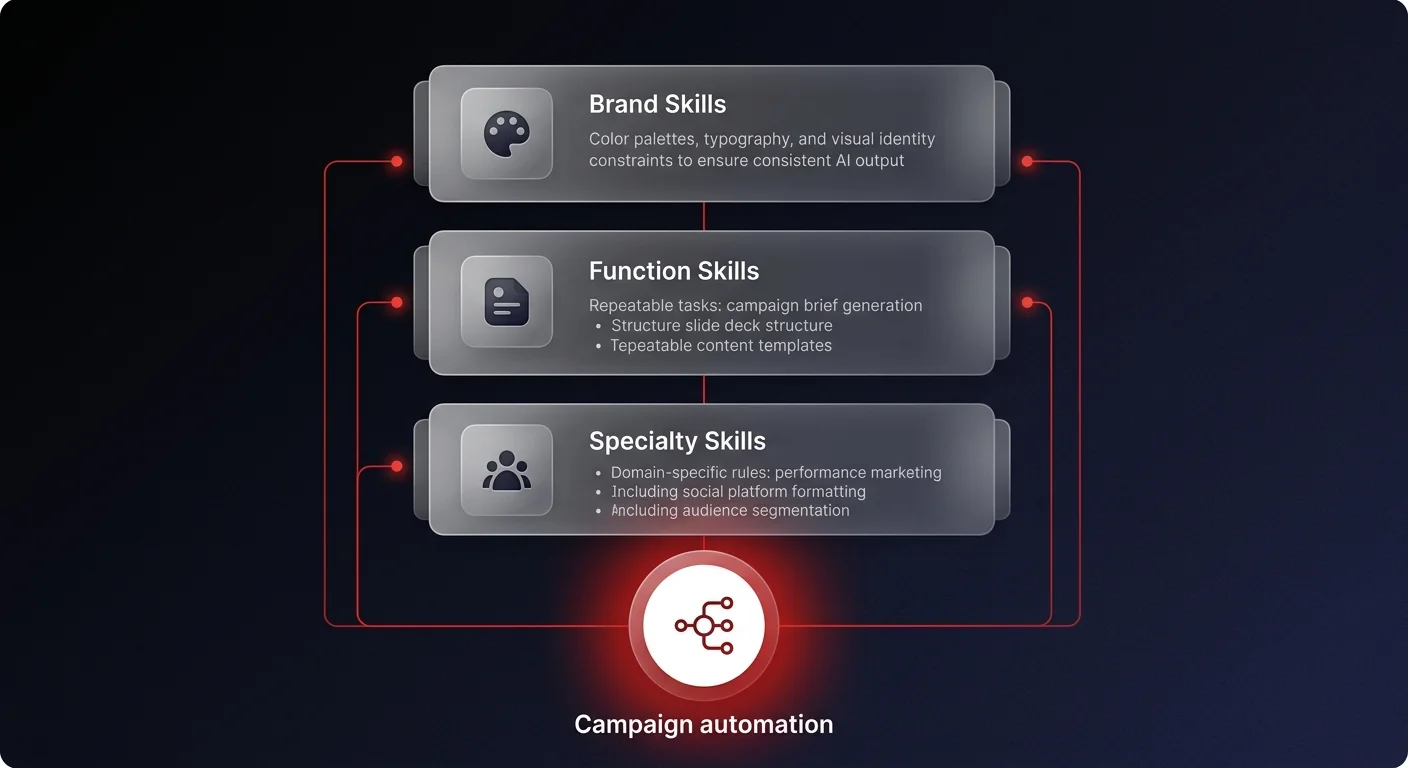
- Brand skills: These establish the foundational constraints for the organization, encompassing brand standards, color palettes, typography, and visual identity.
- Function skills: These dictate the repetitive, day-to-day marketing tasks, such as generating campaign briefs or structuring slide decks.
- Specialty skills: These handle highly specific domain rules, such as performance marketing guidelines or specific formatting requirements for social platforms.
By building brand skills first, marketing professionals ensure that every subsequent automated task - whether it is generating an animated video or writing a landing page - adheres to a unified corporate identity.
How modular campaign automation works in practice
To illustrate the power and complexity of these local systems, consider a typical workflow for a B2B SaaS campaign launch. Modern automation allows a single user to coordinate multiple specialized AI capabilities from a single brief.
Autonomous design system extraction
Instead of manually typing out brand guidelines, users are leveraging tools like Claude Design to ingest existing marketing materials. By pointing the AI at a branded landing page or a GitHub repository, the system can autonomously extract primary hex codes, UI mockups, component structures, and font types. This extraction is then packaged as a reusable "brand skill" file that lives on the user's local hard drive, ensuring all future outputs automatically inherit the correct visual language.
Multi-tool function orchestration
The true breakthrough occurs when these foundational skills are combined with external research and generation tools. For example, a campaign planning skill can be programmed to trigger Perplexity for real-time market research, synthesize that data against the company's ideal customer profile, and output a fully formatted XML slide deck - complete with speaker notes, funnel mapping, and budget allocation forecasting.
Automated asset generation
With the strategy in place, the system moves to execution. Current desktop orchestrations can automatically generate high-fidelity carousel templates, utilizing external image generation tools for cover art while ensuring the text layout adheres to the previously established brand skill. Furthermore, these systems are capable of generating 30-second animated marketing videos using SVG motion graphics. While not yet replacing professional video production, these automated animations are highly effective for landing page explainers and social media hooks.
The manager agent
The pinnacle of this workflow is the "Campaign Manager Agent." Rather than running these skills sequentially by hand, a user initiates a master agent via their computer's local terminal. The user provides a simple prompt with basic campaign goals and budget parameters. The manager agent then autonomously spins up separate sub-agents to handle the research, write the brief, design the slide deck, code the animated video, and build the landing page. Within thirty minutes, a comprehensive, multi-channel marketing campaign is generated locally.
The hidden risks of desktop marketing AI agent deployment
While the technological capability described above is highly impressive, the operational reality of how it is being deployed should trigger immediate concern for any operations or IT leader.
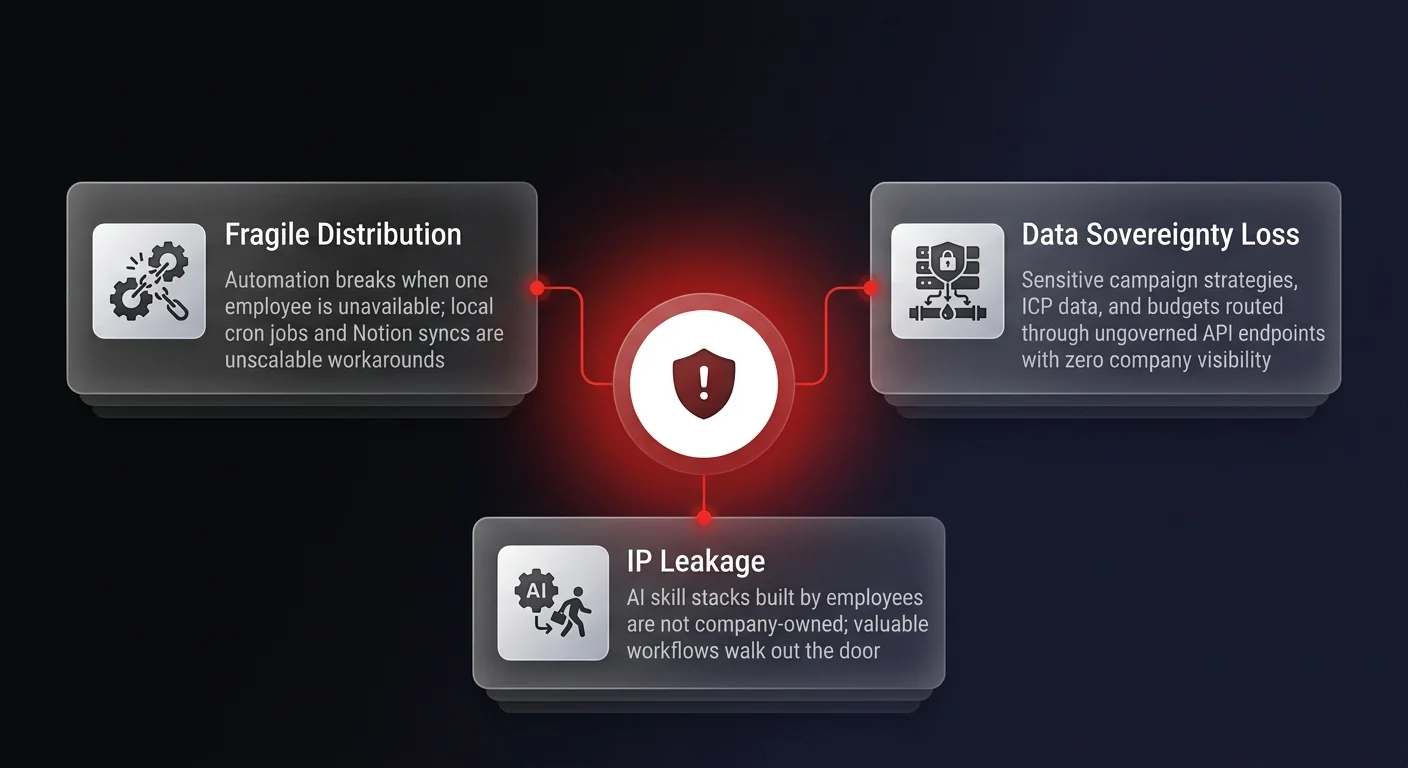
This entire ecosystem of manager agents, brand extractors, and automated asset generators currently exists as local files on individual employee machines. This is the definition of shadow AI - powerful, invisible to leadership, and inherently fragile. The risks align closely with the shadow AI lethal trifecta: ungoverned data access, operational single points of failure, and invisible IP leakage.
Fragile distribution methods
Because these systems are built locally, sharing them across a marketing team requires precarious workarounds. Research shows users are building local scheduled routines - essentially desktop cron jobs - to automatically scan their local folders for updated AI skills and push those files to a shared Notion database every week.
This is a hacky, unscalable solution for enterprise collaboration. If that specific employee goes on vacation, updates their operating system, or leaves the company, the entire "automated" marketing system breaks.
Data sovereignty and intellectual property risks
When employees build agent orchestrations on their local terminals, they are frequently routing sensitive corporate data - strategy documents, budget forecasts, and proprietary ICP data - through various ungoverned API endpoints. The company has zero visibility into where this data is going, how it is being retained, or what models are training on it.
Furthermore, the "skill stacks" themselves become valuable intellectual property. If your marketing automation relies on a complex web of local files developed by one tech-savvy manager, your organization does not actually own its AI capabilities - it is merely renting them from the employee who built them.
Moving from shadow AI to sovereign marketing AI systems
Organizations are caught between two bad options. They can either allow this ungoverned, risky desktop sprawl to continue because it produces results, or they can attempt to ban it, thereby killing massive productivity gains.
At Ability AI, we view this challenge through a different lens. The solution is not to stifle innovation, but to elevate it from fragile local environments into centralized, governed infrastructure. This is the core principle of a Sovereign AI Agent System.
The end-to-end campaign workflow engine - autonomous brief creation, KPI forecasting, and cross-channel asset generation - is a highly repeatable use case that organizations should own at the system level. See how our marketing operations clients have made this transition, moving from fragmented desktop experiments to governed, company-owned campaign automation. By leveraging open-source orchestration frameworks alongside tools like n8n, organizations can build production-grade AI content automation in a matter of weeks, at a fixed cost, with no ongoing platform subscription fees.
Strategic takeaways for operations leaders
The transition from marketing AI agents as individual tools to AI as an orchestrated system is already happening inside your organization. To regain control and maximize the value of these technologies, leaders must take definitive action.
First, audit your organization for shadow orchestration. Look beyond employees simply pasting text into ChatGPT. Identify power users who are leveraging terminal commands, local desktop applications, and automated database syncs to run their daily workflows. These individuals are highlighting the exact processes that need to be formalized.
Second, centralize your brand knowledge. The concept of an "AI brand skill" is powerful. Organizations should proactively develop standardized, secure repositories of brand constraints, ICP data, and marketing strategies that can be safely accessed by governed AI systems, rather than allowing employees to haphazardly scrape landing pages.
Finally, transition from individual experimentation to strategic partnership. Embrace a Land and Expand approach. Take the most successful, yet fragile, local AI workflows - such as the campaign manager agent - and rebuild them as secure, centralized solutions.
The organizations that win the next era of automation will not be the ones with the most clever local desktop hacks. They will be the ones that successfully transform those individual experiments into robust, governed systems that the company wholly owns and controls.