
Desktop AI agents are autonomous systems that execute complex, multi-step workflows directly on a local machine — but ungoverned deployments create severe data security vulnerabilities. Organizations running DIY open-source agent frameworks are exposing API keys, enterprise credentials, and proprietary data through uncontrolled local environments. Without proper governance, individual productivity wins become organization-wide security liabilities that cost mid-market companies control over their most sensitive data.
Desktop AI agents are rapidly becoming the new frontier of workplace automation, fundamentally shifting how organizations handle complex, multi-step workflows. As operations leaders look to scale their capabilities, the allure of autonomous systems that can manage everything from sales scraping to inbox triage is undeniable.
However, a severe governance crisis is unfolding quietly in the background. The initial wave of DIY, open-source agent frameworks has introduced massive security vulnerabilities and unpredictable operational costs. The recent release of Anthropic's Claude Dispatch — a system that allows users to securely trigger and manage local desktop agents from their mobile devices — highlights a critical turning point in the industry. The market is aggressively pivoting away from fragile, ungoverned AI experiments toward secure, observable architectures.
For CEOs, COOs, and VPs of Operations, understanding this shift is no longer optional. Deploying AI agents without the proper governance framework is a direct threat to data sovereignty and bottom-line profitability. Here is a deep dive into the hidden risks of DIY agent stacks, the operational value of secure desktop agents, and how businesses must adapt their AI strategies.
Shadow AI and the open-source security nightmare
The appeal of decentralized, open-source AI agents is easy to understand. Frameworks like OpenClaw and other DIY agent stacks promise ultimate flexibility, allowing users to text a model from Telegram or a command line and watch it execute economically valuable tasks. But beneath this user-friendly surface lies an absolute security nightmare.
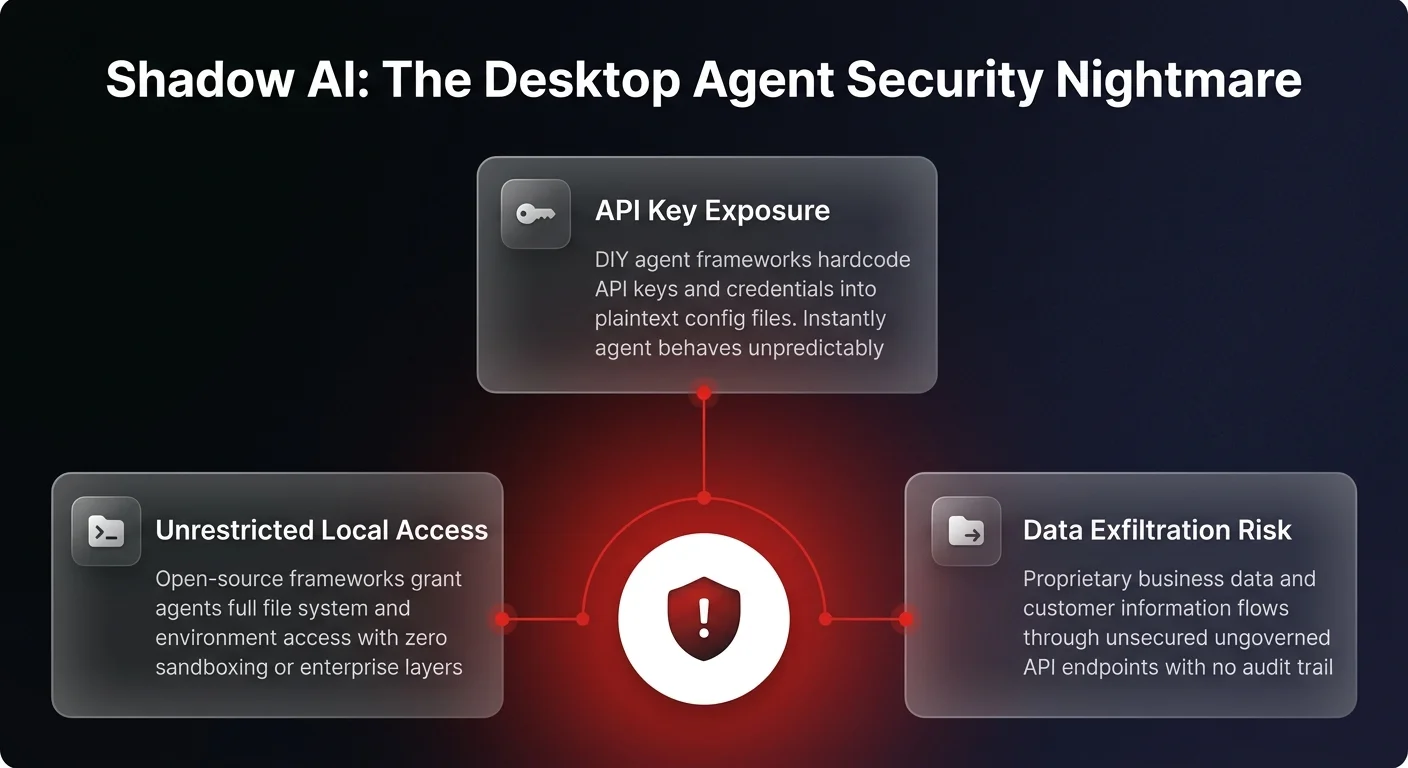
Recent industry data paints a grim picture of the current state of open-source agent security. Tens of thousands of API keys have been leaked due to elementary security errors inherent in these DIY setups. When employees implement these fragmented tools on their local machines, they are essentially granting an autonomous system unrestricted access to their local environment, file systems, and enterprise credentials.
These DIY frameworks are fundamentally flawed from a security perspective. They lack the necessary sandboxing and permission layers required for enterprise environments. When a user connects an open-source agent to their corporate applications, they are often hardcoding API keys, credit card numbers, and identity credentials into plaintext configuration files. If the agent acts unpredictably — or if the open-source repository itself contains vulnerabilities — those credentials become instantly compromised.
For operations leaders, this represents the ultimate shadow AI governance crisis. When employees bypass IT to run autonomous agents on their desktops, the organization loses all data sovereignty. The risk of proprietary business data or customer information being exfiltrated through an unsecured API endpoint is simply too high to justify the marginal productivity gains of a DIY tool.
Context explosion and unpredictable operational costs
Beyond the glaring security vulnerabilities, DIY agent stacks suffer from a fatal economic flaw that devastates operational budgets: context explosion.
Most open-source agent frameworks operate on a direct pay-per-token API model. Every time the agent takes an action, evaluates a result, or communicates with the user, it makes a direct call to the backend infrastructure of a foundational model provider. Because agents require vast amounts of context to operate autonomously, they continually send the entire conversation history, system prompts, and tool outputs back and forth.
In a business setting, this creates an unmanageable financial drain. A single automated conversation might cost fifty cents, while running a complex, multi-step skill could burn through two dollars in a matter of minutes. As the agent loops through tasks, retries failed actions, and processes large documents, the API usage compounds exponentially. It is not uncommon for users to burn through hundreds of dollars in a matter of days when leaving these systems running unchecked.
This unpredictable usage-based billing makes it impossible for COOs and operations leaders to forecast their software expenditure. Serious business applications require predictable OpEx. This is exactly why the industry is moving toward flat-fee, locally executed models. Features like Claude Dispatch leverage the user's existing monthly subscription, running the heavy computational logic locally or through subsidized enterprise plans. This predictable pricing model is the only viable path forward for organizations looking to deploy AI agents at scale.
How desktop AI agents bridge the operational gap
When properly governed and securely architected, desktop AI agents offer transformative value for business operations. The modern workflow — as demonstrated by tools like Claude Dispatch — relies on a secure, multi-layered architecture rather than vulnerable direct API connections.
In a mature desktop AI agent setup, the user's mobile device acts merely as a secure remote control. The actual execution happens on a designated local machine — such as a dedicated Mac Mini or an employee's primary workstation — which stays awake to process tasks. The agent utilizes Model Context Protocol (MCP) servers and pre-established Standard Operating Procedures (SOPs) to interact with the local environment.
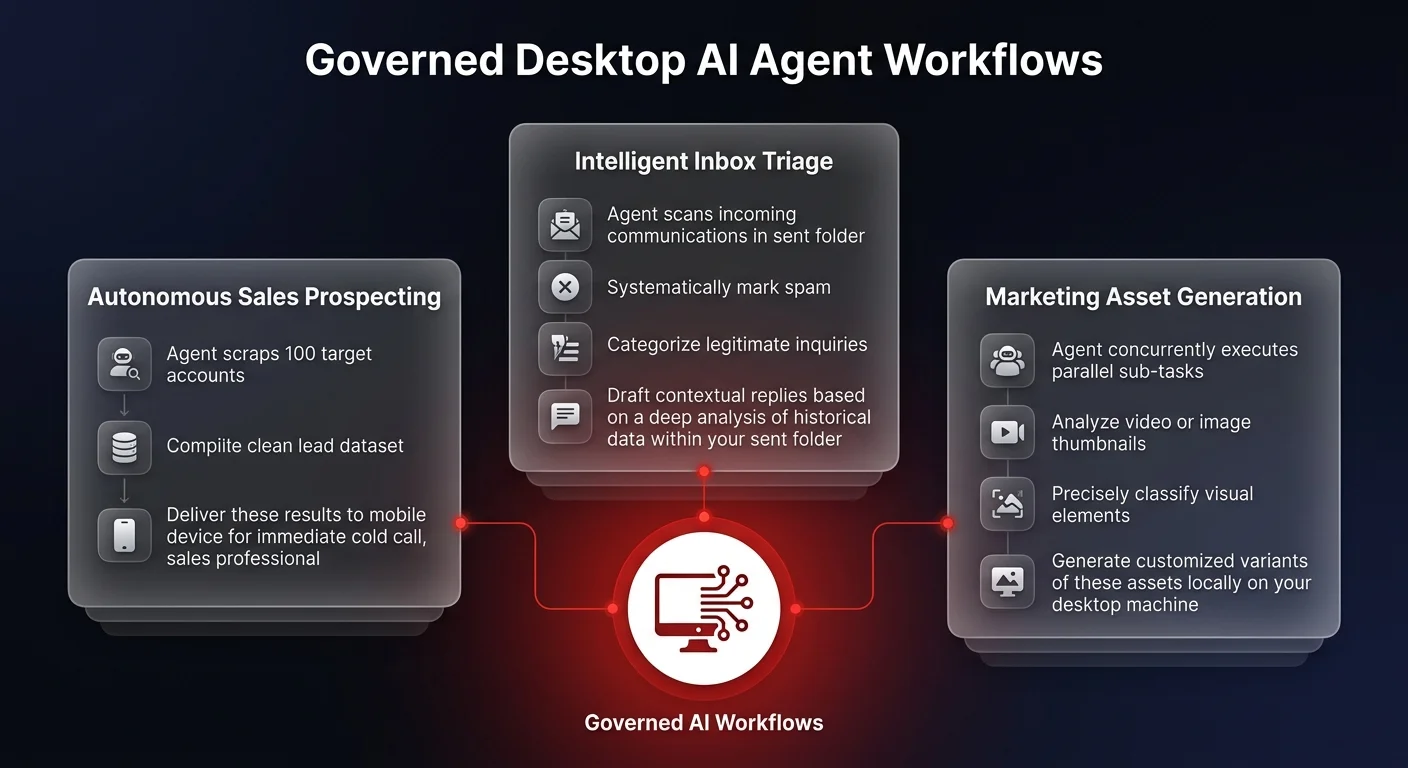
This architecture enables powerful, highly specific business workflows:
- Autonomous sales prospecting: An agent can be triggered to scrape specific target accounts — for example, identifying 100 HVAC agency owners in Texas. The agent autonomously navigates the web, runs local scrapers, compiles the data into a clean dataset, and delivers the lead list directly to the user's mobile device, allowing a sales representative to begin cold calling immediately.
- Intelligent inbox triage: Operations and support leaders can deploy inbox cleaner workflows. The agent scans incoming communications, automatically marks solicitations as spam, categorizes important inquiries, and pre-drafts contextual replies based on a deep analysis of the user's historical sent folder. The human operator simply reviews and approves the drafts, saving up to 90% of the time traditionally spent on email management.
- Marketing asset generation: Agents can run parallel sub-tasks, such as analyzing a successful YouTube thumbnail, classifying its core elements, and generating customized face-swapped variants using local image generation skills.
These automated loops consistently save operators two to three hours per day. By porting these capabilities through a secure desktop-to-mobile bridge, employees gain the flexibility of mobile execution without sacrificing the processing power and secure context of their local desktop environment.
If your operations team is evaluating secure desktop AI agents for workflow automation, explore Ability.ai's Operations Automation solutions to see how governed agent systems can replace fragmented desktop experiments with predictable, observable results.
The necessity of human-in-the-loop governance
The key differentiator between a dangerous DIY script and a secure enterprise agent is observability and explicit permissioning.
In secure architectures, when an agent requires access to a new local file, system resource, or external application, it halts execution. It then triggers an allow-listing request, sending a notification directly to the user. The human operator must explicitly grant permission before the agent can proceed.
This human-in-the-loop security model prevents the autonomous system from making unauthorized purchases, sending rogue emails, or accessing sensitive directories. It ensures that the agent remains a highly capable assistant rather than an uncontrollable liability. For scaling organizations, this level of observable logic is mandatory. If an agent system cannot provide an exact, auditable trail of what data it accessed and what actions it took, it has no place in a corporate network. This is why AI workflow automation governance has become a board-level priority for mid-market companies deploying agents at scale.
Moving from fragmented experiments to sovereign systems
The evolution from ungoverned open-source experiments to secure, flat-fee systems like Claude Dispatch is a positive step for individual productivity. However, for mid-market and scaling organizations, relying on individual employees to manage their own desktop AI agents still presents a systemic operational challenge.
When marketing, sales, customer support, and operations teams are all running isolated, individual agent instances, the business suffers from operational fragmentation. Data remains siloed on individual machines, best practices aren't shared across the organization, and leadership has zero visibility into how AI is actually driving business outcomes. As explored in desktop AI agents: the new productivity boom or governance crisis, this fragmentation is the defining operational risk of the current AI adoption wave.
To truly harness the power of autonomous workflows, organizations must graduate from fragmented desktop experiments to governed, sovereign AI agent systems. This is the core operational philosophy at Ability.ai. We believe that businesses do not just need smarter individual tools — they need unified, observable infrastructure.
A sovereign AI system ensures that your organization's proprietary data remains fully under your control, never utilized to train public models or exposed via vulnerable open-source APIs. By deploying AI agents designed for specific business outcomes, operations leaders can replace unpredictable token costs with guaranteed operational value.
The future of work belongs to organizations that can transform chaotic AI experimentation into reliable, governed operational systems. The technology to automate your most complex workflows is already here — the real competitive advantage lies in how securely and strategically you govern it. Book a call with Ability.ai to build a sovereign desktop AI agent architecture that eliminates shadow AI risk and delivers measurable operational outcomes.