
Third-party AI tools governance is the practice of applying deterministic guardrails to external agentic integrations - ensuring that AI agents using third-party MCP servers and libraries operate within strict security, performance, and behavioral boundaries. Without these controls, enterprises face non-deterministic agent behavior, data leakage, and escalating operational risk.
The deployment of agentic workflows is accelerating, but integrating third-party AI tools remains a critical vulnerability for mid-market and scaling enterprises. Operations leaders are increasingly adopting Model Context Protocol (MCP) servers and third-party libraries to give their Large Language Models (LLMs) the ability to interact with browsers, databases, and internal software. However, out-of-the-box agentic integrations are inherently volatile.
Without strict governance, handing an LLM a suite of external tools leads to non-deterministic behavior, degraded performance, and significant security risks. For a Chief Operating Officer or VP of Operations, an AI agent that behaves unpredictably is not a solution - it is a new operational liability. This pattern mirrors the broader AI agent governance crisis that enterprises face when scaling autonomous systems.
Transforming these fragmented AI experiments into reliable, governed operational systems requires a fundamental shift in how we handle agentic integrations. Based on extensive architectural testing with browser-automation MCP servers, we have developed a five-step framework to bend public AI tools to your operational will without breaking your workflows.
The hidden risks of ungoverned third-party AI tools
When you connect an AI agent to a third-party MCP server, you are essentially providing the agent with a suite of callable functions wrapped in descriptions. These descriptions serve as the agent's instructions for when and how to use the code.
The immediate problem is that third-party developers write these tools to be generic. They must cater to thousands of potential use cases. An out-of-the-box browser automation tool might simply carry the description "Resize the browser window" or "Close the page." To an LLM, these shallow descriptions offer too much freedom and too little operational context.
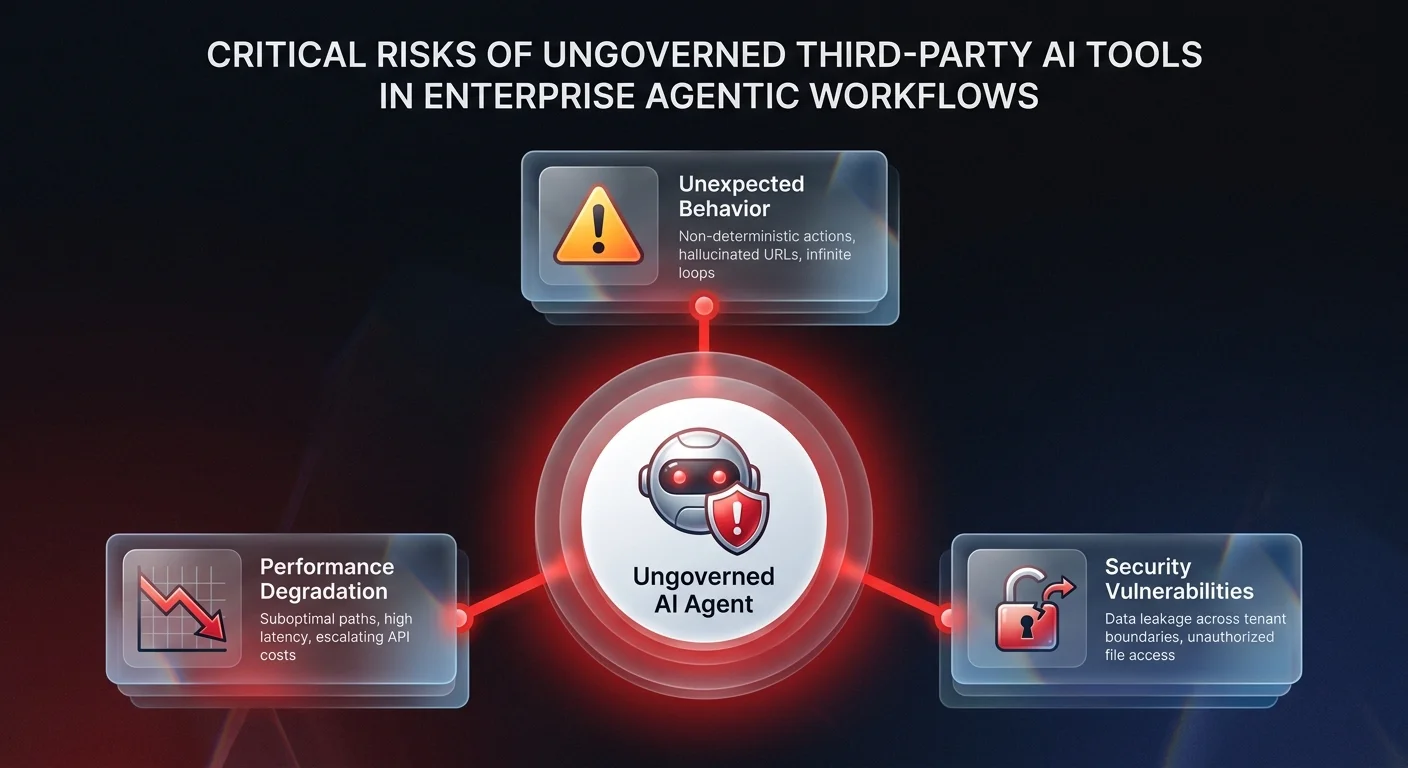
This lack of context manifests in three distinct ways:
- Unexpected behavior: Agents are non-deterministic by nature. Give them generic tools, and you get unpredictability at scale. They might click the wrong elements, hallucinate non-existent internal URLs, or enter infinite loops.
- Performance degradation: An agent might eventually achieve the desired outcome, but it will take suboptimal, compute-heavy routes to get there, increasing latency and API costs.
- Critical security vulnerabilities: In a multi-tenant architecture, an agent without deterministic guardrails lacks awareness of your folder structures, databases, or schemas. If tasked with saving an output or retrieving a file, an unbound agent could easily leak client data across tenant boundaries - a risk pattern also explored in our analysis of shadow AI risks.
To safely deploy AI in a business environment, you must implement observable logic and strict data sovereignty.
A 5-step framework for third-party AI tools governance
To illustrate how to secure these tools, consider a high-value operational automation - an AI-powered specification reviewer. This agent's job is to read a product requirement in Jira, review a visual design in Figma, navigate to a staging environment, and visually validate whether the implementation matches the requirement.
To execute this, the agent relies on an external browser automation server (like Playwright). Left ungoverned, the agent fails - hallucinating 404 pages and saving screenshots in random directories. By applying the following five deterministic guardrails, operations automation teams can transform this chaotic process into a highly reliable system.
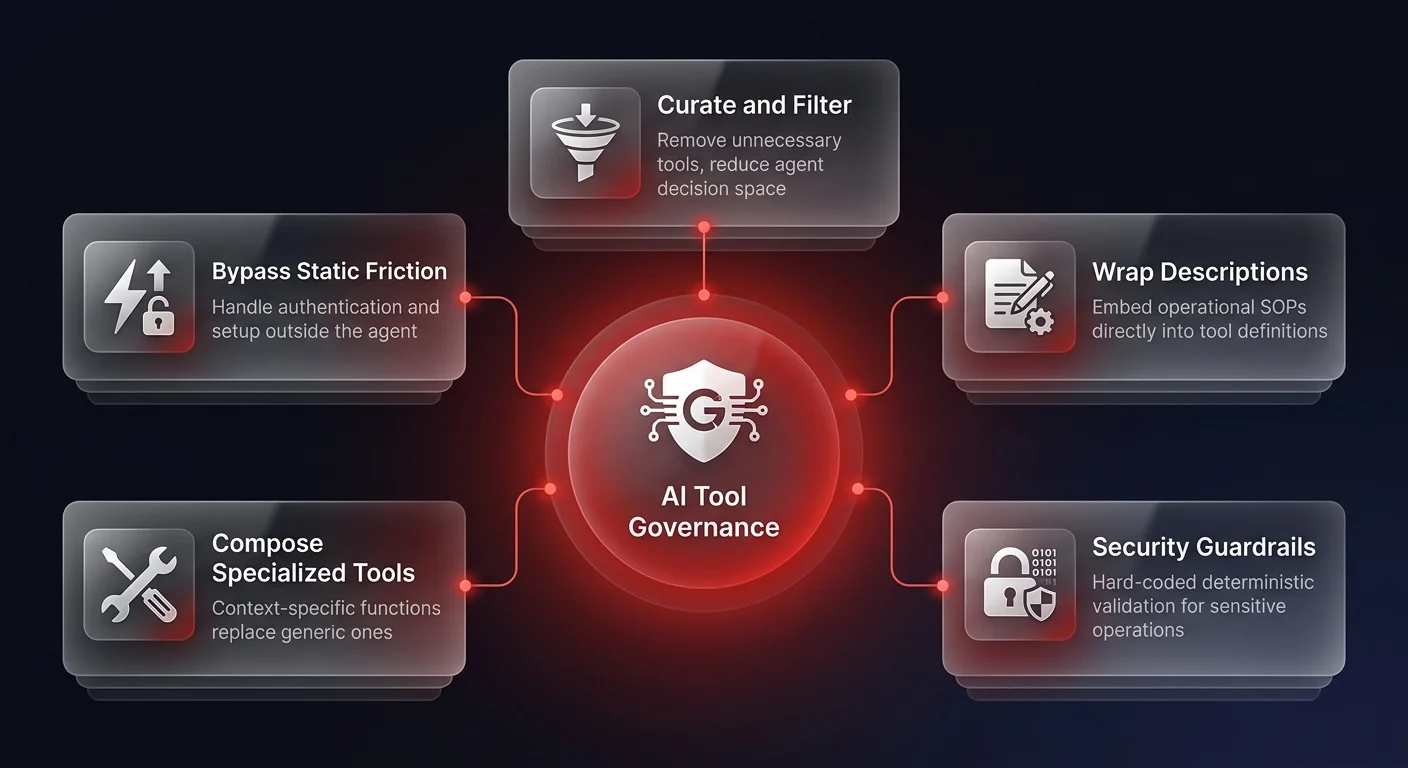
1. Curate and filter your third-party toolset
Blindly importing all available tools from a third-party server bloats your context window. For instance, a standard browser automation server might provide 21 distinct tools, including options to resize windows, install dependencies, or run arbitrary code in the console.
An agent tasked with visual Quality Assurance (QA) does not need to resize windows or run console code. Leaving these options available forces the LLM to expend processing power considering them, increasing the likelihood of hallucinations.
The first rule of agent governance is reduction. Explicitly filter out unnecessary tools before the agent's session begins. By reducing the available actions from 21 to 16, you immediately streamline the agent's decision-making process and tighten your operational focus.
2. Wrap generic tools with rigid, operational descriptions
Because default tool descriptions are heavily generalized, you must wrap them with highly specific, use-case-driven instructions. This is where you bake your operational Standard Operating Procedures (SOPs) directly into the agent's toolkit - an approach central to harness engineering for AI governance.
For example, an out-of-the-box "click" tool might just say "Click an element." In practice, agents often struggle to find the right element on complex web applications. Through testing, we found that forcing the agent to read an "accessibility text snapshot" - a text-based map of all buttons and menus - drastically improves its accuracy.
Instead of accepting the generic tool, wrap it with a custom description: "Before calling the click tool, you must first call the accessibility snapshot tool to understand the page layout." By wrapping generic functions in rigid behavioral guidelines, you force the AI to follow your preferred operational sequence.
3. Enforce deterministic security guardrails
Never trust a non-deterministic agent with sensitive actions like file pathing, multi-tenant data routing, or database writes. These mission-critical aspects of your workflow must be protected by hard-coded, deterministic logic that intercepts the agent's decisions.
Consider the act of taking an automated screenshot and saving it to a server. An unbound agent might attempt to save the image in a root directory or, worse, a different client's folder.
To govern this, implement an interception layer. When the agent attempts to invoke the "save screenshot" tool, your system must deterministically validate the file path against an approved routing schema.
Crucially, if the validation fails, do not crash the application. Instead, return a gracefully formatted, agent-facing error message: "Access is denied. You cannot save to this directory. Please provide a proper file name and route to the approved folder." The LLM will process this deterministic pushback, self-correct, and try again within the safe boundaries you established.
4. Compose specialized tools for strict contexts
Sometimes, a single tool serves multiple operational purposes, but treating it as a generic function leads to poor data structuring. Instead of relying on the agent to remember formatting rules, compose brand new, specialized tools out of the existing ones.
For example, you might need the agent to take generic screenshots for its own navigation, but you also need it to take formal "evidence screenshots" to attach to Jira tickets.
Create a new tool explicitly named "Evidence Screenshot." In the description, instruct the agent: "Only use this tool when capturing final evidence of a passed or failed QA test. You must identify the relevant Jira ticket number and append it to the file name before saving."
By splitting one generic action into two contextually distinct tools, you remove the burden of memory from the agent and ensure that your operational data is formatted perfectly every time. See how MarketingOps achieved similar governance patterns with specialized agent tooling across their automation workflows.
5. Bypass the agent for static operational friction
There is a misconception that to build an AI workflow, the agent must execute every single step. In reality, forcing an agent to handle clunky, static IT friction is a waste of compute and a massive point of failure.
System authentication is the prime example. Asking an LLM to navigate login screens, handle JWT tokens, and inject secrets into local storage is highly unreliable. Each client system might have a different authentication mechanism, creating a web of unnecessary complexity.
The most effective governance strategy is often to bypass the agent entirely. Execute the login sequence deterministically using standard software automation. Inject the necessary tokens, authenticate the session, and only then hand the reins over to the AI agent. Unburdening the agent from these static setup tasks ensures its context window and processing power are reserved purely for the high-value cognitive work.
The operational imperative of sovereign AI infrastructure
As businesses move beyond casual AI experiments and attempt to deploy autonomous systems at scale, the reliance on ungoverned third-party tools will become a central point of failure. The difference between an AI gimmick and a reliable business system lies entirely in the architectural constraints placed upon it.
The framework outlined above - curating tools, wrapping descriptions, enforcing hard-coded security gates, specializing functions, and bypassing agents for static friction - forms the foundation of hybrid automation. It proves that pure, non-deterministic agents will fail without strict orchestration. This aligns directly with the principles behind effective AI agent integration governance across enterprise environments.
For mid-market and scaling companies, this highlights the absolute necessity of governed agent infrastructure. You cannot simply plug an LLM into your internal software and hope it understands your compliance requirements. You must deploy sovereign AI systems where logic is observable, actions are bound by deterministic rules, and multi-tenant data is fundamentally protected from agentic hallucinations.
Transforming experiments into reliable operational systems
The allure of plug-and-play AI tools is strong, but out-of-the-box convenience often masks severe operational vulnerabilities. When third-party agentic tools are deployed without a governance framework, they introduce unpredictability that modern operations cannot tolerate.
By taking control of the tooling layer, operations leaders can harness the profound automation capabilities of AI while completely neutralizing the associated risks. The key takeaway - it is entirely possible to achieve complex, agent-driven workflows like automated visual QA and requirement reviewing without compromising your system's integrity.
Stop treating AI as a black box of unpredictable magic. By applying deterministic guardrails and sovereign infrastructure, you can transform fragile AI features into resilient, governed operational engines that drive measurable business outcomes.