
Agentic workflow automation is the deployment of persistent, autonomous AI systems that replace fragmented manual processes - scattered spreadsheets, email chains, and isolated data silos - with intelligent agents capable of independently executing complex operational decisions and dynamically balancing resources without human intervention. In legacy industries, operations running on 150+ disconnected spreadsheets are being consolidated into centralized AI systems that cut capital project timelines from years to months.
The race for artificial intelligence dominance is frequently framed as a competition of massive computational models and advanced silicon chips. But the hard truth is that computing dominance and broader economic re-industrialization are fundamentally physical projects. They require physical materials, massive energy generation, and the robust capability to move electricity where it is needed, exactly when it is needed.
Scaling this physical capacity faces a catastrophic bottleneck. The friction preventing rapid industrial expansion is not just regulatory - it is deeply operational. Across the country, legacy industries are attempting to manage billion-dollar capital projects and complex manufacturing supply chains using entirely archaic systems.
The solution to these entrenched bottlenecks is agentic workflow automation. By shifting from disjointed manual software tools to persistent, autonomous intelligent systems, organizations can overcome the severe labor shortages and process fragmentation that cripple modern operations. This is not about making human operators marginally faster - it is about deploying synthetic labor as core infrastructure.
The physical constraints of the AI economy
The industrial backbone required to support the next decade of technological growth is faltering. Industry data reveals that the United States is currently up to 50 years behind global competitors in critical minerals supply. Even when new domestic projects are successfully permitted and licensed, the physical execution remains devastatingly slow. It routinely takes five years to build a new facility, and an additional three to five years to ramp it up to operational target rates.
A similar crisis exists within the power grid. While we have witnessed massive innovations at the edge of the grid - electric vehicles, high-speed charging infrastructure, and commercial battery storage - the systems underpinning the core grid remain largely unchanged. On the other side of the wire, we are relying on mechanical systems that were developed over a century ago. These systems lack modern control, offer zero real-time monitoring, and result in an overbuilt, highly fragile network.
To move fast enough to remain competitive, organizations must stop relying on the slow, manual processes that defined 20th-century operations. We have to fundamentally rethink the entire operational stack, starting with how human beings interface with industrial processes.
The 150 spreadsheet problem: why legacy operations fail
When you look closely at what actually sets the rate of progress in complex operations, you find the operating teams. More specifically, you find the technology stack those operating teams rely on to make decisions.
In modern mining operations, refineries, and large-scale construction projects, the operating technology stack is shockingly brittle. It is not uncommon to find highly complex, multi-million-dollar workflows being managed by pen, paper, and upwards of 150 spreadsheets scattered randomly around an operation.
This is the ultimate manifestation of shadow AI and process sprawl. When critical operational data is decentralized across static documents and individual hard drives, optimization is impossible. Project managers cannot balance resources dynamically. Procurement teams cannot execute rapidly. Every individual spreadsheet represents an isolated data silo that requires a human being to manually update, interpret, and pass along to the next stakeholder in the chain.
This fragmented scaffolding is exactly why capital project lifecycles - from process development and engineering to construction and procurement - take years instead of months. The human bandwidth required to manually orchestrate these systems is a massive operational tax.
Replacing operators with agentic workflow automation
The traditional answer to process inefficiency has been to hire more people or train existing staff. However, we have experienced 35 years of meaningful attrition in specialized industrial labor pools.
The specialized workforce equipped with deep, embedded operational know-how simply no longer exists at scale. In a modern refinery, feedstock is highly variable. The earth is heterogeneous, meaning operators must constantly tune temperatures, flow rates, chemical addition rates, and residence times to keep the plant running safely and efficiently. We no longer have a domestic labor pool that can walk up to a complex refinery, immediately get it operating on spec, and effectively manage that constant variability.
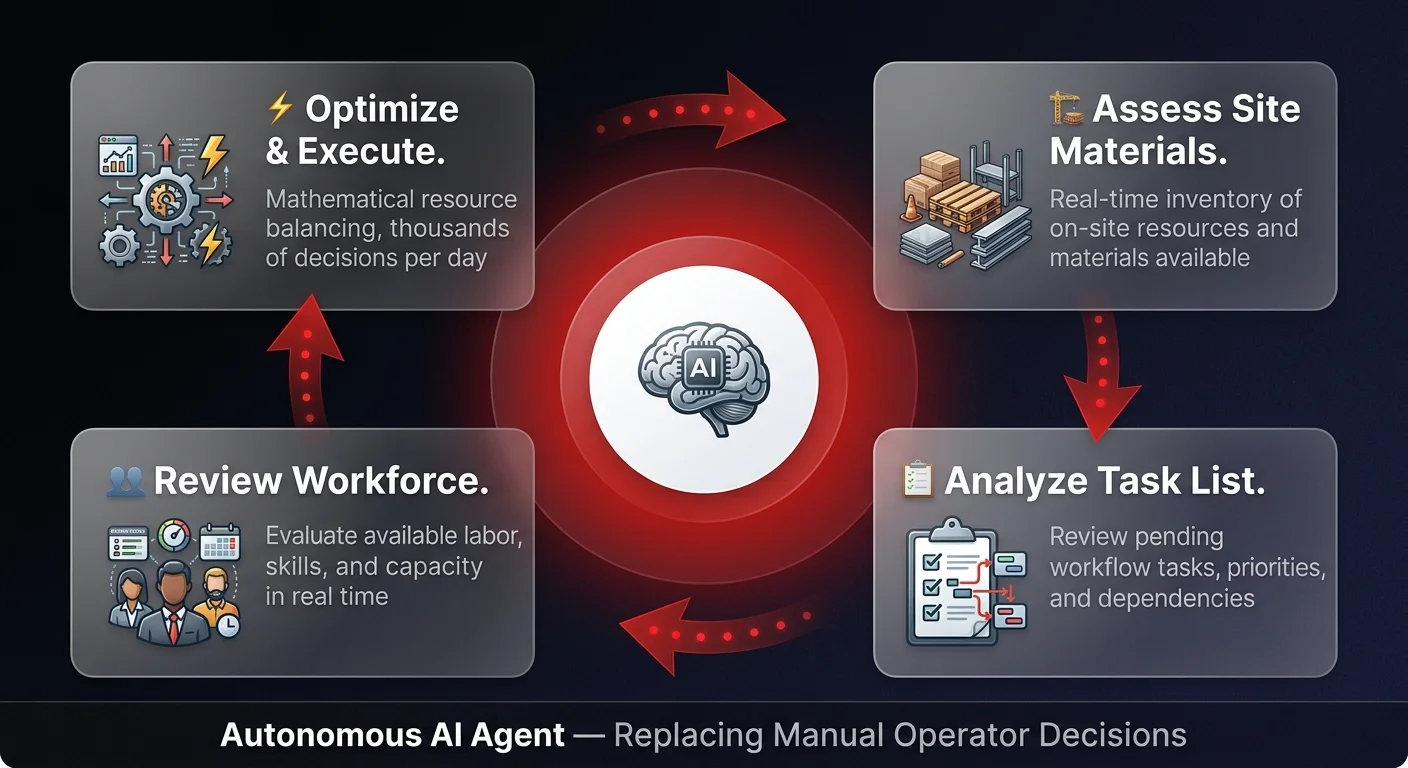
Because the labor pool is gone, organizations are being forced to make massive bets on autonomy. Leading industrial innovators are utilizing agentic workflow automation and reinforcement learning to actively remove humans from the loop - a pattern that mirrors how autonomous AI agents are scaling throughput across every sector.
Instead of relying on human operators to manually balance resources, autonomous AI agents are being deployed to execute short-interval control of construction and mining operations. These agents dynamically assess what materials are on site, analyze the pending task list, review the available workforce, and mathematically optimize the workflow. At the edge of production, algorithms are now making thousands of complex decisions a day - decisions that previously required teams of specialized engineers.
Cross-industry algorithmic parity
One of the most profound realizations in modern operational AI is that the mathematical logic required to automate heavy industry is not entirely unique to heavy industry. There is immense transferability in the underlying optimization algorithms.
Whether an AI agent is orchestrating a copper mine or managing a digital supply chain, the core logic is remarkably similar. The reinforcement learning models and resource-balancing algorithms utilized to run autonomous plants share architectural parity with the algorithms used in consumer ride-share optimization, digital loan underwriting, and programmatic ad bidding.
This cross-industry algorithmic parity is incredibly promising for mid-market operations leaders. It proves that you do not need 100 years of legacy heritage in a specific sector to deploy autonomous systems. The optimization math works across domains. If an agentic workflow can successfully balance the procurement lifecycle of a lithium refinery, a similarly architected system can absolutely automate vendor orchestration and supplier management, customer support triage, or pipeline generation in a mid-market enterprise.
The Tesla DNA: innovating archaic systems
Deploying these systems requires a specific cultural mindset - one popularized by companies like Tesla. Transitioning an operation from 150 scattered spreadsheets to agentic workflow automation requires an immense appetite for risk and a firm belief that archaic systems can actually be modernized.
Too often, organizations attempt to implement autonomous workflows, hit their first major integration roadblock, and immediately shelf the project. They isolate the AI experiment to a small innovation team that never actually influences core production.
To successfully deploy agentic workflows, leadership must force alignment. You have to ensure that the software engineers and AI builders sit directly alongside the operating teams on the floor. If the autonomous tools are not designed specifically for the culture and technical comfort level of the people doing the work, adoption will fail. You have to barrel through the operational friction and commit to the outcome.
Agentic workflow automation infrastructure: the sovereignty mandate
As organizations shift from using AI as a casual brainstorming tool to deploying agentic workflow automation as core operational infrastructure, the architectural requirements change completely. You cannot run a capital project lifecycle or automate procurement decisions using a fragile, multi-tenant SaaS wrapper.
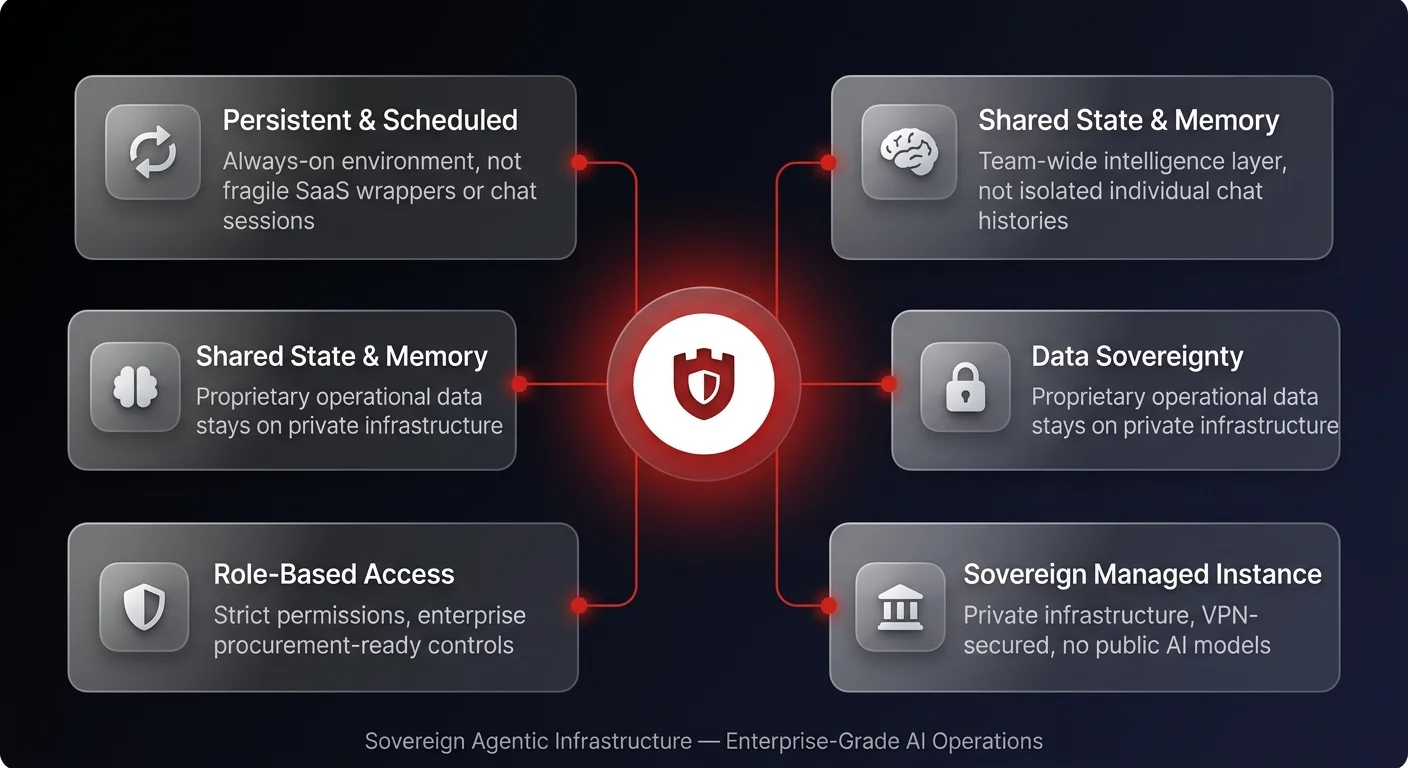
If AI agents are making thousands of critical operational decisions a day, they must be treated as company infrastructure. This requires a persistent, scheduled, and auditable environment. Agents must possess shared state and team memory, allowing multiple users to interact with a centralized intelligence layer rather than fragmented, individual chat histories.
Most importantly, this requires strict data sovereignty - the same principle driving the shift toward sovereign AI agent infrastructure across the enterprise landscape. The operating parameters of a refinery, the proprietary engineering schematics of a new product, and the internal supply chain logistics of a mid-market enterprise cannot be fed into public, ungoverned AI models.
Organizations require a sovereign managed instance. The agent infrastructure must be as private as a large language model running on your own localized server, accessible only via VPN, and secured with strict role-based access controls. This is the difference between a high-risk shadow AI experiment and production-grade operational infrastructure that easily passes enterprise procurement.
Moving beyond software as a service
The future of operations is not about paying per-seat subscription fees for software that your employees still have to manually operate. It is about fundamentally changing how many human operators you need to run your business.
When modern automated factories are built today, the labor cost differential between global regions often drops below 10 percent. Software and robotics have leveled the playing field. The competitive advantage now lies in who can build and orchestrate autonomous systems the fastest.
Whether you are rebuilding the American power grid or scaling a mid-market manufacturing company, the operational mandate is the same. You must eradicate the 150 scattered spreadsheets. You must capture embedded institutional knowledge before your specialized workforce retires. And you must deploy persistent, secure synthetic labor to manage the workflows that fall between the cracks of traditional software.
To truly transform your operations, you need production-grade hosting for the agent layer. Platforms like Trinity Cloud provide the sovereign infrastructure required to deploy autonomous reasoning agents safely. By moving away from fragmented tools and embracing governed agentic infrastructure, operations leaders can cut process bottlenecks, ensure strict data privacy, and scale their output without linearly scaling their headcount.