
AI agent implementation is the process of building the governed infrastructure layer - including workflow design, data access controls, action authority, custom evaluations, and audit trails - that connects foundation models to real enterprise operations. Organizations that master this implementation layer capture trillion-dollar workflow value; those relying on generic wrappers get squeezed out.
The battle for enterprise automation has shifted entirely. Mastering AI agent implementation is no longer just a technical hurdle - it is a fundamental restructuring of enterprise software economics. For years, the market believed the future of artificial intelligence was simply a story about smarter models or better prompts. But as organizations desperately try to move beyond basic chat interfaces, a stark reality is emerging. The true bottleneck for enterprise AI is not the underlying model, but the implementation layer that surrounds it.
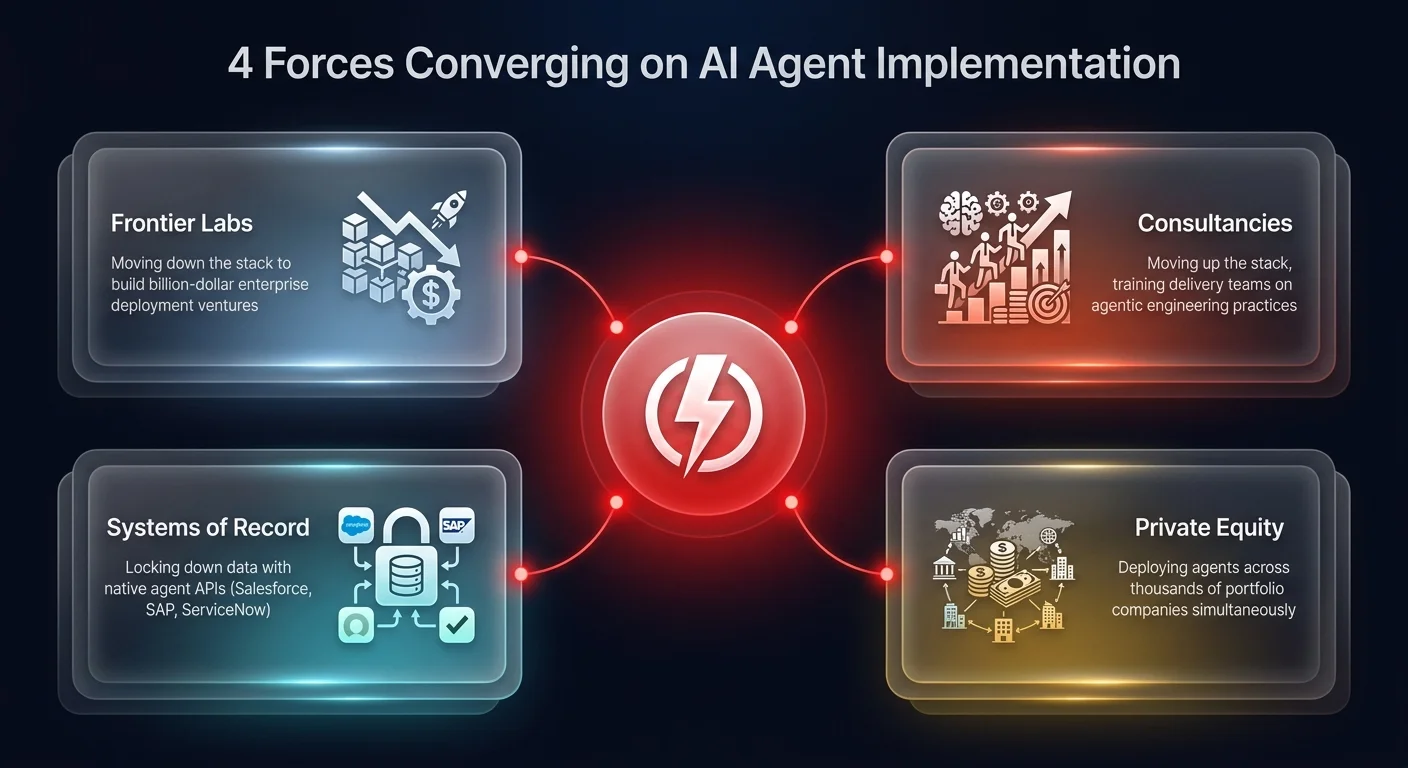
This shift is causing a convergence of massive market forces. Hyperscalers are finding out what doesn't work, traditional software companies are trying to figure out where disproportionate value lies, and finance is entirely rewriting what it believes the future model of software will be. All of these forces are squeezing the generic AI wrappers out of the market and placing a trillion-dollar premium on fully delegated, agentic workflows. Teams already navigating harness engineering for AI governance will recognize this as the logical next step.
Why AI agent implementation marks the end of generic SaaS
For a long time, private equity firms operated on a simple saying - all SaaS companies taste like chicken. From a balance sheet perspective, traditional SaaS companies all looked the same. They shared identical growth characteristics, predictable churn metrics, and standardized operating models. This made them ideal investment vehicles that could be bought, optimized, and sold on a predictable timeline.
Recently, however, those predictable SaaS growth metrics and profitability models have cratered. Traditional software vendors are struggling to make themselves relevant in a world where AI agents can increasingly execute the tasks those platforms were merely designed to track. This has put massive competitive pressure on investment firms. Many funds with 2026 and 2027 target dates are now wrestling with how to sell portfolio companies that were healthy a few years ago but are now structurally endangered by AI.
As a result, smart capital is heavily pivoting into agentic workflows. Private equity operating partners are actively testing the defensibility of their SaaS investments through what some call the weekend test - seeing if their internal engineering teams can replicate a platform's core workflow using Claude Code over a weekend. If an application can be rebuilt that quickly, its business model is effectively dead.
This realization is forcing a massive strategic reframe. The disproportionate value in the market is no longer in providing a generic interface. It is in getting an autonomous agent to reliably complete 100% of an entire workflow. Reaching that 100% completion rate at scale is a brand new phenomenon, and it requires a dramatically different approach to deployment. The pattern mirrors what we see with agentic workflows replacing traditional SaaS interfaces across every vertical.
The four massive pressures on AI agent implementation
If you are a CTO, an internal AI champion, or a builder trying to ship AI solutions into an enterprise environment today, you are operating inside a massive market squeeze. There are four distinct axes of pressure currently forcing the industry toward highly governed, custom agentic workflows.
Frontier labs are moving down the stack
Companies like Anthropic and OpenAI used to simply ship models via API and let the ecosystem build around them. That era is over. The labs have realized they cannot just sit in Silicon Valley conference rooms and talk about how easy AI is to implement. They are realizing that enterprise deployment requires forward-deployed engineers sitting in the weeds with customers.
Anthropic recently announced a deployment venture with Blackstone, Hellman & Friedman, and Goldman Sachs, backed by a reported one and a half billion dollars in capital. OpenAI is pursuing similar massive deployment ventures. When the companies building the frontier models tell you that the bottleneck is not their model, but the entire implementation layer around it, technical leaders need to take notes.
Consultancies are moving up the stack
Major consultancies like McKinsey, BCG, PwC, and Accenture are no longer just doing organizational change management. They are building deliberate agentic engineering practices. They are training delivery teams on production deployment patterns and wiring AI directly into enterprise operating systems. With decades of entrenched relationships with decision-makers, they are aggressively moving to capture the value of agentic workflows.
Systems of record are locking down data
Disrupting an established system of record has become incredibly difficult. Platforms like Salesforce, SAP, ServiceNow, and Workday are rapidly exposing structured APIs and agent frameworks designed specifically for AI to act inside their native systems. These vendors do not want a startup or a generic middleware tool sitting between their data and the customer's agent. They want the agent to call their platform directly, using their internal permissions and audit trails. This challenge of AI agent integration and governance is becoming the central technical problem for enterprise architects.
Private equity as bulk distribution
Private equity effectively owns and influences thousands of mid-market companies. These firms are desperate to extract more operational efficiency out of their portfolios. Because of this, PE has become a massive deployment channel. A firm can introduce a single, highly effective AI agent implementation partner across fifty different portfolio companies simultaneously, comparing results and standardizing efficiency playbooks. Vendor-by-vendor startup sales motions simply cannot compete with this distribution shape.
Defining the AI agent implementation layer
With everyone from hyperscalers to private equity converging on the same pot of gold, the market is paralyzed by choice. Every vendor claims their proprietary data access or custom prompt is the key to unlocking AI value.
But the real moat is not in the data alone, nor is it in the model. The true leverage point is the implementation layer - the harness that sits around the model and dictates how it interacts with the business. Generic intelligence only becomes valuable when it is firmly attached to the specific objects, policies, and actions that define real work.
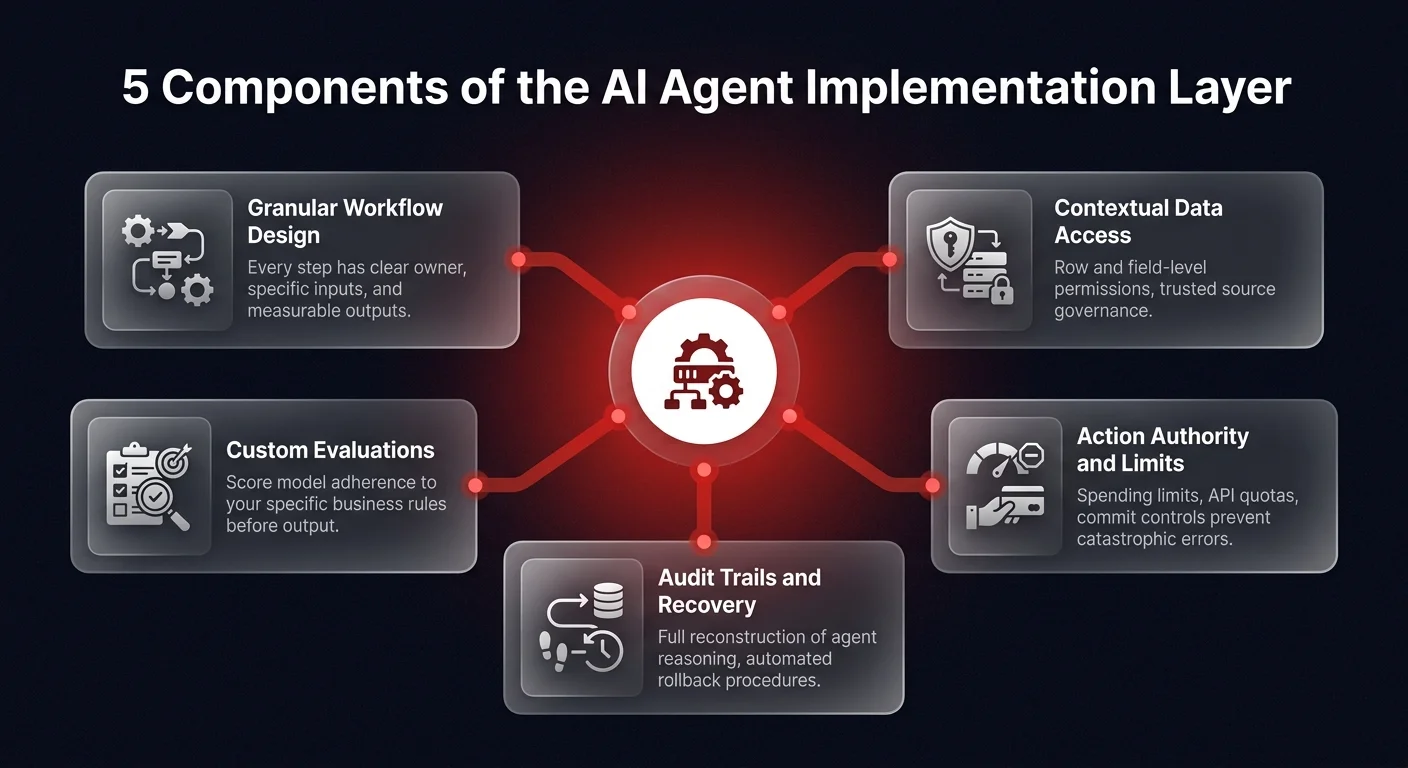
To build resilient agentic workflows, technical operators must construct an implementation layer that includes five non-negotiable components.
1. Granular workflow design
Workflow design is not writing a complex system prompt. It is a strictly defined process where every step has a clear owner, a specific input, and a measurable output. You must explicitly define which decisions the model is allowed to make autonomously, which steps require a human-in-the-loop, where the handoffs occur, and exactly what conditions must be met for a task to be counted as done. For organizations exploring this discipline, our operations automation solutions provide a practical framework.
2. Contextual data access
It is not enough to simply point an agent at a vector database. The implementation layer must govern exactly which sources of truth the agent can read and enforce permissions at the row and field level. A frontier model can produce a highly confident answer based on a stale, six-month-old PDF just as easily as it can from a live, authoritative database record. The implementation infrastructure dictates which source is trusted.
3. Action authority and limits
Reading data carries one risk profile - writing data or spending company money carries an entirely different one. The implementation layer must control exactly what the agent is allowed to do against target systems. This includes enforcing strict spending limits, API call quotas, and commit limitations that prevent catastrophic automated errors. Understanding the full spectrum of AI agent architecture and governance is essential here.
4. Custom evaluations (evals)
Evaluations are the way you score a model's adherence to your specific business rules before its output goes anywhere. Evals are not generic industry benchmarks. If an organization cannot clearly articulate the evals running inside their implementation layer, they have no functional way to guarantee whether their agent is actually performing its designated workflow safely.
5. Audit trails and system recovery
Enterprise agents must operate transparently. The harness must dictate exactly what gets logged and how an auditor can reconstruct the agent's reasoning after a failure. Furthermore, the implementation layer must define what happens when an agent makes a mistake, how an automated action gets reversed, and who holds ongoing ownership of the system's state. Without this, organizations face the growing problem of shadow AI sprawl and coordination debt.
Building sovereign infrastructure for AI agent implementation
These components - audit trails, role-based access control, persistent shared state, and strict action authority - are far too complex to be strung together over a weekend with raw code or consumer chat scaffolding. CTOs and internal AI champions at scaling companies are quickly realizing that agents are not just workflow glue - they are core company infrastructure.
For builders and engineering leaders, the choice is clear. You can attempt to build this massive implementation harness from scratch, exposing your organization to security risks and endless maintenance overhead, or you can deploy on purpose-built infrastructure. See how Ability.ai's IT service management solutions address the governance and access control challenges that make or break enterprise AI deployments.
The critical requirement is sovereignty. Enterprise AI infrastructure cannot be traditional multi-tenant SaaS. It must operate as a sovereign managed instance - as private and secure as running a frontier model on a local server in your own data center. Your server, your data, and your workflows, locked behind VPN-only access with enterprise-grade RBAC and audit logging built natively into the architecture.
The trillion-dollar opportunity in AI is no longer about accessing the smartest model. It is about securely wiring that intelligence into the deep, messy reality of your business operations. Organizations that master the AI agent implementation layer will redefine their industries. Those that rely on generic software wrappers will simply be squeezed out of existence.