
Autonomous AI agents are centralized, deeply integrated AI systems that operate as persistent company infrastructure - connected to your codebases, CI pipelines, and internal documentation to execute complex engineering tasks with full contextual awareness. Industry data from companies like Intercom shows these agents can double engineering throughput in under a year without doubling headcount.
The deployment of autonomous AI agents is forcing a paradigm shift in how technology organizations scale their engineering output. For the past two years, technical leaders have chased the promise of AI-driven productivity by distributing individual coding wrappers and autocomplete tools across their teams. Yet, despite the widespread adoption of these tools, most engineering departments have not seen a proportional increase in their actual shipping throughput.
Recent industry data from Intercom - a global SaaS company with 1,400 employees and a massive 15-year-old Ruby on Rails monolith - reveals exactly why this happens. After initially adopting a fragmented approach to AI tooling, they set an audacious goal: double engineering throughput without doubling headcount. They achieved this milestone in under a year, not by buying more SaaS tools, but by completely abandoning scattered coding assistants in favor of a unified, sovereign AI platform.
For CTOs and internal AI champions at mid-market companies, the findings present a clear architectural mandate. Multi-tool AI sprawl is a dead end. The future of engineering productivity relies on deploying a centralized, managed instance where AI operates as persistent company infrastructure. Organizations already navigating the shift from AI agent harnesses to enterprise automation will recognize this as the next logical step.
Why autonomous AI agents fail under multi-tool sprawl
When modern large language models first demonstrated coding capabilities, engineering teams became "omnivorous" in their tooling. Developers were encouraged to use their preferred editors and wrappers - some adopted GitHub Copilot, others moved to Cursor, and some experimented with tools like Augment.
While these tools provided localized, marginal improvements to developer experience, they failed to deliver compounding organizational benefits. The reason is structural. Disconnected AI tools operate in silos. They lack deep contextual awareness of a company's unique architecture, security standards, and historical decision-making processes.
This fragmentation leads to what engineering leaders call "model anxiety" - the inefficiency of spreading work across multiple disconnected providers. When an organization's intellectual property and workflow data are scattered across different third-party SaaS wrappers, the company cannot optimize the system or build durable, testable AI skills. To achieve a step-function increase in productivity, organizations must treat AI not as a lightweight scaffolding layer for individual developers, but as an operational platform for the entire engineering organization. This mirrors the broader pattern of ungoverned AI agents creating technical debt when deployed without centralized coordination.
Treating autonomous AI agents as company infrastructure
To double throughput, technology leaders must shift their architectural philosophy. Instead of renting individual seats for AI coding wrappers, organizations must deploy a centralized, managed instance that connects to everything.
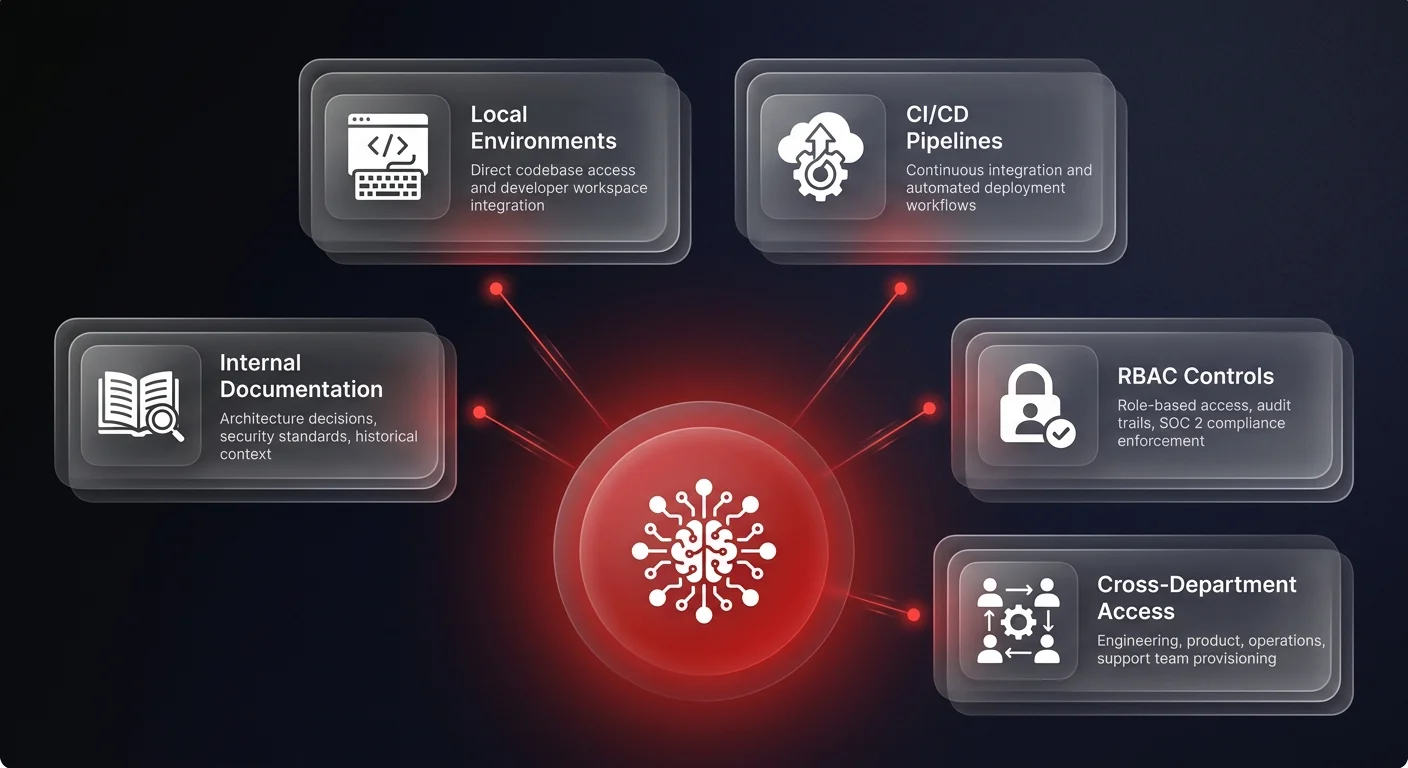
In a mature implementation, an autonomous agent acts like a senior engineer. It is connected to the same systems your developers use - local environments, codebases, continuous integration pipelines, and internal documentation. Naturally, this level of access requires rigorous enterprise controls, role-based access controls (RBAC), and strict permissions.
A sovereign managed instance allows you to safely connect AI to your private infrastructure. It provides a highly governed environment - as private as running a model on a local Mac Mini, restricted by VPN-only access - while retaining the compounding benefits of a shared platform.
When AI is centralized as infrastructure, the organization can build progressive, durable capabilities. Engineers can encode the company's specific security rules, testing standards, and architectural patterns directly into the agent's environment. The result is a persistent shared state where agents possess team memory and execute workflows exactly as a seasoned internal developer would. For teams exploring this architecture, our software development automation solutions provide a practical starting point.
From task prompting to problem delegation
When AI transitions from a localized tool to centralized infrastructure, how engineers interact with it fundamentally changes. They move away from granular "task prompting" and transition to "problem delegation."
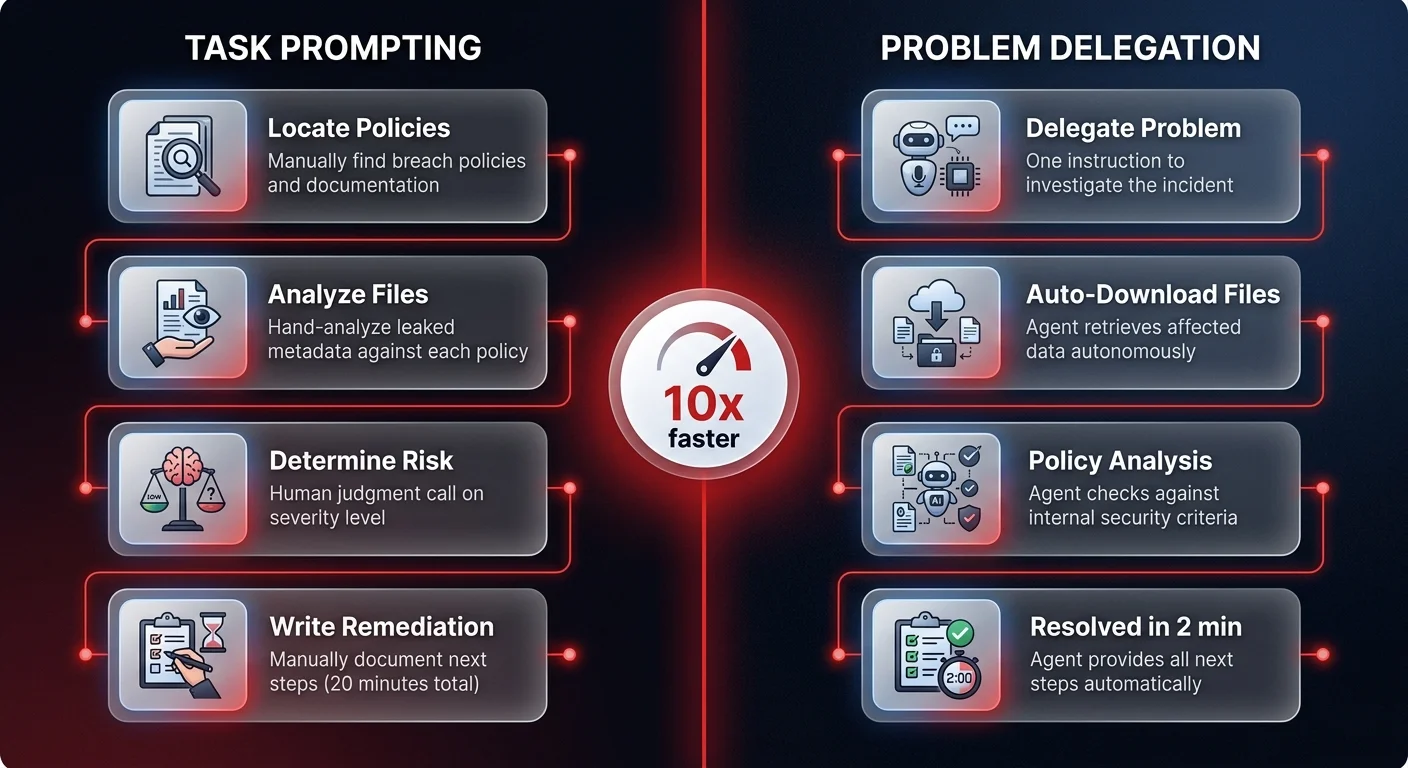
A powerful real-world example illustrates this shift. Consider a critical security incident where Snowflake table metadata is accidentally published to a public GitHub repository. In a traditional workflow, an engineer would need to locate the specific data breach policies, manually analyze the leaked files against those policies, determine the risk level, and outline remediation steps - a stressful, multi-step process taking at least twenty minutes.
However, when an autonomous agent is deeply integrated into the company's infrastructure, the engineer simply delegates the problem. They instruct the agent to join the relevant Slack channel and investigate. Without further prompting, the agent automatically downloads the affected files, analyzes them against the company's internal security criteria, determines the metadata is innocuous, and provides all necessary next steps. The entire incident is resolved in two minutes.
This level of autonomous reasoning cannot be achieved with basic workflow automation or isolated coding assistants. It requires an agentic runtime capable of multi-step reasoning, persistent state, and secure access to internal policy documentation.
Enterprise compliance without human bottlenecks
The most common objection CTOs raise regarding autonomous AI agents is compliance. How can a company maintain strict SOC 2, ISO 27001, and HIPAA certifications if an AI agent is independently resolving defects, updating infrastructure, and merging code?
The misconception is that enterprise compliance requires a "human-in-the-loop" for every action. In reality, auditors do not mandate manual human bottlenecks - they mandate rigorous, deterministic audit trails, strict access controls, and proven review mechanisms. The deeper challenge of AI agent architecture and governance lies in designing these controls from the ground up.
By leveraging a sovereign managed instance, organizations can automate deep approval processes safely. For instance, well-architected agent platforms can handle code review autonomously by back-testing the agent's decisions against historical incident data to ensure a high confidence level. When properly configured, these agents can reach automatic approval rates of nearly 20% on pull requests without degrading the environment or introducing new risk.
Because the agent platform logs every action, synchronizes all session transcripts to secure storage like Amazon S3, and enforces RBAC at the platform level, the environment remains fully compliant. In fact, replacing tired, error-prone manual code reviews with a deeply governed, perfectly consistent AI agent often reduces overall system risk. It is a level of operability that passes stringent enterprise procurement and ensures CTOs are not paged at 3:00 AM.
Defect deflation and quality acceleration
One of the most unexpected benefits of deploying a unified AI platform is the rapid deflation of historical technical debt. When engineers are equipped with an autonomous agent capable of solving complex problems, the speed at which defects are closed accelerates dramatically.
Tasks that engineering teams typically avoid - such as investigating and fixing thousands of flaky tests within a massive test suite - become highly suitable for agentic delegation. An engineer can assign the agent the goal of stabilizing the test suite. The agent works through a feedback loop, analyzes the failures, builds lookup tables of common issues, and systematically rewrites the specs. The output rivals the work of the most senior developers.
This continuous, automated refinement raises the overall quality of the codebase. Independent research from institutions like Stanford validates that when organizations deeply integrate autonomous AI platforms into their software development lifecycle, objective code quality metrics increase significantly. The agent is not just writing faster code - it is systematically paying down years of technical debt. See how organizations are achieving similar results with AI support agents and measurable CSAT improvements.
The cross-department virality of sovereign AI
While this architectural shift often begins in engineering, it rarely stays there. When a company deploys a unified agent instance, the capability curve becomes obvious to the rest of the organization. Non-technical departments - product managers, designers, customer support, and operations - quickly demand console access to automate their own workflows.
This cross-department virality validates the "one instance, every function" architecture. Instead of buying a separate AI tool for human resources, another SaaS wrapper for the sales team, and another platform for engineering, the CTO can provision role-based access from a single, sovereign managed instance. Product managers can use the agent to analyze user data and automatically generate product experiments, while operations leaders can use it to reconcile data across disparate systems. Organizations ready to extend this approach across departments can explore our operations automation solutions for a structured framework.
The managed instance imperative for CTOs
The mandate for technical leadership is clear. As the capability curve of artificial intelligence accelerates, the tools you use to harness it must mature. Renting per-seat licenses for disjointed SaaS wrappers is a temporary stopgap that introduces security risks, fragments your intellectual property, and ultimately fails to deliver the promised throughput gains.
To double engineering throughput - and eventually double the operational output of the entire company - CTOs must treat autonomous AI agents as core infrastructure. It requires a centralized platform that prioritizes data sovereignty, persistent shared state, and enterprise-grade auditability. The pattern of scaling AI agents with governance lessons from GitHub demonstrates how leading organizations have already made this transition successfully.
By deploying a production-grade managed instance, you are not just making your existing team marginally faster. You are fundamentally changing the architecture of how work gets done, replacing manual operator tasks with a sovereign, autonomous layer that drives real business outcomes.