
AI agent architecture is the structural design framework that determines how autonomous systems are organized, governed, and deployed to execute real business workflows - encompassing agent role specialization, API-first infrastructure, and governance layers that transform fragmented AI experiments into owned operational advantages. Over 60% of traffic on leading developer platforms is now machine-generated, signaling a fundamental shift in how applications are built and consumed.
A silent transformation is occurring at the infrastructure level of modern businesses. As organizations rethink their operational workflows, the focus is rapidly shifting toward proper AI agent architecture to handle this new reality. We are facing an unprecedented disruption in both how we build software and what we build. The era of humans clicking through endless SaaS dashboards is giving way to a new paradigm where autonomous agents are both the builders and the primary consumers of business applications.
For operations leaders caught between the ungoverned sprawl of Shadow AI and massive, slow-moving consulting projects, understanding this shift is critical. The companies that will thrive are those that pivot from buying generic software to building governed, sovereign AI systems that they own and control. For a detailed look at how architecture failures create silent operational breakdowns, see our analysis of AI agent architecture and governance patterns.
The economics of AI agent architecture: why building beats buying
Historically, the software market has been constrained by development costs. Imagine a circle representing all the software and workflow automations that should exist within a business. Until recently, we could only afford to build a small fraction of that circle. Countless internal processes - those requiring deep business context and complex conditional logic - were simply too expensive to automate using traditional engineering methods.
AI agents fundamentally alter this economic reality. Workflows that were previously unviable to automate are now easily within reach. This shift is driving what engineers are calling the SaaS-pocalypse - a wholesale rethinking of how organizations consume software.
Organizations are increasingly rejecting bloated software subscriptions with massive platform fees. Instead, they are asking a fundamental question: why rent generic software when we can own customized agents? This make-versus-buy shift allows companies to build specific, outcome-driven solutions without paying per-seat subscriptions for features they never use. By deploying sovereign AI agent systems, businesses retain complete control over their IP, their data, and their automation infrastructure.
Three proven AI agent architecture patterns for immediate value
When leaders hear about AI engineering, they often get distracted by complex, fully autonomous coding agents. However, the most immediate business value lies in low-hanging fruit - straightforward agent architectures that save millions of dollars without requiring massive organizational change.
Organizations succeeding in this space typically adopt a solution-first model. They begin with a tightly scoped starter project to prove immediate ROI before expanding. Here are three highly effective agent archetypes being deployed today.
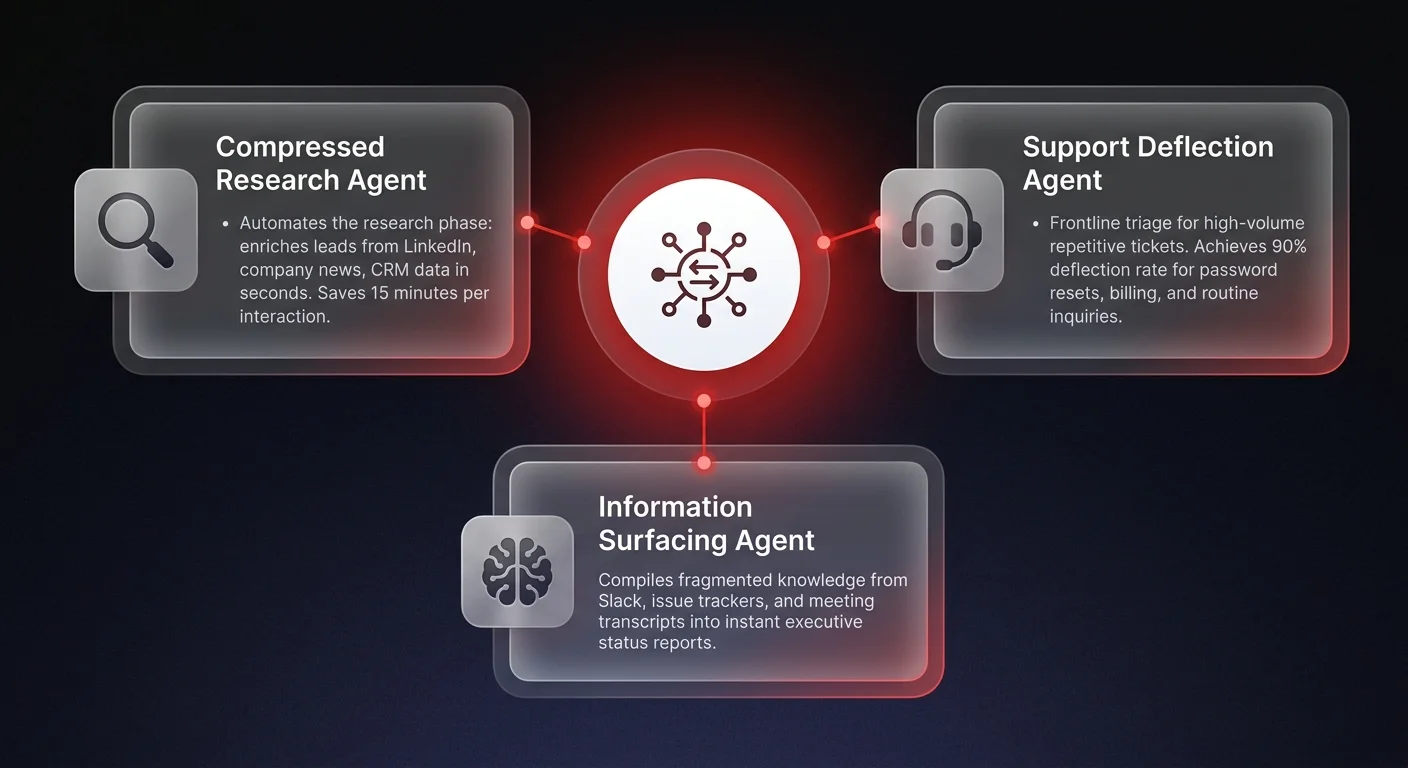
Agent archetype one: compressed research
Almost every business possesses processes that follow a specific, linear shape: a business event occurs, someone performs research, and then a human makes a decision.
Deploying a compressed research agent is one of the safest and most profitable AI implementations available. Instead of overhauling the entire workflow, you simply build an agent to handle the middle step. The process remains the same, and the human remains the final decision-maker, which keeps the organizational risk profile near zero.
For example, when an inbound lead submits a contact form, an agent can instantly scrape the prospect's LinkedIn profile, analyze the company's size, check recent news, and route the enriched dossier to the correct sales representative. A task that previously took a human 15 minutes of manual browser toggling is compressed into seconds. When multiplied across 100,000 interactions a year, the cost savings are astronomical. This is exactly the kind of workflow that sales intelligence automation is designed to handle at scale.
Agent archetype two: frontline support deflection
Support and operations teams are frequently bogged down by high-volume, low-complexity toil. Implementing an agent layer between the customer and the human team can drastically alter operational overhead.
Recent implementations of advanced in-house support agents have achieved real-time deflection rates as high as 90%. By handling password resets, billing inquiries, and basic troubleshooting, the AI handles the repetitive noise. Organizations deploying customer support automation report dramatic improvements in both resolution speed and team satisfaction.
Interestingly, the greatest benefit of this architecture isn't just cost reduction - it is employee retention. When human agents are freed from mind-numbing repetition, job satisfaction explodes. They are finally able to focus on high-stakes escalations and complex relationship building.
Agent archetype three: internal information surfacing
Corporate knowledge is notoriously fragmented. Vital information is trapped in Slack channels, issue trackers, meeting transcripts, and fragmented documents. When a manager needs a status update, a human typically has to spend an hour hunting down context.
Information surfacing agents act as an intelligent layer over an organization's existing data silos. By integrating with secure, governed infrastructure, these agents can instantly compile status reports, update stale issue trackers based on meeting transcripts, and retrieve historical context. They utilize information that already exists but is practically unusable due to human bandwidth constraints.
Designing AI agent architecture for machines, not dashboards
As organizations build out this new application layer, the fundamental nature of technology infrastructure is changing. When AI agents become the primary consumers of your web properties and internal tools, traditional user interfaces become secondary.
Forward-thinking engineering teams are already speed-running this transformation. When evaluating new internal tools or infrastructure, the first question is no longer about the dashboard - it is about the API and the command line interface. User interfaces are becoming the cheapest, least important part of the stack. If a tool cannot be seamlessly operated by an autonomous agent via an API, it is rapidly becoming obsolete.
Confronting the security crisis in AI agent architecture
With this rapid acceleration comes severe risk. The AI industry is currently marching toward a security crisis reminiscent of the early internet in 1999 - an era where everything was interconnected but fundamentally vulnerable.
Many organizations are currently suffering from Shadow AI governance failures. Employees are pasting sensitive data into public models, utilizing ungoverned browser extensions, and deploying poorly architected agent frameworks.
One of the most critical architectural flaws in popular, off-the-shelf agent harnesses today is the failure to separate the execution environment. Running the agent's cognitive harness in the same environment as the code it generates creates massive security vulnerabilities. Leading AI labs have recently validated this concern, pushing for strict isolation models in agent deployments.
This is why data sovereignty and centralized governance are non-negotiable. Enterprise automation requires a professional, middle-ground approach. Solutions must be deployed on battle-tested infrastructure - utilizing secure workflow orchestrators and enterprise-grade environments - to ensure that sandbox environments are fully isolated and corporate data never leaks back into public training models. See how organizations are building operations automation infrastructure with governance built in from day one.
Model commoditization and the future AI agent architecture layer
There is a common misconception that to leverage AI, you must be tethered to a specific foundational model. In reality, the foundational models themselves - whether from OpenAI, Anthropic, or Google - are rapidly commoditizing.
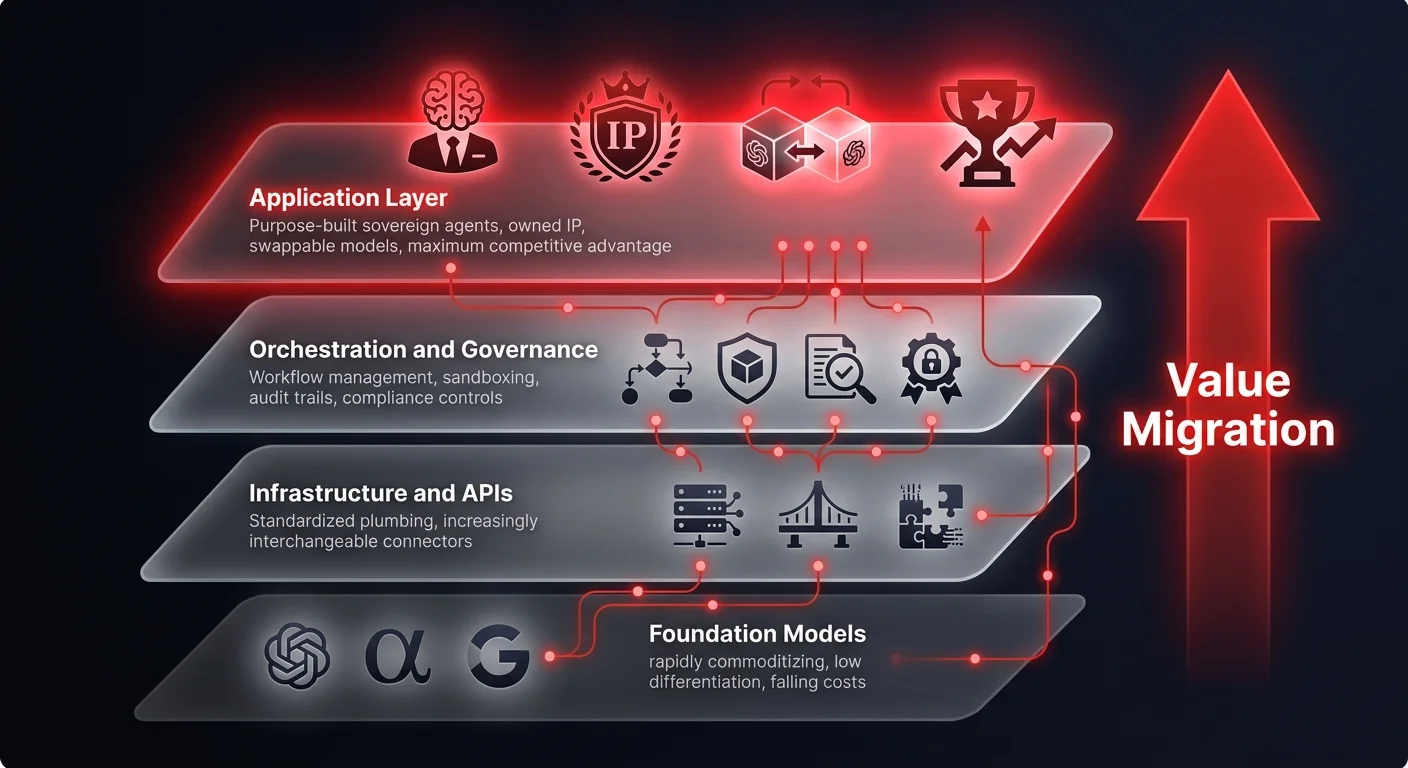
As infrastructure costs plummet and model performance normalizes across providers, the true business value is migrating upward to the application layer. The winners in the next decade of operations will not be the companies that build the smartest underlying models. The winners will be the organizations that build the most stable, governed, and effective agent orchestration layers on top of those models.
This decoupling means that organizations do not have to predict which tech giant will win the AI race. By building a robust, agnostic architecture, businesses can swap models in and out as pricing and capabilities fluctuate, ensuring they always have the most cost-effective intelligence powering their internal systems.
Moving from experimentation to governed AI agent architecture
We are still in the early innings of the AI engineering revolution. The transition from manual operational toil to governed AI systems is not a massive, multi-year consulting gamble - it is a series of strategic, highly focused technical deployments.
The most successful operations leaders are sidestepping the hype. They are avoiding the trap of Shadow AI sprawl, refusing to pay endless SaaS platform fees for generic wrappers, and instead focusing on custom, sovereign AI systems that drive actual business outcomes.
By starting with a focused internal use case - like automating the research phase of a high-volume operational workflow - companies can prove immediate value. From there, it is simply a matter of scaling that governed architecture across the enterprise, transforming fragmented AI experiments into a long-term, owned operational advantage.