
AI software economics is the study of how artificial intelligence is dismantling traditional software value chains, pricing models, and competitive moats. As AI agents replicate SaaS features in days instead of years, the five-to-ten-year lifecycle of enterprise software has collapsed to weeks - forcing a fundamental rethink of how organizations buy, build, and own their technology stack.
The fundamental rules of technology are undergoing a massive dislocation, fundamentally rewriting AI software economics for the modern enterprise. For the past decade, business leaders have operated under a predictable set of assumptions regarding software procurement, competitive advantage, and operational efficiency. If you bought a top-tier SaaS product, you could expect a five to ten-year lifecycle of utility.
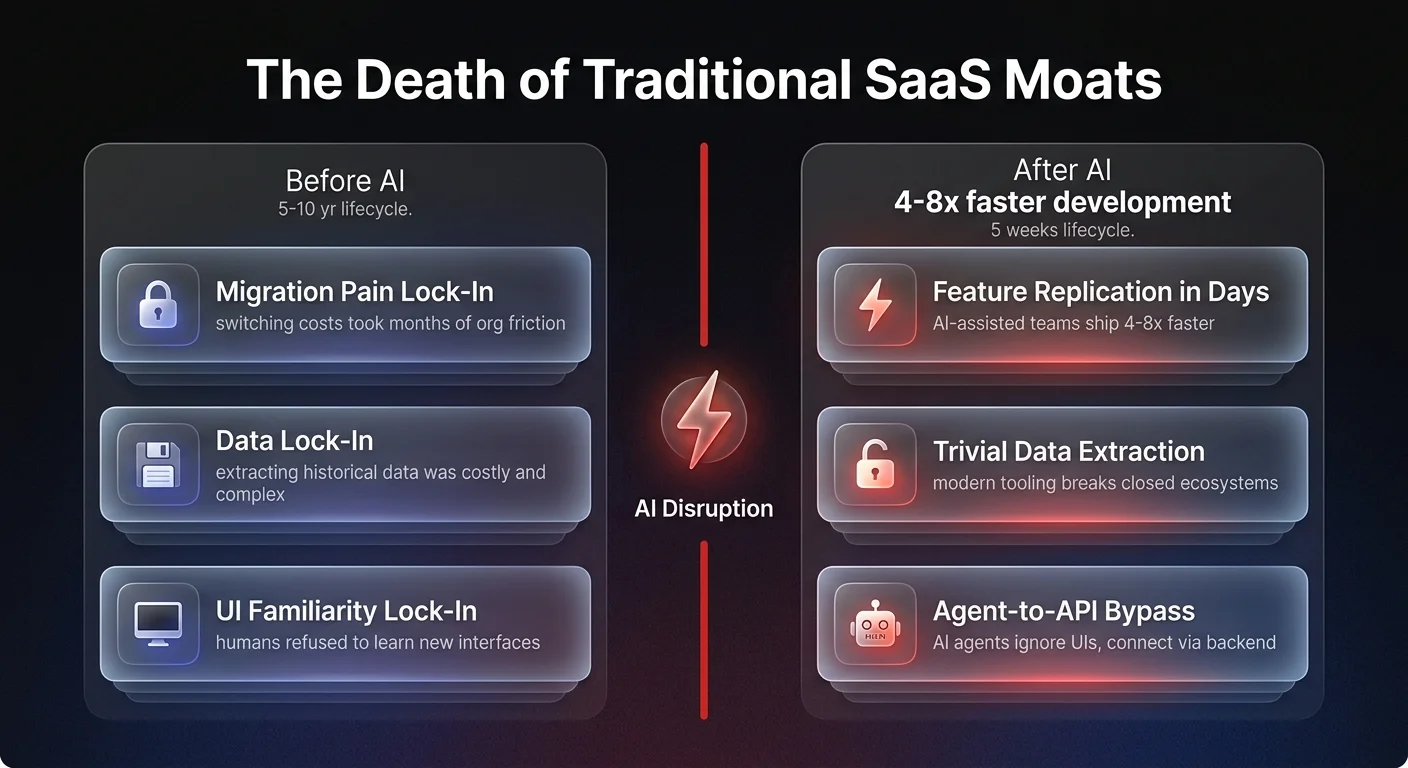
Today, that lifecycle might be reduced to five weeks.
We are currently witnessing what industry insiders are calling the "SaaSpocalypse" - a rapid erosion of terminal value for traditional software companies. For mid-market CEOs, COOs, and operations leaders, this shift presents both an existential threat and an unprecedented opportunity. The organizations that thrive will be those that understand the new laws of software physics and transition away from fragmented shadow AI experiments toward owned, governed sovereign AI agent systems. For a deeper look at how this disruption is reshaping the SaaS landscape, see our analysis of the enterprise AI agents and the SaaSpocalypse.
How AI software economics rewrites the laws of development
To understand the current dislocation, we must first look at the axiomatic laws of software development that have historically governed the industry. The most famous of these was coined by Fred Brooks in The Mythical Man-Month: you cannot throw money at a delayed software project to speed it up. Nine women cannot have a baby in one month. If your product was two years behind a competitor, hiring a thousand engineers would not close the gap.
That law is now entirely obsolete.
Today, you can absolutely throw money at a software problem. If an organization has sufficient capital and access to high-quality data, they can purchase enough GPU compute power to solve almost any software engineering challenge at record speed. According to a16z's 2025 infrastructure report, AI-assisted development teams are shipping features 4-8x faster than traditional engineering organizations. Competitors can replicate complex code bases in days rather than years.
This reality fundamentally alters the buy-versus-build calculus for enterprise operations. When features can be spun up instantaneously by anyone with compute power, paying massive subscription premiums for basic software functionality becomes an active drain on your bottom line. Organizations already exploring the outcome economy and AI business model shifts understand that value is migrating from software access to operational execution.
The death of user interface and data lock-in
Historically, software possessed a 9/10ths of the law advantage once it was installed in an organization. Software companies relied on three massive moats to retain customers:
- The migration pain lock-in: The sheer organizational friction of moving from one platform to another.
- The data lock-in: The difficulty of extracting historical data from closed ecosystems.
- The user interface lock-in: The reality that human employees refuse to learn a new UI once they are comfortable with an existing one.
In the era of AI, these moats are dead.
Code is easily replicated, and data extraction has become remarkably straightforward with modern tooling. But most importantly, the future of enterprise software does not involve humans clicking buttons on a screen. The next generation of software interaction will be agent-to-software.
AI agents are incredibly flexible regarding how they interact with systems. They do not care about a clunky UI; they bypass it entirely to interact via API or backend connections. When humans are no longer the primary operators of your software stack, UI lock-in completely vanishes. Gartner estimates that by 2028, 33% of enterprise software interactions will be handled by AI agents rather than human users. This underscores why forward-thinking companies are moving away from paying per-seat platform fees for SaaS tools and instead building autonomous systems that orchestrate workflows silently in the background. Companies concerned about the risks of this transition should review how AI vendor lock-in risks compound when organizations delay the shift to owned infrastructure.
The dirty secret of agentic workflows
It is easy to assume that because foundation models are incredibly powerful, they will magically solve all operational bottlenecks. However, there is a stark difference between a neat AI feature and a defensible operational product.
Consider corporate travel management. A consumer might easily use ChatGPT to build a generic itinerary, but deploying an agentic travel workflow for an enterprise is vastly more complex. To execute a real business outcome, the system must navigate exclusive corporate vendor relationships, connect natively to rigid legacy budgeting software, ensure compliance with company travel policies, and route approvals to the correct travel managers.
Major foundation model providers have absolutely no interest in building deep, localized channels to your specific HR department or your niche legacy ERP system. They provide the reasoning engine, but the "last mile" of operational execution is left entirely to you. McKinsey's 2025 AI adoption survey found that 74% of enterprise AI pilots stall at exactly this integration layer.
This is precisely why massive consulting projects often fail to deliver ROI, and why employees resort to ungoverned shadow AI out of frustration. To actually achieve business outcomes, organizations require a solution-first approach. By starting with a highly focused starter project - a fixed scope, fixed cost initiative delivered in weeks - companies can bridge the gap between raw LLM intelligence and their messy, real-world legacy systems. Explore how operations automation solutions are already applying this pattern to reduce time-to-value from months to weeks using open-source orchestration platforms and custom-fit workflows.
The impending outbound communication crisis
Perhaps the most immediate operational crisis facing modern business leaders is the total collapse of traditional communication channels.
In the past, generating a highly personalized, well-researched sales email or phone call required significant human labor. That labor cost acted as a natural friction point against infinite spam. Today, anyone armed with a generic AI model can scrape LinkedIn, cross-reference corporate data, and generate thousands of hyper-personalized messages at zero marginal cost.
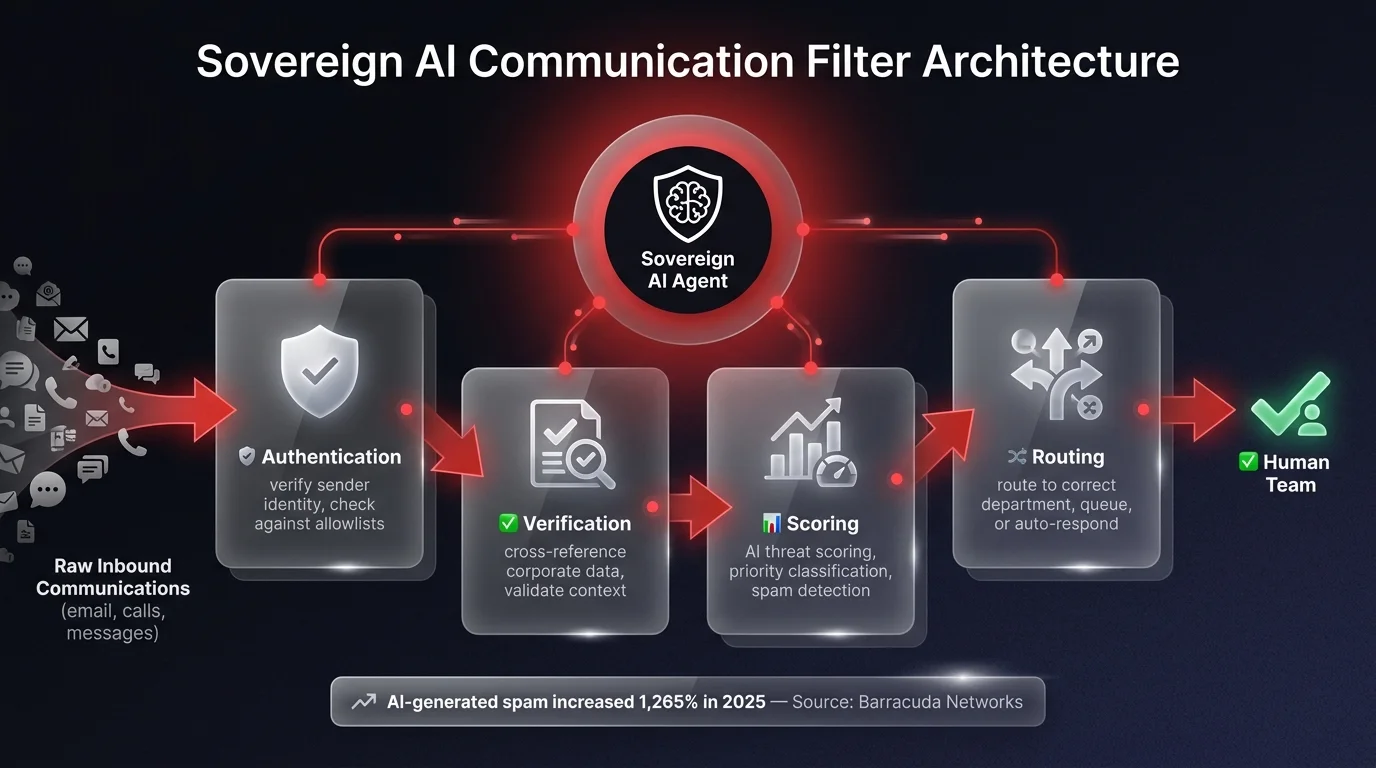
We are rapidly approaching a state where corporate email inboxes function as public to-do lists with open write access for the entire world. When every vendor, recruiter, and competitor can instantly mimic the intimacy of a personalized human connection, inbound communication becomes completely unusable. According to Barracuda Networks, AI-generated phishing and spam emails increased 1,265% in 2025 alone.
For Sales, Marketing, and Customer Support leaders, this means your employees will soon be buried under an avalanche of synthetic noise. Organizations must deploy their own defensive AI architecture to survive. Sovereign AI agent systems are now required to sit at the perimeter of your operations - authenticating, verifying, scoring, and routing inbound communication before it ever touches human bandwidth. Without intelligent support triage and lead enrichment automation, your human capital will be entirely consumed by responding to competitor bots.
Navigating physical infrastructure bottlenecks in AI software economics
While the software landscape shifts, the physical constraints of AI cannot be ignored. The demand curve for AI compute is essentially a vertical line, but the physical supply chain required to support it is severely constrained.
We are facing critical bottlenecks across the entire physical stack. It is not just about securing Nvidia chips; there are massive shortages in server RAM, specialized manufacturing capacity, and perhaps most critically, electricity. Data centers are exhausting grid capacities, and fundamental components like power transformers - a technology that has barely changed since the invention of the electrical grid - are in critical shortage. The International Energy Agency projects that global data center electricity consumption will double by 2028, reaching over 1,000 TWh annually.
For mid-market companies, these infrastructure bottlenecks present a unique risk. Relying entirely on shared, public cloud AI infrastructure means your critical operational workflows are at the mercy of global supply crunches and throttling. This is a key reason why serious enterprises are transitioning toward sovereign AI agent systems deployed securely within their own controlled environments. Owning the deployment architecture ensures that when external compute resources become scarce or expensive, your core operational workflows remain protected, governed, and highly available.
The shadow AI wildcard accelerating SaaS erosion
The collapse of SaaS moats is not only driven by external market forces - it is accelerated from within by shadow AI. When employees find that a free AI tool can replicate 80% of what their company pays thousands per month for in SaaS subscriptions, they stop using the official tool. This creates a dangerous feedback loop: reduced usage weakens the SaaS vendor's retention metrics while simultaneously exposing the organization to ungoverned data flows.
The pattern is well-documented. Frustrated teams build personal AI automations that bypass approved software entirely, creating the exact shadow AI risks and lethal trifecta that governance teams fear most - exposed API keys, unmonitored data processing, and zero observability into sensitive information leaving the organization.
The solution is not to ban these experiments but to channel them into governed infrastructure. By providing teams with a centralized, secure automation platform, organizations can capture the productivity gains of AI while maintaining control over data, credentials, and compliance.
Moving forward: owning your operational outcomes
History has shown that periods of massive technological dislocation are always frightening, but they inevitably lead to better, more efficient ways of working. In the 18th century, over 90% of the population worked in agriculture; today, that number is in the low single digits, and the global standard of living has skyrocketed.
AI will not end operations work - it will elevate it.
The challenge for business leaders today is to stop playing by the old rules of software economics. Stop relying on SaaS vendors to dictate your operational workflows through rigid interfaces. Stop paying exorbitant platform fees for tools that are rapidly losing their competitive moats. And most importantly, stop allowing employees to risk your corporate data through ungoverned shadow AI experimentation.
The path forward is clear. Operations teams must adopt a land-and-expand approach, utilizing focused starter projects to solve immediate, specific pain points - whether that is automating candidate screening in HR, triaging support tickets, or orchestrating complex supply chain data.
By taking control of the AI deployment layer, organizations can transform disjointed, expensive software stacks into a unified, sovereign AI agent system. The new laws of tech economics reward those who own their intelligence, control their data, and focus ruthlessly on operational outcomes.