
Enterprise AI agents are governed, autonomous systems that execute specific business workflows using AI intelligence, replacing off-the-shelf SaaS platforms with outcome-driven automation. Organizations deploying sovereign enterprise AI agents are building proprietary competitive advantages that generic software cannot replicate — while those clinging to beta SaaS face an existential threat as the market undergoes a fundamental restructuring.
We are witnessing a fundamental restructuring of business technology. The era of buying off-the-shelf software to solve operational problems is ending, replaced by the rapid deployment of enterprise AI agents tailored to specific business outcomes. For CEOs and COOs, this transition — increasingly referred to as the SaaS-pocalypse — presents both a massive opportunity and a critical governance challenge.
The traditional enterprise software model is fracturing. For decades, organizations purchased standard applications, inadvertently molding their internal processes to match their competitors. Today, AI enables the creation of hyper-specific, outcome-driven systems. But this shift brings a hidden danger: unmanaged, bottom-up AI adoption is creating a web of security and operational risks.
To survive this transition, operational leaders must shift their mindset. They must move from buying generic tools to deploying governed, sovereign AI agent systems that transform fragmented experiments into reliable, observable logic.
The SaaS-pocalypse: the death of beta software
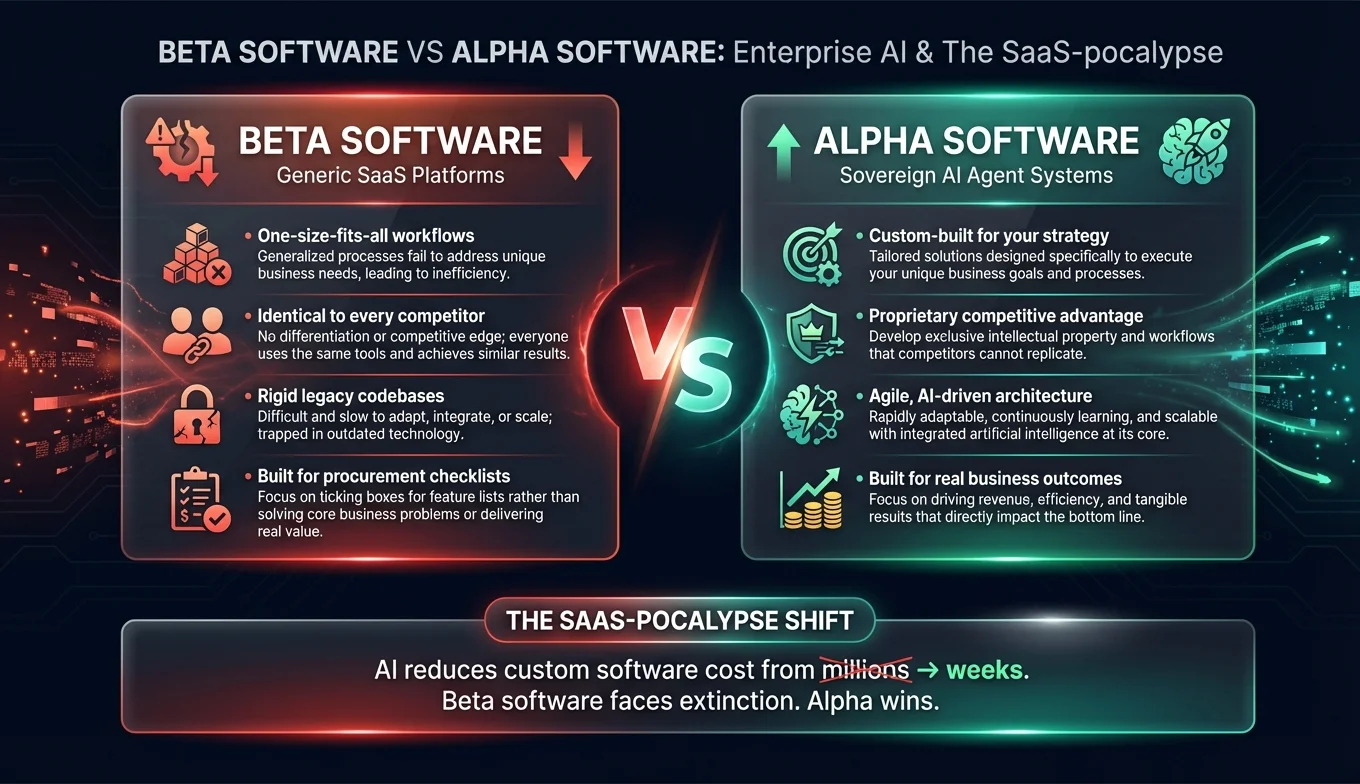
To understand the current enterprise technology landscape, we must divide software into two distinct categories: beta and alpha.
Beta software is standard issue. It is the generic SaaS platform, the massive ERP implementation, and the standard CRM workflow. Beta software makes your operations identical to everyone else in your industry. The historical feedback loop for the software industrial complex has always been about sellability, not necessarily true value creation. Vendors built features that looked good on a corporate procurement checklist, resulting in bloated systems that force companies into rigid, generalized workflows.
The fragility of beta software becomes glaringly obvious during periods of rapid disruption. Consider the operational pivots required during sudden market shifts or global supply chain crises. Historically, multi-million-dollar beta implementations have fallen over like paper tigers when forced to adapt instantly. They simply lack the agility required for modern market dominance.
Alpha software, on the other hand, is built to express a unique competitive advantage. It is the digital manifestation of your proprietary strategy. Until recently, building alpha software was prohibitively expensive for most mid-market and scaling companies, requiring massive engineering teams and years of development.
The advent of advanced AI has fundamentally altered this equation. Through AI-assisted development and intelligent agent workflows, companies can now generate software and systems specific to their unique operational needs. As we analyzed in why SaaS is facing an existential crisis from AI agents, the platforms focused on delivering alpha will capture the market — while beta software faces extinction. The threat is not incremental; it is structural.
Consolidation breeds conformity in enterprise tech
Before the current AI revolution, the enterprise software market experienced decades of massive consolidation. Much like the historical consolidation of industrial manufacturing which reduced dozens of agile innovators down to a handful of massive prime contractors, the tech sector saw a few mega-vendors swallow up specialized tools.
The conventional explanation was that consolidation provided efficiency and seamless integration. The reality, however, is that consolidation bred conformity.
When a few massive vendors control the operating systems of global business, innovation stagnates. These mega-vendors shifted their focus from aggressive engineering and problem-solving to financial engineering, dividend payouts, and shareholder metrics. The heretical thinkers — the brilliant engineers who wanted to build entirely new paradigms — were pushed out in favor of predictable, incremental updates.
This dynamic created the exact vulnerability that enterprise AI agents are now exploiting. Because the mega-vendors stopped delivering true operational alpha, they left the door wide open for agile, AI-driven solutions that actually solve specific, complex business problems without the bloat of legacy codebases.
The rise of the latent heretic: bottom-up AI adoption
As the barrier to creating custom software drops, a new dynamic is emerging within organizations: the explosive rise of bottom-up AI adoption driven by frontline domain experts.
Every organization has latent heretics — highly capable operators in marketing, sales, customer support, and operations who deeply understand their domain but have historically been constrained by bureaucratic IT roadmaps. Ten years ago, if an operations manager had a brilliant idea to optimize a workflow, they had to build a slide deck, pitch a program manager, and wait eighteen months for an engineering sprint that might never happen. Because they were smart and valued their time, they rarely bothered.
Today, that same operations manager can use AI to build the solution themselves in two weeks. They are bypassing the traditional procurement and development cycles entirely. This is happening because the stakes for these operators are immediate and high. They are not building for marginal efficiency; they are building tools to win large deals, resolve critical customer issues, and hit aggressive revenue targets.
We see this exact pattern mirrored in the most high-stakes environments globally, including defense and logistics, where frontline operators are rapidly deploying custom AI applications because the outcome is binary. In the enterprise space, this translates directly to dominating your sector versus slowly losing market share to more agile competitors.
Shadow AI risks: the enterprise AI governance crisis
While this explosion of bottom-up innovation proves the incredible value of custom AI, it introduces a terrifying reality for executive leadership. When every ambitious operator in your company is building their own AI workflows, integrating disparate corporate data sources, and utilizing unvetted commercial models, you are facing a massive governance crisis.
This is the modern manifestation of shadow AI — ungoverned agents running critical business processes on local machines or unauthorized cloud environments. It is no longer just employees quietly pasting sensitive text into public chatbots to write emails. It is complex, autonomous systems processing confidential data outside any security perimeter.
For a scaling company, this creates unacceptable operational complexity and data security risks. If a frontline sales manager builds a highly effective but completely ungoverned AI agent to process confidential customer contracts, what happens when that manager leaves the company? Where does the proprietary data go? How does the executive team audit the logic the agent used to approve a massive pricing discount?
The solution is not to stifle this innovation by forcing ambitious employees back into rigid beta software. The solution is governed agent infrastructure.
To scale safely, organizations must provide a secure, centralized environment where these custom workflows can be built, observed, and managed. This requires absolute data sovereignty — ensuring that your proprietary data and the unique logic of your alpha systems remain entirely under your corporate control. By implementing observable logic, COOs and operations leaders can audit exactly how an AI agent arrived at a decision, turning fragmented, risky AI experiments into reliable, governed operational systems.
If you are ready to move from shadow AI chaos to governed infrastructure, our enterprise AI agent deployment practice specializes in exactly this transition — building sovereign agent systems that your team controls end-to-end.
Mixed mammal-AI teaming: building the Iron Man suit
A pervasive and dangerous myth in the broader technology industry is the singular focus on artificial general intelligence and total human replacement. Many technology labs view the inability to completely replace a human worker as a failure of the model. This is a purely aesthetic pursuit, not a practical business strategy.
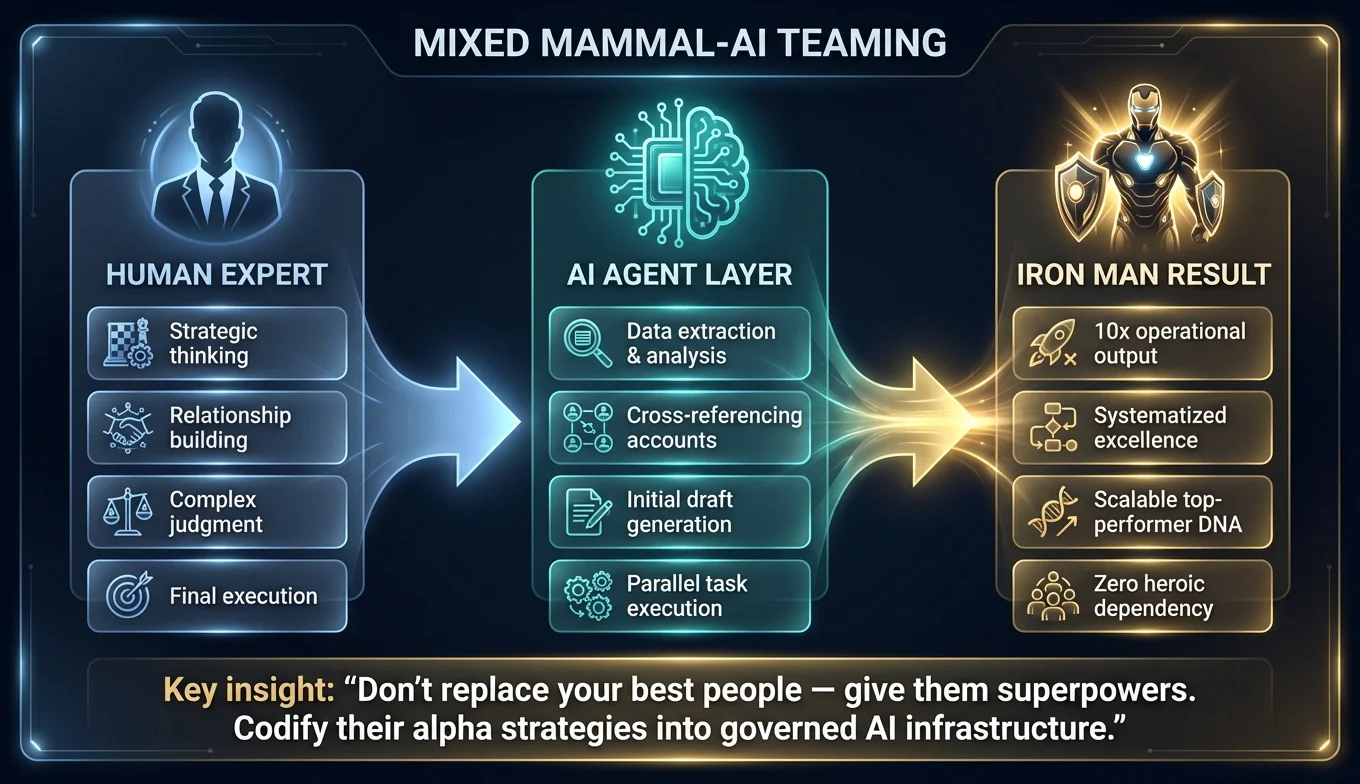
Pragmatic business leaders do not invest in enterprise AI agents simply to fire their sales teams or operations staff. They invest in AI to completely dominate their industry. The most effective deployment of enterprise AI agents follows a model of mixed mammal-AI teaming.
Instead of trying to replace your best people, use enterprise AI agent systems to build an Iron Man suit for them. Take your top-performing sales executive or your most brilliant customer support strategist and give them operational superpowers. An AI agent can handle the rote data extraction, the complex cross-referencing of historical accounts, and the initial drafting of bespoke solutions. This allows the human operator to focus entirely on high-leverage strategy, complex relationship building, and final execution.
This approach also systematizes excellence across the enterprise. By building observable AI agents that mimic the workflows of your top performers, you raise the baseline capability of your entire organization. As we explored in why enterprise AI agents behave like capable but unsupervised interns, you are no longer reliant on the heroic, unscalable efforts of a few talented individuals — you have codified their alpha strategies into your governed infrastructure.
Value accrual: why infrastructure matters
As the SaaS-pocalypse accelerates, executive leaders must clearly understand where value is actually accruing in the new technology stack. The market is aggressively commoditizing generic AI applications — the thin wrappers built around public models that offer no unique proprietary workflow and force companies back into a beta software mindset.
Economic value is consolidating at two extremes: the underlying compute hardware, and the AI infrastructure layer.
For mid-market and scaling enterprises, the AI infrastructure layer is where the battle is won. This is the layer that provides the necessary ontology, the governance frameworks, and the secure environment needed to deploy custom agents at scale. If you are investing heavily in generic AI applications that simply summarize text or generate standard marketing copy, you are buying the beta software of the future. You are investing in tools that your competitors can purchase for the exact same price, yielding zero strategic advantage.
True value creation requires investing in robust agent infrastructure that allows you to deploy sovereign enterprise AI agents tailored to your specific business outcomes. This infrastructure must integrate deeply with your proprietary data while maintaining strict security, role-based access controls, and total observability. The risks of not doing this — becoming locked into a single vendor's ecosystem — are significant, as we detailed in our analysis of AI vendor lock-in risks every CEO must understand.
How enterprise AI agents secure your operational future
The shift from rigid SaaS platforms to dynamic enterprise AI agent systems is not a distant future prediction — it is an active, aggressive market reality. The companies that cling to beta software will inevitably find themselves outmaneuvered by competitors who have embraced the agility and power of custom, alpha-generating AI.
However, the rush to adopt AI must be matched by a rigorous commitment to operational discipline. Allowing shadow AI to proliferate unchecked across your organization will result in fragmented data silos, catastrophic security breaches, and unscalable business processes.
The mandate for modern business leaders is clear. You must empower your domain experts to build and innovate, but you must do so within a framework of strict governance.
By deploying sovereign enterprise AI agents with observable logic, you transform the chaotic, risky energy of bottom-up AI adoption into a scalable, secure, and uniquely powerful operational engine. The enterprise software market has fundamentally changed, and the future belongs entirely to those who choose to build their own alpha.