
The outcome economy is a business model shift where companies pay for results — resolved tickets, completed tasks, and delivered outcomes — rather than software seats or user licenses. AI-native companies are leading this transition, generating $500,000 to $1 million in Annual Recurring Revenue per full-time employee — more than double the SaaS-era benchmark of $400,000. For operations leaders, this signals that scaling with AI agents rather than headcount is rapidly becoming a competitive necessity.
New data analyzing the growth trajectories of top AI companies reveals a startling divergence from historical SaaS benchmarks. AI-native companies are growing more than 2.5 times faster than their non-AI predecessors. But the speed of growth is less interesting than the nature of that growth. The most efficient AI companies are now generating between $500,000 and $1 million in Annual Recurring Revenue (ARR) per full-time employee (FTE). For context, the "gold standard" during the SaaS era was roughly $400,000 per employee.
This is not merely a productivity bump; it is a fundamental rewriting of unit economics. When revenue decouples from headcount, the operational logic of the enterprise changes. We are moving from a world where scaling required adding more humans to manage more software, to a world where scaling requires adding more compute to manage more outcomes.
For operations leaders and CEOs, this shift presents a binary strategic choice: you either continue to run a business on human labor, or you begin the difficult transition to running on governed, intelligent infrastructure. Understanding how to measure AI's impact on business metrics is critical to navigating this transition.
The outcome economy: from access to results
To understand the magnitude of this shift, we must look at the evolution of B2B business models. Historically, we have moved through three distinct phases, and are now entering the fourth.
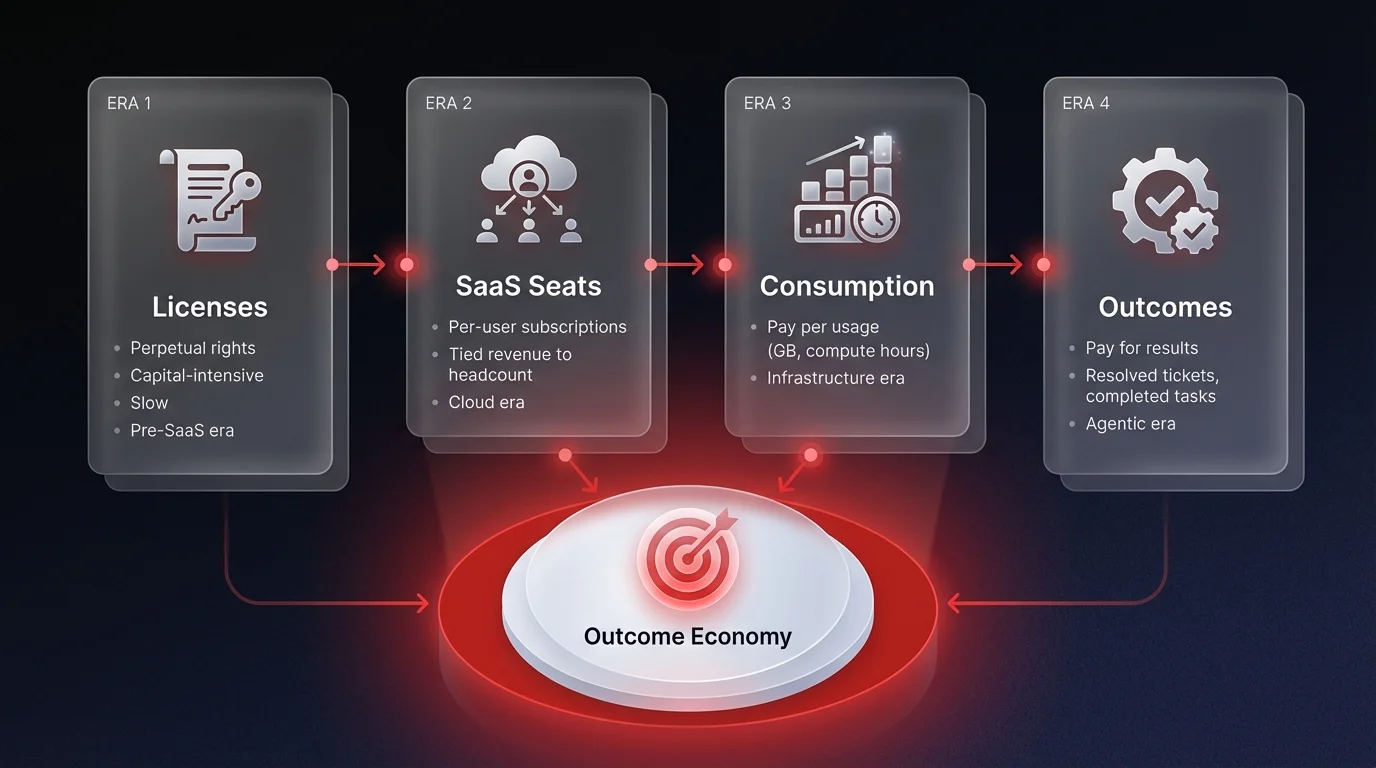
- Licenses: The pre-SaaS era. Companies bought perpetual rights to software and paid for annual maintenance. This was capital intensive and slow.
- SaaS (Seats): The cloud era. Companies paid for subscriptions based on the number of users. This lowered upfront costs but tied revenue to headcount.
- Consumption: The infrastructure era. Companies paid for usage - gigabytes stored, compute hours used. This aligned cost with activity but not necessarily value.
- Outcomes: The agentic era. Companies pay for results - a resolved customer support ticket, a completed background check, or a fully reconciled ledger.
The research indicates that the most disruptive force in the market today is the transition from step two/three to step four. While consumption models (like those used by cloud hyperscalers) are efficient, the outcome model represents the ultimate alignment between vendor and buyer.
Consider the customer support function. In a seat-based model, a vendor is incentivized to sell you more helpdesk software seats, which implies you need more support agents. In an outcome-based model, the vendor is incentivized to resolve the ticket without a human ever touching it. The value proposition flips from "tooling for humans" to "replacement of labor." This is exactly what AI-powered churn prevention systems accomplish - they resolve issues without human intervention.
This shift helps explain why AI companies are seeing such explosive demand. Buyers are exhausted by shelfware. They are no longer looking for tools that help their employees work; they are looking for systems that do the work for them.
Electricity versus blood: a new operational metric
The most striking insight from recent market analysis comes from a CEO of a portfolio company who has radically reframed their resource allocation. For every task the company needs to complete, this leader now asks a single qualifying question: "Can I do this with electricity, or do I need to do it with blood?"
While provocative, this question - distinguishing between compute power (electricity) and human effort (blood) - cuts to the core of the modern operational challenge. The $1 million ARR per employee metric cited earlier is the direct financial result of choosing electricity over blood.
The implications for organizational design are profound. If a competitor can execute a workflow using electricity (AI agents) at a marginal cost of fractions of a cent, while you are executing the same workflow using blood (human salaries) at a cost of dollars, your margins will eventually collapse. This is not a distant threat; it is happening now in the private markets.
We are seeing companies run leaner not because they are cash-constrained, but because demand is outstripping their ability to hire, and they are filling the gap with intelligence rather than headcount. The best AI companies are spending less on sales and marketing than their SaaS counterparts while growing significantly faster. The product itself — purpose-built autonomous AI agents — is doing the heavy lifting that human sales teams used to do.
The adaptation gap: changing the engine while flying
For "pre-AI" companies - those established before the generative AI boom - the data suggests a stark "adapt or die" reality. The challenge is not just adopting new tools, but fundamentally rebuilding the engine of the company.
An instructive example involves a founder who became frustrated with the pace of product development. Instead of hiring more engineers or buying more management software, they assigned two AI-fluent engineers to rebuild a core product from scratch using modern coding agents and tools like Claude Code and Cursor. The result? They moved 10 to 20 times faster than the traditional engineering team. The bill for the compute was high - electricity isn't free - but the speed and output shattered the previous operational benchmarks.
This creates a dilemma for operations leaders at scaling companies. You likely have established workflows, legacy tech stacks, and teams comfortable with their current tools. Transitioning to an AI-first operating model isn't as simple as buying a ChatGPT license. Building an AI-first culture requires:
- Re-evaluating the tech stack: Legacy software often locks data in silos that AI agents cannot access or reason across.
- Cultural change management: Moving employees from "doers" to "reviewers" of agentic work is a massive psychological shift.
- Infrastructure investment: You need the plumbing - the governance, the vector databases, the sovereign agent structures - to allow "electricity" to flow safely through the business.
The research shows that while Fortune 500 CEOs are eager to adapt, they are struggling with change management. They are ready to be AI companies in spirit, but their operational reality is still stuck in the seat-based era. This implementation gap is where the next wave of value will be created.
Proof points: margin expansion through resolution
Skeptics often argue that AI efficiency is theoretical. However, specific operational case studies are now putting hard numbers on the board. The metrics are moving beyond "time saved" to "margin expansion."
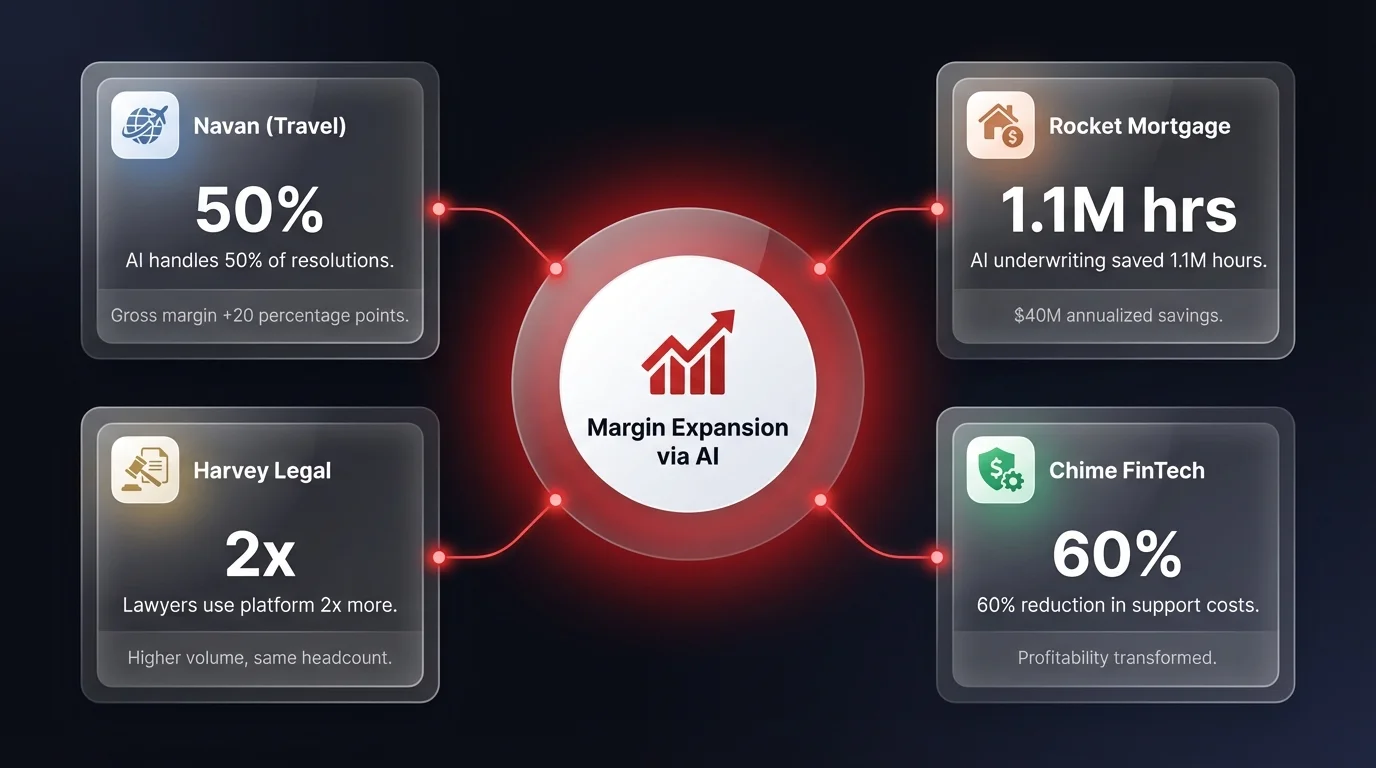
Navan (Travel & Expense) Navan has successfully deployed AI agents to handle complex travel resolutions - not just answering FAQs, but actually modifying bookings and handling logistics. AI now handles roughly 50% of these user interactions. The financial impact is visible in their gross margins, which have expanded by 20 percentage points over the last three years. This is the tangible result of replacing human service costs with compute costs.
Rocket Mortgage By implementing AI in their underwriting process, Rocket Mortgage reported saving 1.1 million hours, equating to roughly $40 million in annualized savings. This is a volume-based operational task where accuracy and speed are paramount, and the switch to automated reasoning provided a massive efficiency dividend.
Harvey (Legal) The legal sector, often viewed as resistant to change, is seeing usage patterns that defy the "AI replaces lawyers" narrative. Data from Harvey shows that lawyers are actually spending double the amount of time in the platform compared to previous tools. Why? Because the reasoning models work. The AI is acting as a "trusted deputy," handling the drudgery of legal research and drafting, allowing the firm to process more volume without linearly scaling associate headcount.
Chime (FinTech) Chime reported a 60% reduction in support costs. For a high-volume B2C business, support is often the largest variable cost line item. Cutting that by more than half fundamentally changes the profitability profile of the entire company.
These examples share a common thread: they are not using AI to help humans type faster. They are using AI to resolve entire units of work. The shift mirrors what we're seeing with AI automation delivering real business value across industries.
The infrastructure of the outcome economy
The transition to an outcome-based economy requires more than just belief; it requires infrastructure. You cannot build a $1 million revenue-per-employee business on flimsy, hallucinating chatbots. If you are going to rely on "electricity" rather than "blood," that electricity must be stable, governed, and directed — the infrastructure layer that enterprise operations automation provides.
The market analysis shows that we are currently in a massive infrastructure build-out phase. There are no "dark GPUs" - every piece of compute hardware hitting the data centers is being utilized immediately. This signals that demand for compute is real and durable.
For the mid-market COO or VP of Operations, the takeaway is clear. The efficiency gains seen in these top-tier companies are not magic; they are the result of rigorous architectural decisions. They are building systems where:
- Logic is observable: You know why the agent made a decision.
- Data is sovereign: Your proprietary data fuels the outcome, not a public model's training set.
- Outcomes are measured: Success is defined by resolution, not conversation length.
The seat-based business model is fading because it is inefficient. It relies on selling potential rather than results. The outcome economy is rising because it aligns incentives and leverages the collapsing cost of intelligence. As the data shows, the companies that figure out how to swap blood for electricity aren't just growing faster - they are becoming a different class of competitor entirely.