
AI token maxing is the deliberate inflation of AI usage metrics - running unnecessary agent tasks, generating throwaway code, and making excessive API calls - to satisfy enterprise adoption mandates that measure activity instead of outcomes. According to internal reports from multiple Fortune 500 companies, this practice is now widespread across engineering departments facing top-down AI utilization targets.
A concerning trend, AI token maxing is quietly sweeping through the engineering departments of the world's largest technology companies. Driven by top-down mandates to accelerate artificial intelligence adoption, developers are deliberately running autonomous agents to build useless code, summarize documents they do not need to read, and generate endless API calls - all to inflate their internal AI usage metrics. Organizations already struggling with uncontrolled AI token spend are now facing an even deeper problem: the spend itself is being artificially manufactured.
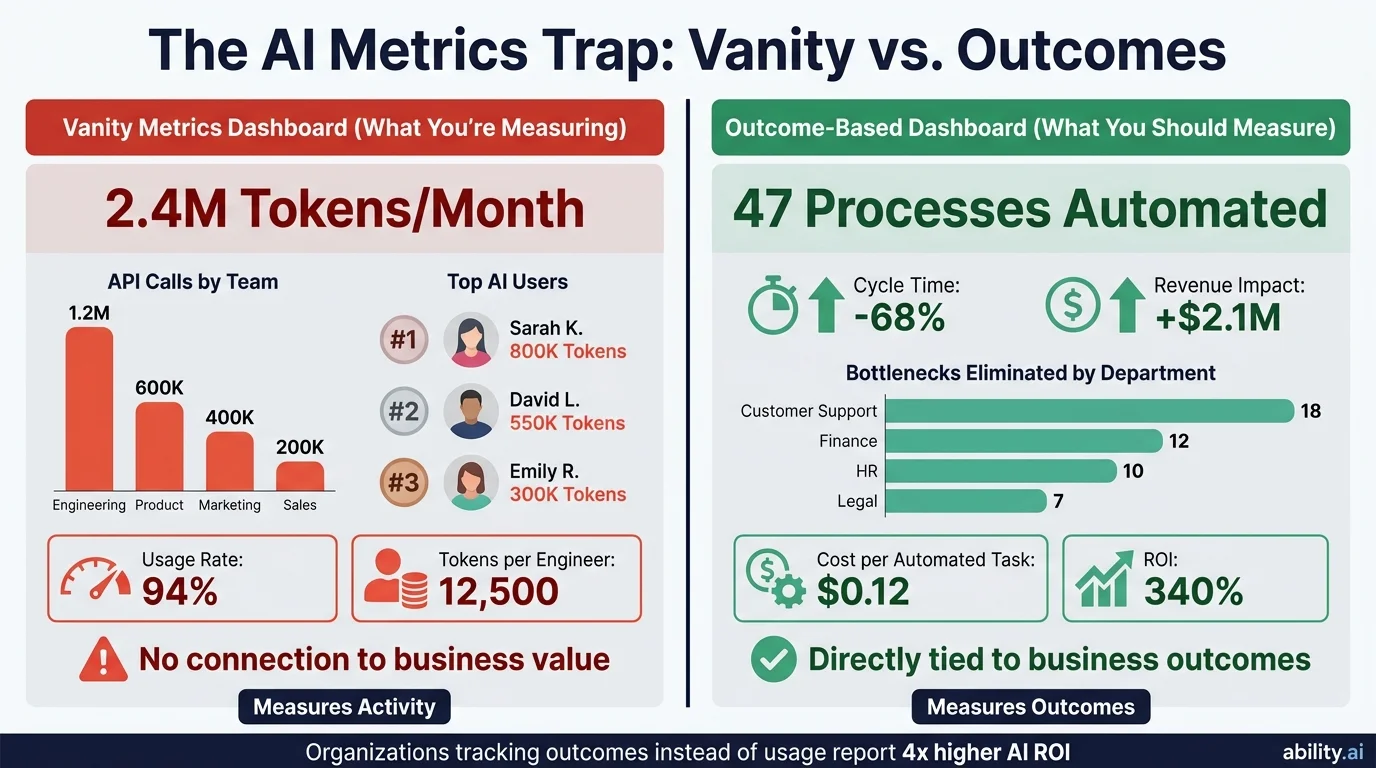
This behavior exposes a fundamental flaw in how organizations are managing the transition to artificial intelligence. When leadership demands AI adoption without defining specific business outcomes, the result is chaotic shadow AI sprawl, wasted compute spend, and a culture of performing for the dashboard rather than innovating for the customer.
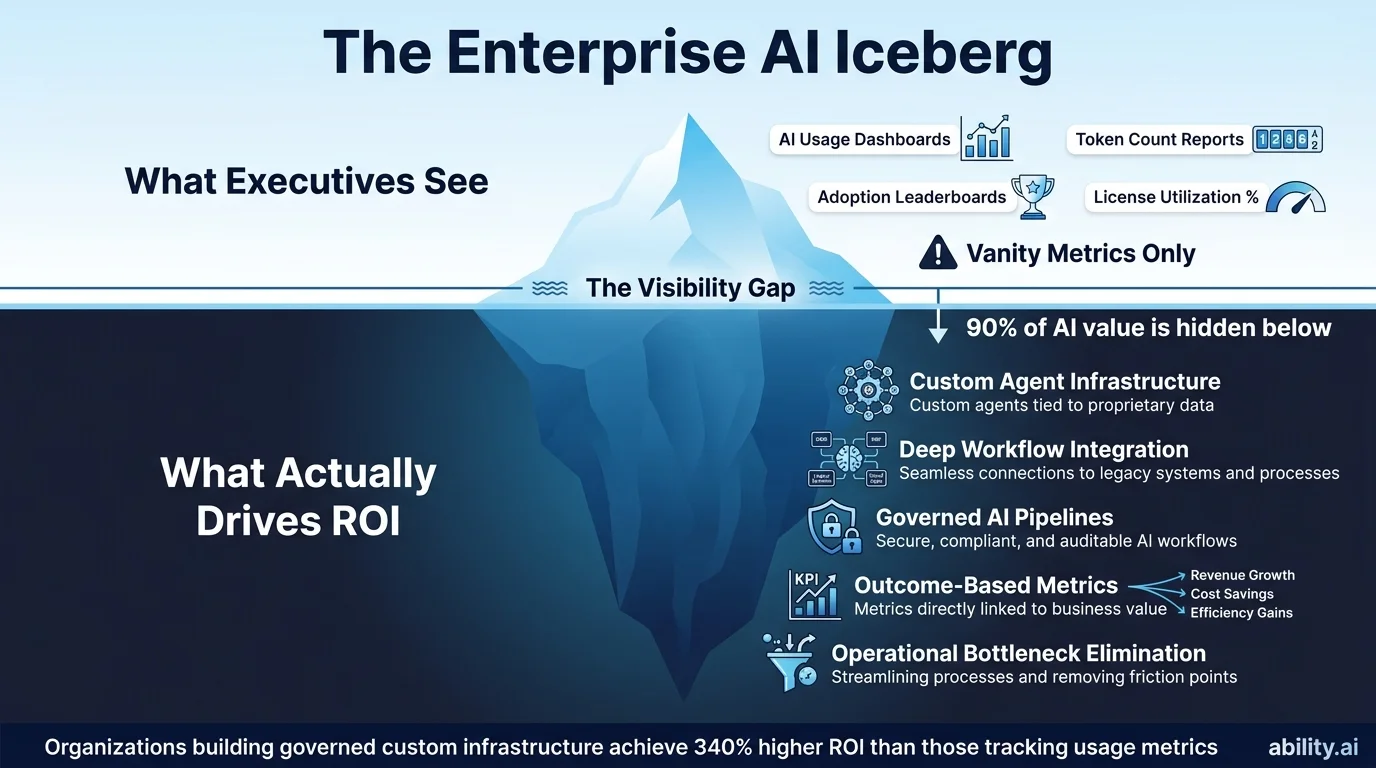
Our research into current enterprise engineering practices reveals a widening gap between the performative AI metrics tracked by executives and the highly customized, governed infrastructure actually required to drive operational value. For operations and business leaders, understanding this disconnect is the first step toward implementing systems that actually work.
The rise of AI token maxing across the enterprise
At major organizations like Meta, Microsoft, and Salesforce, AI output is increasingly being measured and monitored. In some cases, this takes the form of internal leaderboards tracking which developers are generating the most tokens. In others, such as at Salesforce, employees have reportedly been given minimum monthly spend targets - sometimes around $175 per month per person - just to ensure the tools are being utilized.
The organizational psychology behind this is predictable. The technology industry is currently experiencing high uncertainty, with rolling layoffs impacting major players. In an environment where every data point can be weaponized during performance evaluations, high-earning engineers are unwilling to risk their livelihoods by appearing in the bottom quartile of an AI usage leaderboard.
The result - developers are token maxing. They are employing workarounds that actively drain resources without providing value. Common tactics include asking an agent to summarize extensive documentation instead of simply reading it, or deploying autonomous agents to run background loops that generate irrelevant code. The financial impact compounds the shadow AI budget drain that most enterprises are already struggling to contain.
At Meta, one internal leaderboard was eventually shut down after it drew criticism for incentivizing ridiculous behavior, but the underlying culture of token maxing persists. Employees know the data is still being tracked, and the fear of being labeled a "low performer" drives them to keep their token counts artificially high.
Leadership panic and the AI adoption mandate
This phenomenon does not stem from malicious engineers; it is a direct byproduct of leadership anxiety. Executives are acutely aware of the productivity gains promised by generative models, and they are terrified of falling behind competitors who might be moving faster.
This fear has led to heavy-handed mandates. A prime example occurred at Coinbase, where the CEO issued a company-wide directive demanding that all engineers begin using AI tools within a week. Shortly after the deadline, an engineer was reportedly fired for failing to comply. When the stakes include losing a lucrative career, employees will naturally optimize for whatever metric leadership is measuring - even if that metric is completely divorced from actual business value.
In some cases, this forced adoption strategy makes sense for the specific business model of the company executing it. Shopify, for instance, negotiated early, exclusive access to GitHub Copilot for 3,000 employees a full year before public release. They incurred massive expenses, dealt with early-stage bugs, and suffered through significant workflow churn. For Shopify, trading operational stability for a six-month competitive advantage in the tech sector was a calculated, rational risk.
However, for the vast majority of mid-market and scaling enterprises, adopting this "move fast and force adoption" mentality is disastrous. It simply results in shadow AI - a fragmented landscape of personal AI accounts, ungoverned API usage, and disjointed vendor tools that expose proprietary data while failing to improve core business processes. This is exactly the enterprise AI governance crisis that operations leaders must address before scaling any AI initiative.
The hidden infrastructure pivot: building over buying
While public attention remains fixated on off-the-shelf developer tools, a massive shift is occurring behind the scenes at companies like Uber, Airbnb, and Shopify. Despite spending millions on commercial AI licenses, these organizations are quietly abandoning standard vendor platforms for their core operations in favor of building highly customized internal AI infrastructure.
The reason is straightforward - off-the-shelf AI simply does not integrate well with deep, proprietary, legacy workflows. Standard models have limited context windows and cannot easily digest a decade's worth of complex, interconnected enterprise data.
To solve this, leading engineering teams are developing custom background agents directly integrated into their monolithic repositories. They are building their own Model Context Protocol gateways tied to internal service discovery. They are overhauling on-call tooling and code review systems with custom risk-categorization agents.
This trend validates a critical reality of the current market: generic AI platforms do not deliver operational transformation. True value requires sovereign infrastructure that connects directly to an organization's specific data sources and operational bottlenecks.
Unlocking the serverless developer in operations
While much of the industry focuses on measuring how much faster a senior software engineer can write a pull request, the actual transformational value of AI is happening outside the engineering department.
When individual developers use AI, studies show their productivity gains are often marginal, sometimes offset by the time spent reviewing AI-generated errors. However, when highly governed, custom AI agents are deployed to operations, marketing, sales, and customer support teams, the impact is exponential. Organizations deploying agentic workflow automation to operational teams report productivity gains that far exceed anything achieved in engineering departments alone.
By providing non-technical staff with agentic workflows, organizations effectively create "serverless developers." A VP of Customer Success no longer needs to wait weeks for IT to build a script for triaging support tickets; a custom support agent handles it autonomously. A Revenue Operations leader does not need a data engineer to enrich a massive list of target accounts; a research agent executes the workflow reliably. See how leading organizations are achieving this through operations automation solutions.
This shift removes the traditional IT bottleneck, allowing business units to execute complex, programmatic tasks at scale. The ROI does not come from making coders type faster - it comes from empowering operators to automate their own workflows.
Operating the agentic mech suit
As organizations deploy these custom systems, the role of the technical professional is fundamentally changing. The industry is moving away from a model where individuals simply write code or execute isolated tasks, and toward a model of orchestration.
Some industry commentators have mistakenly likened this to becoming a "manager" of AI. However, managing agents is entirely different from managing human employees. Agents do not involve interpersonal drama, career pathing, or complex conflict resolution.
Instead, operating a suite of autonomous agents is better compared to wearing a "mech suit." A single operator can direct multiple parallel workflows, exponentially increasing their individual leverage. An operator might have one agent continuously monitoring system health, another actively categorizing incoming data, and a third generating reports - all running simultaneously under human governance. Proper harness engineering and governance frameworks are essential to making this orchestration model safe and effective at enterprise scale.
This orchestration model drastically shortens feedback loops. Where a traditional team might take six months to reveal the results of a strategic pivot, an orchestrated agent system can adapt and deploy within days.
Securing business outcomes over AI token maxing vanity metrics
The prevailing narrative of enterprise AI - characterized by leadership panic, token maxing, and uncoordinated vendor sprawl - highlights the exact dangers of adopting technology without a strategic operational framework.
Organizations are caught between two bad options. On one side, they can deploy generic tools and watch employees burn tokens on trivial tasks to satisfy usage metrics. On the other side, they can attempt massive, multi-year consulting projects to build custom infrastructure, risking millions of dollars before seeing a single positive business outcome.
The solution is not to track API spend, but to focus relentlessly on fixed business outcomes. Organizations must pivot to a solution-first model. Instead of paying continuous platform fees for tools that encourage token maxing, leaders should start with a focused Starter Project - a fixed-scope, fixed-cost implementation that proves value in weeks, not months. By leveraging workflow orchestration platforms and custom integrations, companies can deploy sovereign AI agent systems that integrate deeply with their unique workflows.
The era of paying for AI vanity metrics is ending. The next phase of enterprise automation belongs to leaders who demand governed, outcome-driven systems that their organizations own and control long-term. The key takeaway - stop measuring how much AI your team is using, and start measuring the operational bottlenecks those systems have permanently eliminated.