
AI token spend shadow budget drain occurs when ungoverned employees burn enterprise API budgets on disposable, untracked workflows with no measurable business outcomes. With the average enterprise consuming 13 times more AI tokens this year than last, the era of token maxing is creating an invisible financial crisis - and the fix starts with governing every dollar of AI spend against a defined, measurable outcome.
There was recently a single developer at an enterprise company who spent $150,000 on AI tokens. The staggering part of this expenditure was not the dollar amount itself, but the organizational reality behind it - leadership had absolutely no idea what the business outcome of that spend actually was. As AI token spend becomes the fastest-growing line item in IT and operations budgets, companies are discovering a hard truth. Ungoverned access to artificial intelligence is creating a financial and operational crisis that extends far beyond the hidden $150k shadow AI billing crisis most leaders have already encountered.
We have officially entered the era of "token maxing." In this environment, spending as much money as humanly possible on AI compute is treated as a badge of honor rather than a metric to be optimized. With the average enterprise burning through 13 times more tokens this year compared to last year, the sheer volume of unchecked usage is starting to break corporate budgets. The CEO of Uber recently noted that they had already burned through their entire 2026 budget for AI. Meta reported burning through a billion tokens in a single month last year.
For operational leaders, CEOs, and founders, this mindset is terrifying. Unpredictable costs, shadow AI sprawl, and a total lack of observable return on investment (ROI) are fundamentally incompatible with running a profitable business. To survive this shift, organizations must pivot from unstructured token burning to governed, outcome-driven AI systems.
The AI token spend crisis: how token maxing became the enterprise norm
The root cause of surging AI costs is a fundamental disconnect between technical capability and operational governance. In Silicon Valley, prominent voices are encouraging maximum compute consumption. Nvidia's founder, Jensen Huang, recently stated that he would be concerned if an average developer was not spending at least $250,000 on tokens. The prevailing philosophy dictates that organizations should pay a base salary and then encourage employees to burn through hundreds of thousands of dollars in API usage to maximize their daily output.
However, this blank-check approach creates massive vulnerabilities for mid-market and scaling companies. When employees are given unrestricted access to foundation models - whether it is Claude, ChatGPT, or Gemini - they naturally gravitate toward the most powerful and expensive options. An employee might use an incredibly compute-heavy model like Opus 4.7 to complete a mundane, simplistic task.
Without routing logic or governance in place, users are making architectural and financial decisions they are not qualified to make. They do not think about margin impact or token efficiency. They simply want the "best" model for every interaction, driving up costs exponentially while producing untrackable results.
The shadow AI trap and disposable workflows
Why are employees burning through these massive budgets? In many cases, it is driven by a desire to bypass the tedious parts of their jobs. AI allows people to build things and bypass bureaucratic hurdles faster than ever before. If an employee previously had to go through a lengthy process to change the color of a button on a webpage, they can now use AI to rewrite the code or rebuild the entire page in minutes.
But this unchecked creativity leads to a critical problem - the proliferation of disposable workflows. This pattern compounds into ungoverned AI agents and technical debt that stalls the organization's ability to scale any AI initiative beyond a one-off experiment.
In Tina Fey's book Bossy Pants, she discusses how Lorne Michaels managed Saturday Night Live. His primary job was not to generate ideas, but to edit creative people and stop them from getting in their own way. Today's AI landscape desperately needs this type of management structure. We are currently letting everybody take every idea - whether brilliant or completely nonsensical - and execute it using expensive enterprise resources.
When a team spends hours and thousands of tokens building a disposable, one-off solution that will never be used again, they are not innovating. They are just driving up shadow AI costs. If an AI use case takes significant time to build but is not a repeatable, scalable process, it should likely not be built at all.
Moving from token maxing to outcome maxing
The most dangerous person in a company today is the employee who maximizes their token spend but remains fundamentally bad at their core craft. To combat this, organizations must shift their operational culture from token maxing to "outcome maxing."
Over the last decade, a major epidemic in business has been the tendency to measure and report on activity rather than actual outcomes. AI has poured gasoline on this fire. Software developers are often measured by the volume of code they change or the pull requests they generate - metrics that AI can easily inflate without actually improving the product.
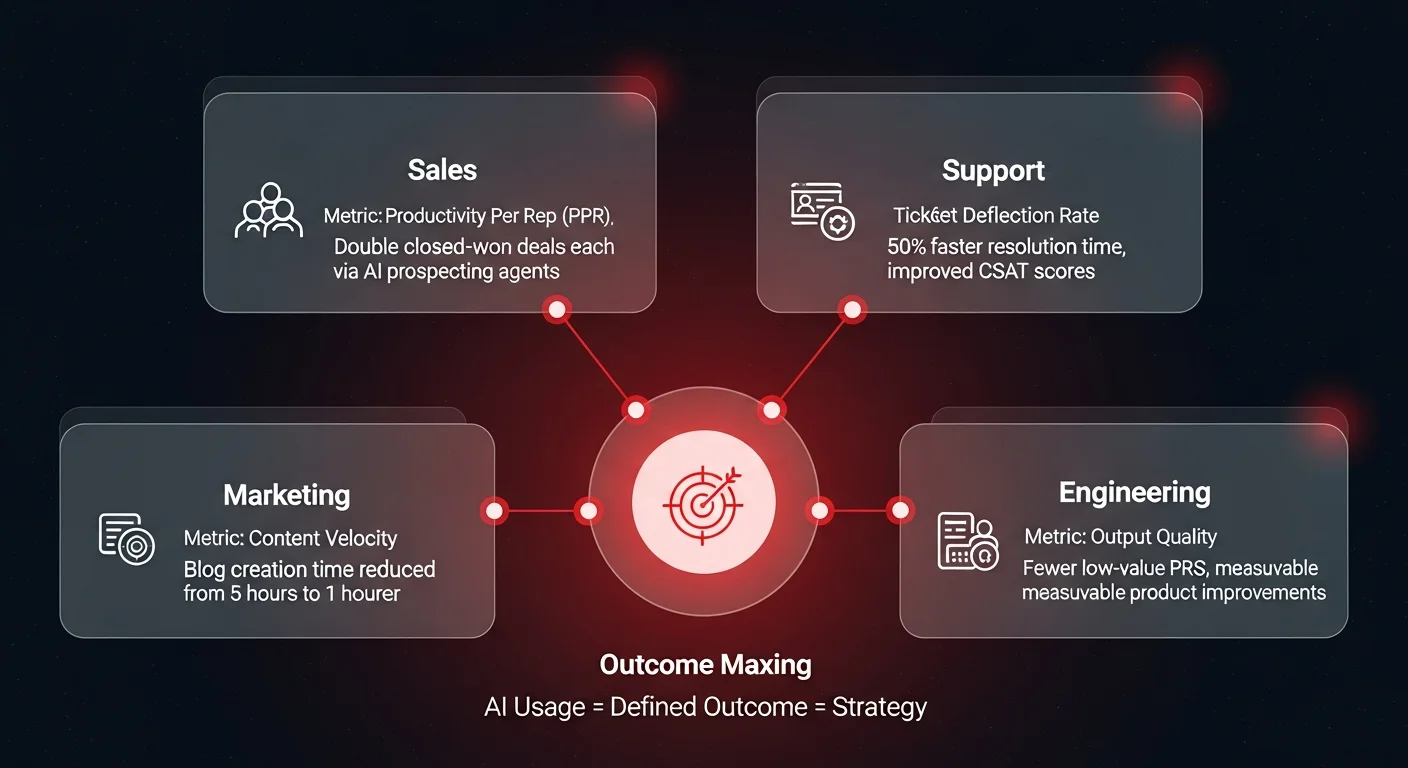
Outcome maxing demands a direct correlation between AI usage and measurable business growth. In sales, for instance, a binary outcome exists: you either closed the deal or you did not. If you implement an AI prospecting agent, the metric for success is not how many tokens the agent consumed or how many emails it drafted. The metric is productivity per rep (PPR) - did the sales team double their closed-won deals this month?
Customer support teams can measure outcome maxing through ticket deflection rates and customer satisfaction quality scores. In marketing, the application is more nuanced but equally critical. A Chief Marketing Officer (CMO) should establish quarterly projects with strict outcome targets. If the content team integrates AI, the measurable outcome might be reducing the time it takes to create a comprehensive blog post from five hours down to one hour, while maintaining engagement metrics. For a deeper breakdown of high-signal KPIs by department, see our guide on moving AI token spend from experimentation to outcomes.
Defining the strategy: AI by outcome
To enforce outcome maxing across an organization, leadership must adopt a very simple but rigid formula: AI by outcome equals strategy.
If you have a team using AI and they cannot articulate the business outcome of that usage in a single, clear sentence, you do not have a strategy. You simply have unstructured token maxing.
Consider an employee who decides to use AI to build a "second brain" for their daily workflows. On the surface, this sounds like a vague, potentially wasteful project. But if that employee can answer a strict series of operational questions, it transforms into a strategy.
For example: "I am using AI to build a second brain because it will reduce the time it takes me to parse historical client data. Because I can retrieve data faster, I will respond to client escalations 50 percent faster. Because I respond faster, our customer retention rate will improve."
Connecting the technical build directly to the overarching business result ensures that every token spent is an investment in corporate growth, rather than just subsidizing the foundational model providers.
Implementing governance and sovereign AI systems
As venture capitalists eventually stop subsidizing the cost of compute and negative margins catch up with model providers, the cost of AI tokens is likely to fluctuate or rise. Companies cannot afford to wait for that financial cliff. They must build sustainable AI infrastructure today.
This is where the traditional SaaS model and the blank-check API model both fail. Organizations are caught between two bad options - allowing shadow AI to sprawl uncontrollably, or buying into massive, slow consulting projects that fail to deliver immediate ROI. As documented in our analysis of the shadow AI governance crisis, the absence of a structured AI strategy creates compounding financial and operational debt that becomes harder to unwind with every passing quarter.
The solution is transitioning to Sovereign AI Agent Systems. Rather than renting intelligence and paying unpredictable platform fees or per-token markups, mid-market companies need systems they actually own and govern.
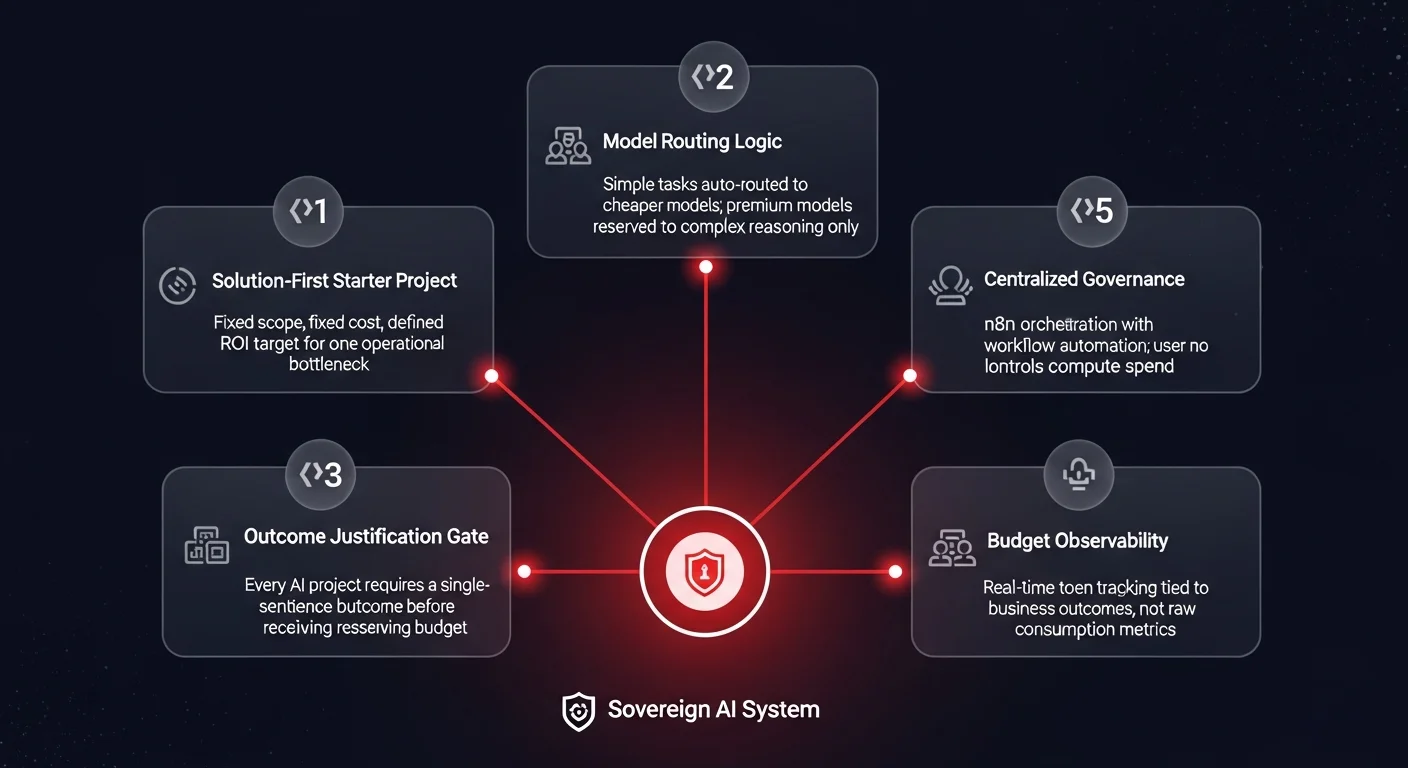
This begins with a Solution-First approach. Instead of telling a department to "go figure out AI," leadership should deploy a focused Starter Project - an initiative with a fixed scope, a fixed cost, and a timeline measured in weeks. By tackling one specific operational bottleneck - such as automated support triage or an autonomous research agent for the sales team - the organization proves immediate value without the risk of runaway token spend.
Once that repeatable, outcome-driven system is established, the company can expand into a long-term transformation partnership. Through platforms like n8n for orchestration and centralized workflow automation, leaders can enforce model routing. Simple tasks are automatically routed to cheaper, faster models, while complex reasoning tasks are reserved for premium models. The user no longer decides the token spend - the governed system does.
See how Ability.ai's operations automation solutions deliver governed AI agent deployments with built-in model routing and budget controls - turning uncontrolled token spend into a predictable, outcome-driven cost line. For organizations where AI spending is primarily a finance and procurement challenge, explore our finance and procurement automation solutions for cost governance frameworks designed specifically for CFOs and operations leaders.
Conclusion: taking back control of your AI budget
Outcomes are what drive revenue, scale operations, and secure market share. Unstructured token maxing simply enriches the companies selling the compute.
To stop the drain of shadow AI and unpredictable budgets, operations leaders must take immediate control of how artificial intelligence is deployed across their teams. Stop funding disposable, one-off AI experiments that provide zero long-term value. Implement strict guardrails, demand single-sentence outcome justifications for all AI usage, and transition away from ungoverned API access.
By embracing outcome maxing and deploying governed, Sovereign AI Agent Systems, your organization can harness the full power of artificial intelligence - turning a chaotic expense into a reliable, scalable engine for business transformation.