
AI token spend is the total compute cost enterprises incur when teams use generative AI without outcome-based governance. As organizations burn through 13 times more AI tokens than last year, untracked usage is draining budgets with zero measurable ROI - and the window of artificially cheap, VC-subsidized token pricing is closing fast.
Unchecked AI token spend has become a quiet crisis in the enterprise. As organizations race to integrate artificial intelligence into their daily workflows, the primary metric of success has dangerously shifted toward consumption rather than results. In fact, the average enterprise is burning through 13 times more AI tokens this year compared to last year.
This explosion in usage - often referred to in industry circles as "token maxing" - is creating a massive vulnerability for operations leaders. We are seeing major global organizations, including tech giants like Uber, entirely exhaust their multi-year AI budgets in the first half of a single fiscal year.
The prevailing mindset, championed by prominent voices in Silicon Valley, suggests that massive compute expenditure is simply the cost of innovation. When leaders like Nvidia's Jensen Huang suggest that an average developer should be burning $250,000 in AI tokens on top of their base salary, it sets a dangerous precedent for the broader business world. For the C-suite, this raises an urgent operational question: are we actually driving business growth, or are we just subsidizing the massive valuation of large language model providers?
It is time to move away from chaotic experimentation and establish strict governance over AI deployments. Organizations must transition from unbounded usage to structured, outcome-driven systems.
AI token spend and the era of token maxing
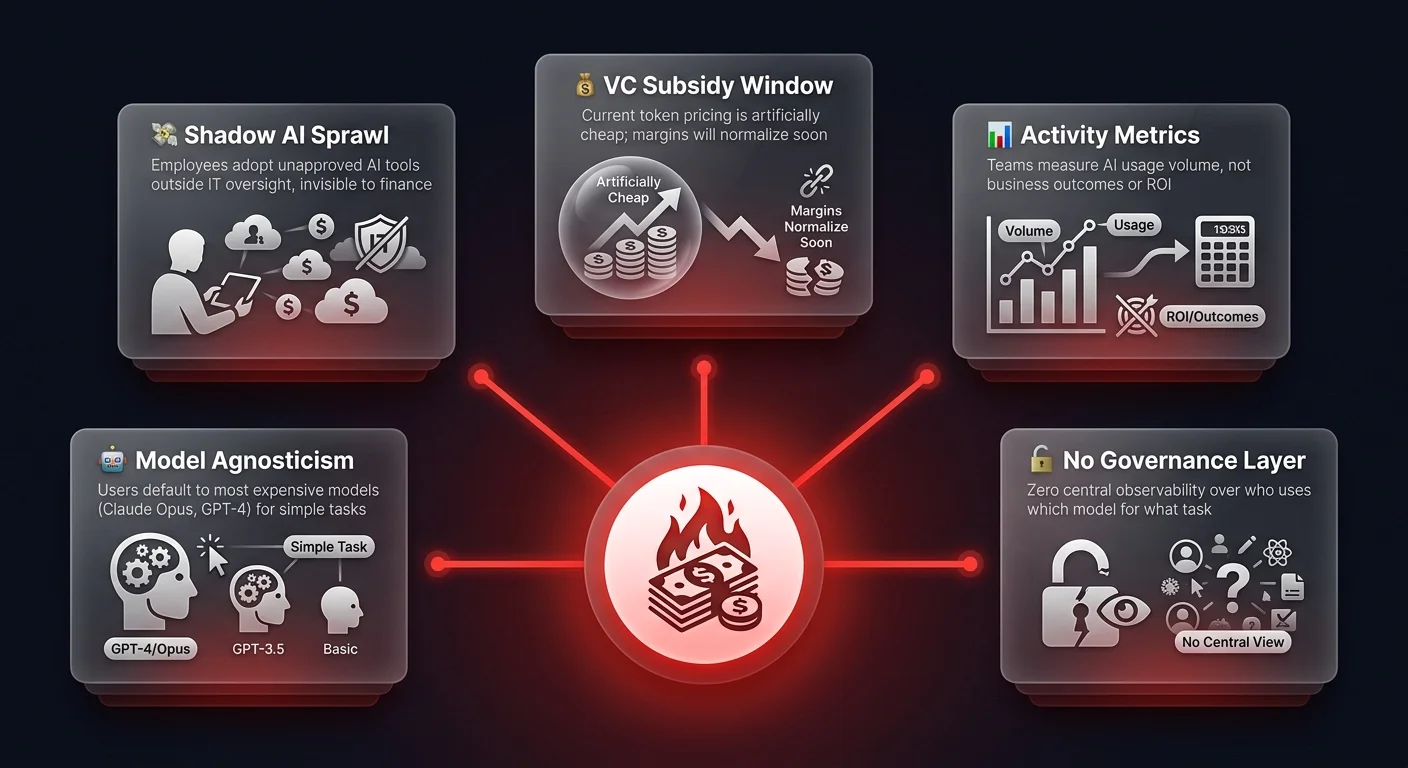
The current enterprise AI landscape is defined by a lack of central oversight. When companies provide their employees with unfettered access to a variety of generative AI tools, they inadvertently create an environment of Shadow AI. Employees are integrating unapproved applications, pasting proprietary data into public models, and burning through expensive API credits with zero central observability.
This pattern is part of a broader shadow AI sprawl problem where ungoverned tool adoption creates compounding coordination debt across the organization.
The hidden costs of model agnosticism
One of the primary drivers of this budget burn is the lack of technical discipline at the user level. Today, employees who sit in standard operational seats - whether in marketing, sales, or HR - have access to a wide array of frontier models. Given the choice, human nature dictates that they will simply select the most advanced, expensive option available.
For example, an employee tasked with a simplistic data extraction job might route that task through a highly sophisticated, compute-hungry model like Claude Opus or GPT-4. They are not thinking about computational efficiency or API costs; they just want the best perceived tool. Because the end-user is currently being asked to decide which model to use - a decision 99% of employees are not equipped to make - companies are paying premium prices for rudimentary workloads.
The venture capital subsidy window
Operations leaders must also recognize that current AI pricing is somewhat artificial. Right now, the massive token burn occurring across the corporate world is being heavily subsidized by venture capitalists and late-stage investors. AI providers are operating on negative margins to capture market share.
This era of cheap learning will inevitably end. As these AI companies face pressure to improve their margins and reach profitability, the cost of tokens will rise. Organizations that have built their workflows around inefficient, ungoverned AI usage will face catastrophic overhead costs. Establishing efficient routing and strict governance today is not just a best practice - it is an economic necessity.
Moving from activity metrics to business outcomes
For the past decade, one of the most persistent epidemics in corporate management has been measuring and reporting on activity rather than outcomes. The AI boom has aggressively amplified this problem.
In software development, for instance, productivity is frequently measured by GitHub pull requests or the volume of code generated by AI assistants. While these code changes act as a proxy for activity, they do not directly represent business value. In marketing, employees might spend hours using AI to rebuild a webpage or test infinite color variations of a button - not because it serves a strategic goal, but simply because the technology makes it easy to do so.
There is a profound difference between unconstrained creativity and strategic execution. When employees are given unrestricted access to AI generation tools, they often suffer from a type of operational ADD. They spend 30 minutes building a completely disposable, one-off automation just to see if it works, regardless of whether it actually moves the needle for the business.
True operational efficiency requires management structures that act as a filter. Leaders need to implement constraints that eliminate trivial AI token spend and focus team efforts on initiatives that actually generate revenue or reduce operational drag.
The AI by outcome formula
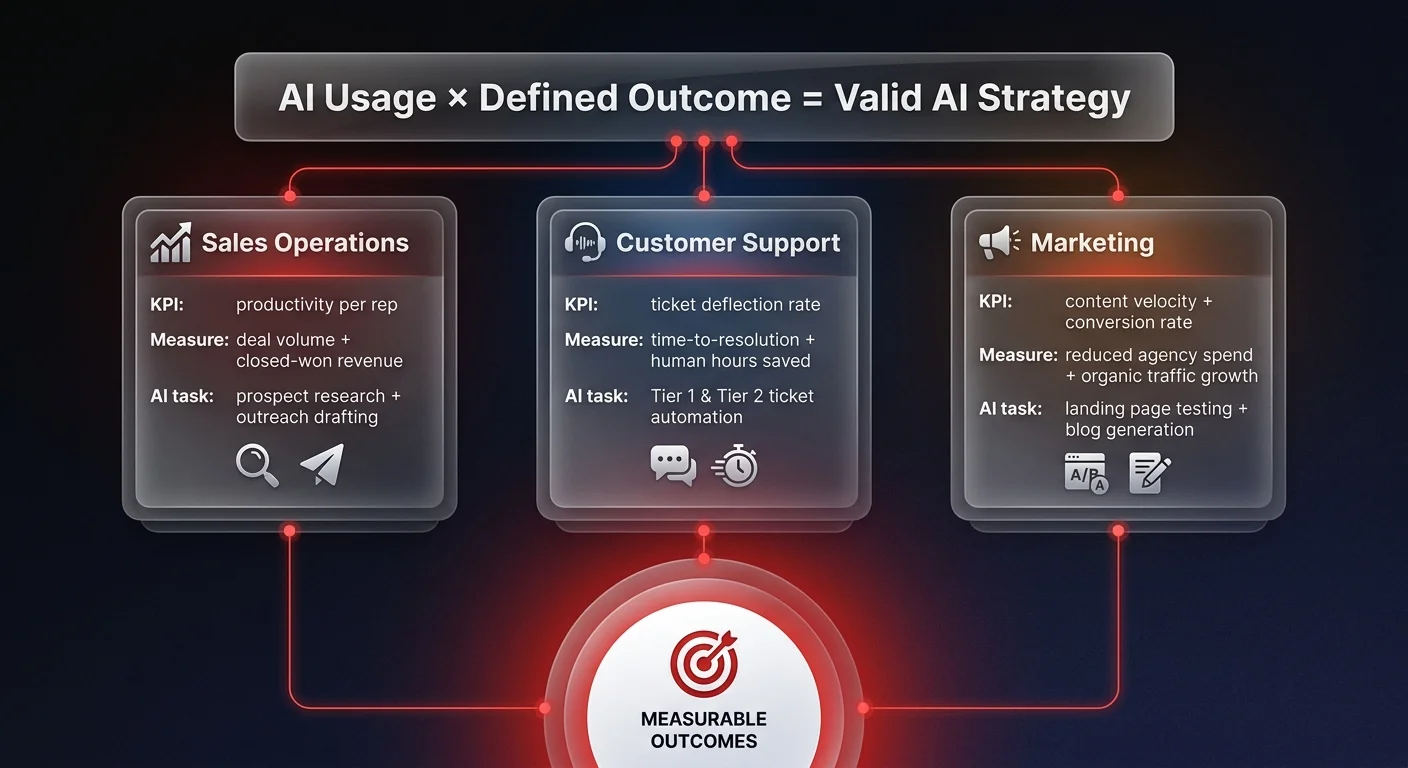
To combat Shadow AI sprawl, operations leaders must adopt a strict framework. The rule is simple: AI usage multiplied by a defined outcome equals an AI strategy.
If a team is utilizing artificial intelligence but cannot articulate the exact outcome of that usage in a single, clear sentence, they do not have a strategy. They simply have usage for the sake of usage.
Consider a content marketing team given access to enterprise AI tools. If their mandate is simply "use AI to make better content," the result will be unpredictable AI token spend. However, if the defined outcome is "reduce the time it takes to create a technical blog post from five hours to one hour," you suddenly have a measurable, strategic goal. The AI usage is directly correlated to increased content velocity and reduced labor costs.
High-signal KPIs by department
To successfully shift to outcome maxing, leaders must establish binary, high-signal metrics for every department utilizing AI:
- Sales operations: The core metric is productivity per rep. If a sales team deploys an AI agent for prospect research and outreach drafting, the outcome must be a measurable increase in deal volume and closed-won revenue.
- Customer support: AI success is defined by ticket deflection rates and time-to-resolution. Support teams can map their AI token spend directly against the reduction in human hours required to close Tier 1 and Tier 2 tickets, while monitoring customer satisfaction scores to ensure quality remains high.
- Marketing: Outcomes here are notoriously nuanced, making strict tracking even more critical. Success should be measured by reduced external agency spend, increased organic traffic velocity, or higher conversion rates on specific landing pages generated through AI testing.
Building repeatable systems over disposable tasks
Strategy, at its core, is a set of repeatable actions. The greatest flaw in current enterprise AI adoption is the reliance on disposable workflows.
Before an employee spends an hour writing complex prompts to solve a specific problem, they must answer a vital question: will this output be used more than once? If the answer is no, and the task takes more than a few minutes, it is a waste of corporate resources.
Organizations must graduate from individual employees using chat interfaces to centralized teams building resilient, automated pipelines. This is where the concept of Sovereign AI becomes critical. Rather than allowing disjointed Shadow AI to dictate workflows, companies need centrally governed systems that the organization entirely owns and controls.
This shift directly addresses the AI agent governance challenges that arise when employees operate AI tools outside any organizational oversight structure.
Sovereign AI Agent Systems remove the burden of model selection from the end-user. By utilizing open-source platforms for autonomous reasoning - paired with battle-tested workflow automation tools - companies can orchestrate complex processes behind the scenes. The system dynamically evaluates the task and routes it to the most cost-effective model, reserving heavyweight compute only for the most complex reasoning tasks. This eliminates user-error and instantly standardizes API costs.
The path forward: Sovereign AI and fixed-cost outcomes
The businesses that will dominate the next decade are not the ones spending the most money on AI tokens. They are the ones successfully translating AI capabilities into sustainable, governed business systems.
Moving away from the chaos of token maxing requires a fundamental shift in how AI is procured and deployed. Massive, slow consulting projects and unpredictable monthly API bills are two sides of the same broken coin. Operations leaders need a solution-first approach that guarantees results without the bloated overhead.
This begins with highly focused Starter Projects - fixed-scope, fixed-cost implementations deployed in weeks, not months. By targeting a specific operational bottleneck, such as automated lead qualification or customer support triaging, businesses can prove immediate value without committing to open-ended platform fees or unbounded AI token spend. Once that specific outcome is achieved, the organization can scale confidently into a broader transformation partnership.
Explore how AI workflow automation governance provides the operational framework for moving from ungoverned token usage to predictable, outcome-based AI deployments.
Your organization's data and workflows are your most valuable assets. Do not surrender them to fragmented tools and ungoverned experimentation. By enforcing strict outcome targets and deploying centralized, Sovereign AI Agent Systems, you can transform artificial intelligence from an unpredictable line item into a reliable engine for long-term growth.