
AI workflow automation is the deployment of governed agent systems that execute business processes autonomously across enterprise tools. Organizations implementing structured AI workflow automation reduce manual task time by 40–60%, but most fail because they skip workflow mapping and governance in favor of fragmented, employee-led experimentation.
Recent industry data reveals a massive gap between what artificial intelligence is technically capable of and what enterprise teams are actually achieving. While boardrooms mandate rapid AI transformation, operations leaders are finding that true AI workflow automation is notoriously difficult to scale. The underlying problem is not the technology itself, but the chaotic, undocumented nature of modern enterprise work and the limitations of grassroots AI adoption.
To bridge this gap, organizations must understand how work actually happens across their decentralized teams, the hard technical ceilings of current consumer AI tools, and the behavioral friction that prevents employee-led automation from succeeding.
Why AI workflow automation fails: the undocumented enterprise problem
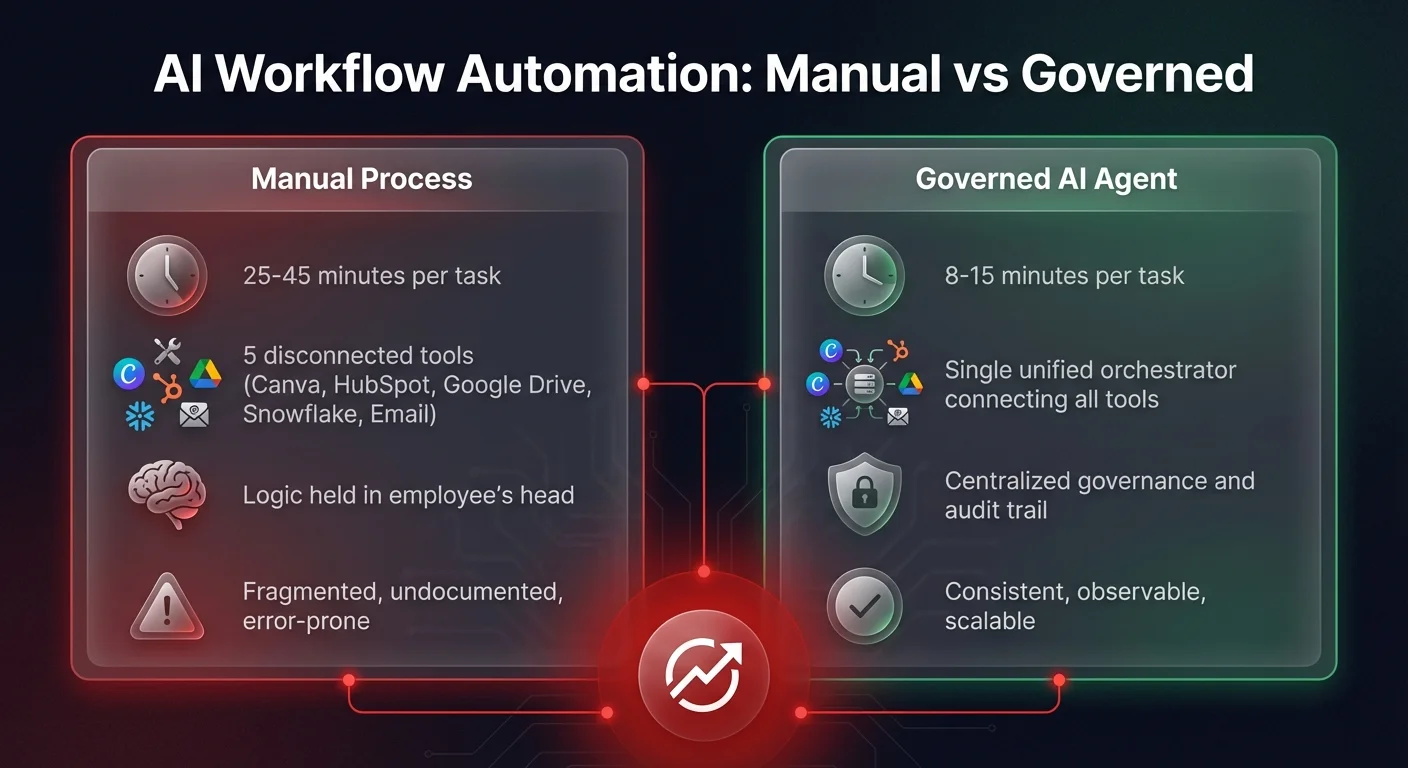
Before you can automate a process, you must understand it. However, the reality for most scaling companies is that day-to-day operations are a fragmented web of disconnected tools. A standard marketing or operations task might require an employee to jump between Canva, HubSpot, Google Drive, and Snowflake — all while holding complex evaluation criteria entirely in their head.
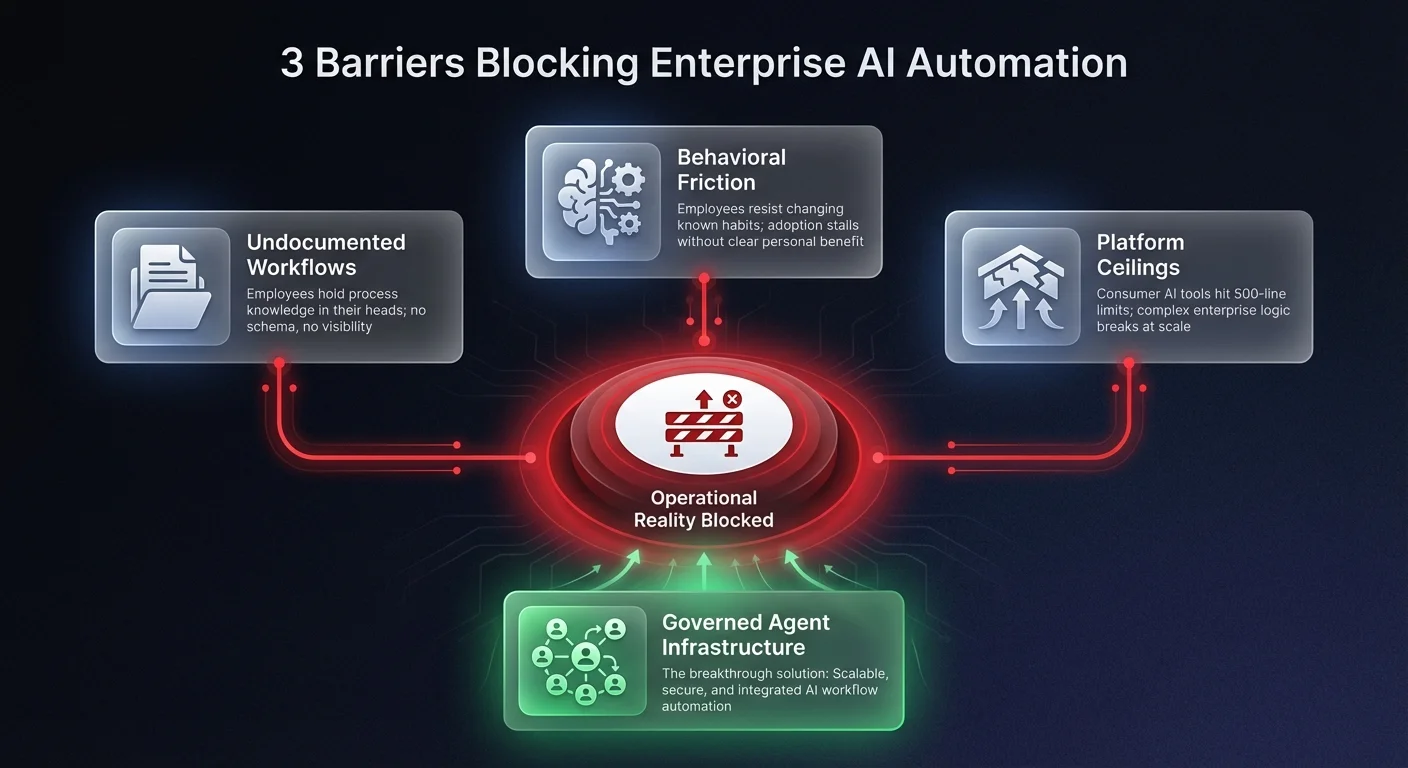
Because these workflows have evolved organically, most teams operate blindly. They lack clear, up-to-date documentation on how daily work actually gets executed. When operations leaders attempt to introduce AI workflow automation into this environment, they are applying a highly logical technology to a fundamentally unstructured human process.
To solve this, leading organizations are leveraging AI itself to map these hidden workflows. By recording an employee narrating a standard task — such as reviewing slides, synthesizing information, collating feedback, and drafting an email response — leaders can generate a raw transcript of the actual work. Feeding this transcript into an LLM alongside specific analytical instructions allows the AI to output a detailed functional process schema.
This workflow extraction methodology provides immediate, undeniable visibility. It reveals exactly what tools are being used, where the manual bottlenecks exist, and the stark contrast in time allocation. For example, a manual data synthesis task that typically takes 25 to 45 minutes can be mapped and estimated to take just 8 to 15 minutes when properly assisted by AI.
See how this workflow mapping approach delivered real results in our e-commerce automation efficiency case study.
The behavioral hurdle blocking AI workflow automation adoption
While mapping the workflow is a critical first step, handing an employee a six-page report on how to automate their own job creates massive adoption friction. This is where grassroots AI initiatives typically stall.
Behavioral change is the single highest hurdle in enterprise AI transformation. Employees naturally default to entrenched habits. When asked to use AI to optimize a routine, boring task they already know how to do manually, adoption is slow and resistance is high. The cognitive load required to read a complex automation report, understand the new steps, and actively change a daily habit is often perceived as more painful than simply continuing the manual work.
Interestingly, behavioral change accelerates when employees use AI to achieve net-new capabilities. When non-technical staff use AI to write code or perform complex data analysis they previously couldn't do, the adoption is instantaneous. The friction lies in optimizing the old, not inventing the new.
This behavioral reality highlights a critical flaw in the "bring your own AI" strategy. Expecting your entire workforce to suddenly become prompt engineers and workflow architects is an unrealistic mandate that ultimately damages productivity. For a deeper look at why bottom-up AI initiatives fail, see our analysis of why AI POC projects stall and how to escape the graveyard.
Platform ceilings that limit AI workflow automation at scale
Beyond behavioral resistance, operations leaders must account for the hard technical constraints of native AI applications. As employees attempt to build their own AI "skills" or custom instructions in tools like ChatGPT, Claude, or Perplexity, they quickly hit platform ceilings.
For instance, custom skill files are often limited to just 500 lines of code or text. When dealing with a complex enterprise workflow that requires deep context, conditional logic, and specific formatting rules, 500 lines is vastly insufficient. Attempting to pack high-density logic into a single file results in erratic AI behavior and degraded output quality.
To achieve reliable AI workflow automation, developers must utilize complex, multi-file architectures. This involves creating a core skill file that references secondary markdown files, specialized examples, and interconnected reference data. Deciding between a single-file approach and a multi-file skill architecture requires legitimate software engineering intuition — something the average employee does not possess.
When employees try to force complex enterprise workflows into basic consumer AI interfaces, the systems break at scale. The result is a proliferation of shadow AI: undocumented, fragile, and ungoverned automation attempts that pose severe security and operational risks to the business.
The talent shift driving demand for governed AI workflow automation
As AI continues to penetrate the enterprise, it is creating a distinct bifurcation in talent profiles. In a pre-AI world, the standard corporate environment fostered workers with low agency and high tolerance. Employees accepted inefficient processes, tolerated unnecessary meetings, and relied heavily on others to build solutions because they lacked the technical means to do it themselves.
AI is inverting this dynamic. The most valuable talent in the modern enterprise exhibits high agency and low tolerance. Because these individuals now possess the tools to build solutions, analyze data, and automate tasks in minutes rather than weeks, their tolerance for legacy inefficiencies has plummeted. According to McKinsey's 2024 State of AI report, organizations with centralized AI governance programs are 2.5x more likely to report measurable productivity gains than those relying on employee-led experimentation.
For operations leaders, managing this new class of high-agency talent requires a delicate balance. You want to encourage their drive for efficiency, but you cannot allow them to build siloed, ungoverned AI workflows on their local desktops. The business requires centralized visibility and control over how data is processed and how decisions are made.
From grassroots experimentation to governed AI workflow automation systems
Transforming an organization to an AI-first operating model is one of the most significant business opportunities of this decade, but it cannot be achieved through unstructured employee experimentation.
The insights drawn from workflow mapping exercises prove that enterprise operations are highly complex, deeply fragmented, and heavily reliant on behavioral habits. Asking employees to act as their own work analysts, system architects, and prompt engineers is a recipe for operational chaos.
This is where a strategic approach to AI workflow automation becomes critical. Rather than forcing employees to learn how to interact with complex AI workflows, organizations must deploy sovereign AI agent systems that simply execute the work.
By leveraging an observable, governed agent infrastructure, operations leaders can:
- Centralize process logic: Instead of having 50 different employees utilizing 50 different custom prompts for the same task, a governed agent executes a single, optimized, and observable workflow.
- Bypass the behavioral hurdle: Sovereign agents do not suffer from habit entrenchment. When a process is optimized, the agent instantly adopts the new workflow, eliminating the friction of human behavioral change.
- Maintain data sovereignty: Multi-file architectures and complex workflow integrations are handled securely within your private environment, ensuring proprietary company data never leaks into public LLM training sets.
- Bridge fragmented tools: Governed agents can natively orchestrate actions across HubSpot, Snowflake, G-Drive, and other enterprise systems without requiring a human to manually transfer data between them.
Our deep-dive on modular AI agent architecture covers exactly how to structure these governed systems for enterprise scale.
Moving forward: actionable AI workflow automation strategy
The gap between AI potential and enterprise reality is bridged by visibility and governance. The first step for any operations leader is to stop guessing how work happens and start mapping it.
Consider implementing a simple process audit within your leadership team. Identify your most tedious, manual, multi-tool tasks. Record the execution of these tasks, extract the workflow schema, and quantify the exact time sink.
Once the reality of your operations is documented, you can transition away from fragile, employee-built skills and deploy governed, sovereign agents to reclaim those lost hours. True AI workflow automation is not about teaching your employees how to automate their work — it is about providing them with a secure, centralized system that does the heavy lifting for them.
Explore our operations automation solutions to see how Ability.ai helps mid-market companies deploy governed AI workflow automation systems that deliver measurable ROI from day one.