
Claude Routines are autonomous natural language automation workflows that transform plain-text instructions into production-grade business operations. Instead of configuring drag-and-drop logic nodes, teams write standard operating procedures in English and deploy them as scheduled, webhook-triggered, or API-driven cloud agents - eliminating hours of manual orchestration.
The enterprise automation landscape is experiencing a fundamental architectural shift. With the introduction of Claude Routines, organizations now have access to a framework that turns large language models into dedicated, autonomous automation platforms. This development allows AI agents to kick off workflows natively in the cloud via schedule, webhook trigger, or API call - bypassing traditional visual logic builders entirely. For teams already exploring agentic workflow automation in operations, Claude Routines represent the next evolution in execution capability.
For operations leaders, CEOs, and technical innovators, this represents both an unprecedented opportunity for efficiency and a terrifying new frontier for data security. Organizations are increasingly caught between two bad options - the uncontrolled sprawl of shadow AI, where employees plug corporate data into random integrations, and massive, slow consulting projects that fail to deliver immediate ROI.
Understanding the mechanics, the economics, and the governance requirements of natural language automation is no longer optional. It is the baseline for competitive operations.
How Claude Routines replace visual builders with natural language automation
The traditional way of designing enterprise automations involved a distinct chain of events. An outside trigger - like a schedule or an incoming webhook - would feed into a platform like n8n or Make. That platform was responsible for the core orchestration: proceeding through a complex chain of logic mapped out via drag-and-drop nodes. Users had to manually configure credentials, perform authentication handshakes, parse incoming data arrays, and map specific variables to specific fields before pushing the output to a CRM or Slack.
Building that middle layer of logic historically required significant technical know-how and hours of configuration.
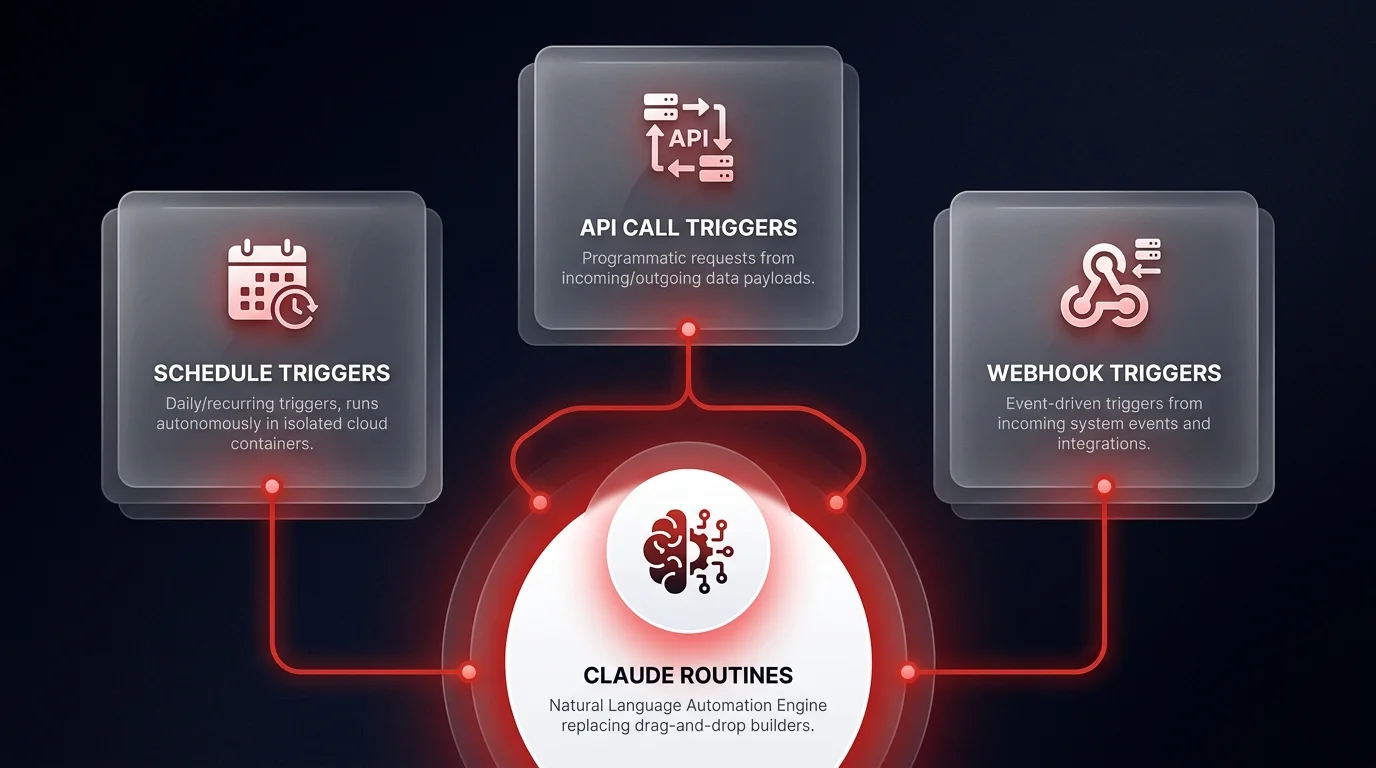
Claude Routines effectively solve that middle problem by acting as a literal one-to-one overlap for orchestration. Instead of constructing drag-and-drop logic nodes, users simply provide standard operating procedures written in natural language. These instructions operate within standardized, isolated cloud containers.
The system functions across three primary execution methods:
- Schedules: Recurring temporal triggers (e.g., waking up at 5:10 AM daily to run a process).
- Webhooks: Automated triggers based on specific incoming system events.
- API calls: Direct programmatic requests triggered by incoming or outgoing data payloads.
Because these routines run entirely hands-off in the cloud, they require a different approach to prompting. Unlike a chat interface where a user can steer the model or correct its mistakes in real-time, autonomous AI routines demand precise, comprehensive instructions to decrease the total scope of potential errors.
High-impact business use cases for Claude Routines
The most compelling aspect of natural language automation is how quickly complex, multi-step cognitive tasks can be deployed. Research into these new capabilities reveals several production-ready use cases that drastically reduce administrative overhead.
Intelligent mailbox triage and drafting
Consider the daily operational burden of inbox management. A routine can be scheduled to run every morning before the workday begins. Connected directly to a corporate Gmail account and a Slack workspace, the agent autonomously pulls all unread emails.
Crucially, it does not just read the current message - it searches for pre-existing conversation threads with that contact to establish context. Using this historical data, it drafts highly contextual replies, whether that involves politely declining an invitation, accepting a meeting, or answering a vendor question. Finally, it uses a Slack connector to send the user a high-level summary of the unreads and the proposed drafts, ready for manual approval and sending.
Autonomous revenue operations and proposal generation
A more advanced implementation involves chaining audio transcription services with document generation. When a sales call concludes, a transcription tool captures the conversation. An API request can then send that full transcript to a Claude Routine.
The routine processes the raw transcript, extracts the specific deal terms, pricing discussions, and client pain points, and feeds that data into a managed AI session. Within minutes, the system outputs a comprehensive, high-quality sales proposal formatted to the company's specific brand guidelines. What previously required two to three hours of manual data entry and document formatting can now occur in less than two minutes, completely autonomously. See how operations automation solutions are already applying this pattern to real revenue workflows.
Event-driven client onboarding
These routines can be interconnected to manage the entire post-sale lifecycle. When a client signs a proposal, a webhook can route that event back to a new routine. This secondary agent automatically proceeds with the next operational steps - drafting a customized welcome email, sending onboarding materials, provisioning calendar invitations, and updating the CRM. Most non-face-to-face operational steps can now be fully delegated to agentic systems.
Claude Routines token economics - when to use routines versus compute
While the ability to copy the JSON output from a traditional workflow and paste it into Claude to instantly generate a natural language equivalent is impressive, it introduces a critical operational caveat: token economics.
When dealing with large language models, operations occur in the domain of tokens. Traditional workflow platforms operate in the domain of raw compute. Processing logic through token-based reasoning is significantly more expensive than running standard programmatic functions. Organizations already navigating the AI token spend crisis understand that unchecked consumption can quietly erode margins.
If an organization needs to scrape thousands of articles, process massive data arrays, or route high-volume webhook traffic, relying entirely on AI routines is highly inefficient and cost-prohibitive.
This reality validates a hybrid architectural approach. While large language models are perfect for complex reasoning, unstructured data parsing, and natural language generation, battle-tested workflow automation tools remain strictly necessary. They control token costs, handle high-volume compute efficiently, and enforce enterprise observability. The optimal system uses standard code for predictable data routing and calls upon AI agents exclusively when cognitive reasoning is required.
The shadow AI crisis created by Claude Routines
The democratization of automation introduces severe enterprise risks. The barrier to entry for building powerful automations has dropped to zero. Any employee can now access a graphical interface, click an OAuth button to connect their corporate Gmail and Slack accounts, and instruct an AI model to read and process sensitive company data.
This ease of use guarantees a massive spike in ungoverned shadow AI. Employees are integrating corporate communication channels directly to third-party cloud environments to automate their busywork. The pattern mirrors what governance teams are already tracking in shadow AI sprawl and coordination debt across other AI tooling categories.
The security implications are alarming. Hard-coded API keys are easily exposed, sensitive customer data is processed in ungoverned containers, and organizations have zero observability into what data is leaving their environment or how it is being utilized. When an employee builds a local automation that reads every incoming email and sends summaries via Slack, the IT department is entirely blind to that data flow.
This is the exact crisis that operations leaders must address immediately. The goal cannot be to ban these tools - they are too valuable for productivity. Instead, the focus must shift to governance, security, and centralized control. For a deeper framework on managing this risk, see our analysis of harness engineering for AI governance.
Building a governed sovereign AI system for Claude Routines
Organizations need a professional middle ground. They need the speed and capability of these new AI routines, but governed within secure, owned infrastructure. This is where the deployment of sovereign AI agent systems becomes a strategic imperative.
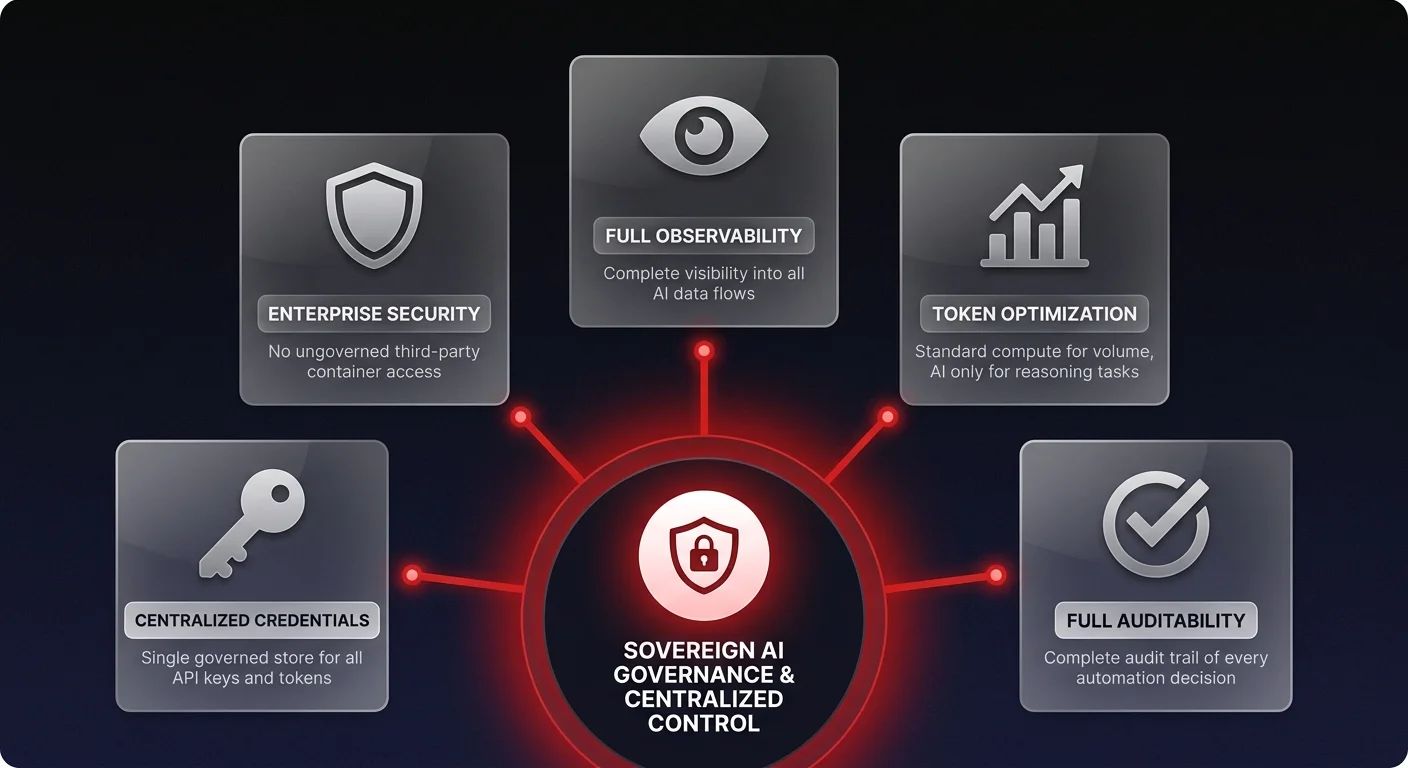
Rather than allowing fragmented, decentralized AI experiments across departments, operations leaders should focus on a solution-first model. By utilizing a hybrid technology stack - combining open-source autonomous reasoning platforms, process orchestration engines, and enterprise-grade security environments - companies can build powerful automations that they actually own and control.
Instead of paying continuous platform fees for decentralized subscriptions, organizations should invest in specific business outcomes. The most effective strategy is to start with a highly focused starter project - fixed scope, fixed cost, executed in weeks. For example, centralizing the proposal generation workflow discussed earlier into a single, highly governed, internally owned application.
Once that specific outcome is proven and ROI is established, the organization can embrace a land-and-expand approach, rolling out further interconnected systems for marketing, customer support, and human resources. This ensures that all agentic workflows are securely managed, token costs are optimized, and data never leaks into ungoverned shadow IT environments. Explore how Ability.ai builds governed automation systems tailored to your operational requirements.
Moving beyond fragmented AI experiments with Claude Routines
The launch of advanced natural language workflows proves that agentic automation is no longer theoretical - it is a highly accessible, highly capable reality. The ability to orchestrate complex logic using simple text instructions will rapidly accelerate operational efficiency for the companies that adopt it correctly.
However, the organizations that will truly benefit are those that recognize this not just as a new technical feature, but as a governance challenge. The future of operations does not belong to companies with hundreds of fragmented, unmonitored workflows running on employee laptops. It belongs to organizations that deploy secure, centralized, and observable AI systems built specifically for their operational requirements.
The technology is ready. The next step is ensuring your infrastructure is mature enough to harness it safely.