

Autonomous AI routines are scheduled or event-triggered agent systems that execute complex, multi-step business operations without continuous human oversight. Unlike reactive chatbots that wait for user input, these systems process work in parallel cloud environments - handling sales proposals, churn recovery, and payment triage around the clock, integrating with your existing SaaS stack through deterministic orchestration layers like n8n.
Operations leaders are facing a critical inflection point. The experimental phase of artificial intelligence is ending, and the demand for reliable, production-ready autonomous AI routines is taking its place. At the center of this shift are systems that transform language models from reactive chatbots into proactive automation infrastructure. For scaling businesses, the ability to execute complex, multi-step operations without constant human oversight is no longer just a competitive advantage; it is an operational necessity.
Our research into the latest advancements in AI agent architecture, specifically analyzing frameworks like Claude routines, reveals a fundamental shift in how work gets done. Organizations no longer need to rely on brittle, rigid rule-based logic for tasks requiring human-like reasoning. Instead, by combining deterministic orchestration platforms with advanced AI skills and connectors, companies can deploy systems that autonomously handle bulk recurring work. For a broader view of how this plays out in enterprise settings, see our analysis of autonomous AI agents as digital employees.
Autonomous AI routines: from reactive chatbots to proactive infrastructure
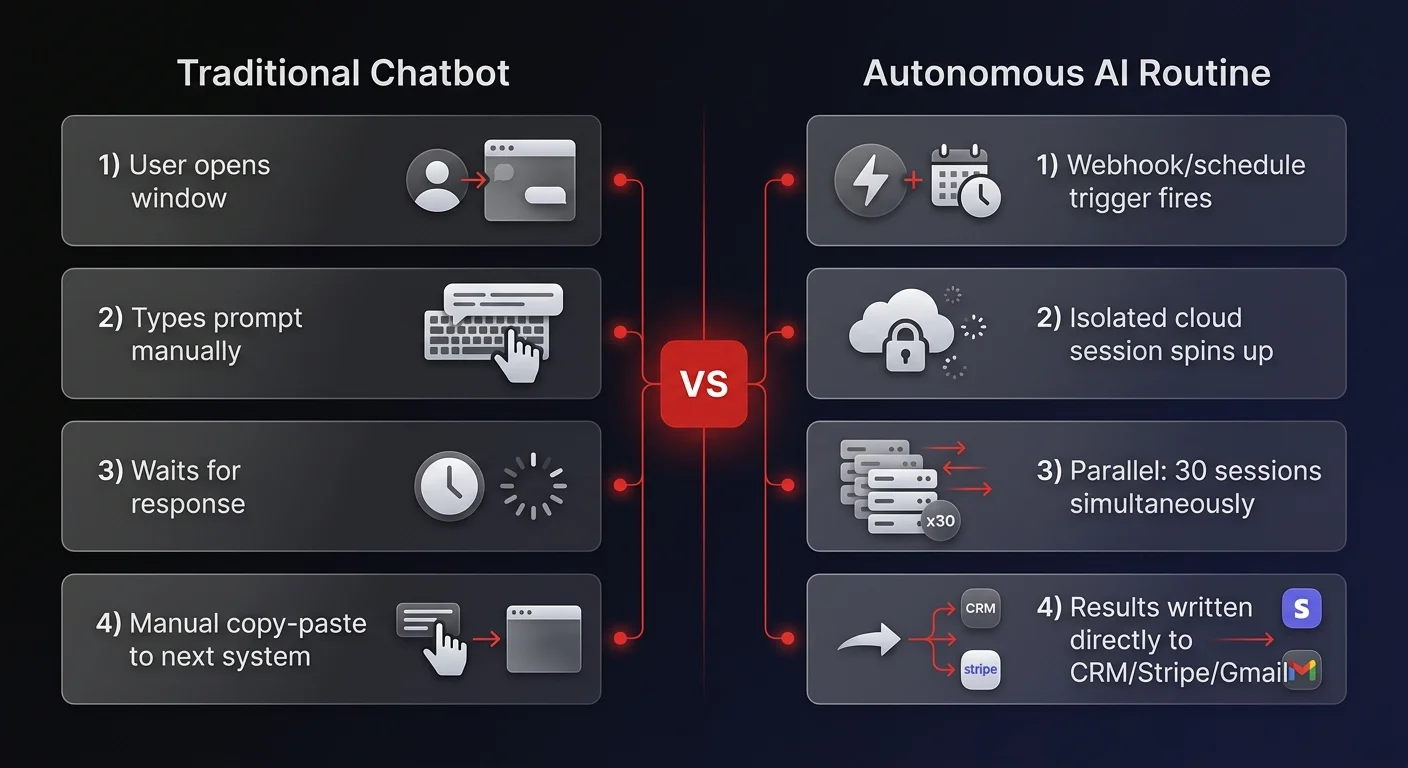
Traditionally, interacting with large language models required active human participation. A user opened a window, typed a prompt, waited for a response, and manually moved that data to its next destination. This manual paradigm created a hard ceiling on productivity and inevitably led to Shadow AI - fragmented, ungoverned AI usage across the organization. For a deeper look at that risk, see our guide on the shadow AI governance crisis.
Recent developments in agent routines bypass this limitation entirely by moving execution to the cloud. Modern autonomous routines operate on two primary trigger mechanisms:
- Scheduled triggers - Running on specific time intervals (hourly, daily, weekly) regardless of whether a human operator is online.
- Event-based triggers - Activating autonomously when a specific action occurs in external software via API webhooks.
Crucially, these systems solve one of the most persistent bottlenecks in AI automation: context window overload and parallel processing. When an event-triggered routine fires, the system spins up a fresh, isolated agent session for each specific task. If a company experiences 30 customer churns in a single hour, the infrastructure creates 30 separate agent sessions processing each case independently. This eliminates the error-prone practice of forcing a single agent to manage bulk data simultaneously, fundamentally changing how we approach volume-heavy operations.
Realizing value: autonomous AI routines in revenue operations and customer success
To understand the practical impact of autonomous AI routines, operations leaders must look at specific, deployed use cases rather than theoretical capabilities. According to McKinsey, organizations that deploy AI-driven workflow automation reduce manual processing time by 60-70% in targeted functions. Our analysis highlights three distinct workflows where agent systems are already driving significant operational outcomes. These patterns align closely with the agentic workflows transforming SaaS-connected operations.
Post-discovery sales proposals
Generating personalized sales proposals often creates bottlenecks for revenue teams. An autonomous routine can fully automate this process using an event-triggered architecture.
The workflow begins when a meeting transcription tool, such as Fireflies, finishes processing a sales call transcript. This event triggers the AI agent, which is equipped with specific skills and connectors. The agent first uses a Gmail connector to scan the inbox for past communication with the prospect, building vital historical context. It then utilizes a PandaDoc integration (via Model Context Protocol or MCP) to populate a proposal template. The agent intelligently injects the prospect's name, company details, a highly personalized introduction based on the call transcript, and a customized scope of work. Finally, it generates a draft email containing the proposal link for a sales representative to review and send.
Automated churn recovery
Customer retention requires immediate, contextual action. A robust churn recovery routine triggers the moment billing software like Stripe detects a canceled subscription.
Rather than sending a generic automated email, the agent cross-references multiple data silos. It pulls the customer's lifetime value and tenure from Stripe, scans recent support interactions in Gmail, and checks engagement levels in community platforms using APIs. Based on this comprehensive data synthesis, the agent drafts a hyper-personalized churn recovery or feedback email. Because it has access to complete historical context, the outreach addresses specific features the user engaged with, dramatically increasing the likelihood of a response.
Failed payment triage
Revenue leakage from failed payments requires consistent monitoring. A scheduled routine can be configured to run daily at 7:00 a.m., autonomously checking Stripe for any payment failures over the preceding 24 hours. Following a strict Standard Operating Procedure (SOP) embedded in its "Skill" instructions, the agent gathers customer data, checks previous communication history to avoid redundant messaging, and drafts a contextualized follow-up message to resolve the billing issue.
Why autonomous AI routines require structured skills, not one-shot prompts
While the capabilities of these routines are impressive, they introduce a distinct governance challenge. Automating processes through large language models means relying on non-deterministic systems - they do not inherently follow strict if-then logic like traditional software.
Organizations attempting to build autonomous routines using simple, one-shot prompts (e.g., "Check my inbox and summarize failed payments") will inevitably experience high failure rates, hallucinations, and non-functional automations.
Reliability at scale requires abandoning the standard prompt in favor of structured "Skills." A Skill is a rigorously defined AI instruction set that outlines an exact SOP. More importantly, Skills can be systematically tested before deployment.
Leading AI frameworks now include built-in evaluation tools. Operators can command the system to run multiple test iterations - for example, passing a real, anonymized customer ID through a churn recovery skill five distinct times. The system generates detailed HTML reports showing lookup consistency and identifying failure points. If an agent attempts to send a duplicate email during a test run, operators can adjust the Skill's logic to patch the vulnerability before the routine ever touches production data. For advanced optimization, teams can deploy auto-research loops - self-improvement frameworks where the AI iteratively tests and optimizes its own skills against predefined success criteria.
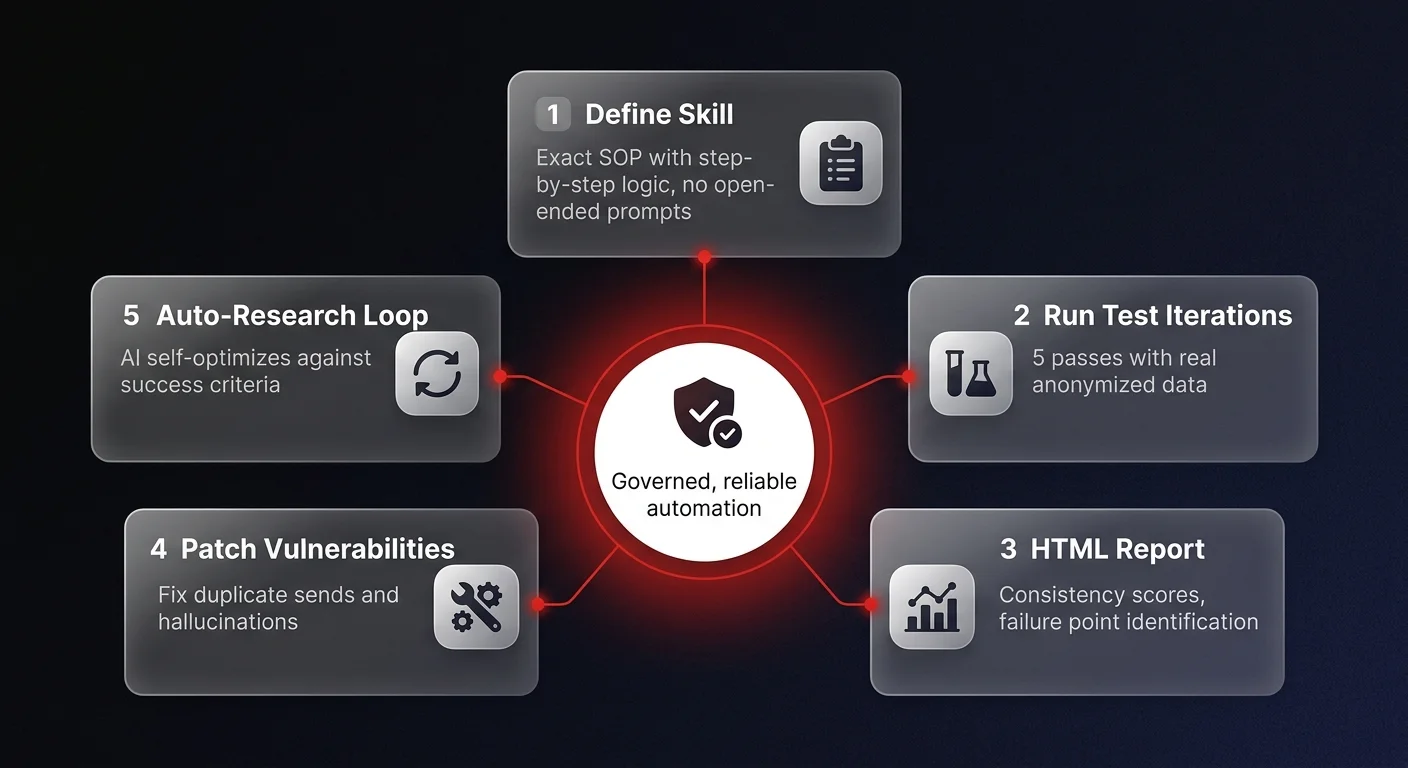
This structured Skills approach is also what separates governed AI deployments from the ungoverned shadow automations explored in our analysis of AI workflow automation governance challenges.
Orchestrating autonomous AI routines with n8n
Despite the power of native AI routines, enterprise execution faces distinct architectural limitations. Currently, leading AI models lack native webhooks for the vast majority of SaaS applications. They also restrict local file access for remote, cloud-based runs - requiring organizations to manage context files and skills through GitHub repositories. Furthermore, enterprise API usage models often transition to consumption-based billing after a strict cap of native routine runs (such as 25 per day).
This is why a robust Sovereign AI Agent System requires a deterministic orchestration layer, most notably n8n.
Platforms like n8n serve as the critical nervous system for AI routines. Because n8n possesses hundreds of native webhook triggers, it acts as the listener for the enterprise. When a customer subscription updates in Stripe, n8n catches that specific webhook event instantly. It then executes an HTTPS request - utilizing authorized bearer tokens and custom environment variables - to trigger the specific AI agent via API, passing along the exact customer data required for the task.
This hybrid architecture combines the absolute reliability of deterministic routing (n8n) with the advanced reasoning and unstructured data processing of generative AI. If you are evaluating how to architect this for your organization, the team at Ability AI designs and deploys governed autonomous agent systems for mid-market operations teams - without platform lock-in or multi-year consulting engagements.
Strategic implications for operations leaders
For executives navigating the AI landscape, these technical realities present a clear strategic mandate. Scaling organizations are currently caught between two highly flawed options: allowing Shadow AI sprawl where employees build fragile, ungoverned routines on their own devices, or engaging in massive, slow-moving consulting projects that fail to deliver immediate ROI.
At Ability AI, we view these developments as validation of the Solution-First model. The most successful organizations bypass experimentation by deploying targeted Starter Projects - fixed-scope, fixed-cost implementations that address immediate operational bottlenecks.
By leveraging an architecture that combines n8n for orchestration with advanced AI reasoning, organizations can deploy Sovereign AI Agent Systems. These are systems the company owns, governs, and controls long-term, free from exorbitant recurring platform fees. Whether deploying a Support Triage Automation engine or a Lead Enrichment System, the focus remains entirely on driving tangible business outcomes through governed infrastructure.
Securing your operations with autonomous AI routines
The transition from manual task execution to autonomous AI routines represents the most significant operational upgrade available to mid-market companies today. The technology has evolved past the limitations of standard chatbots, offering true parallel processing, deep tool integration, and sophisticated evaluation frameworks to ensure reliability.
However, unlocking this value requires more than just access to the latest AI models. It requires a disciplined approach to architecture, a commitment to rigorous testing, and the strategic foresight to integrate deterministic workflow engines with non-deterministic reasoning agents. By adopting a governed, systems-level approach to AI automation, operations leaders can successfully scale their revenue and customer success functions without scaling their headcount - bringing order to operations and eliminating the chaos of ungoverned AI.