
Internal software review agents are purpose-built AI systems that automatically evaluate employee software requests against approved technology stacks, conduct autonomous web research, and route decisions through existing communication platforms like Slack - eliminating the procurement bottleneck that drives shadow IT sprawl. According to Gartner, enterprises waste 25% of their SaaS budget on redundant or unused licenses that centralized review agents can prevent.
As organizations scale, the bottleneck between employee needs and IT procurement grows tighter. Internal software review agents represent a breakthrough in how businesses handle this friction - replacing the slow, manual evaluation processes that block productivity and drive employees to bypass governance entirely. A new class of intelligent automation is emerging to solve this: purpose-built AI agents designed to process high-volume IT inquiries instantly. By evaluating requests against approved tech stacks, conducting autonomous web research, and integrating seamlessly into existing communication platforms, these agents are transforming procurement.
Research into recent enterprise AI deployments reveals a blueprint for how organizations can eliminate procurement bottlenecks. By deploying autonomous systems that operate with strict parameters, operations leaders can stop paying for duplicate software, prevent ungoverned application sprawl, and unblock users from doing their best work. This is exactly the kind of operational challenge that IT service management automation is designed to address at scale.
The rising cost of manual software procurement
The traditional software review process is fundamentally broken for modern, fast-moving teams. In a typical mid-market organization, IT and procurement teams drown in high-volume, repetitive triage workflows. According to a 2025 Flexera State of ITAM report, the average enterprise manages over 130 SaaS applications - with requests for new tools arriving daily from every department.
For human operators, processing these requests requires a tedious, multi-step workflow. An IT professional must read the request, search the company's existing technology stack to see if a similar tool is already licensed, research the requested tool's capabilities on the web, evaluate security compliance, and finally route the decision back to the employee. If the request is approved, they must then manually provision the seats or escalate the task to another department.
This manual triage creates two distinct operational failures. First, it drains highly paid IT professionals of their time, forcing them to act as basic human routers rather than strategic technologists. Second, it delays employee productivity. When an employee is blocked from accessing a tool they need to execute a campaign or close a deal, the business loses momentum.
How internal software review agents use skill-based execution
The critical differentiator between a generic large language model - like an employee using ChatGPT - and specialized internal software review agents is the concept of skill-based execution. Enterprise agents operate using predefined skills, which are strict behavioral parameters and workflows programmed into the AI.
These skills define best practices and contain the necessary instructions for an agent to perform its work accurately and consistently every single time. Instead of relying on open-ended reasoning that might lead to hallucinations or inconsistent approvals, a governed AI agent utilizes these programmed skills to follow the exact same review process that a human IT team would follow.
By anchoring the AI's behavior in specific skills, organizations ensure that the agent checks all the required compliance boxes, cross-references the correct internal databases, and adheres to company policy without deviation. This is where AI transitions from a novel chatbot into a reliable, enterprise-grade operational system. For a deeper look at how this architecture prevents silent failures, see our analysis of AI agent architecture and governance patterns.
Core workflows of a software review agent
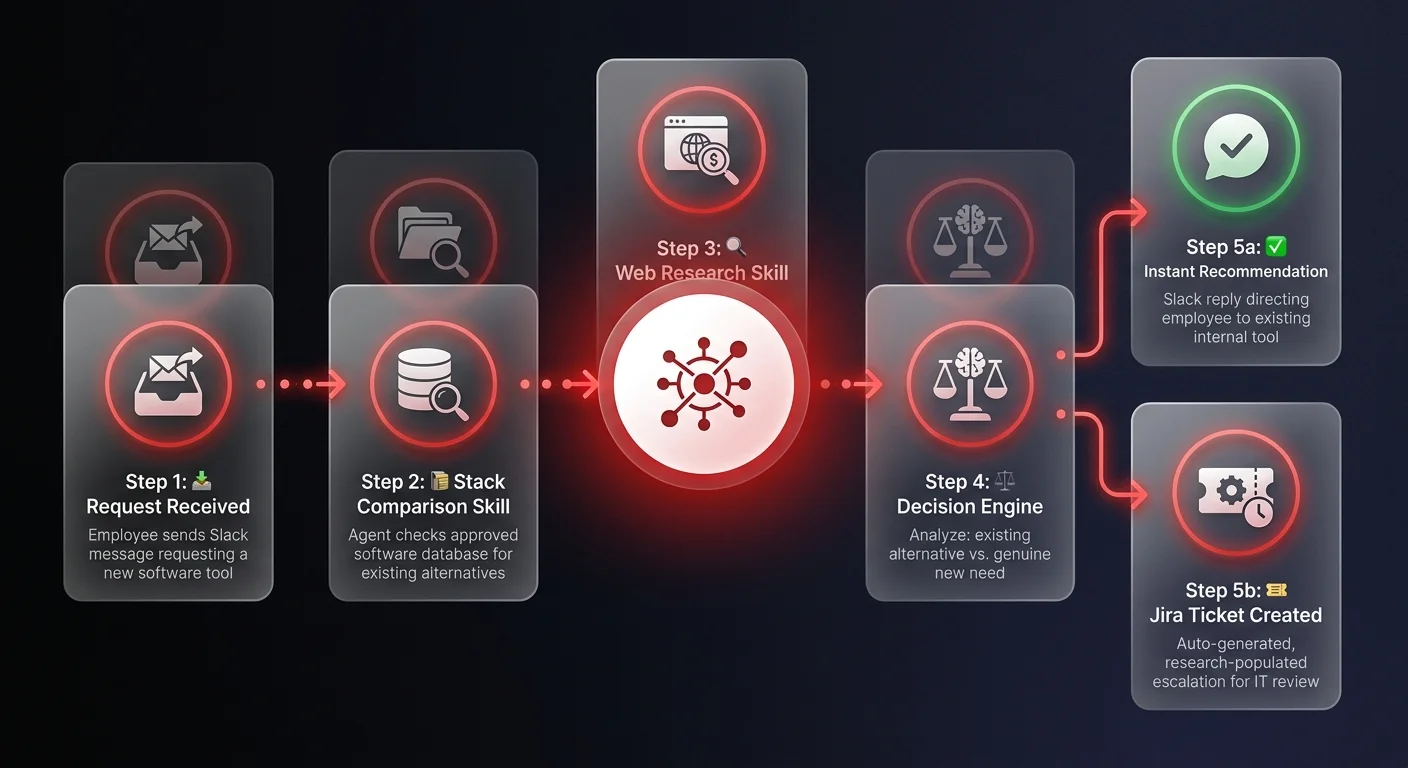
To understand the operational impact of these systems, it is essential to examine the specific workflows they execute. A comprehensive software review agent functions across three primary domains: communication, research, and escalation.
Native integration where work happens
The most successful automation initiatives meet employees where they already work. Modern software review agents are designed to function seamlessly within enterprise communication platforms like Slack or Microsoft Teams.
Instead of forcing an employee to log into a separate procurement portal, fill out a cumbersome form, and wait for an email response, the interaction happens organically. For example, if an employee needs a high-quality video recording tool for their client demos, they simply send a message to the agent directly within Slack. According to McKinsey's 2025 digital workplace study, tools that integrate into existing workflows see 3x higher adoption rates than standalone portals. This frictionless interface encourages adoption and prevents users from bypassing the official request process out of sheer frustration.
Autonomous research and stack comparison
Once a request is received, the agent begins its core analytical work. It utilizes its predefined skills to perform live web research on the requested tool - extracting the software's capabilities, pricing, and primary use cases.
Simultaneously, the agent checks the company's approved software lists and internal technology databases. It compares the capabilities of the newly requested tool against similar software already present in the approved stack. If the employee requested a new video recording application, but the company already has enterprise licenses for an identical tool, the agent identifies this redundancy immediately. It then responds to the user in Slack, recommending the existing internal tool and providing instructions on how to access it - effectively preventing redundant software spend.
Seamless escalation and ticket routing
While AI agents are highly capable of triage and research, certain actions require human oversight, financial approval, or complex technical provisioning. When an agent determines that a request is valid and necessary, it does not simply drop the process - it orchestrates the next step.
If the request requires IT support to provision new seats or allocate budget, the agent automatically files a Jira ticket on behalf of the user. It populates the ticket with all the necessary context, including its comparative research, the business justification provided by the user, and the exact software details. This intelligent escalation handles the time-sensitive busywork, delivering a fully researched, ready-to-action ticket to the IT desk. Organizations using help desk automation agents report 40-60% of tickets auto-resolved without human intervention.
Combating shadow IT with internal software review agents
The operational value of an automated software review process extends far beyond mere efficiency - it is a critical defense against shadow IT and shadow AI. When internal processes are slow, employees inevitably find workarounds. They use personal credit cards to purchase software subscriptions, or they expense unvetted AI tools to get their jobs done faster.
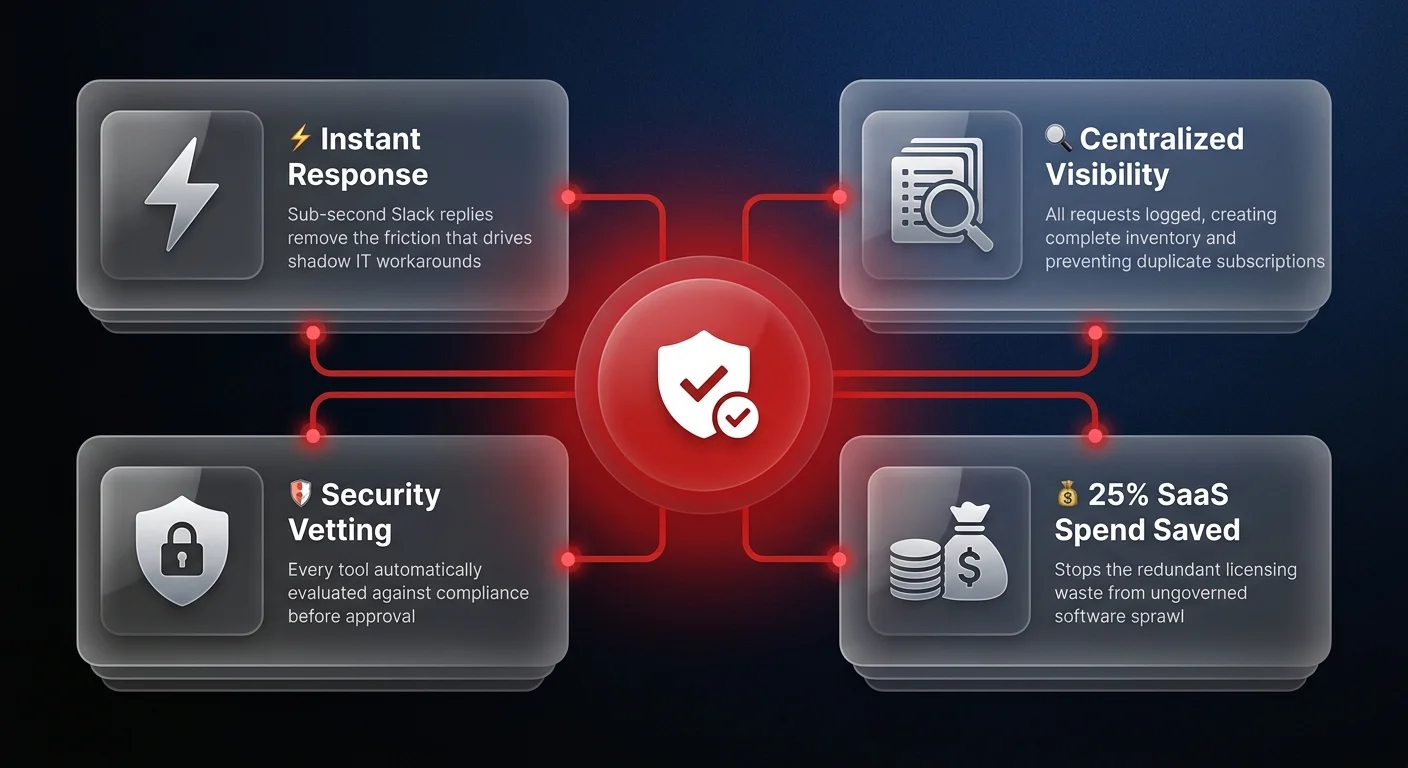
This sprawl creates massive vulnerabilities. Ungoverned data sharing, security risks, and decentralized data silos become rampant. Furthermore, organizations end up paying for duplicate capabilities across different departments because there is no centralized visibility. According to Productiv's 2025 SaaS Management Index, the average enterprise has 40% more SaaS applications than IT is aware of - a direct consequence of procurement friction.
Deploying a governed AI agent system to manage the technology stack establishes a frictionless, centralized point of control. Because the agent responds instantly, employees are incentivized to use the official channel. The organization regains control over its technology footprint, ensuring that all new software is properly vetted, documented, and aligned with security standards before it ever touches company data. For more on how ungoverned tools create compounding operational risk, explore how shadow AI sprawl creates coordination debt across the organization.
The starter project approach to IT automation
For many operations leaders, the prospect of automating IT procurement feels like a massive, multi-month digital transformation initiative. This hesitation often leaves companies caught between two bad options - allowing shadow IT to continue unchecked, or embarking on massive, slow consulting projects that fail to deliver immediate ROI.
The most effective way to deploy this technology is through a solution-first model. By scoping the initiative as a focused starter project, organizations can deploy an IT support triage agent in a matter of weeks, not months.
Using a powerful orchestration layer combined with custom development, businesses can connect Slack, live web scraping capabilities, internal databases, and Jira into a single, cohesive workflow. This fixed-scope approach proves value immediately. It solves a specific, high-friction bottleneck, demonstrates measurable ROI through reduced duplicate software spend, and establishes a foundation for expanding automation across other IT service management workflows.
Strategic implications for operations leaders
The capabilities demonstrated by modern software review agents signal a fundamental shift in how internal operations function. We are moving away from an era where highly skilled IT professionals spend their days cross-referencing spreadsheets and routing basic requests.
By leveraging autonomous reasoning to handle high-volume triage, organizations can finally unblock their employees while enforcing strict governance. According to Forrester's 2025 Total Economic Impact studies, organizations that automate IT procurement triage reduce average request resolution time from 4-8 days to under 4 hours - a 95% improvement in employee wait time.
The key takeaway: it is entirely possible to achieve both speed and security in IT procurement. By deploying targeted, skill-based AI agents, you can protect your organization from shadow AI sprawl, optimize your technology spend, and allow your IT professionals to focus on the strategic initiatives that actually drive the business forward.