
Multi-agent systems are coordinated fleets of specialized AI agents that execute complex workflows concurrently - replacing sequential human processes with parallel, autonomous operations. According to research on high-performance engineering teams, organizations without robust multi-agent architecture risk falling six months behind competitors within a single development cycle.
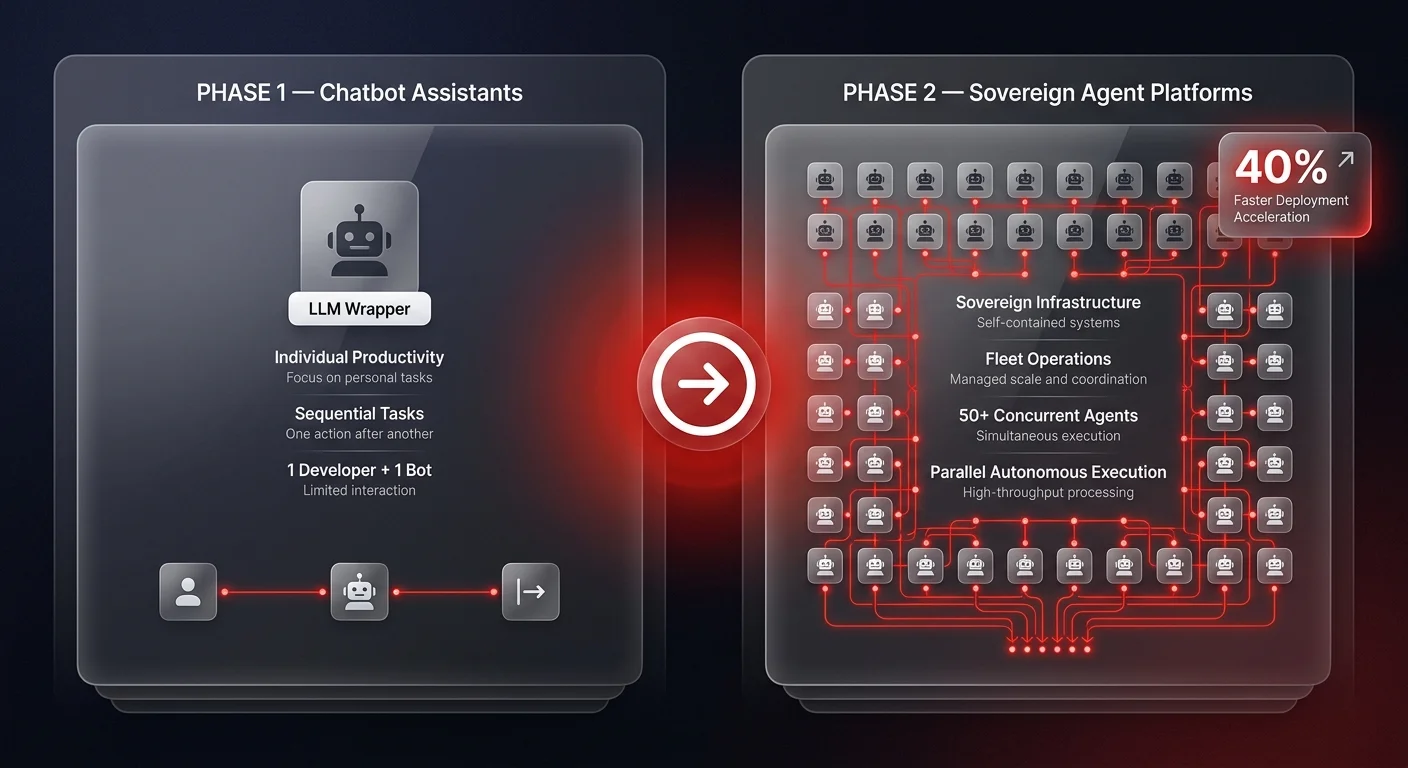
The shift from simple LLM wrappers to comprehensive AI infrastructure marks the second phase of the enterprise AI revolution. In the first phase, organizations experimented with chatbots to assist individual developers. In this current second phase, leaders are building sovereign platforms capable of running dozens of concurrent agents to handle core operational tasks like code review, release validation, and inference at scale. This research explores the architectural shifts required to support these fleets and the strategic implications for CTOs and internal AI champions.
How multi-agent systems accelerate deployment in modern finance
For an internal AI infrastructure team, the primary metric of success is speed. However, this is not merely about writing code faster - it is about reducing the latency between a concept and a production release. In traditional environments, the bottleneck often lies in the human-led review processes and the manual validation of complex merge requests (MRs). According to McKinsey's 2025 State of AI report, companies with mature AI automation ship products 40% faster than industry peers.
The most successful teams are solving this by building a dedicated inference layer. This layer serves as the core utility for the entire organization, providing a centralized platform where personalized user experiences and automated back-end logic can be deployed predictably. By treating AI inference as a core infrastructure component rather than a series of fragmented tools, companies can achieve a level of scale that was previously impossible.
When inference is commoditized internally, it allows for the deployment of 50 or more agents running concurrently. These are not passive observers - they are active participants in the software development lifecycle. In a finance-centric context where security and precision are paramount, the ability to have a massive fleet of agents review a single piece of code provides a safety net that human teams cannot replicate at the same velocity. If 50 specialized agents review a merge request and reach a consensus on its safety and logic, the confidence level for a release increases exponentially while the time required for that confidence drops from days to minutes.
Moving beyond workflow glue to agentic runtimes
Many organizations attempt to build multi-agent systems using traditional workflow automation tools or simple scaffolding. However, there is a significant difference between workflow glue - which follows deterministic, linear paths - and an autonomous agentic runtime. Tools designed for simple integration often fail when faced with the non-linear, System 2 reasoning required for complex tasks like code analysis or financial risk modeling. Gartner estimates that by 2028, 33% of enterprise software applications will include agentic AI, up from less than 1% in 2024.
To achieve the results seen by leaders like Payward, the infrastructure must support autonomous reasoning. This is where the distinction between a script and a system becomes clear. A script performs a task; a system provides the operational layer beneath the agent - including persistence, shared state, and the ability to schedule agents as persistent workers rather than ephemeral API calls. This is the core challenge of multi-agent orchestration at enterprise scale.
For a CTO, the decision to build or buy this underlying plumbing is a critical strategic fork in the road. Building the scheduling, observability, and audit logs required for a 50-agent fleet can consume months of engineering time - ironically causing the very delays the AI was meant to solve. A production-grade runtime allows the internal team to focus on the agent logic - the part that actually drives business value - rather than the infrastructure maintenance. Organizations looking to scale AI agents effectively must weigh this build-versus-buy decision early.
The consensus mechanism as a multi-agent systems release gate
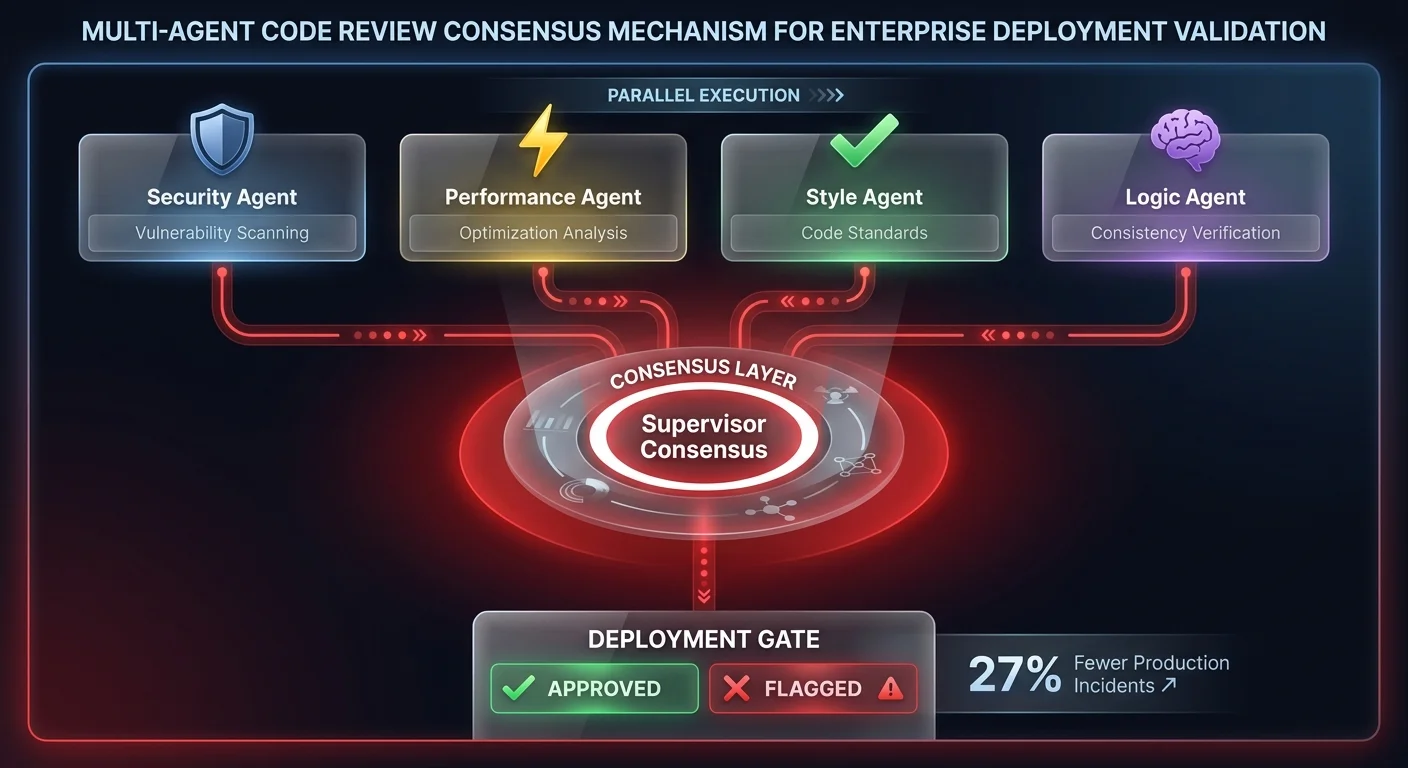
One of the most profound findings in our research is the use of multi-agent consensus for release validation. In a standard DevOps pipeline, you might have automated tests and a human peer review. In an agent-first pipeline, the process looks fundamentally different:
- Specialization: Different agents are assigned specific lenses - one for security vulnerabilities, one for performance optimization, one for adherence to style guides, and one for logical consistency with existing financial models. Teams deploying an intelligent code review agent see immediate improvements in defect detection rates.
- Concurrency: These agents run simultaneously, not sequentially, drastically cutting down the feedback loop.
- Consensus: A final supervisor agent or a consensus algorithm aggregates the findings. If the fleet agrees the code is safe, it proceeds to the final human check or direct deployment.
This approach provides a level of rigor that is physically impossible for a human team to sustain. A human developer might catch a logical flaw but miss a subtle security vulnerability in a large MR. A fleet of 50 agents, each focused on a narrow domain, is significantly less likely to miss these details. The value here is not just speed - it is the reduction of technical debt and the mitigation of catastrophic release failures. Deloitte's 2025 AI adoption survey found that organizations using AI-assisted code review reduced production incidents by 27%.
Sovereignty and the builder's dilemma
For companies in sensitive sectors like finance, data sovereignty is a non-negotiable requirement. While partnering with foundational model providers is essential for accessing the latest reasoning capabilities, the infrastructure that orchestrates these models must remain under the organization's control. This is the core of the sovereign AI agents movement.
Internal AI infrastructure teams are increasingly looking for managed instances that can run within their own secure environments, such as a VPC on Azure or AWS. They need the privacy of a local setup with the scale of the cloud. A sovereign managed instance delivers this - as private as running a model on a local machine, but with the enterprise-grade RBAC, audit logs, and single-tenant isolation required to pass strict procurement and compliance audits.
When agents are treated as company infrastructure rather than individual productivity tools, they require a different level of governance. You need to know exactly what an agent did, why it made a specific decision during a code review, and what data it accessed. This level of auditability is what transforms a collection of experiments into a reliable agent system that an organization can actually own and control long-term.
The economics of scaling multi-agent systems
As organizations scale their multi-agent systems, the pricing model for AI shifts from "per seat" to "per agent" or "per outcome." In the Payward example, the value is found in the ability to run 50 agents at once. If those agents were priced like human seats, the cost would be prohibitive. However, when treated as synthetic labor units, the economics change dramatically - Stanford HAI's 2025 AI Index reports that inference costs dropped 90% year-over-year for leading models.
Per-agent pricing aligns with this new reality. Instead of paying for every employee who might occasionally use a chatbot, companies pay for the persistent, autonomous agents that are actually performing the work. This model supports a strategic shift: while traditional AI tools aim to make a developer 10% more productive, a sovereign agent system is designed to fundamentally change how many people you need to manage a complex release management cycle.
This shift in economics is what allows a mid-market company to compete with global giants. By deploying a fleet of agents that can work 24/7 on tasks like MR reviews, market research, or customer support triage, a smaller team can maintain the output of a much larger organization. The goal is no longer just to save seats - it is to generate pipeline and ship product at a velocity that defines the market.
Conclusion: the path to an agentic future
The transition to multi-agent systems is not just about adopting new tools - it is about building a sovereign layer of intelligence that can be integrated into every function of the business.
Whether you are an internal AI champion at a 50-person scaling company or a CTO at a 500-person enterprise, the challenge remains the same: how do you deploy these systems without getting bogged down in the plumbing? The organizations that win will be those that embrace a professional, infrastructure-first approach - focusing on agent logic rather than reinventing the operations automation infrastructure from scratch.
The evidence is clear - those who wait to build their own infrastructure from scratch risk being six months behind by the time they reach production. The time to transition from fragmented AI experiments to a centrally governed, sovereign agent system is now. The future of operations is not just AI-enabled - it is agent-driven, persistent, and entirely under your control.