
Multi-agent AI architecture is a system design pattern where multiple specialized AI agents collaborate through orchestration infrastructure to autonomously execute complex business processes. Unlike single coding assistants, multi-agent AI systems use persistent shared state, context segregation, and sandboxed tool execution to handle enterprise workflows end-to-end - from RFP processing to CRM automation.
The transition from experimental desktop assistants to enterprise-grade multi-agent AI architecture represents the most critical engineering shift facing technical leaders today. We are currently emerging from what industry researchers accurately describe as the experimental phase of coding agents. Organizations are realizing that the true value of these systems does not lie in helping individual developers write isolated scripts. Instead, the future belongs to embedded, multi-agent business systems that autonomously orchestrate core operations.
For CTOs and internal AI champions at scaling companies, the challenge is no longer figuring out how to prompt an LLM. The challenge is architectural - how do you transition from single-player, stateless chat interfaces to a persistent, governed infrastructure where autonomous agents execute complex business processes?
Recent technical implementations in the open-source community offer a blueprint for this transition. By stripping away the bloated user interfaces of commercial AI tools and examining the core loops of agent frameworks, we can extract critical patterns for building robust, multi-agent AI systems.
Why multi-agent AI architecture outperforms monolithic systems
At its most fundamental level, an AI agent is simply an LLM that runs tools in a continuous loop. It receives a goal, processes context, makes a tool call, evaluates the result, and loops back until the objective is achieved.
When this loop is wrapped in a shell and paired with a runtime environment, you get a coding agent. But when you abstract that same mechanics - the continuous reasoning loop and tool execution - away from the developer's desktop and embed it into your backend systems, you create operational infrastructure.
This shift requires a new way of thinking about AI deployment. Most organizations attempt to build massive, monolithic AI systems that try to understand the entire business context at once. This approach consistently fails, resulting in hallucinations, infinite loops, and broken data integrations. The alternative pattern emerging in successful enterprise deployments relies on a much older architectural concept.
The Unix philosophy for multi-agent AI tool integration
Ken Thompson, the inventor of Unix, famously established the philosophy: write programs that do one thing and do it well. This principle is becoming the golden rule for AI agent architecture.
When building tools for agents to use, engineers often make the mistake of providing massive, complex APIs. However, agents operate most reliably when they are given small, highly focused Command Line Interfaces (CLIs) or micro-tools.
Consider how leading desktop agents interact with complex software like Excel. They do not attempt to learn the entire Microsoft Graph API. Instead, they utilize small, specific packages - like Pandas or OpenPyXL - bundled into a single skill. From the outside, it looks like a complex integration, but internally, the agent is simply executing a basic, well-scoped micro-tool.
For CTOs architecting multi-agent systems, the directive is clear - make it easy for the agents. If you want an autonomous system to update your CRM or query your ERP, do not force the LLM to navigate complex OAuth flows and massive JSON payloads. Build simple, deterministic CLI tools that the agent can trigger with basic arguments. The complexity should live in your infrastructure, not in the agent's prompt. Organizations that have already adopted modular agent architectures consistently report higher reliability and faster iteration cycles.
Context segregation and persistent session memory
Moving beyond single-use chat interfaces requires a sophisticated approach to state and memory. In a multi-agent system, context cannot be a massive, unstructured text dump. It must be cleanly segregated.
Technical implementations of successful autonomous systems utilize strict context boundaries:
- General rules (agent.md): This defines the global behavioral constraints, the system's purpose, and the operational boundaries. It instructs the agent on how to use its available tools and how to handle errors.
- Entity-specific context (customer.md): This provides localized information. In a B2B setting, this might include a specific client's historical quirks, custom discount tiers, or unique SLA requirements.
By separating the "how to operate" from the "who I am operating on," systems can dynamically load context based on the incoming trigger. Furthermore, these systems rely on persistent session management. Instead of starting from scratch with every interaction, the system loads a historical thread, allowing the agent to "remember" previous tool calls and context. This persistent shared state is what elevates a basic script into true company infrastructure. Teams struggling with context degradation in long-running agents find that proper context segregation eliminates most reliability issues.
Architecting the autonomous RFP pipeline
To understand how these principles work in production, consider a multi-agent sales operations workflow designed to handle incoming Requests for Proposals (RFPs).
In a standard, non-agentic workflow, a human reads an email, logs into an ERP to check inventory, opens the CRM to check client tiers, and manually drafts a quote. In a governed multi-agent architecture, this pipeline is entirely autonomous:
- The gateway: An inbox monitor detects a new RFP email. A lightweight routing agent evaluates the intent and determines if it requires action.
- Session allocation: The gateway routes the email to a specific, customer-dedicated agent session, loading both the global rules and the specific client's context.
- Autonomous execution: The agent enters its reasoning loop. It uses a secure CLI tool to query the ERP for parts availability. It uses another micro-tool to query the CRM for the client's current discount tier.
- Frictionless output: The agent synthesizes the data and generates a response.
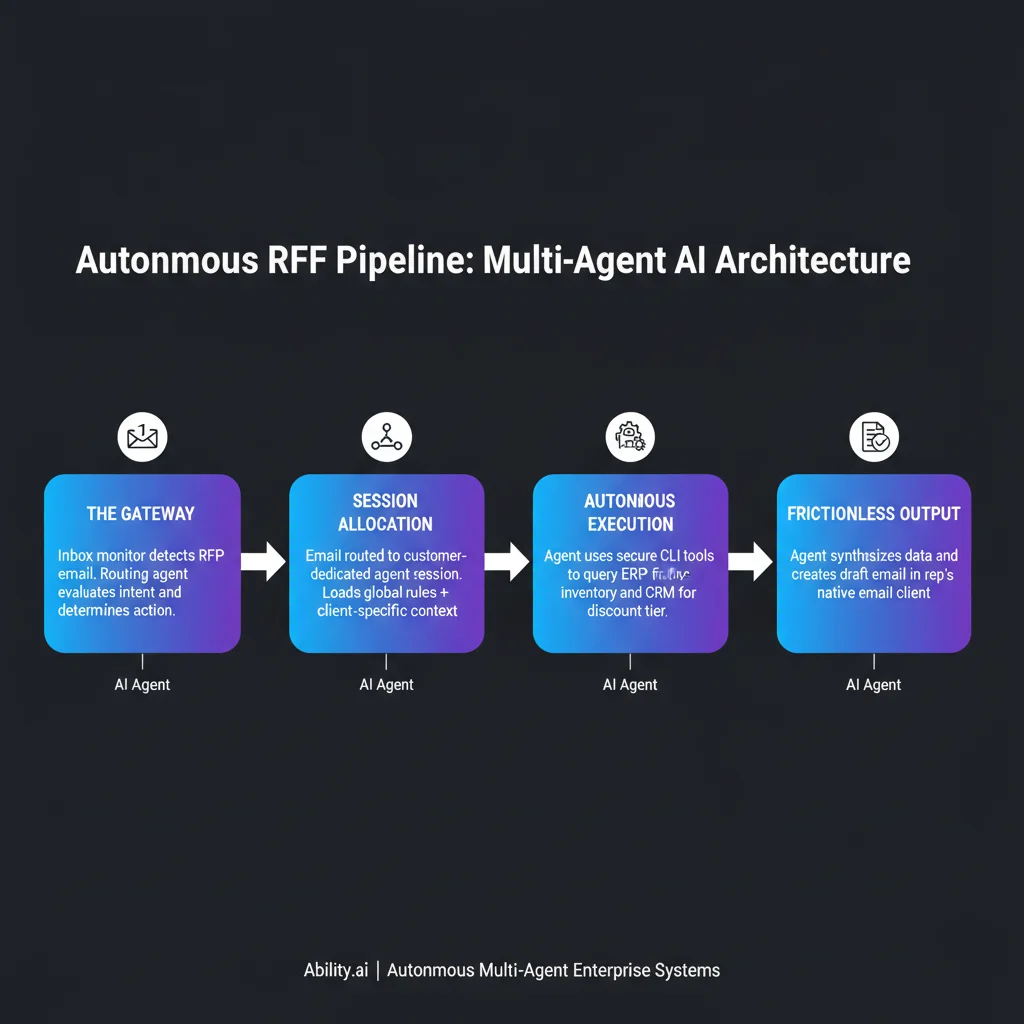
Crucially, the output is not pushed to a new, proprietary AI dashboard that employees have to learn. Instead, the agent simply creates a draft directly in the sales representative's existing email client. See how AI-powered sales automation can transform pipeline velocity for mid-market teams.
This frictionless human-in-the-loop design is vital for adoption. The user stays in their native environment, reviewing a fully researched, data-backed draft rather than starting from a blank page.
Sovereignty and sandboxing in multi-agent AI execution
As soon as you give an AI agent the ability to execute tools that interact with your ERP or CRM, you introduce massive security implications. The experimental phase of AI ignored these risks; the operational phase must confront them.
Tool calling cannot be an unconstrained activity. Enterprise-grade agent architectures require strict governance and intervention points. Before any tool call is executed, the system must trigger pre-execution checks. Does this specific agent session have Role-Based Access Control (RBAC) permission to run this query? Is this action destructive?
Furthermore, tool execution must happen within isolated sandboxes. Emerging standards point toward strict environment policies where agents can safely write code, run queries, and parse data without risking the broader corporate network. Organizations already investing in sovereign AI agent infrastructure are building these sandboxing layers into their core platform.
If an organization cannot audit exactly what an agent did, why it did it, and restrict its access via standard procurement-friendly security protocols, that system is not ready for production. Data sovereignty is not a luxury - it is a hard technical requirement for multi-agent architecture.
Building production-grade multi-agent AI infrastructure
The gap between a clever open-source experiment and a production-ready business system is infrastructure. You cannot reliably run mission-critical, multi-agent workflows on fragmented desktop applications or unmonitored scripts.
This is why technical operators are shifting toward sovereign, managed infrastructure. The operational layer required to host autonomous intelligent systems is not just workflow glue, and it is not a mere scaffolding framework - it is a production-grade environment for your agentic workforce.
For CTOs and internal AI champions making architecture decisions for scaling companies, sovereign cloud infrastructure offers the required isolation - a managed instance that functions as privately as software running on your own servers, with VPN-only access and total data isolation. It natively supports the persistent shared state and multi-user access required for complex, threaded workflows like the RFP pipeline described above. Companies seeking sovereign, governed AI automation benefit most from infrastructure they own and control without vendor lock-in.
Most importantly, production-grade infrastructure solves the operability challenge. It provides scheduled, auditable, and recoverable agent instances with built-in RBAC and event logging at the tool-execution layer. You gain the power of advanced multi-agent systems without the burden of waking up at 3 AM to fix a broken, unmonitored Python script.
As organizations move beyond basic chat interfaces, the winners will be those who treat AI agents as core company infrastructure. The code is only the beginning - the infrastructure is what guarantees the outcome.