
A weekly metrics reporting agent is a governed, autonomous AI system that connects to your business data sources and executes your exact analytical playbook on a reliable schedule - eliminating hours of manual spreadsheet consolidation every week. Organizations deploying structured reporting agents report 80%+ time savings on routine data operations while gaining full audit trails that shadow AI workflows never provide.
Operations leaders across mid-market organizations face a recurring Friday nightmare - manually pulling data from scattered spreadsheets, standardizing disparate metrics, and formatting weekly readouts for the executive team. While employees often try to solve this bottleneck using consumer AI tools, this creates a new set of data privacy and reliability risks. The strategic alternative is deploying a weekly metrics reporting agent - a governed, automated system that connects directly to your data sources and executes your exact analytical playbook on a reliable schedule.
Scaling companies are currently caught between two bad options. On one side is shadow AI sprawl, where well-meaning employees use ungoverned tools to process sensitive company data. On the other side are massive, slow consulting projects that take months to deliver basic value. A structured, purpose-built reporting agent represents the professional middle ground. By moving from fragmented AI experiments to a centrally governed Sovereign AI Agent System, operations teams can automate routine reporting without sacrificing security, accuracy, or control.
The shadow AI reporting crisis and why you need a weekly metrics reporting agent
To understand the value of an autonomous reporting agent, we must first look at how operations teams are currently attempting to use AI. Revenue operations, marketing, and customer success leaders are drowning in manual spreadsheet consolidation. To save time, an employee might export a CSV file from the company CRM, upload it to ChatGPT, and ask the model to generate a summary.
This workflow is fundamentally flawed for several reasons. First, it requires manual data movement, which introduces the potential for human error and version control issues. Second, it relies entirely on a single person's configuration and prompting style. If that employee leaves the company, goes on vacation, or changes their workflow, the reporting process breaks down completely. This is the hidden cost of shadow AI in enterprise operations - operational fragility disguised as personal productivity.
Agent-owned connections: treating your weekly metrics reporting agent as enterprise infrastructure
The foundation of a reliable automated workflow starts with how the AI system accesses your proprietary data. Enterprise-grade automation requires moving away from user-dependent logins and shifting toward agent-owned connections.
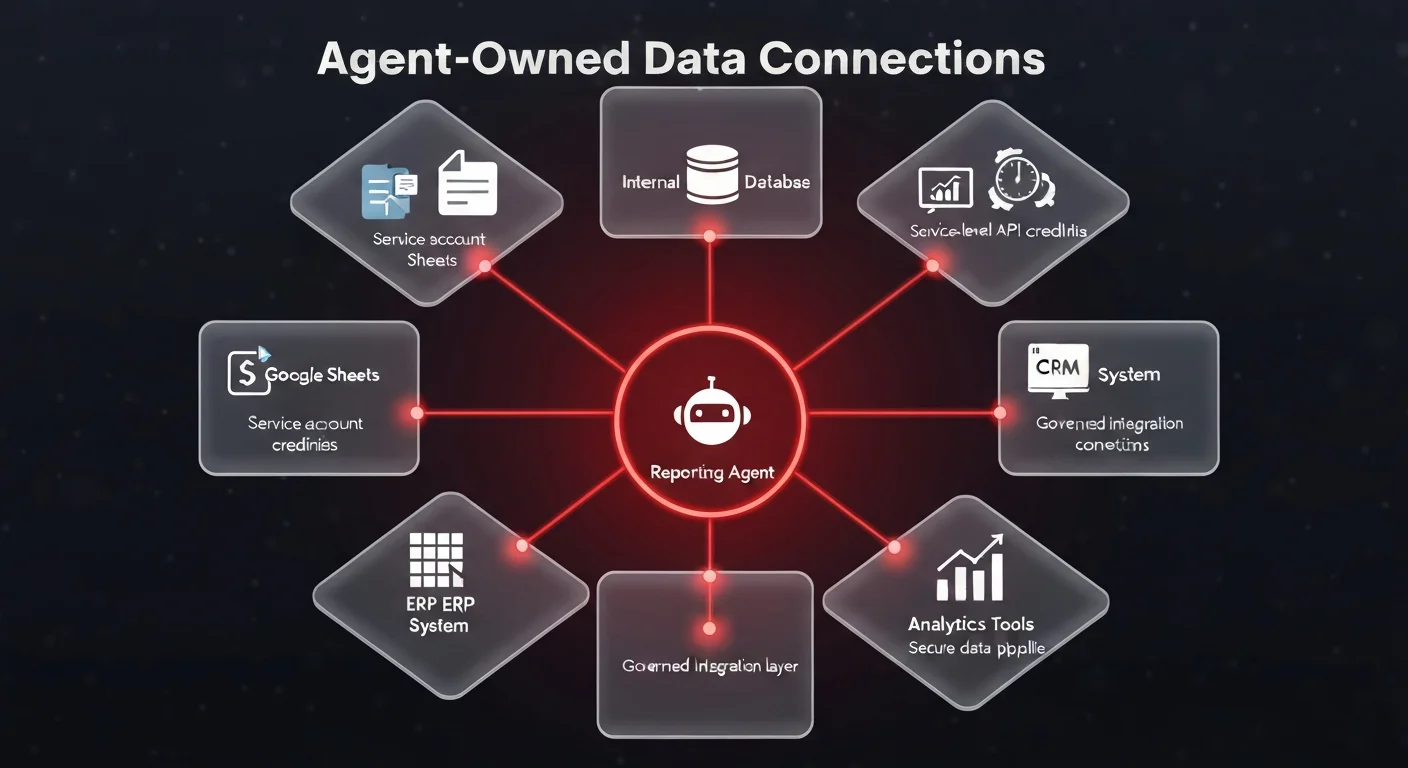
When configuring a reporting agent, the connection to data sources - such as Google Drive or internal databases - should be assigned directly to the agent. You can think of this like a service account for your integration infrastructure. It allows the agent to work with the files and spreadsheets exactly where the data lives, instead of requiring a human to manually move information around every week.
By treating the agent as a system user with its own secure, governed credentials, organizations eliminate the risk of workflow breaks caused by employee turnover. Whether you are using battle-tested workflow automation tools (n8n, Make, or your preferred platform) or enterprise environments (Microsoft Azure, AWS, or your cloud), assigning agent-owned connections ensures that your data stays within your controlled infrastructure. Companies already building sovereign AI agent infrastructure find this pattern essential for maintaining data governance at scale.
Defining AI skills to eliminate unpredictable improvisation
One of the primary frustrations operations leaders have with generative AI is its tendency to improvise. If you ask a standard consumer model to analyze weekly performance data, you might receive a completely different format, tone, or mathematical calculation each time. For business operations, consistency is non-negotiable.
To make workflows reliable, organizations must define specific "skills" for their agents. Rather than writing every instruction from scratch for each report, you can equip the agent with a dedicated metrics calculation skill. This structured skill helps the agent understand exactly which metrics matter, how they should be mathematically interpreted according to company definitions, and how the final weekly readout should be structured.
When you bind an agent to these strict process guardrails, you eliminate the risk of hallucination or creative interpretation. The agent stops improvising and starts relying on reusable guidance for how to approach each new task. This is the essence of System 2 AI reasoning - forcing the model to slow down, consult a predefined operational playbook, and execute steps systematically rather than guessing the next most likely word.
Scheduled autonomy: from manual prompts to reliable weekly metrics reporting agent cadences
An AI solution that requires a human to log in, write a prompt, and manually trigger an action is not true automation - it is simply a faster manual process. The ultimate goal of deploying an autonomous AI agent is to remove the human entirely from the execution phase of routine, repetitive tasks.
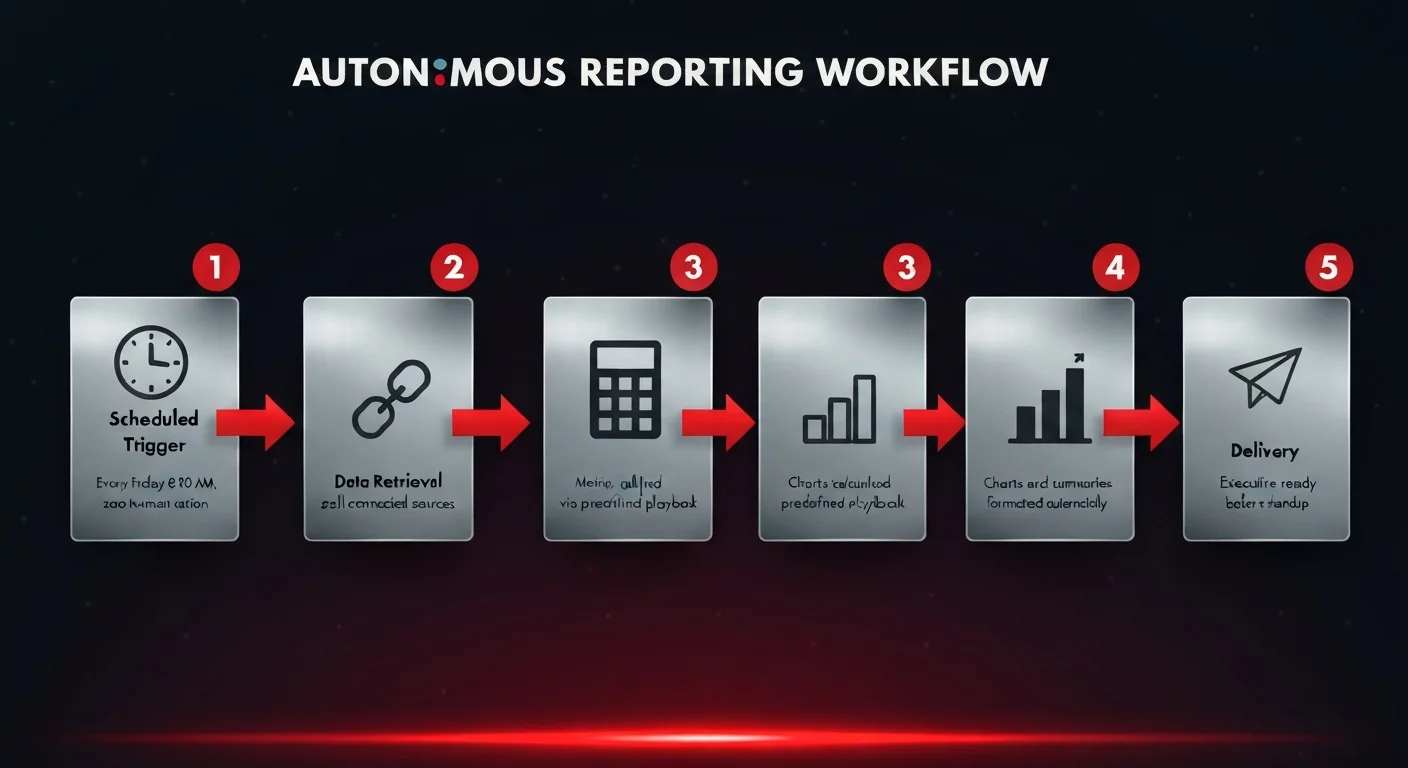
By setting the agent up on a weekly cadence, operations leaders can completely remove the friction of reporting. For example, you can schedule the agent to run every Friday at 8:00 AM with a simple internal starting message like "run analysis." From there, the agent autonomously executes the same reporting workflow on its schedule, ensuring the team does not have to remember to kick the process off every week.
This shift from conversational AI to scheduled autonomy is what transforms a neat technological trick into a durable business system. The data is retrieved automatically, the code is executed to calculate metrics and create charts, and the final readout is ready for review before the team's weekly standup meeting. See how this pattern works in practice with automated operations workflows.
Observability: why audit trails matter for your weekly metrics reporting agent
Scaling organizations demand full transparency into how AI reaches its conclusions. The black-box nature of standard AI models is a major liability for operations teams who need to trust the numbers presented in their weekly executive readouts.
A properly governed AI system requires comprehensive activity history and logging. Human operators must be able to open a specific run, inspect the exact steps the agent took, see which tools were used, and review the output it created before that output is disseminated to the broader team. This is exactly the kind of AI observability infrastructure that separates production-grade systems from experimental prototypes.
For example, a transparent audit trail will show the agent looking at the specific data in the spreadsheet, running the necessary Python code to calculate complex metrics, generating visual charts, and pulling the analysis together into a cohesive document. This level of observability provides total visibility into the agent's work. If a metric looks incorrect, you do not have to guess why - you can trace the agent's logic step-by-step and adjust the underlying calculation skills if necessary. This anti-black-box approach is critical for building trust in automated systems.
Transforming operations with a governed reporting agent
Transitioning from manual spreadsheet consolidation to an automated weekly reporting framework does not require a massive, multi-month digital transformation initiative. In fact, replacing an ungoverned, employee-owned AI workflow with a reliable Sovereign AI Agent System makes for an ideal, high-impact Starter Project.
With a fixed scope and fixed cost, operations leaders can deploy a governed weekly metrics reporting agent in a matter of weeks. This solution-first approach proves immediate value by eliminating hours of manual data consolidation, allowing you to establish trust in the system before expanding into a broader autonomous operations transformation. Because there are no ongoing platform fees associated with the agent's core infrastructure, you pay for the solution and the outcome, not an endless subscription.
The strategic takeaway is clear - organizations must stop letting critical business reporting rely on fragile shadow AI workflows and single-employee configurations. By investing in agent-owned connections, defined calculation skills, and strict observability, you can build a reliable automated reporting system that acts as a permanent, governed extension of your operations team.