
Agentic web apps are digital interfaces purpose-built for autonomous AI interaction - replacing fragile screen-scraping automation with governed, machine-readable functions that let AI agents execute business workflows directly, reliably, and securely. For operations leaders, this architectural shift eliminates the brittle workarounds of legacy RPA and creates the foundation for sovereign AI operational systems.
The internet was designed for human eyes and human hands. But as businesses increasingly deploy AI to automate marketing, sales, customer support, and operational workflows, a fundamental friction point has emerged. Traditional web architecture actively resists AI automation. Enter agentic web apps - a fundamental rewiring of digital interfaces that optimizes websites and internal portals for autonomous AI interaction.
For mid-market operations leaders, this shift is critical. Moving from human-first web design to agent-first web architecture transforms fragmented AI experiments into reliable, governed operational systems. By understanding the emerging standards of the agentic web, organizations can eliminate the brittle workarounds of legacy automation and build secure, observable AI workflows.
The breaking point of traditional automation
Historically, when software needed to interact with a web application that lacked a clean API, developers relied on screen scraping or Robotic Process Automation (RPA). These systems function by mimicking human behavior - they open a browser, parse the Document Object Model (DOM), look for specific visual coordinates, and simulate clicks or keystrokes.
This approach is inherently fragile. If a marketing team changes the color of a button, or an update shifts a form field by a few pixels, the entire automation pipeline breaks. The system is guessing intent based on visual rendering, which makes maintaining these automated workflows a costly and frustrating operational nightmare.
Furthermore, this mimicry is computationally expensive and difficult to govern. When an AI agent has to "read" a screen visually to figure out how to submit a customer support ticket or update a CRM entry, it creates operational complexity that is nearly impossible to observe or secure at scale. Operations leaders need deterministic, reliable execution, not visual guesswork. See our deep-dive into AI workflow automation governance for the full framework on making automated systems observable and auditable.
What makes agentic web apps the new standard for AI operations
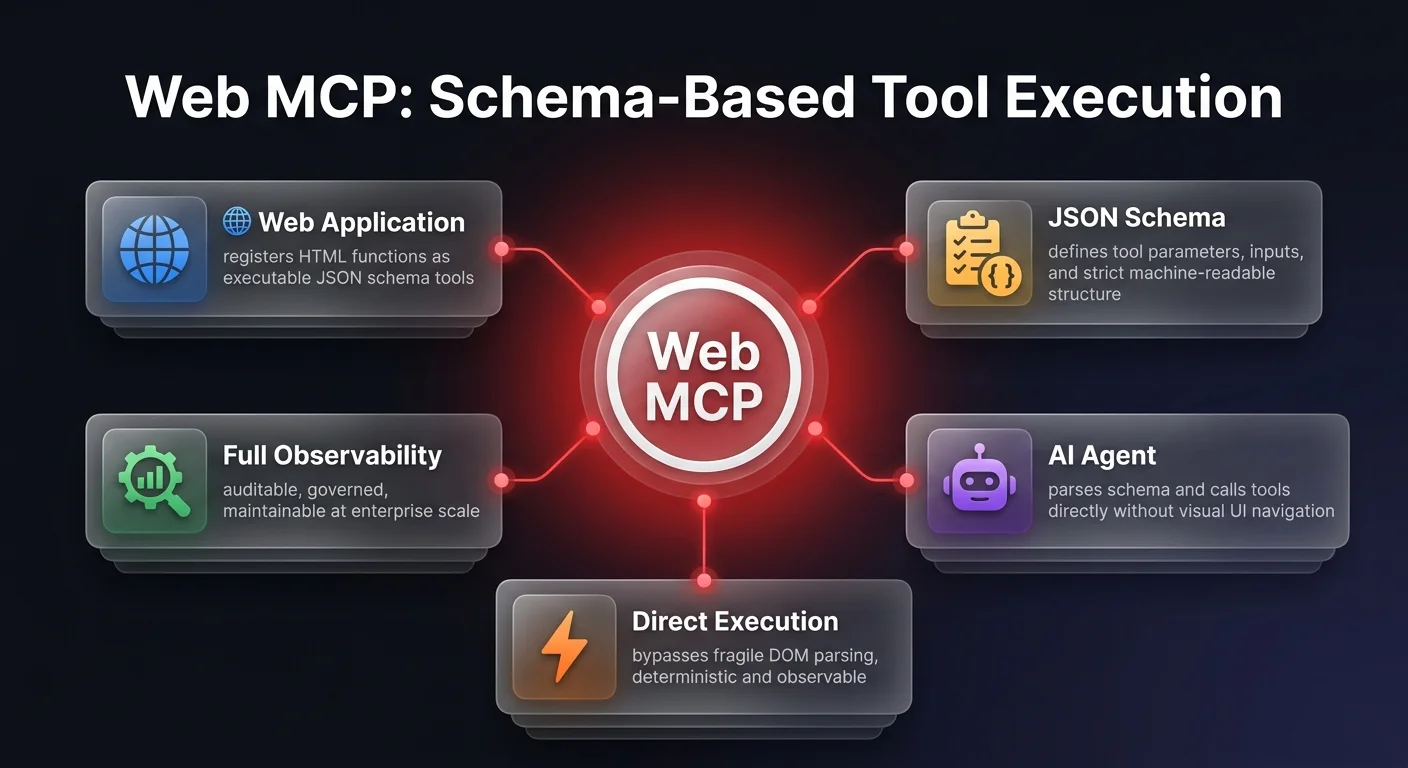
The solution to this fragility is emerging through a new framework: Web Model Context Protocol (Web MCP). Currently in rapid development across the industry, Web MCP fundamentally changes how AI interacts with websites. Instead of forcing an AI agent to "see" a button and click it, Web MCP allows developers to register specific website functions as machine-readable tools.
Consider an internal procurement portal. Today, an employee navigating to the site to order three new laptops must find the search bar, locate the item, set the quantity to three, and click the "Add to Cart" button. For an AI to do this using legacy methods, it must emulate every single one of those human steps.
With Web MCP, the "Add to Cart" action is registered directly on the web page as an executable tool. The web application provides the AI agent with a strict JSON schema detailing exactly what the tool does and what parameters it requires - in this case, an item name and a quantity.
The agentic browser can simply execute the tool via the schema, bypassing the visual UI entirely. The result is instantaneous, reliable, and observable execution.
Recent implementations have shown that this can even be retrofitted to existing web elements. By adding specific descriptive tags to a standard HTML form, developers can instantly transform it into a Web MCP tool. An agent can then parse the required inputs, generate the appropriate response, fill the fields, and even trigger an auto-submit function without requiring any human interaction.
For operations leaders, the implications are profound. Your internal systems, CRMs, and customer-facing portals can become seamlessly interoperable with AI agents, moving your company away from brittle RPA toward governed, logic-based automation.
Browser-native AI and the data sovereignty advantage
Alongside the structural changes to how web applications are built, the engines that power AI are also migrating. We are seeing a massive shift toward browser-native AI APIs. Major web browsers are now shipping with built-in, local Large Language Models (LLMs) that execute directly on the user's machine.
These initial local models - typically around 4GB in size - download once and remain cached in the browser. Web developers can then access built-in Prompt APIs, Summarization APIs, and Proofreading APIs to process text and data without ever sending a single byte of information back to a cloud server.
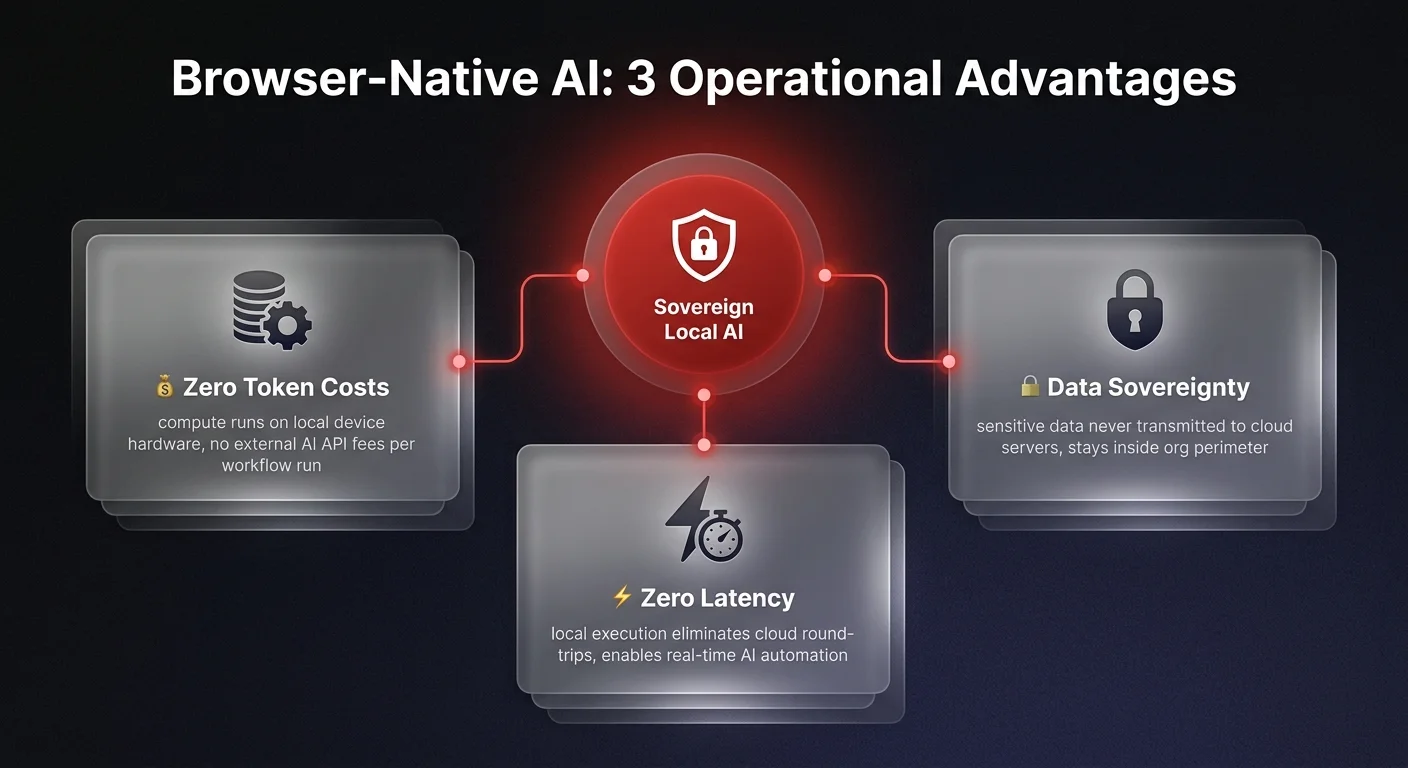
This architecture solves three massive operational hurdles:
- Zero token costs: Because the compute happens locally on the user's hardware, businesses do not pay external AI providers for API usage every time a workflow runs.
- Zero latency: Local execution eliminates the network delay of sending requests to the cloud and waiting for a response, enabling real-time automation.
- Data sovereignty: This is the most critical advantage. When an employee uses AI to summarize sensitive internal documents or draft responses to confidential customer inquiries, the data never leaves their machine.
In one compelling industry demonstration, a user uploaded a photo of a damaged piece of equipment to an internal portal. The browser's native multi-modal AI analyzed the image, identified the damage, and automatically generated a formatted incident report in JSON. Because the entire process happened locally, the proprietary image and the resulting report were kept entirely within the organization's secure perimeter.
For organizations battling the security risks of Shadow AI - where employees paste sensitive company data into ungoverned public chatbots - browser-native AI offers a compliant, secure alternative. Read our analysis of shadow AI governance risks to understand the full exposure organizations face when teams bypass governed systems. Browser-native AI aligns perfectly with the need for data sovereignty, ensuring that your operational data remains your intellectual property.
See how Ability AI's operations automation solutions help mid-market businesses implement governed AI infrastructure - eliminating security gaps while maintaining full operational oversight.
Agentic SEO: the rise of llms.txt
As AI agents take on more autonomous workflows, they need to be able to read and understand your company's digital properties. Just as human-focused web development relies on sitemaps and intuitive navigation menus, and traditional search engines rely on robots.txt, the agentic web relies on a new standard: the llms.txt file.
An llms.txt file acts as a dedicated directory specifically formatted for Large Language Models. When an autonomous agent visits a website to gather information or execute a workflow, it first checks for this file. The document provides clean, markdown-formatted links to the most relevant documentation, stripping away the visual clutter, CSS, and javascript that confuse machine readers.
Taking this a step further, organizations are also deploying llms-full.txt files. These files aggregate the entirety of a website's critical knowledge base into a single, comprehensive text document. If an agent needs to reference your product catalog, compliance guidelines, or API documentation, it can ingest this single file to immediately gain total context.
If your company's web properties and internal portals lack an llms.txt file, they are functionally invisible to the rising wave of AI agents. Updating your digital presence to include these machine-readable maps is a low-effort, high-impact way to ensure your business is ready for agentic interaction.
Autonomous debugging and operational monitoring
The transition to agentic web apps is not just about customer-facing sites; it is transforming how technical and operations teams monitor performance. By giving agents access to browser developer tools via MCP, organizations can automate deep diagnostic work.
Instead of a human QA engineer manually testing a web application's performance across different network speeds, an agent can now be instructed to take over. The agent can autonomously launch a browser session, throttle the network connection to simulate a 3G mobile environment, navigate through complex user workflows, capture baseline metrics, and generate a comprehensive performance analysis.
During recent technical reviews, these autonomous agents successfully identified render-blocking CSS issues, pinpointed oversized image assets causing critical path latency, and recommended specific code optimizations - all without human intervention.
By integrating these agentic capabilities into your operational workflows, teams can maintain rigorous oversight of system performance at a fraction of the traditional resource cost.
The governed operational future
The web is no longer exclusively a human domain. The introduction of Web MCP, local browser-native AI models, and agentic SEO frameworks represents a fundamental maturation of digital infrastructure.
For CEOs, COOs, and VPs of Operations, this technological shift offers a clear path out of the chaos of fragmented AI experiments. Brittle screen scraping and expensive, insecure cloud API calls are being replaced by governed, observable logic and sovereign data practices.
To prepare for this future, operations leaders should audit their current automation workflows. Identify where systems rely on fragile visual mimicry, and explore how Web MCP can standardize those interactions. Implement llms.txt files across your public and internal knowledge bases to ensure AI agents can securely and accurately ingest your organizational context.
Ultimately, the goal is not just to use AI, but to deploy sovereign AI agent systems that drive specific business outcomes. By embracing the architecture of agentic web apps, mid-market and scaling companies can build the reliable, governed infrastructure necessary to dominate their operational future. Ready to move from fragile RPA to governed agentic systems? Explore Ability AI's operations automation solutions to see how mid-market businesses are making the transition today.