
Autonomous AI agents for engineering teams are persistent, infrastructure-level systems that replace traditional agile ceremonies with agent-driven workflows. Organizations deploying them report a 25x increase in deployment frequency - turning five-day sprint cycles into five daily production releases.
For more than two decades, the Agile Manifesto and scrum methodologies have defined how software is built. But a radical shift is happening within high-performing, mid-market engineering teams. By deploying autonomous AI agents as core operational infrastructure, organizations are actively abandoning traditional sprint planning, eliminating project management layers, and achieving unprecedented deployment frequencies.
The historical assumption has always been that software engineers are the ultimate bottleneck in product delivery. Consequently, tech organizations optimized heavily for developer comfort - offering everything from flexible schedules to elaborate office perks - simply to squeeze out incremental productivity gains.
Today, the bottleneck is no longer the engineer writing the code. The bottleneck is the legacy agile process itself.
Recent case studies analyzing high-traffic data platforms - systems processing upwards of 100 million annual page views and 9 million complex user transactions - reveal that transitioning to a post-engineer, agent-driven organizational structure can yield a 25x multiplier in deployment frequency. But achieving this requires CTOs and internal AI champions to move past surface-level coding assistants and invest in persistent agent infrastructure.
Why shadow AI fails autonomous AI agents for engineering teams
A common, yet deeply flawed, approach to scaling artificial intelligence in software teams is the "license and pray" model. Engineering leaders distribute individual AI coding assistant licenses to every developer, host a weekend hackathon, and expect a localized revolution in productivity.
This decentralized shadow AI approach consistently fails to deliver systemic operational improvements. When individual developers use isolated AI tools, the generated code often lacks the specific architectural context and ethos of the broader organization. Every engineering organization operates differently, utilizing distinct design patterns, testing methodologies, and branching strategies.
To drive genuine transformation, autonomous agents must operate from a shared state. Instead of acting as a generalized coding autocomplete tool, an agent must act as a persistent team member that analyzes historical company design documents and codebases. When agents are built as company infrastructure rather than localized developer tools, they write specifications and code that perfectly match the established engineering culture - ensuring that a service repository pattern or a trunk-based development standard is strictly maintained.
Scaling this infrastructure requires a phased, deliberate approach. Successful rollouts do not happen by onboarding everyone simultaneously. Instead, CTOs must start slowly, selecting their most system-knowledgeable engineers to pilot autonomous workflows on non-critical, verifiable tasks before expanding to production-critical systems.
Dismantling scrum: how autonomous AI agents replace agile process
When autonomous AI agents handle the operational scaffolding of software development, traditional agile ceremonies quickly become redundant overhead.
In organizations fully embracing the post-engineer model, the traditional project manager role is effectively eliminated. The multi-layered telephone game of translating requirements between stakeholders, managers, and developers is replaced by direct, agent-facilitated workflows.
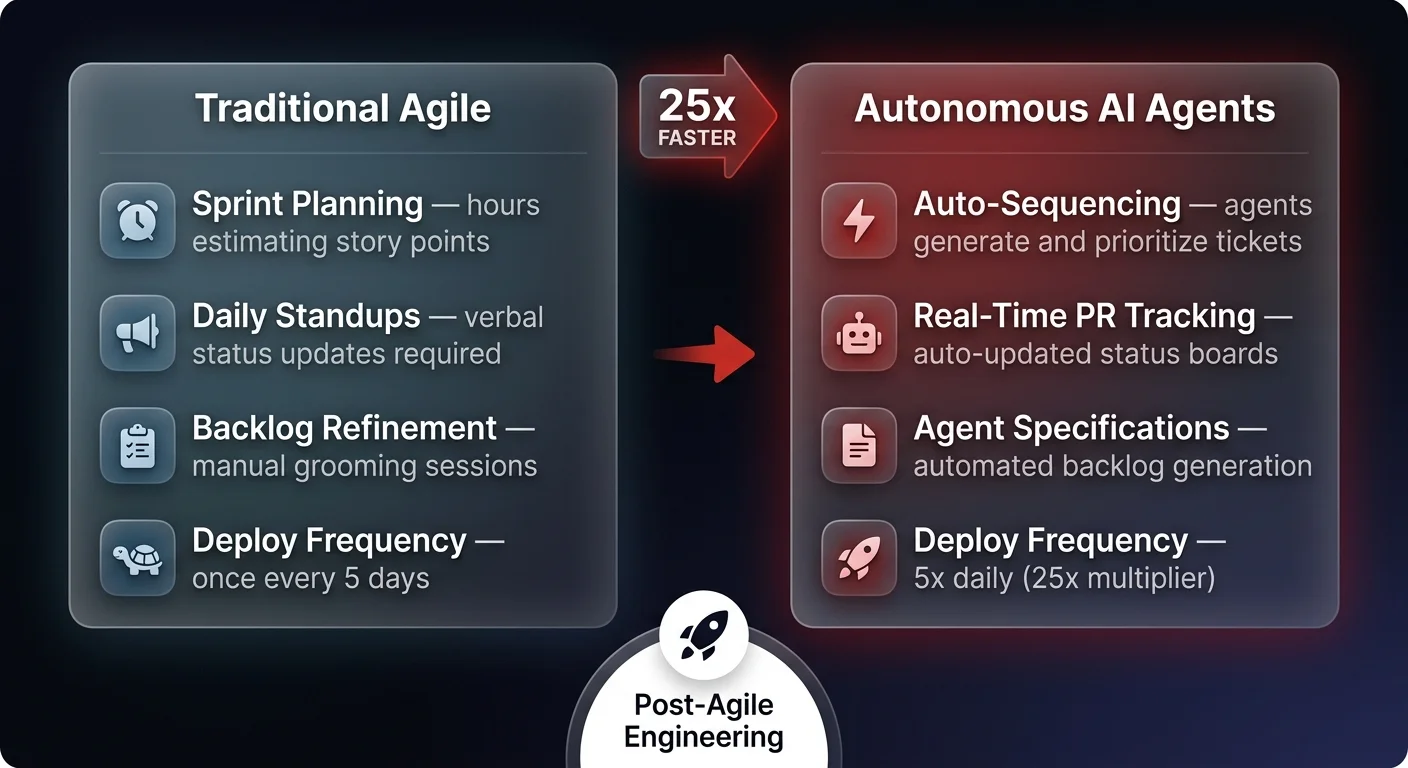
Research into these transformed teams shows the complete dismantling of standard agile artifacts:
- Sprint planning is eliminated: Hours spent estimating story points are reclaimed. Because agents auto-generate and sequence non-blocking tickets, manual estimation becomes irrelevant to delivery velocity.
- Daily standups are abandoned: Developers no longer need to verbally report status updates. As pull requests are opened, reviewed, and merged, agents automatically update ticket statuses in real-time across the project board.
- Sprint refinement is automated: Backlog grooming is replaced by agent-driven specification workflows.
The results of removing this friction are staggering. In a direct comparison, a traditional 10-person engineering team might deploy to production once every five days. A smaller, two-person tiger team utilizing autonomous AI infrastructure can deploy five times every single day - a 25x increase in deployment frequency.
Even when adjusting for the natural agility of smaller teams and blending the output with code complexity metrics, the autonomous workflow still yields a verified 10x output multiplier. More importantly, this velocity does not sacrifice quality. Customer satisfaction scores for features delivered through this pipeline routinely jump from baseline averages of 7.5 up to 8.6 out of 10.
Treating the engineering lifecycle like a factory floor
To achieve this level of operational throughput, engineering leaders must deconstruct their development lifecycle into discrete, composable skills - much like a car manufacturing plant isolates the installation of a steering wheel from the painting of a door.
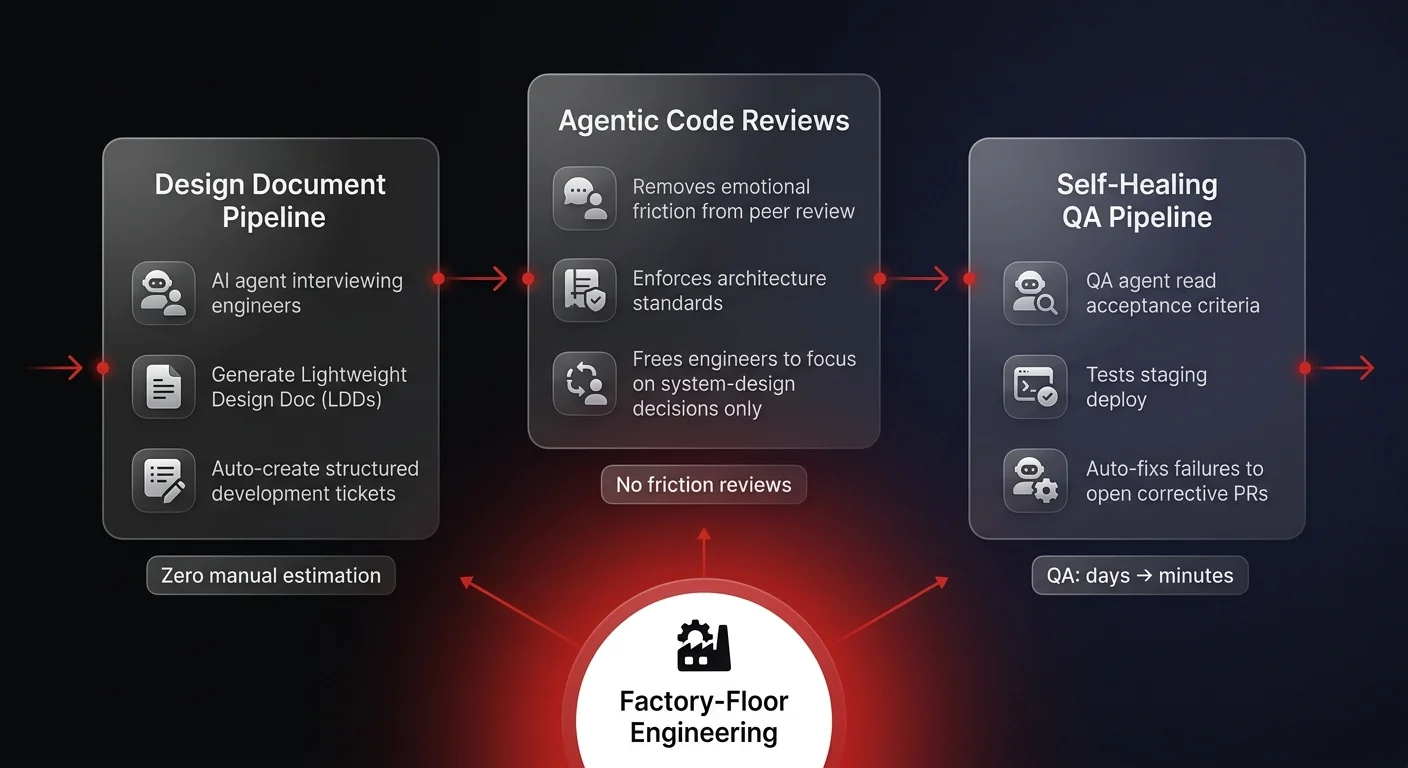
This factory-floor approach breaks the development process into an automated, highly structured pipeline:
The lightweight design document pipeline
The workflow begins with an agent actively interviewing a human engineer or product owner about a feature specification. Based on this interview, the agent generates a Lightweight Design Document (LDD). Because the agent is tied to the company's shared infrastructure, it references past LDDs to ensure the proposed architecture aligns with the company's established ethos. Once the LDD is distributed and approved by the team, the agent automatically creates structured, non-blocking development tickets and their subsequent PRs.
Agentic code reviews that remove human friction
One of the most persistent sources of friction in engineering teams is the peer review process. Humans naturally dislike receiving pedantic feedback on styling, variable naming conventions, or opinionated code structures. By offloading these specific, deterministic reviews to intelligent code review agents, teams entirely remove the emotional friction from code reviews. Human engineers are freed to focus strictly on reviewing big-picture system design and complex business logic.
Automated QA and the self-healing pipeline
The integration of autonomous agents completely transforms the quality assurance phase. In an optimized setup, merging a PR triggers an automatic deployment to a staging environment. Immediately, a dedicated QA agent spins up, reads the original acceptance criteria from the auto-generated ticket, and tests the deployed code against those requirements.
The next frontier of this workflow is the self-healing pipeline. When a QA agent identifies that an acceptance criterion has failed, it does not simply alert a human developer. Instead, a secondary agent analyzes the failure, writes the necessary code to fix the bug, and automatically creates a new PR to resolve the issue. Organizations building this kind of agentic workflow automation are seeing QA cycles shrink from days to minutes.
The mid-market speed advantage for autonomous AI agents
This shift toward autonomous engineering infrastructure creates a unique, highly advantageous window for mid-market companies.
A scaling organization with 20 to 50 engineers can pivot its entire development lifecycle and adopt these agentic workflows in a matter of months. Conversely, a massive enterprise with 10,000 engineers is burdened by entrenched bureaucracy, deeply embedded legacy processes, and rigid compliance layers that make rapid adoption nearly impossible.
The speed advantage gained by mid-market teams creates a compounding operational effect. If autonomous agents unblock an engineer in under a month - compared to a traditional three-month development cycle - that engineer immediately begins building the next feature. A mid-market team that operates just a few months ahead of its enterprise competitors today will find itself 12 to 18 months ahead in product maturity within a year.
However, this requires immediate action. The capabilities of autonomous AI agents are scaling rapidly, and teams that remain overly conservative risk falling into an unrecoverable deficit.
Moving from scaffolding to sovereign agent infrastructure
The transition to a post-agile engineering organization requires more than just API wrappers or basic workflow glue. It requires production-grade, persistent infrastructure designed for autonomous intelligent systems.
For CTOs and internal AI champions building this future, agents must be treated as core company infrastructure. This means providing a sovereign operating environment where autonomous agents live, execute, and maintain shared state - not isolated developer tools that each team member configures independently.
Engineering teams adopting this infrastructure model gain:
- Architectural sovereignty: A single, sovereign instance the entire company operates from, ensuring that agents process proprietary codebase context within a secure environment that seamlessly passes enterprise procurement.
- Persistent shared state: Agents that remember your specific architectural blueprints, ensuring every auto-generated design document and automated PR perfectly matches your organization's unique software patterns.
- Production-grade operability: Fully scheduled, auditable, and recoverable agent workflows that run silently in the background, executing complex QA and deployment tasks without paging your operations team at 3 AM.
- Headcount replacement, not seat assistance: By utilizing per-agent pricing aligned with synthetic labor units, teams can replace entire operational layers - like project management and manual QA testing - fundamentally changing how many people you need to scale your product.
The era of using AI simply to make your existing engineers slightly faster is ending. The organizations that will dominate the next decade are utilizing autonomous AI agents for engineering teams to completely rebuild their operational floor. By discarding outdated agile ceremonies and moving to sovereign agent infrastructure, mid-market technology teams can achieve delivery velocities that legacy enterprises can only imagine.