
System 2 AI is an architectural approach that separates deterministic calculation from language generation to eliminate AI hallucinations in business operations. By routing strict business logic through rule-based engines before passing structured data to LLMs for natural language output, organizations stop the root cause of AI failures - asking language models to perform calculations they were never designed to handle.
Organizations are rapidly discovering that large language models are exactly that - language models. They are exceptional at parsing context and generating text, but they are fundamentally flawed when asked to perform strict calculations or apply rigid business rules. When employees rely on ungoverned tools like ChatGPT to execute complex operational logic, the result is shadow AI sprawl and costly hallucinations. To solve this, operations leaders must adopt System 2 AI - an architectural approach that pairs autonomous reasoning with deterministic tools.
Recent engineering insights from Take Take Take - a chess platform founded by world champion Magnus Carlsen - provide a masterclass in this exact architecture. By examining how their engineering team built an AI-powered chess coach that successfully avoids hallucinations, business leaders can extract a perfect blueprint for deploying reliable, governed AI systems in enterprise operations.
Why large language models fail at business calculations
The intersection of chess and artificial intelligence has a long history, dating back to Claude Shannon's 1949 paper on programming computers to play chess. While traditional brute-force engines and intuitive neural networks (like DeepMind's AlphaZero) eventually surpassed grandmaster levels, modern LLMs struggle to play the game reliably.
During a recent AI tournament hosted by Kaggle, Magnus Carlsen observed an LLM playing the "poison pawn line" in a chess opening. The model completely hallucinated its position, not because it misunderstood the opening theory, but because transformer architectures cannot inherently calculate strict positional logic step-by-step. High-reasoning models can simulate calculation through reasoning tokens, but they quickly fall apart when the logic tree becomes too complex.
The business parallel here is critical. If an LLM cannot track pieces on an 8x8 board without hallucinating, it certainly cannot calculate tiered commission payouts, determine optimal supply chain routing, or enforce strict legal compliance across a 50-page vendor contract. Asking a standalone LLM to perform rigid business operations is the root cause of corporate AI failures.
System 2 AI architecture: separating logic from language
To build a reliable AI coach, the engineering team had to bridge the gap between traditional chess computers (which play flawlessly but cannot speak) and LLMs (which speak fluently but cannot calculate). Their solution was a strict decoupling of business logic from language generation.
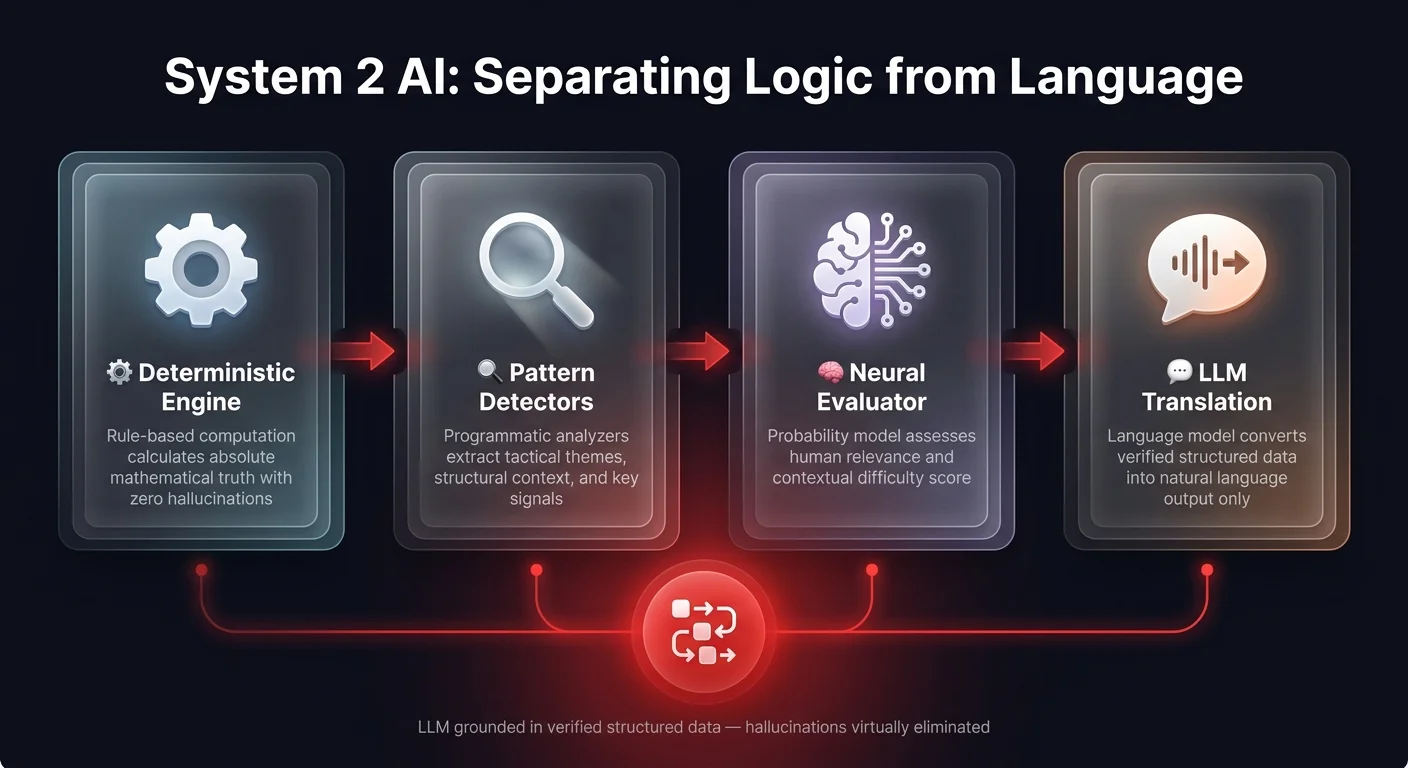
When a game concludes, the pipeline does not ask the LLM to analyze the moves. Instead, a deterministic, traditional chess engine called Stockfish analyzes the board to find the absolute truth - the mathematical best move. Next, the system runs a series of programmatic detectors to extract structural context, identifying tactical themes like forks, pins, and positional disadvantages. Finally, a neural network called Maya evaluates the probability of a human finding that specific move based on their rating.
Only after this robust, deterministic data pipeline is complete does the LLM enter the workflow. The LLM's job is restricted entirely to translating this rich, structured JSON data into natural English commentary. Because the model is strictly grounded in the provided context, hallucinations are virtually eliminated.
For operations leaders, this is the definition of System 2 AI. When deploying sovereign AI agent systems for specific business outcomes, you must separate the workflow. Deterministic workflow automation tools should query the CRM, run the calculations, and enforce the business rules. The LLM should only be used as the translation and reasoning layer on top of that ground truth.
Autonomous triage loops and human oversight
One of the most impressive operational components of this chess architecture is the closed-loop autonomous triage system used for quality assurance. In any consumer application or enterprise software, handling edge cases and user feedback is a massive operational bottleneck.
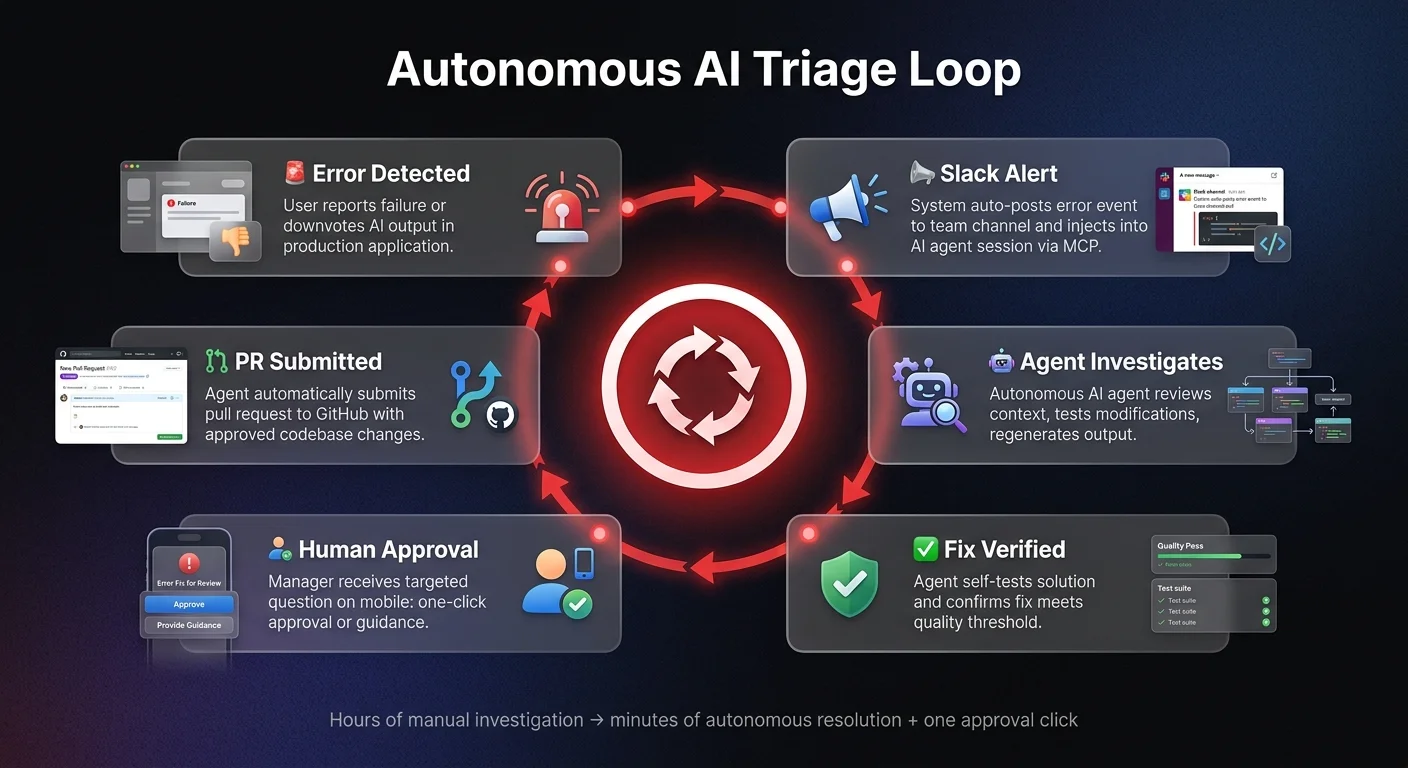
When a user downvotes an AI-generated comment in the application, the system automatically posts the event to a Slack channel and simultaneously injects the event into a Claude Code session via an MCP (Model Context Protocol) server. The autonomous agent immediately begins investigating the failure. It invokes a triage skill, reviews the context, tests prompt modifications, and regenerates the commentary.
Once the agent verifies its own fix, it pings the engineering team directly in Slack, asking a specific question like: "What specifically feels wrong about the commentary?" or offering a solution. A human reviewer can guide the agent from their mobile phone while riding the bus. Once approved, the agent automatically submits a pull request to GitHub to update the codebase.
This autonomous triage loop represents a massive opportunity for RevOps and Customer Support teams. Instead of human agents manually investigating every support ticket or CRM data error, organizations can deploy a focused AI implementation that routes error reports directly to an autonomous agent. The agent does the heavy lifting of investigating the database, drafting the fix, and simply requesting an approval click from a human manager. See how automated task management and workflow automation can streamline this exact pattern in your operations.
Managing the latency and quality trade-offs
When deploying AI into production, organizations must constantly balance the depth of reasoning against the user experience. In a consumer chess app, users expect to cycle through their post-game analysis almost instantly. A "coach is thinking" loading screen is unacceptable.
To meet a sub-3-second end-to-end latency requirement, the engineering team utilizes Gemini 3 Flash. While heavier reasoning models like Claude or GPT-5 offer slightly better analytical depth, their latency is slower and, more importantly, unpredictable. A reasoning model might take two seconds on one prompt and fifteen seconds on another, breaking the user experience.
Operations leaders must apply this same strict evaluation to their internal workflows. You must clearly define which business processes are synchronous (requiring instant, lower-latency models like customer-facing chatbots or real-time data validation) and which are asynchronous (allowing for deep, background reasoning models like contract analysis or lead enrichment).
Automated evaluation for continuous System 2 AI reliability
You cannot govern what you cannot measure. As new models are released at a breakneck pace, organizations need a reliable way to benchmark performance without relying on manual QA testing.
To solve this, the engineering team built 16 distinct testing scenarios based on real-world chess games, focusing on specific tactical patterns and known hallucination risks. By routing their requests through OpenRouter, they can instantly swap in the latest versions of Gemini, Claude, or GPT models and run automated evaluations using an "LLM-as-a-judge" framework. This allows the team to continuously monitor whether a faster model can maintain the required quality threshold, or if a smarter model has finally solved a persistent edge case.
Enterprise organizations must adopt this rigorous approach to AI governance. Relying on employee experimentation - where staff randomly switch between ChatGPT and Claude based on personal preference - creates massive security and consistency risks. A centrally governed AI architecture ensures that every model update is tested against specific business scenarios before being deployed. For organizations ready to formalize this process, AIOps incident prediction and prevention can automate model evaluation and anomaly detection across your AI infrastructure.
The operational imperative for System 2 AI
The architectural decisions made to build a reliable chess coach perfectly mirror the decisions required to build reliable enterprise operations. Asking an off-the-shelf LLM to calculate data, enforce rules, and generate insights simultaneously is a recipe for operational failure.
Organizations are currently caught between two bad options - allowing ungoverned shadow AI to infect their daily workflows, or engaging in massive, multi-year consulting projects that fail to deliver immediate ROI. The professional middle ground is a solution-first approach.
By identifying a specific operational bottleneck - such as customer support triage or sales data enrichment - and deploying a governed, System 2 AI architecture that pairs deterministic logic with LLM reasoning, businesses can prove value in weeks, not months. The key takeaway - stop asking your AI to calculate the board from scratch. Give it the ground truth, govern its outputs, and let it do what it does best.