
AI model commoditization is the convergence of large language models toward interchangeable, price-competitive utilities. Industry research shows open-source models are now only 3–6 months behind the most advanced proprietary alternatives — meaning the competitive moat once held by any single AI model is rapidly eroding. For COOs and operations leaders, this fundamentally changes the strategic calculus: the race to select the "best" model is becoming irrelevant, and the real advantage lies in the orchestration layer built above them.
For operations leaders and C-suite executives navigating the rapid evolution of artificial intelligence, a common anxiety persists: the fear of locking into the wrong foundation model. However, recent industry research indicates that this anxiety is fundamentally misplaced. We are rapidly approaching an era of AI model commoditization, where the underlying large language models will compete primarily on price while exhibiting nearly identical behaviors.
Right now, business leaders are watching a fragmented landscape of artificial intelligence tools create unprecedented operational complexity. The market is flooded with competing models, each boasting different benchmarks and capabilities. But analyzing the current trajectory of foundational models reveals a clear strategic mandate. The ultimate winners in the enterprise space will not be the companies that select the single best underlying model. Instead, market dominance will belong to organizations that build an intelligent, technology-agnostic orchestration layer on top of these models — a layer designed exclusively to solve deeply understood customer needs.
The current landscape of model specialization
To understand where the market is going, we first have to understand where it currently stands. If you look closely at the leading models available today, they are actually very different in their practical application. While they may all seem like general-purpose chatbots to the end-user, under the hood, they possess distinct functional strengths.
Industry research identifies these unique strengths as functional "spikes." Intelligent system design in the present moment requires understanding these spikes and routing specific tasks to the models best equipped to handle them.
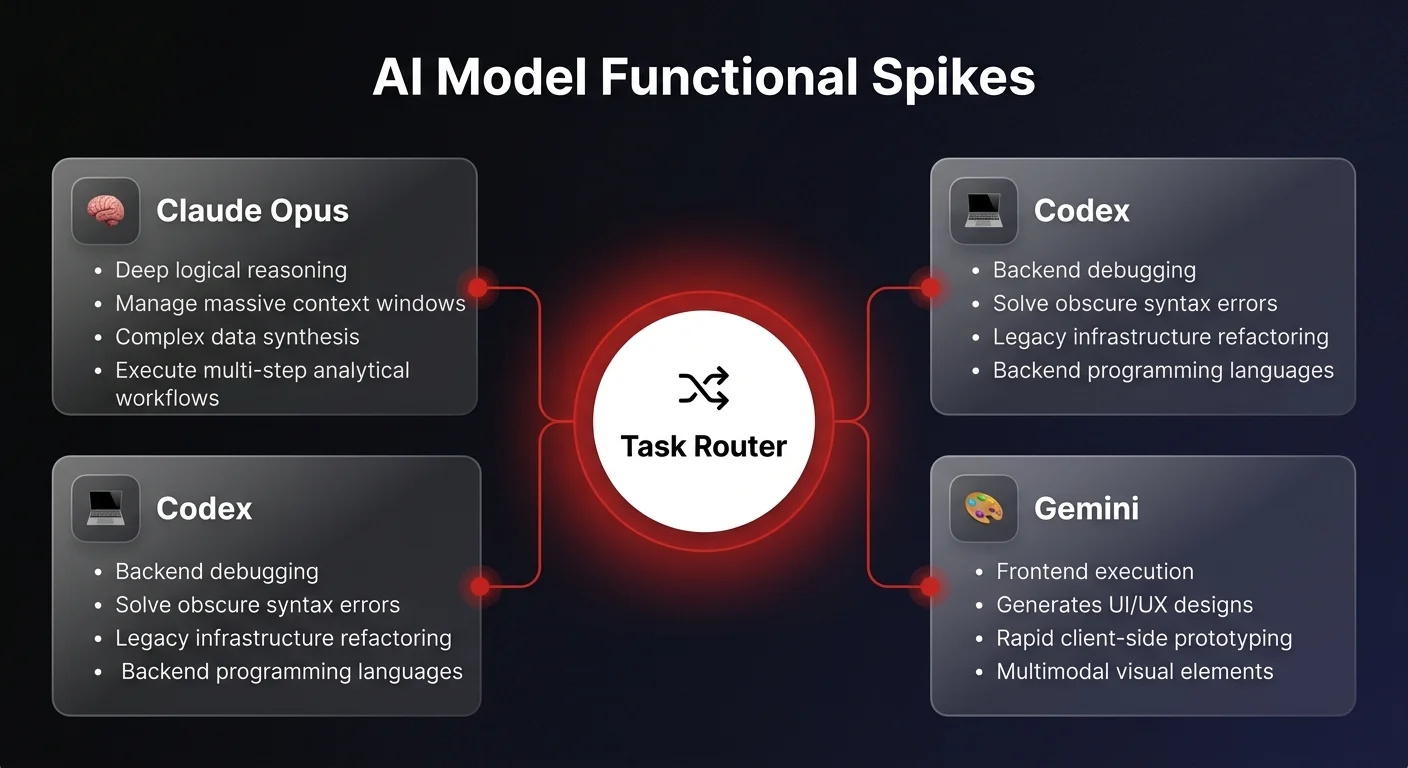
Recognizing functional spikes across leading models
When evaluating the current ecosystem, specific models clearly separate themselves based on specialized utility:
- Opus as the enterprise workhorse: Claude 3 Opus operates as a heavy-duty workhorse. Its spike lies in handling massive context windows, deep logical reasoning, and complex data synthesis. For operations teams dealing with multi-step analytical workflows or extensive document processing, Opus currently leads the pack in reliability and nuance.
- Codex for backend debugging: When it comes to backend development, Codex exhibits a massive spike in capability. It excels at identifying obscure syntax errors, refactoring legacy infrastructure, and navigating the rigid logic of backend programming languages.
- Gemini for frontend execution: Conversely, Google's Gemini models have demonstrated significant spikes in frontend tasks. Their multimodal capabilities and speed make them exceptionally good at UI/UX generation, rapid client-side prototyping, and managing the visual elements of application development.
For a Chief Operating Officer or VP of Operations, the takeaway is clear. Forcing a single model to handle every business function across your organization is inherently inefficient. A robust artificial intelligence strategy currently relies on recognizing these behavioral spikes and utilizing them to provide the best possible experience for your users and internal teams.
The inevitable reality of AI model commoditization
While understanding current model spikes is necessary for immediate system design, banking your long-term operational strategy on the supremacy of any single model is a critical mistake. The underlying technology is moving aggressively toward absolute commoditization.
Our worldview — backed by shifting market dynamics and pricing structures — is that foundational models will soon become interchangeable utilities. Within a very short timeframe, we will see these models converge. They will exhibit similar behaviors, share comparable reasoning capabilities, and ultimately be forced into fierce price competitiveness.
This mirrors exactly the pattern we analyzed in AI vendor lock-in risks every CEO must understand — the organizations that hardcode their workflows to a single vendor's API will be the ones least able to capitalize on the cost collapse that commoditization produces.
The economics of compute utility
Think of foundation models like cloud hosting or internet bandwidth. In the early days of cloud computing, companies fiercely debated which provider had the best proprietary servers. Today, compute is a commodity. You choose a cloud provider based on the ecosystem, governance, and services built on top of that compute, not the raw servers themselves.
Artificial intelligence is following the exact same trajectory. As model builders figure out the optimal architectures and training methodologies, the performance gap between them shrinks daily. When every model can achieve a 95% success rate on complex reasoning tasks, the only remaining competitive lever is price. For enterprise operations, this is highly beneficial. It means the cost of intelligent automation will plummet, provided your infrastructure is flexible enough to swap out models as prices drop.
Why open-source proximity changes the buying cycle
One of the primary catalysts driving this commoditization is the relentless pace of the open-source community. Industry analysis shows that open-source models are currently only three to six months behind the most advanced, proprietary, closed-source models.
This narrow gap has profound implications for enterprise procurement and vendor risk management.
Eliminating the fear of vendor lock-in
Historically, purchasing enterprise software meant locking into a single vendor's ecosystem for three to five years. Applying this traditional procurement mindset to foundational AI models is dangerous. If you hardcode your entire customer support workflow or sales automation exclusively to a specific proprietary model's API, you are trapped.
When an open-source alternative catches up just three to six months later — offering the exact same behavioral capabilities for a fraction of the cost, or allowing for local deployment to ensure total data privacy — you want the agility to pivot instantly. The narrow gap between proprietary and open-source capabilities validates the need for a technology-agnostic approach. You should never be wholly dependent on the roadmap of a single model provider.
Building the ultimate orchestration layer
If foundational models are interchangeable commodities, where does the actual business value live? The answer lies in the layer built on top. The market will be won by organizations that understand customer needs intimately and build an application and orchestration layer that abstracts the complexity of the underlying models.
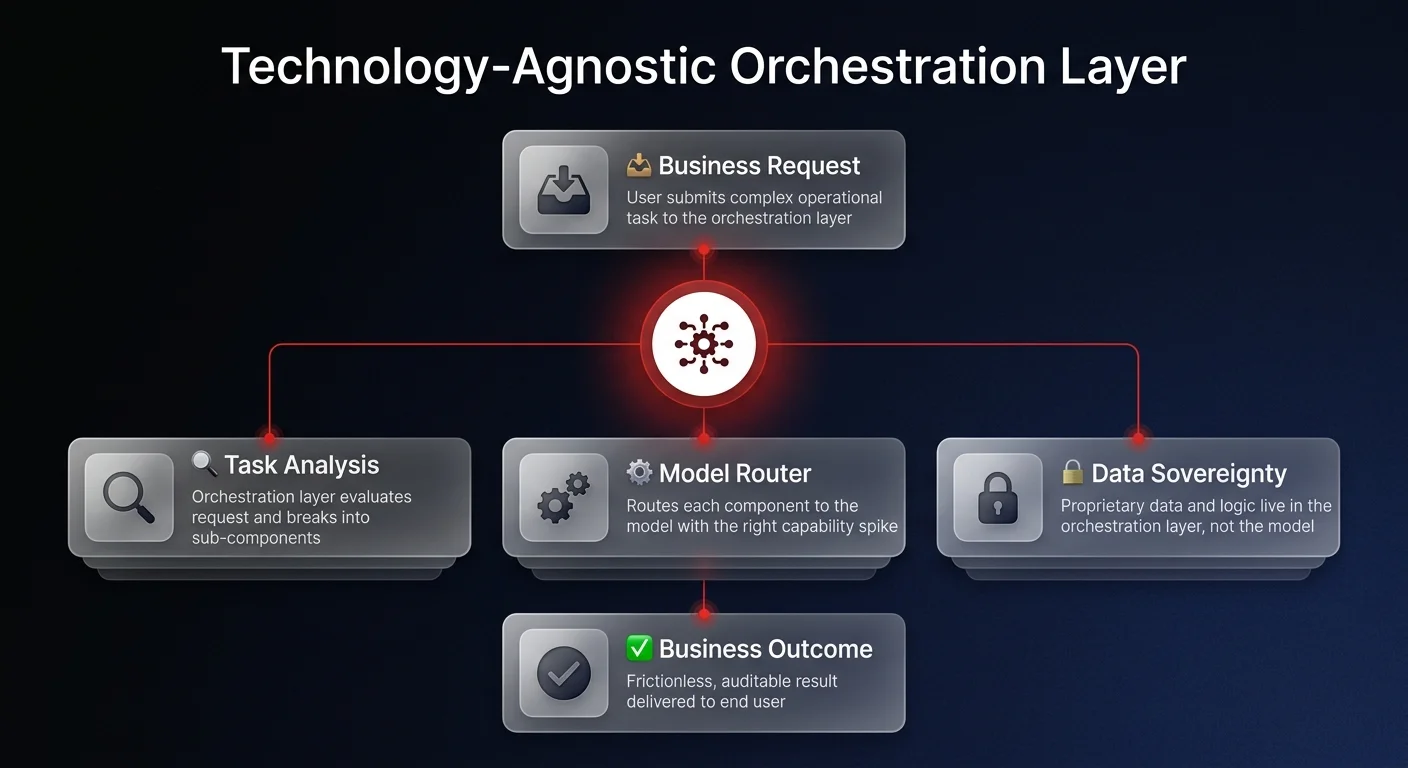
Dynamic model routing and abstraction
An effective orchestration layer acts as an intelligent traffic controller. It sits between your business operations and the commoditized language models. When a user submits a complex request, the orchestration layer evaluates the task, breaks it down into sub-components, and dynamically routes each piece to the model with the appropriate "spike."
If a request requires deep logical synthesis, the layer routes it to Opus. If a secondary step requires backend code generation, it seamlessly hands that context over to Codex. The end-user never knows which model is executing the task — they only experience a frictionless, highly accurate business outcome.
Furthermore, as models commoditize and open-source options close the gap, this orchestration layer automatically swaps in cheaper, faster models without requiring you to rewrite your underlying business logic. This is how you future-proof your investment. See how Ability.ai's operations automation solutions deliver exactly this kind of model-agnostic orchestration infrastructure — governed systems where your business logic remains stable regardless of which underlying model is executing the work.
Transforming fragmented experiments into governed systems
For mid-market and scaling companies, the lack of an orchestration layer is precisely what causes the current crisis of shadow AI. When employees are left to experiment with ungoverned, standalone AI tools, you get fragmented workflows, severe data security risks, and unpredictable operational logic.
This research strongly validates the core philosophy behind Ability.ai and our approach to Sovereign AI Agents. We recognize that the true value of artificial intelligence in the enterprise does not come from reselling access to a single, monolithic language model. It comes from providing the exact "layer on top" that the industry requires.
The shadow AI governance crisis is a direct consequence of this gap — organizations without a governed orchestration layer end up with employees routing sensitive data through unvetted consumer tools. This creates security exposure and zero organizational leverage. For a deeper look at the governance challenges that emerge as AI agent deployments scale, read our analysis of agentic AI risks and enterprise governance challenges.
The role of sovereign AI agents
To translate raw, commoditized compute into reliable business operations, you need governed agent infrastructure. Sovereign AI agents operate within this orchestration layer to deliver specific business outcomes in marketing, sales, customer support, and operations.
By deploying agents that are model-agnostic, you achieve several strategic operational advantages:
- Data sovereignty: Your proprietary business data and operational logic live in the orchestration layer, not inside the foundational model. This protects your intellectual property from being absorbed into a public model's training data.
- Observable logic: Instead of relying on the "black box" of a single language model, governed agents provide a transparent, auditable trail of how decisions are made and tasks are executed.
- Future-proof scalability: As the open-source community releases new models three months from now, your operational workflows remain intact. The orchestration layer simply points the agents to the new, more efficient compute engine.
Strategic takeaways for enterprise leadership
As we look toward the future of enterprise automation, operations leaders must fundamentally shift their perspective on artificial intelligence procurement and deployment. The anxiety over choosing the absolute best underlying model is a distraction from the real strategic imperative.
The key takeaway — it is the application and orchestration layer that drives competitive advantage. By embracing the inevitable commoditization of AI models, you can stop treating artificial intelligence as a delicate, specialized asset and start treating it as a raw utility to power your operations.
Focus your resources on deeply understanding your internal operational bottlenecks and customer journey friction points. Then, deploy a governed, technology-agnostic agent infrastructure that solves those specific problems. By abstracting the underlying models through dynamic routing, you ensure that your business systems remain secure, observable, and perfectly positioned to capitalize on the ongoing AI price wars. The future belongs to those who govern the logic, not those who rent the model.
Explore how Ability.ai's operations automation solutions help mid-market companies build sovereign, governed AI infrastructure — systems you own that stay competitive as model commoditization accelerates and cost structures shift.