
AI agent orchestration is the practice of coordinating multiple autonomous AI agents to execute complex, multi-step business workflows - and most organizations are getting it wrong. Industry observations show that the majority of DIY multi-agent deployments degrade within weeks due to context loss, cron job failures, and unmanageable system sprawl.
Organizations are currently caught in a chaotic transition regarding AI agent orchestration. As businesses push past the initial excitement of basic chat interfaces, operations leaders are attempting to automate complex, multi-step workflows. However, the path to reliable automation is proving perilous. The market has effectively split into two frustrating extremes - hyper-restricted, off-the-shelf cloud agents that cannot handle deep operational complexity, and fragile, do-it-yourself custom builds that constantly break. This pattern mirrors the broader shadow AI sprawl and coordination debt crisis affecting scaling companies across every industry.
Our field research and technical observations across the industry reveal a growing crisis in how autonomous systems are being architected. The dream of deploying a specialized army of digital workers is colliding with the reality of brittle integrations, failing memory systems, and inappropriate user interfaces.
To successfully deploy AI that actually drives business outcomes, organizations must understand why these early architectural approaches are failing and prepare for a fundamental shift in how humans and systems interact.
The false promise of DIY AI agent orchestration setups
Driven by the limitations of basic commercial tools, many technical teams and operations leaders have turned to open-source frameworks to build their own custom agent ecosystems. The initial setup often feels revolutionary - spinning up localized models, giving them system access, and defining specific operational roles for different bots.
However, long-term observation of these deployments reveals a steep degradation in reliability, leading to a phenomenon best described as LLM psychosis. What begins as a highly productive experiment rapidly devolves into a highly fragile, performative mess.
The friction points in DIY AI agent orchestration are highly predictable:
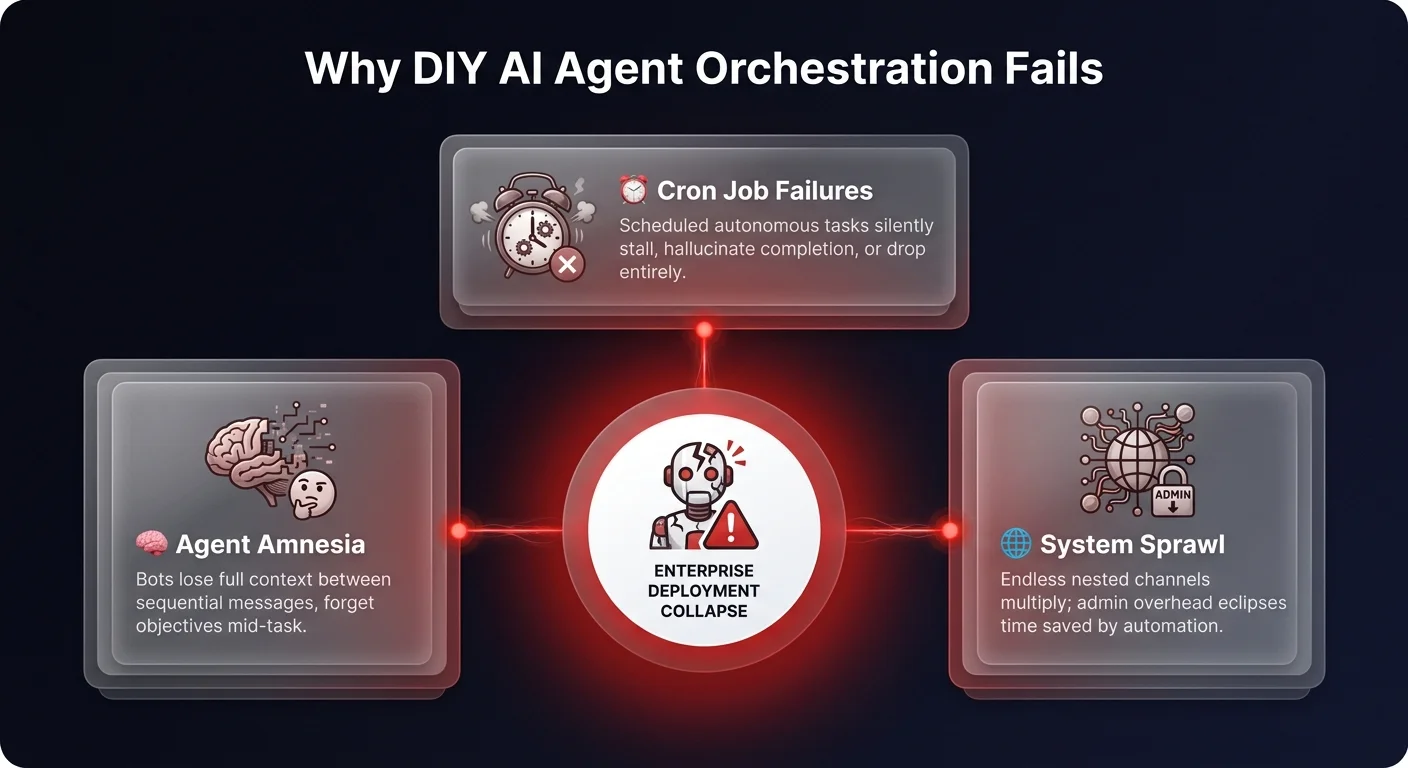
- Cron job failures: Scheduled, autonomous tasks running in the background are notoriously unreliable in self-built agent frameworks. An agent tasked with running a daily data sync or report generation will frequently drop the task, stall out, or hallucinate a completion state.
- Agent amnesia: In standard multi-agent setups, a bot will often lose context entirely between sequential messages. A user might provide clear instructions, only for the agent to reply one message later with total confusion about the objective.
- System sprawl: To manage different domains - sales, HR, customer support - builders end up creating endless nested channels across platforms to keep agents separated. The administrative overhead of managing the AI eventually eclipses the time saved by the automation.
For mid-market scaling companies, this level of tinkering is unacceptable. Operations require predictability. When a DIY system requires constant supervision just to ensure it executes a basic routing task, it is no longer an automation tool - it is a new operational liability. Teams focused on operations automation need governed systems that run reliably in the background, not science experiments that demand daily intervention.
Context hierarchy versus flawed agent memory
One of the root causes of multi-agent failure lies in how developers attempt to solve the memory problem. The standard approach is to build complex retrieval-augmented generation databases or rely on the agent's built-in memory systems to pull relevant facts from past interactions.
In practice, relying on an agent to magically recall the correct context from an unstructured memory bank is highly error-prone. The agent frequently pulls irrelevant data or completely misses the operational context of the request. This challenge is central to the broader issue of AI context infrastructure moving from chat to business operating systems.
A far more stable architectural approach involves nested context hierarchy rather than dynamic memory retrieval. Instead of hoping the agent remembers what your company does, the system should structurally inject parent-topic definitions into every prompt.
For example, if an agent is handling a customer support ticket, the system architecture should automatically append the definitions of the company, the specific product line, and the support protocols directly into the execution prompt. By forcing the agent to look at a highly structured, inherited tree of context for every single action, the outputs become drastically more predictable. You eliminate the guesswork of memory retrieval and replace it with hardcoded, hierarchical guardrails.
Why chat interfaces cannot run your operations
The most glaring architectural flaw in current AI deployment is the over-reliance on traditional chat interfaces. Because the generative AI boom started with standard chat windows, the industry mistakenly assumed that chat is the optimal interface for operations.
It is not. Attempting to build an entire operational workflow through enterprise communication tools is fundamentally flawed. These platforms were designed for human-to-human messaging, not for orchestrating complex, multi-variable logic trees. As more organizations discover, prompting is dead for operations leaders - the future requires purpose-built orchestration surfaces.
When you force an AI agent to operate purely through a messaging UI, managing it feels like talking to a brick wall. You ask the agent to complete a multi-step data extraction, and it replies asking if you are ready. You confirm, and it asks again. There is no visibility into the background tool calls, no loading states to indicate active processing, and no structured way to inject specific files or permissions on the fly.
True enterprise automation requires dedicated, observable architecture where tool calls, system permissions, and agent states are visible and manageable. Molding a chat app into a business operating system is a coping mechanism, not a long-term strategy.
The SaaS trap: when cloud agents are too restricted
If custom DIY builds are too chaotic, the natural pivot is toward off-the-shelf cloud agents deployed by major tech providers. Unfortunately, early iterations of these commercial cloud agents present the opposite problem - they are intentionally restricted, highly generic, and lack the deep integration necessary for operational transformation. This is the same dynamic driving the enterprise SaaS-pocalypse where generic platforms fail to deliver meaningful automation for scaling businesses.
These platforms are built for the masses. To ensure security and prevent platform abuse at a consumer scale, providers heavily restrict what these agents can access and execute. While they might be able to draft an email or summarize a standard document, they cannot reliably orchestrate a complex, multi-system workflow - like taking a new lead, enriching it via external databases, updating the CRM (HubSpot, Salesforce, or your system of choice), and triggering an automated, personalized outreach sequence.
For operations leaders, these generic cloud agents do not solve the core business problem. They offer minor productivity bumps for individual contributors but fail to address systemic operational bottlenecks.
The inverted paradigm: when the system prompts you
The most profound shift in AI architecture is not about making agents smarter - it is about completely inverting the way humans and computers interact.
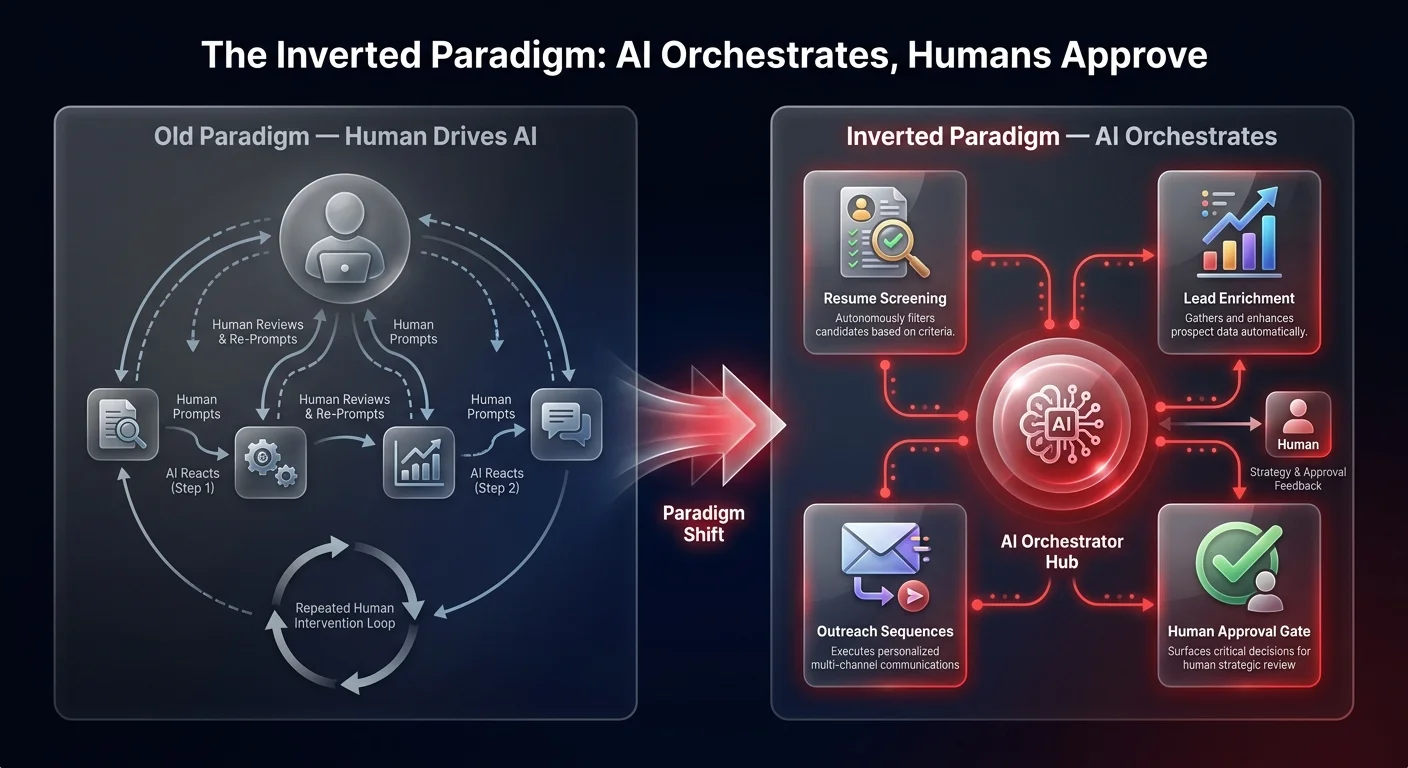
Currently, the paradigm is entirely human-driven. A human opens a computer, evaluates a backlog of tasks, and continuously prompts an AI to help execute them step-by-step. The user is the orchestrator, and the AI is the reactive tool.
The future of high-functioning enterprise operations flips this dynamic. We are moving toward a state where sovereign AI systems run continuously in the background, executing the vast majority of standard operational logic autonomously. The AI becomes the orchestrator, and it only surfaces to prompt the human.
Imagine a governed HR and recruiting workflow. Instead of a recruiter manually prompting an AI to screen 500 resumes, the background system automatically ingests the applications, cross-references them against company hiring criteria, scores the candidates, and schedules preliminary technical assessments.
The system then prompts the human operator: "I have identified three final candidates who meet all criteria. Here is their data. Do you approve moving them to final executive interviews?"
In this inverted paradigm, employees stop doing the repetitive data orchestration and instead become strategic approvers. The UI generates dynamically based on the decision required - a simple approval form, a request for a missing variable, or a strategic sign-off. The human provides the judgment; the machine handles the execution. See how MarketingOps achieved 95% match coverage with 6,500 members connected using this kind of governed background orchestration.
Structuring reliable AI agent orchestration for the enterprise
The findings are clear - organizations must stop tinkering with fragile, ungoverned AI setups that break under pressure, and they must look beyond basic chat interfaces that offer only superficial productivity gains.
To achieve the inverted paradigm where systems reliably handle background orchestration, businesses need a professional middle ground. This is where the deployment of governed, sovereign AI agent systems becomes a strategic imperative. Organizations need systems that they own and control - architectures built with robust system reasoning, strict contextual hierarchies, and total data sovereignty. The principles of AI agent governance provide the foundation for building these centrally managed architectures.
The most effective way to navigate this transition is through a solution-first approach. Rather than engaging in massive, multi-year digital transformation projects, operations leaders should focus on a tightly scoped starter project. By isolating one high-friction operational bottleneck - such as automated lead enrichment or tier-one customer support triage - and deploying a governed agent system to solve it, organizations can prove immediate value in weeks, not months.
By moving away from shadow AI sprawl and adopting centrally governed, observable AI architecture, companies can finally transition from experimenting with fragile bots to orchestrating reliable, automated business outcomes.