
AI marketing agents are autonomous AI systems that execute specialized marketing tasks — research, content creation, data analysis, and asset production — without constant human direction. Companies deploying governed multi-agent marketing systems report transforming weeks of manual workflow into minutes of automated output, but only when the underlying architecture is purpose-built and properly secured.
The deployment of AI marketing agents is rapidly shifting from a futuristic concept to a present-day operational requirement. For marketing teams and operations leaders, the challenge is no longer about finding AI tools, but rather managing the chaotic fragmentation of ungoverned AI experiments. When employees juggle too many disparate applications with no unified system, productivity stalls and security risks multiply.
Recent industry implementations reveal a powerful new paradigm — building fully autonomous AI marketing teams using local development environments and advanced models like Claude. By architecting specialized agents that can research, write, analyze, and design collaboratively, businesses can transform manual marketing workflows into automated, observable logic.
However, this powerful capability introduces significant operational and governance challenges. We need to examine how these multi-agent systems are being built, how they integrate into existing workflows, and why scaling them requires a transition from local desktop experiments to governed, cloud-hosted infrastructure.
Architecting the autonomous AI marketing agents department
Building an effective multi-agent system requires shifting away from generic chatbot interactions toward a structured, role-based architecture. Effective AI marketing setups mirror how a real business organizes its work.
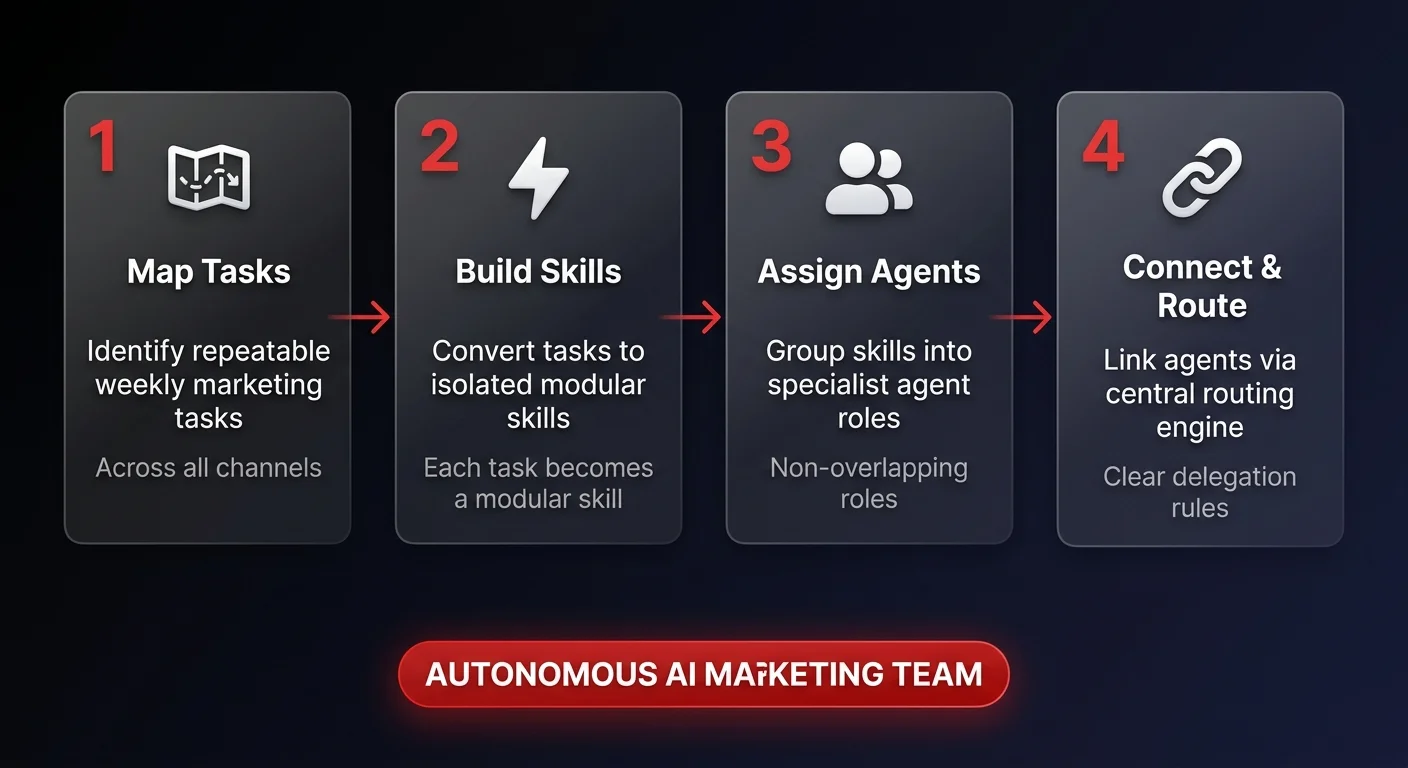
The foundational architecture for deploying an AI marketing team follows a distinct four-step framework:
- Map the marketing function to identify repeatable weekly tasks.
- Turn each repeatable task into an isolated AI "skill" — ideally maintaining one specific workflow per skill.
- Group similar skills into non-overlapping agent roles to ensure the AI maintains deep focus.
- Connect these agents and skills as a cohesive team with central routing rules.
For example, a modern travel brand might configure a system with five specialized agents and 12 distinct skills. To support this, the underlying file structure must be meticulously organized. Operations leaders must mandate the separation of system folders — which contain reusable brand voice guides, SOPs, and templates — from working folders where the agents deposit finalized assets like ad creatives, landing pages, and strategy presentations.
Pre-loading system folders with deep context is what separates a generic AI output from a brand-aligned asset. When agents are pre-equipped with product offerings, style guides, and historical marketing strategies, their output requires significantly less human correction.
Separating modular skills from specialized agent roles
One of the most critical discoveries in AI orchestration is understanding the difference between a "skill" and an "agent." If you pipe too many instructions into a single conversation, the underlying language model becomes unfocused — much like asking one human employee to simultaneously act as your lead writer, data analyst, and graphic designer.
Skills are essentially shared playbooks. They are modular, specific execution pathways that your agents can trigger. For instance, a "Branded Deck" skill can be created using a reference-based method. By feeding the AI an existing company slide deck and having it analyze the specific margins, formatting, and structural logic, the system can generate a custom presentation skill. When a strategy deck for a summer campaign is required, the AI calls this specific skill to output a 13-slide presentation that perfectly matches corporate guidelines.
Agents, conversely, are specialized team members with defined roles, responsibilities, and access to specific groups of skills.
Consider the Data Analyst agent. Its core instruction is to think in numbers, charts, and patterns. If you feed this agent a complex campaign dataset containing eight different performance metrics, it can synthesize the data and call upon data visualization skills to output a comprehensive performance dashboard. This dashboard tracks week-on-week revenue trends, channel performance breakdowns, and top-line metrics with interactive charts.
Similarly, a Content Creator agent is designed to think in stories and headlines. When tasked with producing assets for an upcoming product launch, it might call a keyword research skill to draft an SEO-optimized blog post, and subsequently trigger a lead magnet skill to design an 11-page PDF resource guide in the brand's exact color palette.
For companies that want the productivity of autonomous marketing agents without building from scratch, the key decision is whether to build internal capability or partner with a specialist who can deploy governed infrastructure on your behalf.
The orchestration engine: routing and system instructions
For a multi-agent system to operate autonomously, it requires a central brain to manage task routing. In local setups using tools like Claude Code, this is typically handled by a core system file — often formatted as a markdown document — that serves as the project's master custom instructions.
This central routing file explicitly tells the system who is on the team and when to delegate to a specialized agent versus when to execute a simple skill directly.
When a marketing manager assigns a complex task — such as launching a new promotional campaign — the system relies on these routing rules to orchestrate the workflow. It recognizes that market research and campaign briefing require high-level synthesis, so it deploys the Market Researcher and Campaign Strategist agents.
Once the strategic foundation is established, the system identifies that generating social media posts and designing a landing page are straightforward execution tasks. It then seamlessly transitions to utilizing specific execution skills — writing the copy, generating image assets via external models, and writing the code for a fully branded landing page with compelling call-to-action sections. Within minutes, a multi-stage, cross-disciplinary project is completed autonomously.
Integrating AI marketing agents into existing operational workflows
One of the most profound operational shifts is moving AI out of the chat interface and into the actual systems where teams already work. Operations leaders understand that forcing employees to adopt new, siloed communication tools creates friction.
The most effective deployments of AI marketing agents integrate directly with existing ticketing and project management software. By setting up a shared task board in platforms like Notion, Jira, or Asana, humans and AI agents can collaborate asynchronously.
In this workflow, a human team member creates a task ticket — for example, "Execute Europe campaign launch" — assigns a priority level, and drops it into a "To Do" column. The AI system is instructed to scan this board continuously. When it detects a pending task, it automatically assigns the correct agent, calls the necessary research and design tools, executes the deliverables, and updates the ticket status to "Complete." Crucially, it attaches the file paths of the generated assets directly to the ticket.
This asynchronous human-in-the-loop system is highly attractive for COOs. It proves that businesses can operationalize AI to act as a 24/7 autonomous workforce that integrates into, rather than disrupts, the existing operational tech stack. See how this pattern maps to a governed content production workflow in our content automation engine solution.
The shadow AI crisis: securing desktop agent deployments
While the capabilities of these multi-agent workflows are transformative, the way they are currently being built in the industry presents a massive security and governance crisis.
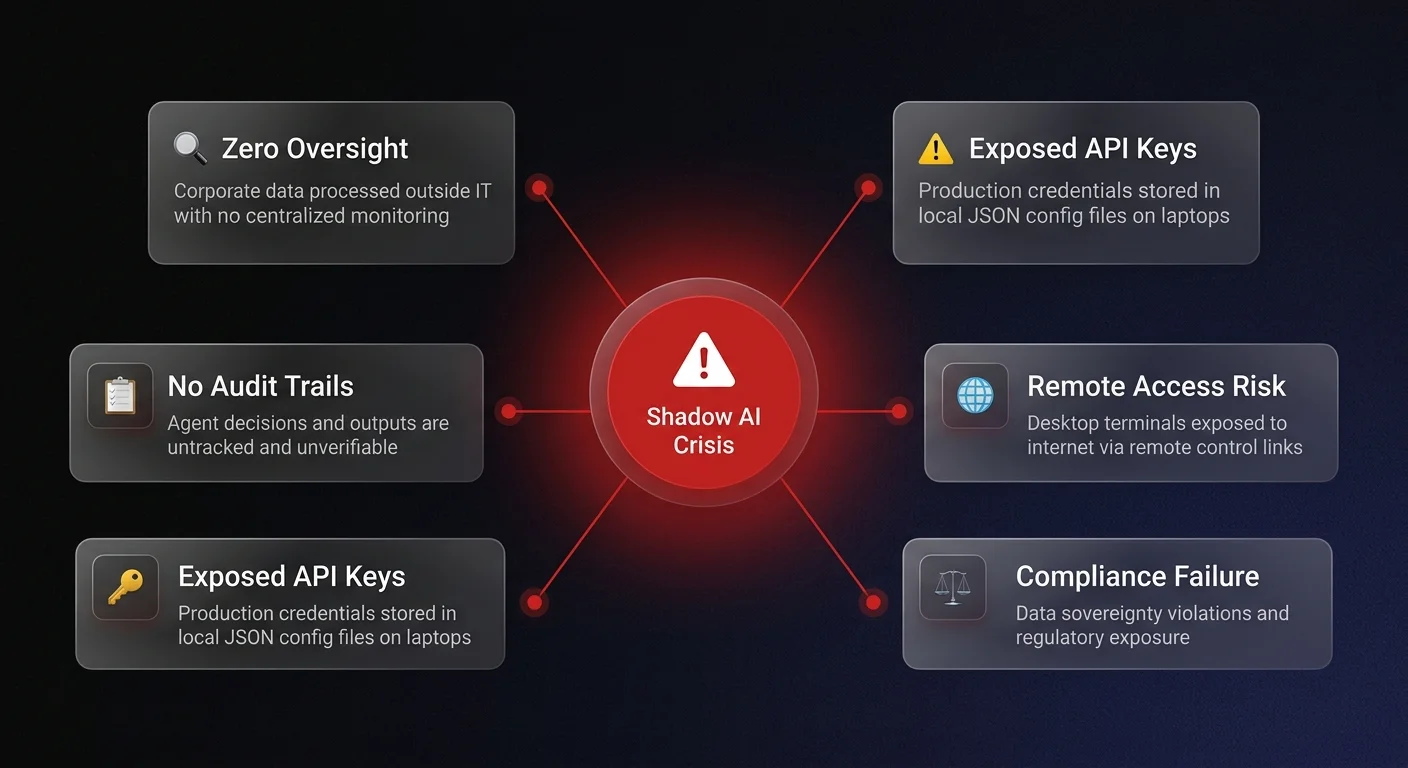
Many of these autonomous marketing teams are being assembled by non-technical marketing professionals running local development environments like VS Code on their corporate laptops. To give these agents the ability to generate images or browse the live internet, users are implementing the Model Context Protocol (MCP) by configuring local JSON files and manually pasting production API keys from providers like Google Gemini or Anthropic.
This is the peak definition of Shadow AI.
When marketing teams build complex, locally hosted AI infrastructure bypassing the IT department, the operational risks are severe. Corporate data, brand templates, and strategic campaign plans are processed through fragmented desktop environments with zero centralized oversight. Furthermore, these local sessions offer no audit trails — if an agent hallucinates a controversial social media post or leaks proprietary data, leadership has no observable logic to investigate the failure.
We are also seeing users connect these local desktop terminal sessions to their mobile phones via remote control links, allowing them to trigger complex agent workflows from their mobile devices while away from their desks. While convenient, opening remote connections to local corporate machines to execute unmonitored AI tasks is an IT security nightmare. For a deeper look at this governance crisis, read our analysis of desktop AI agents and the shadow AI governance challenge.
Moving from local experiments to governed infrastructure
The operational blueprint for autonomous AI marketing agents is proven. Specialized agents, separated skills, central routing logic, and asynchronous ticketing integrations represent the future of marketing operations.
However, for mid-market and scaling enterprises, the execution model must evolve. Companies cannot scale operations by having employees run unmonitored AI agents through local terminal windows on their laptops. The operational complexity and security risks are simply too high.
This is where the transition to governed agent infrastructure becomes critical. Organizations must deploy these multi-agent clusters within sovereign, cloud-hosted environments. By moving the agent orchestration off the local desktop and into a secure, centralized platform, operations leaders can maintain data sovereignty, protect API keys, and enforce strict access controls.
The goal is to capture the incredible productivity gains of an autonomous AI marketing team — the automated research, the perfectly branded slide decks, the integrated task execution — while replacing the chaos of Shadow AI with reliable, observable operational systems. By adopting governed agent systems, businesses can confidently scale their AI operations, knowing their strategic workflows are secure, compliant, and fully aligned with corporate objectives.