
Operational AI is the deployment of governed AI agents directly on top of an organisation's operational data to automate workflows, eliminate data silos, and orchestrate physical operations at software speed. A new generation of founders — shaped by SpaceX and Tesla's execution culture — is proving that capital-intensive industries can move as fast as software companies when AI agents replace manual coordination across engineering, procurement, and construction.
Operational AI is reshaping how companies build and scale in the physical world. Legacy industries like defense, mining, and critical mineral refining are notoriously slow, relying on operational processes established 50 to 100 years ago. But a new class of founders — heavily influenced by the hyper-growth environments of SpaceX and Tesla — is proving that complex hardware operations can move at the speed of software.
The secret behind this velocity is not simply enforcing impossible deadlines or working all-nighters. The real driver of execution excellence is the dismantling of traditional data silos and the deployment of AI-driven operational orchestration. By applying manufacturing and software frameworks to large-scale capital projects, these leaders are writing a new playbook for industrial growth.
The hidden cost of operational data silos
When a hardware or manufacturing team scales past 100 people, a dangerous organisational phenomenon occurs — deep data silos naturally begin to form. In traditional capital project execution, which encompasses engineering, procurement, and construction (EPC), massive walls emerge between departments.
In standard legacy operations, core engineering data gets trapped on local hard drives or buried in email threads that must be manually forwarded to reach the construction or procurement teams. These pockets of hoarded information create immense operational friction. Even when executive leadership demands transparency, the sheer complexity of building large-scale infrastructure inevitably isolates data.
The result is a workforce that makes decisions based only on the fragmented data immediately available to them, rather than globally optimal decisions that benefit the entire project. To achieve extreme operational velocity, companies must eradicate these silos at the architectural level.
Operational AI and the democratisation of context
To solve the silo problem, forward-thinking operations leaders are abandoning legacy, permission-heavy folder structures. Instead, they are building integrated data frames — entirely web-based operational systems where internal access controls are significantly flattened.
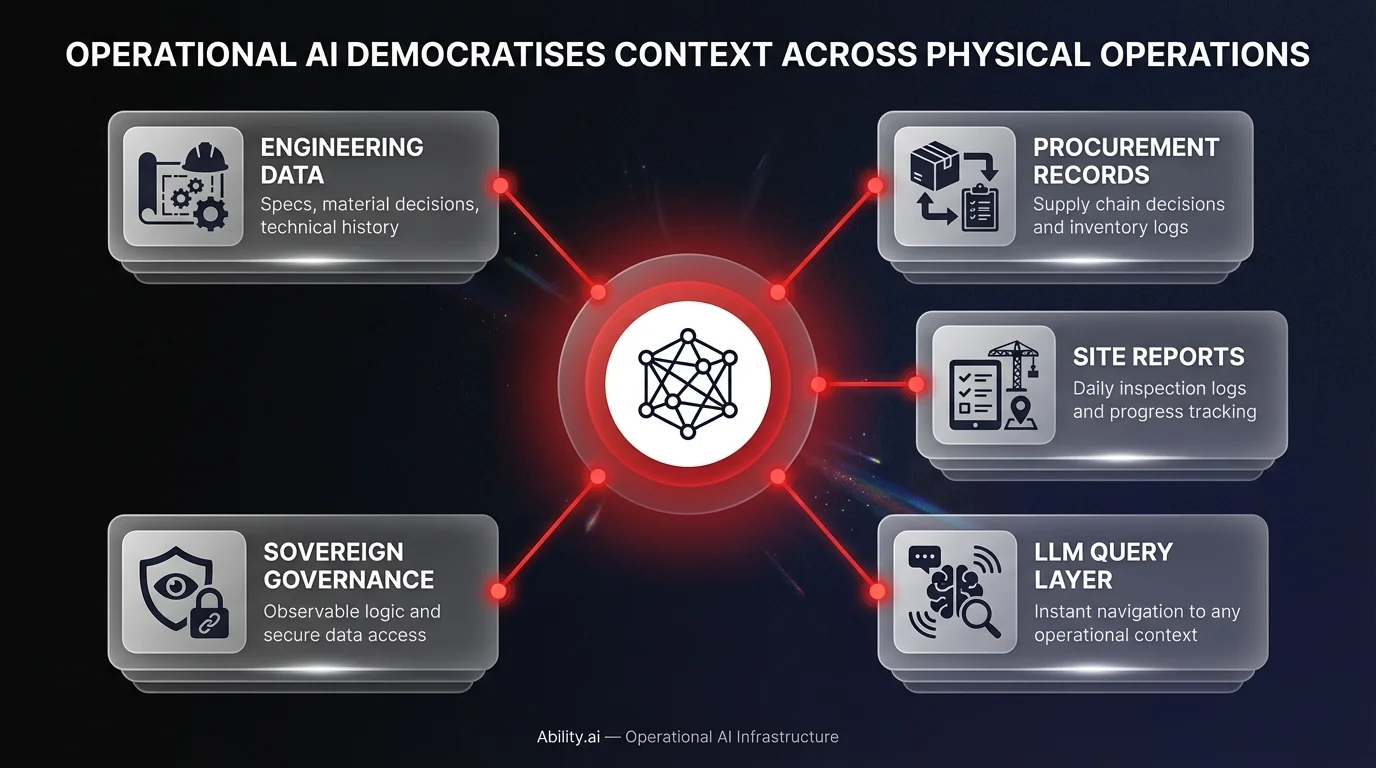
The goal is to ensure the history and context of every individual decision is tracked and visible to anyone in the organisation. When a junior engineer needs to understand why a specific material was chosen for a missile propulsion system or a lithium refinery, they should not have to trace a six-month-old email chain.
Once this unified data repository is established, companies are layering large language models (LLMs) directly on top of their operational data. If an employee does not understand the nuances of a complex folder structure, they can simply query the AI to instantly navigate to the correct technical specifications or decision history.
This approach democratises access to information, allowing teams to move with high conviction and high velocity. However, it also introduces a critical governance requirement. Letting AI models navigate proprietary engineering data requires sovereign AI systems — infrastructure where data remains secure, and the AI's logic is entirely observable to the organisation. This is the same governance principle that makes autonomous AI agent workflows reliable enough for enterprise deployment.
Automating the daily drumbeat with operational AI
Manufacturing and continuous construction projects rely heavily on "shift passdowns" — daily reports detailing what a team accomplished, what they missed, and why they deviated from the plan. These reports are the heartbeat of operational accountability.
In traditional environments, these passdowns are highly manual time-sinks. Site leaders or shift managers often spend an hour at the end of every day manually compiling data from various disconnected systems to write their reports.
Next-generation operators are treating R&D and construction sites like high-efficiency manufacturing floors by automating this process. By feeding site data into an operational AI agent, the system can cross-reference daily goals with actual outputs and auto-populate the bulk of the shift passdown.
This fundamentally shifts the human role from data entry to strategic review. The operator simply reads the AI-generated report, verifies its accuracy, adds nuanced contextual commentary, and hits send. Ownership and accountability remain with the human, but the administrative burden is effectively eliminated.
Algorithmic resource allocation and short interval control
Managing a complex physical operation requires coordinating three distinct databases: the materials and equipment on site, the specialised labour available, and the pending tasks that must be completed.
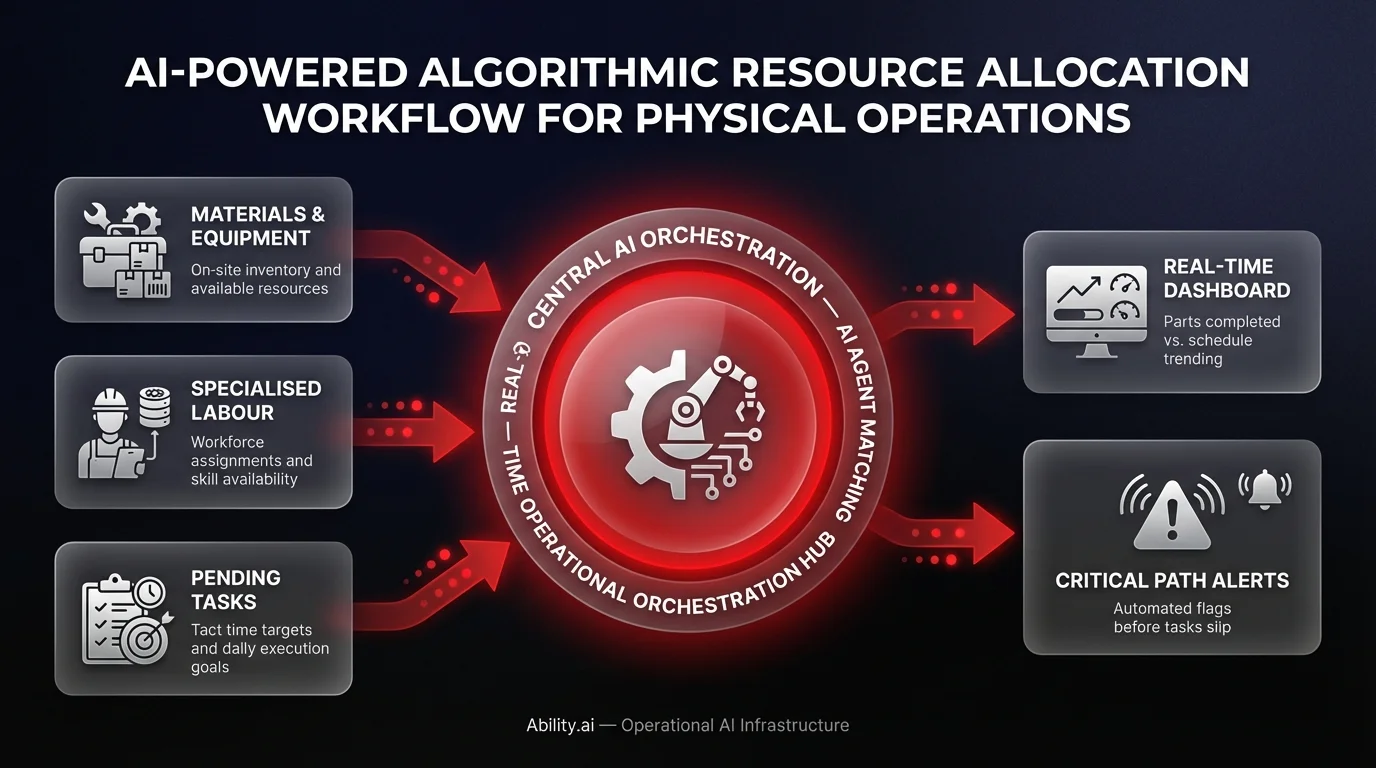
Today, this coordination is largely manual. A construction superintendent will typically stand in a circle with the trades every morning, asking what each person plans to do, and follow up at the end of the day to see what was actually done. There is very little quantified, short-interval control.
By contrast, high-velocity companies apply "tact time analysis" to construction and mining. This involves breaking down every discrete step required to build something — from analytical lab testing to torquing bolts — and assigning precise hourly or daily targets.
Instead of relying on human superintendents to manually cross-reference databases, organisations can use AI agent systems to algorithmically match labour, materials, and tasks. When paired with automated data capture — such as using robotics to take 3D site scans and reconciling them against architectural models — teams gain real-time dashboards showing exactly how many parts or tasks are trending ahead or behind schedule.
If your operations team is still coordinating resources manually, explore how Ability.ai's operations automation solutions architect AI agent systems for exactly this kind of physical-world orchestration.
Preventing the second-grade soccer problem
Maintaining aggressive schedules requires a relentless focus on the "critical path" — the specific sequence of tasks that are actively bottlenecking the entire project schedule. When a critical path item blocks production, the natural human instinct is to swarm the problem.
Former SpaceX engineers refer to this as the "second-grade soccer" problem. If everyone abandons their posts to swarm the ball, the immediate fire might get extinguished, but the next sequential task stalls. That neglected task inevitably becomes tomorrow's critical path.
Scaling physical operations requires mobilising specialised SWAT teams to independently attack critical path blockers in parallel, while the rest of the organisation maintains the broader operational drumbeat. Operational AI orchestration tools are increasingly vital here, automatically monitoring secondary tasks to ensure they do not slip into the critical path while leadership's attention is diverted.
This is precisely why governance frameworks matter. Ungoverned AI automation creates the same swarming problem at the system level — agents pulling resources toward one task while silently blocking another. For a deeper look at the risks of ungoverned agents in operational settings, read our analysis of agentic AI risks and governance challenges.
From bespoke requirements to rapid iteration
Speed in hardware development is directly tied to simplicity. Complex, bespoke requirements are the enemy of production velocity.
During the rapid iteration cycles of the Starship programme, engineers constantly hunted for requirements they could delete. In one instance, rather than designing a complex, bespoke ventilation system from scratch, the team realised they could borrow existing hardware designs from a different part of the rocket — provided they could quickly prove the valves could handle liquid condensation.
By running a rapid, focused test to validate the borrowed hardware, they bypassed months of custom design and manufacturing cycles. This mindset — questioning every requirement and pulling off-the-shelf or cross-departmental solutions wherever possible — is only possible when an organisation has total visibility into its operations and inventory.
The governance requirement for operational AI infrastructure
Applying software-like agility to physical world operations is no longer just a theory; it is actively being deployed by the founders building the next generation of defence systems, critical mineral supply chains, and aerospace infrastructure.
However, achieving this level of operational orchestration requires more than just buying off-the-shelf AI tools. Ungoverned AI experiments create operational complexity and severe security risks, especially when dealing with proprietary engineering data, supply chain logistics, and capital project execution.
To safely democratise data access and automate resource allocation, organisations must deploy governed agent infrastructure. By utilising sovereign AI agent systems with observable logic, operations leaders can transform fragmented, manual processes into reliable operational systems. The result is an organisation that moves at exceptional speeds, driven by data, and free from the friction of legacy silos.
If your organisation is ready to move beyond AI experiments and deploy governed operational AI that drives measurable outcomes, explore how Ability.ai architects sovereign agent systems for operations teams.