
AI agent harnesses are structured software environments built around foundation models that constrain, guide, and verify AI outputs — transforming unpredictable large language models into reliable enterprise automation systems. Unlike raw LLMs that flounder in ambiguous business domains, AI agent harnesses provide observable logic paths, verifiable reward signals, and strict success criteria that make automation genuinely trustworthy at scale.
Business leaders evaluating AI for operational efficiency often focus on the wrong metric: raw intelligence. The prevailing narrative suggests that as foundation models scale, they will naturally figure out how to automate complex business operations. Industry research tells a different story. The recent leaps in agentic capabilities are not the result of models becoming smarter — they are the direct result of human engineers building AI agent harnesses that constrain, guide, and formally verify AI outputs.
For mid-market and scaling companies, this distinction is critical. Deploying raw, ungoverned AI into unstructured workflows creates operational complexity and serious security risks. To transform fragmented AI experiments into governed operational systems, organisations must fundamentally rethink how they deploy machine learning — moving away from expecting AI to magically solve fuzzy business problems and instead structuring operations into verifiable domains.
The illusion of fluid intelligence in enterprise AI
To understand why AI agent harnesses are necessary, we must look at how AI is currently evaluated. The ARC-AGI benchmark — one of the most rigorous standards for measuring machine intelligence — tests a model's ability to acquire new skills in entirely novel environments.
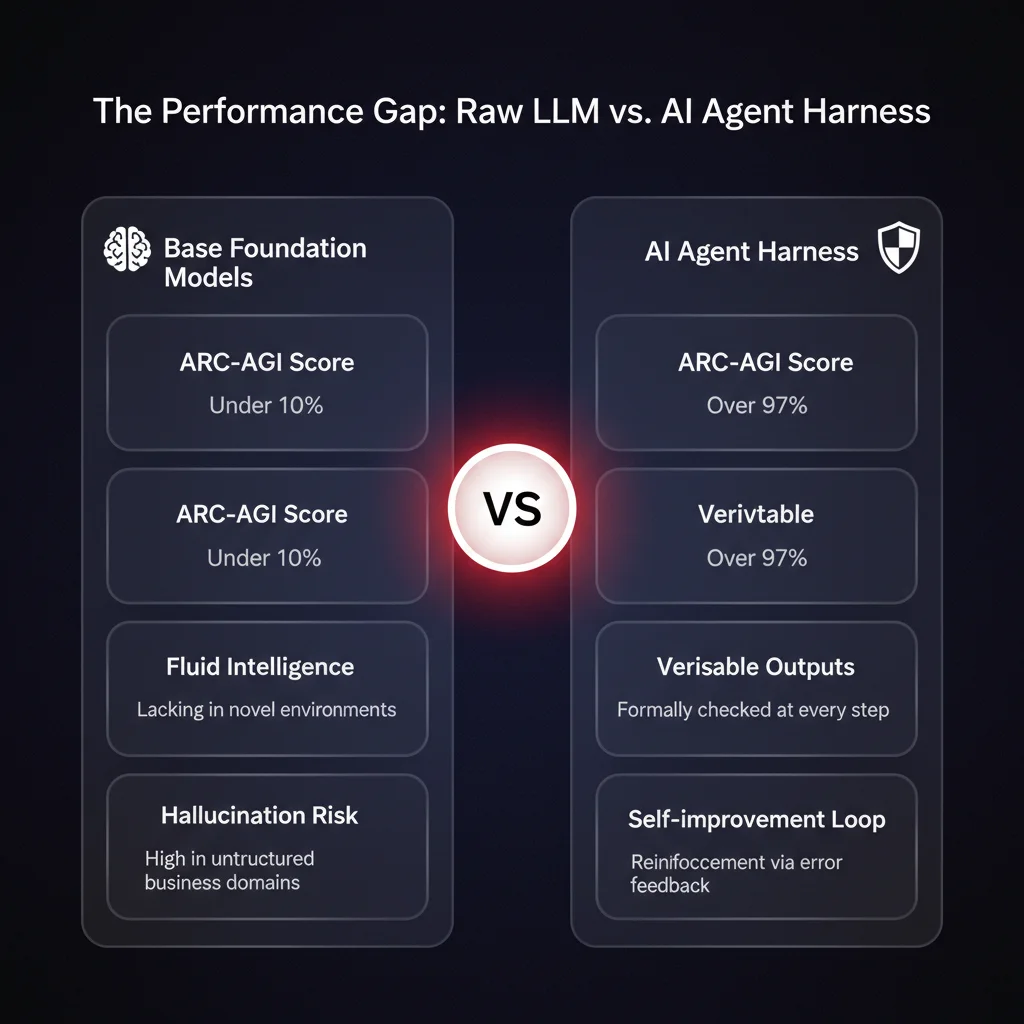
Historically, base large language models have scored below 10% on these fluid intelligence tests, even as parameter counts and training compute scaled by factors of 50,000. This exposes a fundamental truth: foundation models are extraordinarily capable knowledge retrieval engines, but they lack true fluid intelligence. They possess vast competence from massive training datasets, yet struggle to independently navigate new, unstructured environments without prior knowledge.
What looks like brilliant AI reasoning is usually exceptional training data compression, not spontaneous problem-solving. There is a critical trade-off between intelligence and knowledge. Because current models possess comprehensive knowledge, they require less raw intelligence to appear competent — until they encounter a fuzzy business environment like an undocumented operational workflow or an ambiguous customer service triage process. At that point, the absence of fluid intelligence becomes immediately obvious through hallucinations and process failures.
Verifiable reward signals: the dividing line of AI success
If foundation models lack fluid intelligence, why have coding agents and mathematical AI tools achieved such explosive success over the past year?
The answer is verifiable reward signals.
Code provides a mathematically absolute, verifiable reward signal. When an AI generates code, it can be compiled, run through unit tests, and formally checked for correctness. Failure produces an immediate, precise error message. This allows the AI to enter a reinforcement learning loop — try a solution, verify the output, refine based on the error, try again. Through millions of these cycles, the AI systematically conquers the problem space and achieves exceptional performance.
Any domain where solutions can be formally verified can be fully automated with current AI technology.
Progress remains slow in domains without verifiable rewards. Writing a strategic essay, evaluating a nuanced legal contract, or assessing a job candidate's cultural fit — these are fuzzy domains. The only way to train an AI here is through expensive, slow human annotation. Because the AI cannot independently verify if an essay is "good" via a unit test, it cannot enter the rapid self-improvement loops that make coding agents so powerful.
AI agent harnesses: the infrastructure of enterprise automation
This is where AI agent harnesses become the most critical architectural consideration for operations leaders.
If AI only achieves high autonomy in verifiable domains, businesses must make their fuzzy operational workflows verifiable. They do this by building AI agent harnesses.
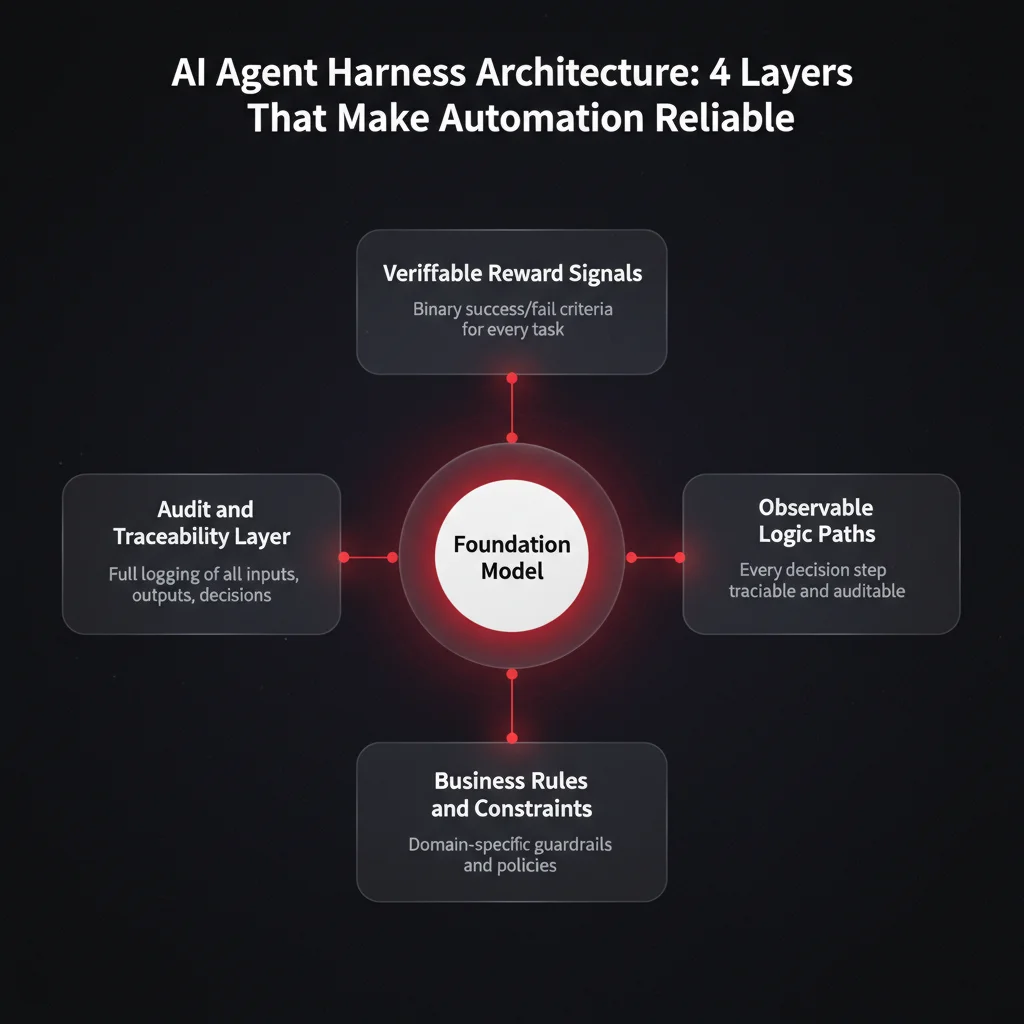
An AI agent harness is a structured software wrapper built around a foundation model. Rather than asking an LLM to simply "handle customer support," a harness decomposes the task into discrete, formally verifiable steps. The harness dictates the high-level solution strategy — providing the AI with rules, observable logic paths, and explicit criteria for success or failure.
The results are striking. Recent saturation of complex AI reasoning benchmarks saw performance jump from single digits to over 97% — achieved entirely through custom harnesses. Engineers built environments where models generate tasks, solve them via program induction, verify solutions, and recursively fine-tune reasoning chains. The models themselves were not smarter; the harnesses were better.
For enterprise operations, the takeaway is profound: the models we already have are capable enough for most business automation — if we build the right boundaries around them. True AGI would build its own harness and navigate new environments from scratch. Since we do not yet have that, human-engineered AI agent harnesses are the mandatory bridge to task automation at scale.
Explore Ability.ai's AI automation solutions to see how governed AI agent harnesses are deployed in real mid-market operations today.
Moving from shadow AI to governed operations
Many mid-market companies currently suffer from "Shadow AI" — the ungoverned, decentralised use of consumer-grade AI tools by employees. Marketing uses one tool for copy generation; operations uses another for meeting summaries; finance uses a third for data extraction.
This fragmented approach relies on raw, unharnessed models operating in fuzzy domains. It requires employees to manually verify every output, which defeats the purpose of automation and introduces serious data sovereignty and security risks. As explored in our analysis of the shadow AI governance crisis, this decentralised sprawl creates compliance blind spots that compound as the organisation grows.
Governed agent infrastructure solves this by productising the AI agent harness. By deploying sovereign AI systems targeting specific business outcomes, you replace fragmented experimentation with observable, auditable logic.
Instead of a generic chat interface, a governed system deploys specialised agents — a data extraction agent, a routing agent, a formatting agent — each operating within a strict harness. This ensures proprietary data does not leak into public training sets, and that every AI decision can be traced, audited, and formally verified against your business rules.
Transforming fuzzy business logic into verifiable workflows
To leverage current AI effectively, CEOs and COOs must audit their operational processes through the lens of verifiability.
Before automating any workflow, design the verifiable reward signal for it. Consider invoice processing: "understanding the invoice" is a fuzzy goal. But "extracting the total amount, matching it to the corresponding PO number in the ERP, and returning true/false on whether they match within a 2% tolerance" is a formally verifiable domain. AI can execute this with near-perfect reliability at a fraction of the cost of an unbounded foundation model.
Smaller, specialised models operating within a strict AI agent harness are vastly more efficient — in both speed and cost — than large parameter models attempting to reason through ambiguity. This is not a workaround; it is the architecture that separates AI experiments from AI operations.
For teams ready to move from proof-of-concept to production, our guide on autonomous AI agent workflows covers the deployment patterns that make this transition reliable and governable.
The strategic imperative for operations leaders
We are on a trajectory toward highly capable, generalised AI — likely arriving in the early 2030s. You cannot stop this progress, nor should you wait for it before optimising your operations. The question for business leaders is how to leverage current technology safely to build a compounding operational advantage today.
The secret to reliable enterprise automation is not waiting for a smarter foundation model. It is building the right AI agent harnesses around the models we already have.
By prioritising governed agent infrastructure, protecting data sovereignty, and redesigning workflows with observable, verifiable logic, you can deploy AI with confidence and generate real business outcomes now. The competitive advantage of the next decade belongs to organisations that master the art of the AI agent harness — turning the inherent unpredictability of raw machine learning into a reliable, auditable engine of daily operations.